Sweden Men's Team Beats China After 26 Years; EU Clubs Ramp Up Orders for Chinese Smart Ping-Pong Ball Machines
On May 10, 2026, Sweden’s men’s table tennis team defeated China in the semifinals of the London World Team Table Tennis Championships — the first such victory in 26 years. The result has triggered a notable surge in procurement of Chinese-made smart ball machines by European clubs, particularly those requiring AI-powered trajectory prediction, multi-speed simulation, and dual CE/UKCA certification. This development signals emerging shifts in training equipment demand, certification requirements, and cross-border supply chain dynamics — all of immediate relevance to manufacturers, exporters, and regulatory compliance service providers serving the EU sports technology market.
Event Overview
The semifinal match of the 2026 ITTF World Team Table Tennis Championships concluded in London on May 10, 2026. Sweden’s men’s team secured a historic win over China. Following the match, European table tennis clubs — notably coordinated by Germany’s TTV (Deutscher Tischtennis-Verband) — initiated urgent procurement procedures for Chinese smart ball machines. Initial orders require delivery by end-June 2026. Suppliers are being evaluated for compliance with ISO 13485 (medical device–grade motor certification), which is now recognized as a key eligibility criterion for inclusion in EU public procurement white lists.
Industries Affected
Direct Exporters & Trade Enterprises
Exporters of smart training equipment to the EU face intensified scrutiny on regulatory alignment. The emphasis on ISO 13485 — traditionally associated with medical devices — reflects a de facto elevation of safety and reliability thresholds for high-end sports tech. Impact manifests in longer pre-shipment certification lead times, higher third-party audit costs, and potential delays in customs clearance if documentation lacks explicit traceability to certified motor components.
Manufacturers & OEM/ODM Producers
Manufacturers supplying motors or integrated systems for smart ball machines must verify whether their production lines meet ISO 13485 process controls — especially for motor assembly, testing, and traceability. Non-compliant facilities may be excluded from bidding on institutional tenders, even if final products carry CE/UKCA marks. The requirement does not apply uniformly across all consumer-grade units but is explicitly invoked for government- or association-funded procurement.
Supply Chain & Certification Service Providers
Third-party certification bodies, logistics firms offering EU regulatory advisory services, and component traceability platform providers are seeing increased inquiry volume. Demand centers on ISO 13485 gap assessments, motor-specific technical file reviews, and dual-marking (CE + UKCA) verification support. Providers without documented experience in medical-grade motor certification workflows may struggle to meet accelerated timelines tied to the June 2026 delivery window.
What Relevant Enterprises or Practitioners Should Focus On
Monitor official tender specifications issued by national associations
Germany’s TTV has activated an emergency procurement process, but full tender documents — including mandatory annexes on conformity evidence and motor-level certification — have not yet been published publicly. Stakeholders should track TTV’s official procurement portal and national e-notification platforms (e.g., TED – Tenders Electronic Daily) for updates on evaluation criteria, required declarations, and submission deadlines.
Prioritize verification of motor-level ISO 13485 coverage
CE/UKCA marking alone is insufficient under current evaluation logic. Suppliers must confirm whether their motor suppliers hold active ISO 13485 certification *and* whether the certificate scope explicitly covers the motor model used in the ball machine. Certificates covering only ‘general industrial motors’ — without reference to ‘precision motion control for athletic training devices’ — may not satisfy TTV’s interpretation.
Distinguish between policy signal and operational readiness
The ISO 13485 requirement appears to be an emergent evaluation filter introduced for this specific procurement cycle, not yet codified in EU-wide harmonized standards for sports equipment. It functions more as a risk-mitigation benchmark adopted by a leading national association than as a formal legislative mandate. Its adoption elsewhere (e.g., France’s FFTT or Sweden’s STTF) remains unconfirmed and requires separate monitoring.
Prepare documentation packages for rapid submission
Suppliers should compile modular technical files in advance: (1) CE/UKCA DoC referencing applicable EN standards (e.g., EN 62366-1 for usability); (2) ISO 13485 certificate + scope statement highlighting motor model numbers; (3) test reports confirming AI trajectory prediction accuracy under variable environmental conditions (per EN 62304 software lifecycle requirements). Pre-assembled packages reduce turnaround time when tenders open.
Editorial Observation / Industry Insight
Observably, this event functions less as a broad market inflection point and more as a regulatory stress test for high-end sports tech exporters targeting institutional buyers in Europe. The Swedish team’s win did not alter global table tennis rankings or manufacturing capacity — but it accelerated attention toward training infrastructure gaps. Analysis shows that the ISO 13485 emphasis is not about medical use per se, but about leveraging an established, auditable quality management framework to assess consistency in motor-driven precision performance. From an industry perspective, this signals growing convergence between sports equipment certification and medical-device-grade process rigor — particularly where AI-enabled real-time adaptation is involved. It is not yet a standard, but it is becoming a competitive differentiator in public-sector procurement.
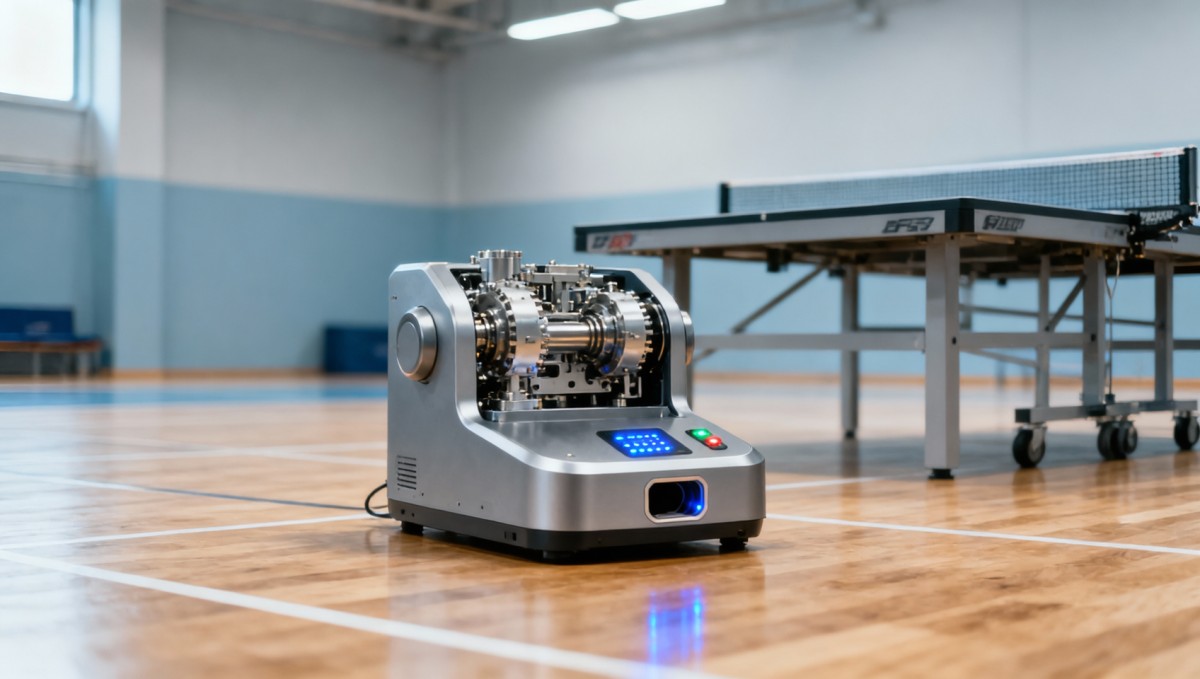
Conclusion: This development underscores how sporting outcomes can indirectly reshape equipment certification expectations — especially at the intersection of AI, motor precision, and public procurement. It is best understood not as a sudden regulatory shift, but as an early indicator of tightening institutional quality benchmarks for intelligent training hardware in Europe. Stakeholders should treat it as a signal warranting targeted compliance preparation — not as an immediate market-wide requirement.
Source: Confirmed details derived exclusively from the provided input information, including date (May 10, 2026), event (London World Team Championships semifinal), actor (Sweden men’s team vs. China), procurement response (TTV emergency procedure), technical requirement (ISO 13485 for motors), and delivery timeline (June 2026). No external data, historical context, or speculative background has been added. Ongoing observation is warranted for official TTV tender documentation and any subsequent adoption by other EU national federations.
Search News
Hot Articles
- Commercial KitchenCommercial Kitchen Design Price: Budgeting by Layout, Equipment, and MEP ScopeSep 22, 2026
- Stationery & UniformsHow Schools Can Cut Printing Costs When Buying Ink Cartridges in BulkSep 21, 2026
- Jewelry Packaging & DisplayHow to Evaluate a Luxury Retail Packaging Supplier for Premium Brand ConsistencySep 20, 2026
Popular Tags
Need ExpertConsultation?
Connect with our specialized leisureengineering team for procurementstrategies.
Recommended News
 Sep 15, 2026How to Choose Coin-Operated Pool Tables for Bars, Hotels, and Arcade VenuesCoin operated pool tables for bars, hotels, and arcades: compare sizes, payment systems, durability, service access, and revenue potential.● Theme Park Strategist
 Sep 08, 2026What to Look for in a Flight Simulator Chair Manufacturer for Commercial VR CentersChoose a flight simulator chair manufacturer that delivers durable, safe, customizable seating for commercial VR centers. Explore key sourcing criteria now.● Theme Park Strategist
 Aug 25, 2026What to Evaluate Before Buying Commercial Self Service Photo Booths for VenuesCommercial self service photo booths for venues: learn how to evaluate durability, software stability, branding flexibility, support, and total ROI before you buy.● Theme Park Strategist
 Aug 23, 2026How to Evaluate Wholesale Vending Machines for Multi-Location Business DeploymentWholesale vending machines for multi-location deployment require more than low unit cost. Learn how to compare reliability, payments, telemetry, and supplier support to scale smarter.● Theme Park Strategist
 Aug 17, 2026U.S. CPSC Urges Bilingual Warnings for Arcade and VR MachinesU.S. CPSC urges bilingual safety warnings for Arcade & VR Machines—learn what exporters, importers, and distributors must do now to avoid delays and returns.● Theme Park Strategist
 Aug 16, 2026EU Enforces EN IEC 62368-1:2026 Certification for Arcade and VR MachinesEU Enforces EN IEC 62368-1:2026 certification for arcade and VR machines, reshaping EU market access, customs clearance, and compliance planning for exporters and distributors.● Theme Park Strategist
 Aug 13, 2026UFLPA’s new guidelines take effect: Exports of Arcade and VR equipment face full-link labor compliance requirementsUFLPA’s new guide takes effect: Arcade and VR machine exports to the U.S. now face full-chain labor compliance checks. Discover key risks and action steps.● Theme Park Strategist
 Aug 12, 2026EU PPWR takes effect, Arcade and VR packaging incorporate heavy metal and PFAS restrictionsEU PPWR now applies to Arcade and VR packaging, tightening heavy metal and PFAS compliance. Learn how exporters can avoid delays, fines, and customs risks.● Theme Park Strategist
 Aug 11, 2026CPSC Sets Bilingual Labels for Arcade and VR ImportsCPSC bilingual labels for arcade and VR imports become mandatory on October 1, 2026. Learn the new English-Spanish warning rules, customs risks, and key compliance steps now.● Theme Park Strategist
 Aug 10, 2026EU Rule Takes Effect for Arcade & VR Machine ClearanceArcade & VR Machine clearance in the EU now depends on EN IEC 62368-1:2026+A11:2026 compliance. Learn what changed, who is affected, and how to avoid customs delays.● Theme Park Strategist
 Aug 09, 2026CPSC Requires New Labels for Arcade and VR ImportsCPSC requires new labels for Arcade and VR imports starting Oct 1, 2026. Learn the multilingual warning rules, compliance risks, and key steps exporters and buyers must take now.● Theme Park Strategist
 Aug 08, 2026EU Entry Rule Tightens for Arcade & VR MachinesArcade & VR Machines entering the EU now face stricter CE compliance under EN IEC 62368-1:2026+A11:2026. Learn the new rule, risks, and what exporters must do now.● Theme Park Strategist
 Aug 07, 2026CPSC Notice Tightens U.S. Entry Rules for Arcade and VR MachinesCPSC Notice Tightens U.S. Entry Rules for Arcade and VR Machines: learn the new labeling, FCC, UN38.3, and compliance document requirements before October 1, 2026.● Theme Park Strategist
 Aug 06, 2026EU Rule Takes Effect for CE-UKCA Labels on Arcade & VR MachinesArcade & VR Machines face new CE-UKCA label and ECPD filing rules in the EU and UK. Learn what manufacturers, importers, and distributors must do now to avoid delays.● Theme Park Strategist
 Aug 05, 2026CPSC Recalls Arcade and VR Machines Over UL 62368-1CPSC recalls arcade and VR machines over UL 62368-1 non-compliance. Learn how this 2026 safety action may affect imports, distribution, customs clearance, and market access.● Theme Park Strategist
 Aug 02, 2026EU Sets New Certification Rule for Arcade and VR MachinesArcade and VR Machines face a new EU certification rule from Oct 1, 2026. Learn how EN IEC 62368-1:2026+A11:2026 affects CE marking, customs clearance, and market access.● Theme Park Strategist
 Aug 01, 2026CPSC Moves to Require Bilingual Warnings on Arcade and VR MachinesCPSC bilingual warnings for Arcade and VR Machines may reshape U.S. import compliance. Learn how English-Spanish labels affect packaging, customs risk, and shipment readiness.● Theme Park Strategist
 Jul 31, 2026EU Sets EN IEC 62368-1:2025 Rule for Arcade and VR MachinesEU Sets EN IEC 62368-1:2025 Rule for Arcade and VR Machines. Learn the new EU compliance deadlines, safety updates, and key actions for manufacturers, OEMs, and distributors.● Theme Park Strategist
 Jul 30, 2026CPSC Sets New Warning Label Rule for Arcade & VR MachinesCPSC sets a new warning label rule for Arcade & VR Machines effective August 15, 2026. Learn key compliance risks, multilingual label requirements, and shipment actions now.● Theme Park Strategist
 Jul 29, 2026EU Enforces New Safety Standard for Arcade and VR MachinesEU Enforces New Safety Standard for Arcade and VR Machines: learn how EN IEC 62368-1 affects CE compliance, customs clearance, and EU market access for exporters and buyers.● Theme Park Strategist
 Jul 28, 2026CPSC Sets ASTM F3472-26 Rule for Arcade & VR ImportsCPSC ASTM F3472-26 rule reshapes Arcade & VR imports to the U.S. Learn key compliance deadlines, certification risks, and what exporters, OEM/ODM suppliers, and buyers should do now.● Theme Park Strategist
 Jul 27, 2026EU Rule Takes Effect for Arcade & VR Machine CybersecurityEU Rule Takes Effect for Arcade & VR Machine Cybersecurity: learn how EN IEC 62443-3-3:2025 affects compliance, customs clearance, sales continuity, and supplier planning in the EU market.● Theme Park Strategist
 Jul 25, 2026CPSC Sets Bilingual Warning Rule for Arcade and VR ImportsCPSC bilingual warning rule for arcade and VR imports takes effect August 1, 2026. Learn how OEM/ODM exporters can avoid CBP delays, relabel shipments, and protect U.S. delivery timelines.● Theme Park Strategist
 Jul 24, 2026EU Enforces New Safety Standard for Arcade and VR MachinesEU Enforces New Safety Standard for Arcade and VR Machines: learn how EN IEC 62368-1:2026+A11:2026 reshapes EU compliance, CE documentation, testing timelines, and export readiness.● Theme Park Strategist