EU Requires EPR Registration for Pro Audio Sales
On June 10, 2026, the European Environment Agency (EEA) announced a new market-access requirement for Pro Stage Audio equipment sold in France, Belgium, Germany, and the Netherlands. From October 1, 2026, products such as mixing consoles, amplifiers, and digital audio processors must complete country-specific EPR registration and pay recycling fees before they can legally move through customs and onto shelves. For exporters, OEM/ODM suppliers, distributors, and buyers, this is not just an environmental compliance notice; it directly affects sales eligibility, delivery arrangements, and contract execution in these four EU markets.
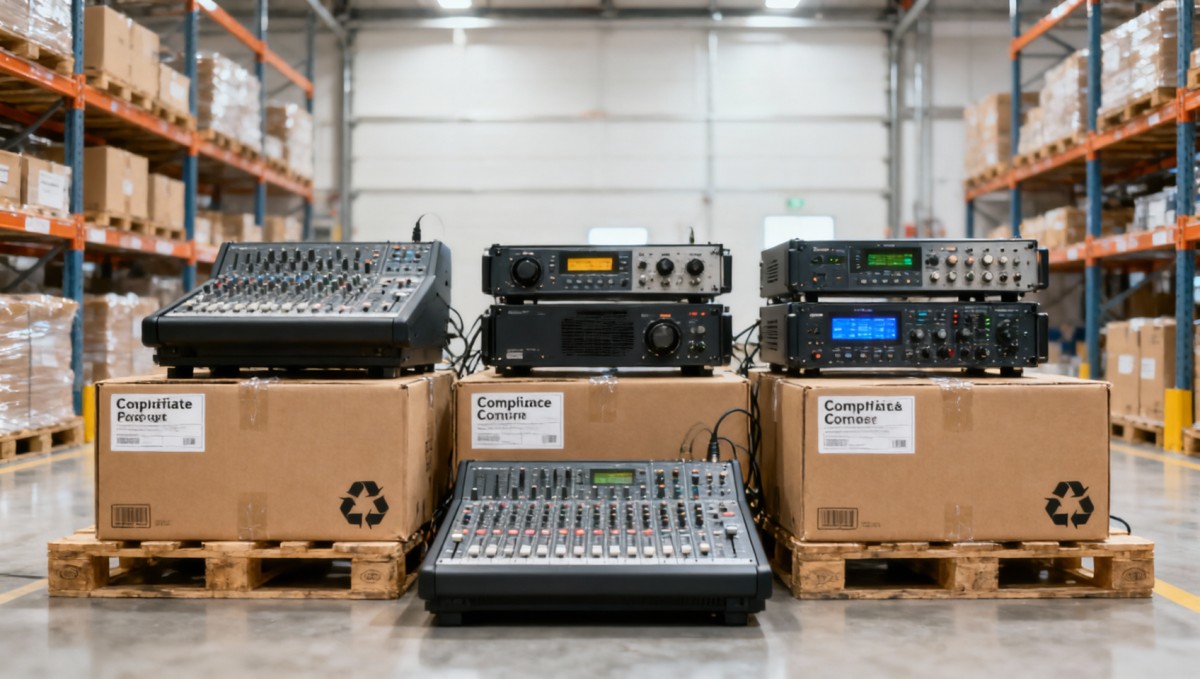
What the new requirement clearly changes
The confirmed change is tied to market sales in four countries: France, Belgium, Germany, and the Netherlands. According to the EEA notice issued on June 10, 2026, all Pro Stage Audio equipment placed on those markets from October 1, 2026 must complete local Extended Producer Responsibility (EPR) registration and pay the related recycling fees.
The products expressly covered include Pro Stage Audio equipment such as mixing consoles, power amplifiers, and digital audio processors. The stated consequence for non-compliant products is clear: they will be barred from customs clearance and from being listed for sale. The notice also makes clear that this change directly affects the export access conditions and contract performance terms of Chinese OEM/ODM suppliers.
Why the impact reaches beyond a single compliance step
Export access now depends on pre-sale compliance preparation
For exporters and contract manufacturers, the immediate issue is that EPR registration becomes a practical entry requirement rather than a back-end administrative task. If a product cannot complete the required registration for the destination country, the problem affects customs handling, sales launch timing, and the ability to fulfill delivery commitments already agreed with customers.
From an operational perspective, what deserves closer attention is whether market-entry documentation, shipment release preparation, and customer onboarding materials are aligned with this requirement before goods are dispatched.
Distributors and channel operators face listing risk
For distributors, importers, and channel operators active in the four affected markets, the rule change touches the point where products move from logistics into actual commercial circulation. Because non-compliant products cannot be placed on shelves, the issue is not limited to import processing; it also affects listing readiness, launch sequencing, and inventory planning for covered audio equipment.
Analysis shows that channel-side businesses should pay close attention to whether supplier qualifications, registration status, and supporting compliance records are checked early enough to avoid disruptions at the listing stage.
Buyers and sourcing teams may need tighter supplier screening
For buyers, especially those purchasing from Chinese OEM/ODM suppliers, the notice signals a change in procurement risk review. If EPR completion becomes a mandatory condition for lawful sales in the destination market, then supplier selection, order confirmation, and contract wording may all need closer scrutiny.
Observably, sourcing teams should not treat this as a purely downstream matter, because any gap in registration readiness can carry through to acceptance timing, delivery planning, and liability discussions under supply agreements.
Supply-chain service providers may see more document coordination pressure
Logistics coordinators, trade service providers, and other supply-chain intermediaries may also be affected because the rule directly connects compliance status with customs clearance and commercial placement. Even without additional execution details in the notice, the practical implication is that documentation coordination becomes more sensitive where multiple parties share responsibility for export, import, and market launch steps.
Where companies should focus before the effective date
Check country-by-country registration readiness
The requirement applies to four separate national markets, so companies should pay attention to whether their products intended for France, Belgium, Germany, and the Netherlands are matched with the necessary local EPR registration pathway. The current notice confirms the obligation and the consequence of non-compliance, but it does not provide further operational detail in the input provided, so businesses should treat follow-up verification as essential.
Review contracts for compliance responsibility
Because the notice directly affects export qualification and contract performance for Chinese OEM/ODM suppliers, companies should examine how compliance responsibility is allocated in existing and upcoming agreements. Analysis shows that the key issue is not only who manufactures the equipment, but also who is expected to complete registration, bear related fees, and manage the timing risk if products cannot be cleared or listed.
Reassess shipment timing and launch planning
With October 1, 2026 set as the effective date, businesses should pay attention to delivery schedules, stocking plans, and launch arrangements tied to the four affected markets. Where products are intended to enter sales channels close to the effective date, the more relevant question may be whether documentation and registration status can support uninterrupted customs and listing processes.
Prepare supporting records for commercial and compliance review
From an industry perspective, companies should also review the product and transaction records that may be needed in procurement reviews, customer due diligence, and trade documentation workflows. The notice provided here does not specify a full document list, so this should be understood as a compliance-preparation priority rather than a confirmed filing checklist.
How this should be understood at this stage
Observably, this development is more appropriate to understand as a concrete execution signal rather than a distant policy discussion. The effective date is defined, the affected markets are identified, the covered product category is named, and the commercial consequence of non-compliance is explicit.
At the same time, analysis shows that the market still needs to watch how the requirement is implemented in practice. The current input confirms the obligation itself, but it does not provide detailed enforcement procedures, documentation standards, or market-by-market operating guidance. That means companies should treat this as a rule that is already moving into application, while continuing to monitor official clarification, procurement language, and downstream execution feedback.
What the notice means for the market now
For the Pro Stage Audio supply chain, this notice matters because it turns EPR from a peripheral compliance topic into a direct condition of market access in four EU countries. The most rational reading at present is that companies involved in export, sourcing, distribution, and contract manufacturing should prepare for a real operational requirement with trade and delivery consequences, while avoiding assumptions about execution details that have not been provided in the available information.
In that sense, the development is best understood as a confirmed compliance threshold with immediate planning value, and also as a rule change that still requires continued observation on implementation practice.
Basis of this article and what still needs verification
This article is generated based on the user-provided news title, effective date, and event summary. The analysis is limited to the confirmed information provided in the input and does not add unverified policy numbers, company names, market figures, or source links.
For this type of development, relevant source categories would usually include official notices, regulator publications, customs or trade administration information, industry association updates, standards-related documents, and reporting by authoritative media. However, a specific official source link was not provided in the input, so the exact source document still requires further verification.
What still needs continued observation includes any detailed implementation language, country-level compliance interpretation, changes in tender or procurement documents, market feedback from affected businesses, and the actual execution approach adopted by companies involved in export and distribution.
Search News
Hot Articles
Popular Tags
Need ExpertConsultation?
Connect with our specialized leisureengineering team for procurementstrategies.
Recommended News
 Oct 24, 2026RME Launches ADI-2/4 PRO EX Audio Converter with Integrated ProcessingExplore the RME ADI-2/4 PRO EX audio converter with AD/DA conversion, dual headphone amps and integrated processing. Discover its potential for studio, live sound and broadcast workflows.● Pro Audio Engineer
 Oct 22, 2026Audio Production for Streaming: How to Build a Dedicated Live Event MixMaster audio production for streaming with a dedicated live event mix. Learn routing, loudness control, and monitoring techniques to deliver clear, balanced sound your online audience will love.● Pro Audio Engineer
 Oct 15, 2026Designing Theater Sound Systems for Clear Dialogue and Even Audience CoverageOptimize stage sound for theaters with practical tips on acoustics, speaker placement, and tuning. Discover how to deliver clear dialogue and consistent coverage across audience seating.● Pro Audio Engineer
 Oct 22, 2026Which Professional Sound System Specs Matter Most for Live Venues?Discover what professional sound system specs matter most for live venues. Compare SPL, coverage, frequency response, and headroom to choose a PA that delivers clear, powerful sound.● Pro Audio Engineer
 Oct 20, 2026Should You Prioritize Stage Sound or Audience Coverage?Should I prioritize stage sound or audience coverage first? Discover how to balance clear audience audio, reliable monitoring, and smarter sound-system upgrades for your venue.● Pro Audio Engineer
 Oct 18, 2026How Much Does Studio Acoustic Treatment Cost per Square Meter?How much does studio acoustic treatment cost per square meter? Learn how to compare panel prices, installation fees, and complete budgets to choose the right treatment without overspending.● Pro Audio Engineer
 Oct 17, 2026How Do Line Array and Point Source Sound Systems Differ?What is the difference between line array and point source systems? Compare coverage, costs, and venue fit to find the right solution for clearer sound.● Pro Audio Engineer
 Oct 16, 2026Are Standard Acoustic Panels Enough for Performance Venues?Are standard acoustic panels enough for performance venues? Discover their limits, explore bass control and diffusion, and learn how to choose treatments that improve sound without wasting budget.● Pro Audio Engineer
 Sep 30, 2026How to Choose an Aluminum Projector Ceiling Mount for Load, Drop, and Ceiling TypeChoose an aluminum projector ceiling mount with confidence. Learn how load capacity, drop length, ceiling structure, safety retention, and service access shape a reliable commercial AV installation.● Pro Audio Engineer
 Sep 26, 2026How to Choose Dynamic Microphones for Vocals in Live Stage SettingsDynamic microphones for vocals: learn how to match polar patterns, feedback control, durability, and clarity to live stage needs for reliable, professional sound.● Pro Audio Engineer
 Sep 07, 2026How to Choose Wall Mount Speakers for Clear Audio in Commercial SpacesWall mount speakers for commercial spaces: learn how to optimize coverage, SPL, directivity, installation, and system design for clear, reliable audio.● Pro Audio Engineer
 Sep 03, 2026How to Choose Locking Speakon Speaker Cables for Reliable Live Sound ConnectionsLocking Speakon speaker cables: learn how to select the right gauge, connector pinout, strain relief, and durable construction for reliable live sound connections.● Pro Audio Engineer
 Sep 08, 2026Is It Worth Upgrading a Stage Sound System Mid-Project?Is it worth upgrading stage sound systems mid-project? Discover how to assess performance gaps, costs, compatibility, and long-term venue value.● Pro Audio Engineer
 Sep 04, 2026Can AV Systems Be Retrofitted Into Older Commercial Buildings?Can AV integration be retrofitted into older commercial buildings? Discover practical strategies for reliable, code-aware AV upgrades with minimal disruption.● Pro Audio Engineer
 Jul 17, 2026How to Choose a Crossover Networks Supplier: Key Specs, Quality Checks, and OEM FactorsFind the right crossover networks supplier with this practical guide to key specs, quality checks, OEM factors, and supply chain risks for better audio performance and sourcing confidence.● Pro Audio Engineer
 Jul 16, 2026How to Evaluate ODM Services for Pro Audio: Design, Certification, and Production CapabilitiesODM services for pro audio: learn how to assess design depth, certification readiness, and production strength to choose a reliable partner and launch better audio products with less risk.● Pro Audio Engineer
 Jul 15, 2026JETRO Flags Modular, Low-Power Shift in Pro Stage AudioPro Stage Audio buyers in Japan are shifting fast: JETRO flags modular amplifiers, IP65 line arrays, low standby power, and JIS compliance as key to channel entry.● Pro Audio Engineer
 Jul 15, 2026Paper Speaker Cones Explained: How Cone Weight and Stiffness Affect SoundPaper speaker cones explained: discover how cone weight and stiffness shape sensitivity, clarity, breakup control, and real-world speaker performance for smarter audio sourcing.● Pro Audio Engineer
 Jul 15, 2026Performance Venues Compliance Checklist: Fire Safety, Accessibility, and Crowd RulesPerformance venues compliance checklist covering fire safety, accessibility, and crowd rules. Learn how to reduce delays, improve approvals, and open safer, more resilient venues.● Pro Audio Engineer
 Jul 14, 2026Japan Adds EMC Immunity Test for Stage AmplifiersJapan Adds EMC Immunity Test for Stage Amplifiers: learn how Japan’s 2026 JIS update affects EMC testing, JIS marking, certification timing, and market access for exporters.● Pro Audio Engineer
 Jul 13, 2026CISCE 2026 Adds Pro Stage Audio ZoneCISCE 2026 Adds Pro Stage Audio Zone as free overseas pre-registration opens. Explore key updates for pro audio suppliers, distributors, and system integrators before the Shanghai expo.● Pro Audio Engineer
 Jul 12, 2026Japan Tightens Pro Stage Audio Efficiency Limits Under JIS C 8105-2026Japan Tightens Pro Stage Audio Efficiency Limits Under JIS C 8105-2026: learn how new PSE compliance rules reshape market access, product eligibility, and shipment planning in Japan.● Pro Audio Engineer
 Jul 12, 2026How to Choose Low Profile Ceiling Speakers for Hotels, Offices, and Retrofit ProjectsLow profile ceiling speakers for hotels, offices, and retrofit projects: learn how to compare depth, coverage, compliance, and installation factors to choose the right fit.● Pro Audio Engineer
 Jul 11, 2026Japan Tightens JIS C 8105-2026 for Pro AudioJapan Tightens JIS C 8105-2026 for Pro Audio: learn how stricter standby power, PSE diamond mark rules, and the 2026 deadline impact exports, compliance, and market access.● Pro Audio Engineer