Roller Coaster Parts With the Highest Replacement Frequency
For procurement professionals in the amusement industry, understanding which roller coaster parts require the most frequent replacement is essential for balancing safety, uptime, and lifecycle cost. From wheels and bearings to restraint components and sensors, knowing the high-wear items helps buyers plan smarter sourcing strategies, reduce unplanned maintenance, and ensure compliance with strict operational standards.
A checklist-based approach is the fastest way to evaluate roller coaster parts because replacement demand is not driven by a single factor. Wear depends on ride intensity, train design, climate exposure, maintenance discipline, passenger throughput, and local inspection rules. For buyers, the practical question is not simply “which part fails first,” but “which part should be sourced, stocked, specified, and audited more carefully than the rest.” That is where a structured procurement checklist creates value: it helps teams prioritize critical wear items, compare suppliers consistently, and avoid hidden lifecycle costs.
Start Here: What Buyers Should Confirm Before Reviewing High-Wear Roller Coaster Parts
Before creating a replacement plan, procurement teams should verify the operating profile of the ride. The same roller coaster parts can have very different replacement frequency depending on whether the coaster is family-oriented, high-thrill, indoor, seaside, seasonal, or year-round. A steel launch coaster with aggressive inversions, for example, stresses wheels, restraint systems, and brake components differently than a compact spinning coaster in a themed indoor park.
- Annual ridership volume and average dispatch interval
- Ride type, train configuration, and speed profile
- Track environment, including heat, humidity, dust, salt air, and UV exposure
- Current preventive maintenance schedule and inspection method
- OEM part dependency versus approved equivalent sourcing options
- Required documentation, such as material certificates, traceability, and testing records
These basic checks allow buyers to distinguish between parts with routine wear, parts with conditional wear, and parts that are replaced mainly for regulatory or preventive reasons. That distinction is essential for cost forecasting.
Core Checklist: Roller Coaster Parts With the Highest Replacement Frequency
The following categories typically show the highest replacement frequency across modern roller coaster systems. While intervals vary by manufacturer and operating conditions, these are the roller coaster parts procurement managers should review first when building stocking policies and supplier frameworks.
1. Road Wheels, Side Friction Wheels, and Upstop Wheels
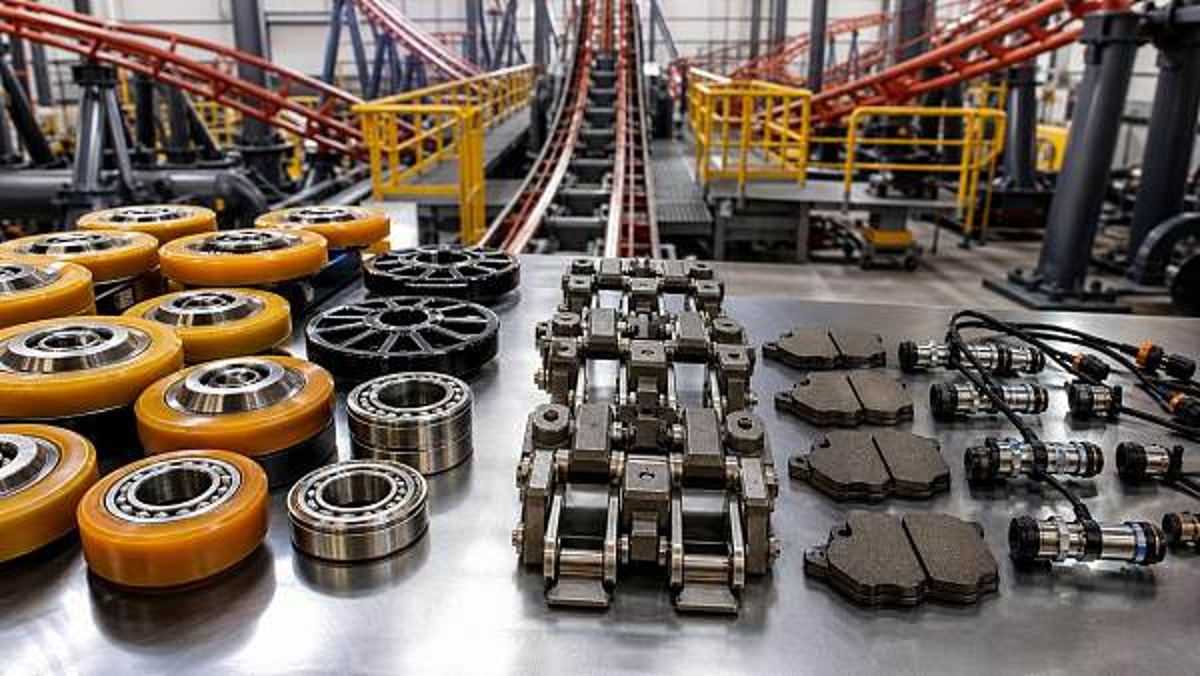
Wheel assemblies are usually the most visible high-wear roller coaster parts. Polyurethane or similar wheel materials degrade through heat buildup, friction, load cycling, and environmental exposure. Depending on design, different wheel positions experience different stresses: road wheels carry the main vertical load, side friction wheels manage lateral guidance, and upstop wheels control uplift during hills and inversions.
Buyers should check durometer rating, heat resistance, hub quality, balancing tolerance, and compatibility with existing bogie geometry. The lowest unit price is rarely the lowest lifecycle cost. A cheaper wheel with inconsistent material density can increase vibration, shorten bearing life, and create more downtime.
2. Bearings and Sealed Bearing Units
Bearings often fail before surrounding assemblies show major structural wear. They are exposed to rotational speed, impact loading, contamination, moisture ingress, and lubrication breakdown. Because bearings are embedded in wheel systems, brake mechanisms, and articulated train components, their replacement frequency can be high even when the larger assembly remains reusable.
Procurement teams should prioritize load rating, seal design, corrosion protection, grease specification, and supplier consistency. Ask whether the bearing is standard industrial stock or a custom amusement-grade component. Standardization can reduce lead times, but only if performance is proven under ride-specific duty cycles.
3. Restraint Pads, Belts, Latches, and Wear Interfaces
Passenger restraint systems include several roller coaster parts that wear more quickly than structural hardware. Pads compress and crack, belts fray, latch interfaces polish or loosen, and moving joints accumulate tolerance changes. Even when metal frames remain serviceable, comfort surfaces and contact components often need regular replacement to meet safety and guest experience standards.
For procurement, the key checks are abrasion resistance, flame performance where applicable, ease of sanitation, vandal resistance, UV durability, and compatibility with lock monitoring systems. Restraint-related parts also require stronger documentation control because they directly affect rider containment and inspection outcomes.
4. Brake Fins, Brake Pads, Friction Elements, and Pneumatic Components
Braking systems create predictable replacement demand. Friction materials wear under repeated deceleration, while pneumatic seals, valves, and actuator components degrade with cycling and contamination. On some coaster systems, non-contact magnetic elements reduce wear, but associated hardware still requires inspection and periodic renewal.
When sourcing these roller coaster parts, buyers should look beyond nominal dimensions. Friction coefficient stability, thermal behavior, response time, spare kit completeness, and maintenance access all affect replacement planning. A part that lasts longer but requires extended shutdown for installation may not be the best choice operationally.
5. Sensors, Proximity Switches, Cables, and Connectors
Electrical and control-related roller coaster parts can have a surprisingly high replacement rate, especially in outdoor parks. Position sensors, speed pickups, proximity switches, cable harnesses, and connectors are vulnerable to vibration, water ingress, heat cycling, and corrosion. These parts may be low in unit cost but high in operational importance because a minor sensor fault can stop the entire ride.
Buyers should verify ingress protection rating, connector locking method, shielding quality, spare interchangeability, and compatibility with the ride control architecture. It is also wise to maintain clear labeling and version control, since mixed revisions can create troubleshooting delays.
6. Chain Lift Components, Anti-Rollback Elements, and Drive Consumables
On chain-lift coasters, chains, sprocket wear surfaces, guide elements, anti-rollback devices, and drive-related consumables can require frequent replacement or staged refurbishment. These parts operate under repetitive load and are sensitive to alignment, lubrication quality, and contamination.
Procurement managers should request fatigue data, lubrication recommendations, replacement thresholds, and evidence of compatibility with the existing drive system. If a park operates older rides, reverse engineering support and dimensional verification may be just as important as price.
Practical Priority Table for Procurement Planning
Use this simplified checklist to rank roller coaster parts by purchasing urgency, stocking logic, and sourcing complexity.
How Replacement Frequency Changes by Ride Type and Operating Scenario
Not all parks should stock the same roller coaster parts in the same quantities. Procurement strategy should reflect the ride portfolio and usage pattern.
- High-speed thrill coasters: prioritize wheels, bearings, brake consumables, and sensor reliability because dynamic loads and heat are greater.
- Family coasters: expect relatively lower structural stress but steady wear on restraint surfaces, seat components, and repetitive-use hardware.
- Indoor coasters: environmental corrosion may be lower, but accessibility constraints can make downtime more expensive, so prebuilt spare kits matter more.
- Coastal parks: corrosion-resistant bearings, connectors, fasteners, and sealed electrical roller coaster parts become a top priority.
- Seasonal operations: storage conditions, startup inspection parts, and pre-season refresh items should be planned in advance to avoid launch delays.
Commonly Overlooked Risks When Buying Roller Coaster Parts
Many procurement issues do not come from choosing the wrong category of part, but from missing the right supporting checks. These are the most common blind spots.
- Ignoring installation labor and ride downtime when comparing suppliers.
- Assuming dimensional compatibility guarantees performance compatibility.
- Overlooking lot traceability for safety-critical roller coaster parts.
- Failing to align spare stock with actual maintenance intervals and lead times.
- Using substitute materials without confirming thermal, fatigue, or compliance behavior.
- Purchasing individual items instead of complete service kits for fast-turn maintenance tasks.
These oversights often lead to hidden costs: emergency freight, longer closures, repeat maintenance, inspection findings, or reduced guest throughput during peak season.
Execution Guide: What to Prepare Before Requesting Quotes
If a park or operator wants stronger sourcing outcomes, the quote request should be more detailed than a simple part name. For frequently replaced roller coaster parts, buyers should prepare a concise technical package that allows suppliers to respond accurately and comparably.
- Ride manufacturer, model, train type, and year of installation
- Part drawings, photos, dimensions, and assembly location
- Current annual consumption and observed failure mode
- Operating environment and maintenance practice
- Required standards, certifications, and inspection records
- Preferred order volume, safety stock target, and delivery window
For global buyers, especially those managing multiple properties or ride portfolios, it is also useful to request supplier support on packaging discipline, batch coding, after-sales response time, and documentation in a format suitable for audits. In commercial trade, sourcing quality is measured not only by the part itself, but by how easily that part can move through engineering review, warehouse control, maintenance installation, and compliance verification.
Final Procurement Takeaway
The roller coaster parts with the highest replacement frequency are usually wheels, bearings, restraint wear items, brake consumables, sensors, connectors, and selected lift or drive components. For procurement professionals, the best practice is to treat these not as simple spare parts, but as priority lifecycle items that deserve tighter specifications, better supplier qualification, and clearer stocking rules.
If you are evaluating sourcing options for roller coaster parts, the most useful next step is to confirm six points with potential suppliers: exact ride compatibility, material and performance data, expected service life, compliance documentation, lead time stability, and recommended spare quantity by operating volume. Those answers will give buyers a more reliable basis for budgeting, vendor comparison, and long-term maintenance planning.
Search News
Hot Articles
Popular Tags
Need ExpertConsultation?
Connect with our specialized leisureengineering team for procurementstrategies.
Recommended News
 May 07, 2026Shen Jing on Trade Rumors: Implications for Basketball Equipment ManufacturingBasketball equipment manufacturing gains strategic clarity as Shen Jing’s trade rumor response boosts OEM confidence—Dongguan & Suzhou suppliers see strengthened NBA facility credibility and smart gear demand.● Theme Park Strategist
 May 07, 2026Ferris Wheel Manufacturer Shortlists Often Miss This RiskFerris wheel manufacturer shortlists often miss lifecycle compliance risk. Learn how to avoid costly delays, safety gaps, and weak after-sales support before you buy.● Theme Park Strategist
 May 07, 2026Lazy River Equipment: Where Energy Use Adds Up FastLazy river equipment can drive energy costs higher than expected. Learn what technical evaluators should check before sourcing or upgrading for better efficiency and lifecycle value.● Theme Park Strategist
 May 07, 2026Water Playground Structures: Design Choices That Reduce Queue TimeWater playground structures that cut queue time: discover layout, capacity, and feature strategies that improve guest flow, safety, and ROI for commercial aquatic projects.● Theme Park Strategist
 May 07, 2026Bumper Cars Wholesale: Battery Options That Change Operating CostsBumper cars wholesale decisions depend heavily on battery choice. Compare lead-acid vs. lithium to cut downtime, lower operating costs, and improve long-term ROI.● Theme Park Strategist
![]() May 07, 2026Pirate Ship Amusement Rides: What Impacts Ride Smoothness Most?Pirate ship amusement ride smoothness depends on structure, drive control, bearings, balancing, and installation. Discover the key checks buyers need for safer, smoother, long-lasting performance.● Theme Park Strategist
May 07, 2026Pirate Ship Amusement Rides: What Impacts Ride Smoothness Most?Pirate ship amusement ride smoothness depends on structure, drive control, bearings, balancing, and installation. Discover the key checks buyers need for safer, smoother, long-lasting performance.● Theme Park Strategist![]() May 07, 2026How to Vet a Water Park Equipment Manufacturer for Large ProjectsWater park equipment manufacturer vetting guide for large projects: compare safety, compliance, capacity, customization, and delivery support to reduce risk and choose with confidence.● Theme Park Strategist
May 07, 2026How to Vet a Water Park Equipment Manufacturer for Large ProjectsWater park equipment manufacturer vetting guide for large projects: compare safety, compliance, capacity, customization, and delivery support to reduce risk and choose with confidence.● Theme Park Strategist May 07, 2026Drop Tower Rides: The Safety Checks That Matter MostDrop tower rides safety starts with the checks that matter most. Learn how restraints, brakes, sensors, and structural reviews support safer approval and smarter sourcing.● Theme Park Strategist
![]() May 07, 2026Flying Chair Ride Capacity Limits That Affect Daily ThroughputFlying chair ride capacity limits shape daily throughput, queue performance, and revenue. Learn the key factors buyers should assess before sourcing or planning layout.● Theme Park Strategist
May 07, 2026Flying Chair Ride Capacity Limits That Affect Daily ThroughputFlying chair ride capacity limits shape daily throughput, queue performance, and revenue. Learn the key factors buyers should assess before sourcing or planning layout.● Theme Park Strategist![]() May 07, 2026Fiberglass Water Slides: Common Surface Issues After InstallationFiberglass water slides can develop blisters, fading, rough spots, and hairline cracks after installation. Learn key causes, early warning signs, and what to inspect in the first 90 days.● Theme Park Strategist
May 07, 2026Fiberglass Water Slides: Common Surface Issues After InstallationFiberglass water slides can develop blisters, fading, rough spots, and hairline cracks after installation. Learn key causes, early warning signs, and what to inspect in the first 90 days.● Theme Park Strategist May 07, 2026How to Compare a Carousel Rides Manufacturer Beyond PriceCarousel rides manufacturer selection should go beyond price. Learn how to compare safety, compliance, customization, and after-sales support to choose a reliable supplier.● Theme Park Strategist
 May 07, 2026Roller Coaster Parts With the Highest Replacement FrequencyRoller coaster parts buyers: discover which components need the most frequent replacement, from wheels and bearings to sensors and restraints, to cut downtime and source smarter.● Theme Park Strategist
 May 07, 2026Electric Trackless Trains or Road Trains for Large Venues?Electric trackless trains for large venues: compare them with road trains to improve guest experience, reduce noise and emissions, and choose a smarter, future-ready mobility solution.● Theme Park Strategist
 May 07, 2026Wave Pool Equipment Failures That Disrupt Peak SeasonWave pool equipment failures can shut down peak-season operations fast. Learn the top breakdown risks, business impacts, and practical ways to reduce downtime and protect revenue.● Theme Park Strategist
 May 07, 2026Ferris Wheel Manufacturer Shortlists Often Miss This RiskFerris wheel manufacturer shortlists often miss lifecycle compliance risk. Learn how to avoid costly delays, safety gaps, and weak after-sales support before you buy.● Theme Park Strategist
 May 07, 2026Lazy River Equipment: Where Energy Use Adds Up FastLazy river equipment can drive energy costs higher than expected. Learn what technical evaluators should check before sourcing or upgrading for better efficiency and lifecycle value.● Theme Park Strategist
 May 07, 2026Water Playground Structures: Design Choices That Reduce Queue TimeWater playground structures that cut queue time: discover layout, capacity, and feature strategies that improve guest flow, safety, and ROI for commercial aquatic projects.● Theme Park Strategist
 May 07, 2026Bumper Cars Wholesale: Battery Options That Change Operating CostsBumper cars wholesale decisions depend heavily on battery choice. Compare lead-acid vs. lithium to cut downtime, lower operating costs, and improve long-term ROI.● Theme Park Strategist
![]() May 07, 2026Pirate Ship Amusement Rides: What Impacts Ride Smoothness Most?Pirate ship amusement ride smoothness depends on structure, drive control, bearings, balancing, and installation. Discover the key checks buyers need for safer, smoother, long-lasting performance.● Theme Park Strategist
May 07, 2026Pirate Ship Amusement Rides: What Impacts Ride Smoothness Most?Pirate ship amusement ride smoothness depends on structure, drive control, bearings, balancing, and installation. Discover the key checks buyers need for safer, smoother, long-lasting performance.● Theme Park Strategist![]() May 07, 2026How to Vet a Water Park Equipment Manufacturer for Large ProjectsWater park equipment manufacturer vetting guide for large projects: compare safety, compliance, capacity, customization, and delivery support to reduce risk and choose with confidence.● Theme Park Strategist
May 07, 2026How to Vet a Water Park Equipment Manufacturer for Large ProjectsWater park equipment manufacturer vetting guide for large projects: compare safety, compliance, capacity, customization, and delivery support to reduce risk and choose with confidence.● Theme Park Strategist May 07, 2026Drop Tower Rides: The Safety Checks That Matter MostDrop tower rides safety starts with the checks that matter most. Learn how restraints, brakes, sensors, and structural reviews support safer approval and smarter sourcing.● Theme Park Strategist
![]() May 07, 2026Flying Chair Ride Capacity Limits That Affect Daily ThroughputFlying chair ride capacity limits shape daily throughput, queue performance, and revenue. Learn the key factors buyers should assess before sourcing or planning layout.● Theme Park Strategist
May 07, 2026Flying Chair Ride Capacity Limits That Affect Daily ThroughputFlying chair ride capacity limits shape daily throughput, queue performance, and revenue. Learn the key factors buyers should assess before sourcing or planning layout.● Theme Park Strategist![]() May 07, 2026Fiberglass Water Slides: Common Surface Issues After InstallationFiberglass water slides can develop blisters, fading, rough spots, and hairline cracks after installation. Learn key causes, early warning signs, and what to inspect in the first 90 days.● Theme Park Strategist
May 07, 2026Fiberglass Water Slides: Common Surface Issues After InstallationFiberglass water slides can develop blisters, fading, rough spots, and hairline cracks after installation. Learn key causes, early warning signs, and what to inspect in the first 90 days.● Theme Park Strategist May 07, 2026How to Compare a Carousel Rides Manufacturer Beyond PriceCarousel rides manufacturer selection should go beyond price. Learn how to compare safety, compliance, customization, and after-sales support to choose a reliable supplier.● Theme Park Strategist