How to Choose Locking Speakon Speaker Cables for Reliable Live Sound Connections
How to Choose Locking Speakon Speaker Cables for Reliable Live Sound Connections
Introduction
For technical evaluators, locking speakon speaker cables should be selected as a system component, not as a generic accessory purchased only by length and price.
The correct choice depends on connector family, conductor gauge, cable length, amplifier loading, environmental exposure, installation method, and the consequences of an unexpected disconnect.
In most professional applications, a genuine locking connector, correctly sized copper conductors, robust strain relief, and verified pinout compatibility provide the most dependable baseline.
This guide focuses on the practical questions evaluators must answer before approving locking speakon speaker cables for touring systems, installed venues, rental inventories, and commercial projects.
What Technical Evaluators Are Actually Trying to Prevent
The core search intent is usually risk reduction: buyers want cables that maintain secure, low-resistance speaker connections during demanding live sound operation and repeated handling.
A failed loudspeaker cable can cause more than a silent cabinet. It may interrupt an event, overload remaining channels, complicate troubleshooting, or damage stakeholder confidence.
Technical teams therefore evaluate mechanical security, electrical suitability, service life, traceability, and interoperability rather than treating the cable as a simple commodity product.
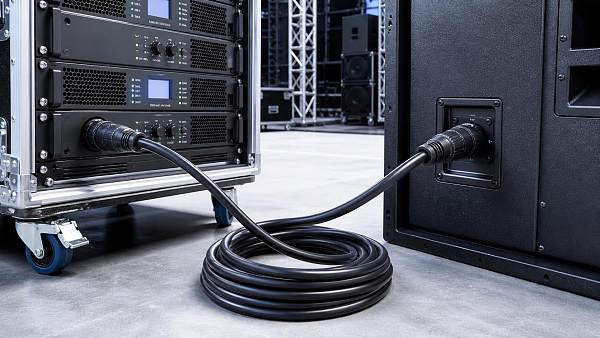
Locking speakon speaker cables address one major failure mode by using a twist-and-lock coupling that resists accidental removal better than exposed phone-style speaker plugs.
However, the locking mechanism alone does not guarantee reliability. Undersized conductors, counterfeit connectors, poor soldering, weak jackets, or incorrect wiring can still create failures.
For fixed installations, the priority may be long-term safety, fire-performance documentation, and maintenance access. For rental use, durability and rapid field replacement usually matter more.
For touring applications, cable flexibility, connector retention, abrasion resistance, and consistent labeling can materially reduce setup time and prevent faults during frequent load-ins.
A sound evaluation begins by defining the operating environment and failure consequences, then selecting specifications that fit those conditions with reasonable engineering margin.
Confirm the Connector Format Before Comparing Cable Construction
Speakon is commonly used as a generic market term, but technical evaluators should distinguish genuine Neutrik speakON connectors from compatible locking speaker connector alternatives.
Connector compatibility should be checked at both ends of every signal path, including amplifiers, patch panels, breakout boxes, passive loudspeakers, and powered speaker outputs.
The most common formats are two-pole and four-pole connectors. Four-pole versions can carry multiple amplifier channels or separate low-frequency and high-frequency feeds.
NL2-style connectors generally support one positive and one negative circuit, while NL4-style connectors provide terminals commonly identified as 1+, 1-, 2+, and 2-.
Some four-pole chassis connectors accept two-pole cable connectors, but that mechanical compatibility does not eliminate the need to verify the electrical contacts used.
Do not assume every amplifier or loudspeaker follows the same terminal assignment. Manufacturer documentation, panel markings, and continuity testing should confirm the required pinout.
Bi-amped systems deserve particular attention because an incorrect NL4 wiring scheme can route amplifier output to the wrong driver section or leave a channel disconnected.
Specify connector part numbers, pole count, contact assignments, and mating requirements in procurement documents instead of using vague descriptions such as “professional speaker connector.”
Choose Conductor Gauge From Current, Distance, and Load Impedance
Conductor size is one of the most important electrical decisions when choosing locking speakon speaker cables, because resistance increases with cable length and decreases with thicker conductors.
High resistance wastes amplifier power as heat, reduces loudspeaker damping, changes effective system response, and can create uneven performance between short and long cable runs.
As a practical starting point, 16 AWG may suit short, moderate-power runs, while 14 AWG and 12 AWG are more appropriate for higher current applications.
The required gauge cannot be determined from wattage alone. Evaluators should consider nominal impedance, actual cable length, amplifier capability, duty cycle, and the acceptable voltage loss.
Low-impedance loads demand greater attention because they draw more current. A cable serving a four-ohm loudspeaker system generally needs more conductor capacity than an eight-ohm equivalent.
Long cable runs magnify resistance concerns. A gauge acceptable for a five-meter stage connection may be inadequate for a fifty-meter distribution run in a large venue.
Specify stranded copper conductors for flexible mobile applications. Verify whether a supplier uses bare copper, tinned copper, copper-clad aluminum, or another conductor material.
Copper-clad aluminum may reduce cost and weight, but its higher resistance and different mechanical characteristics require careful assessment before use in professional high-current speaker circuits.
Evaluate Cable Construction for the Real Handling Environment
Cable jacket material determines much of the product’s field durability. PVC is common and economical, while rubberized compounds often provide better flexibility and abrasion resistance.
For touring and rental inventory, choose cables that remain manageable in cool conditions, coil easily, resist crushing, and tolerate repeated deployment without jacket splitting.
For permanent installation, assess local code requirements and project specifications. Flame-retardant, low-smoke, halogen-free, plenum-rated, or riser-rated constructions may be necessary.
Outer diameter matters because it affects connector strain-relief compatibility, handling comfort, cable reel capacity, and the ability to route assemblies through infrastructure openings.
A thicker jacket can improve protection, but excessive bulk may make patching difficult in crowded amplifier racks or stage boxes. Select robustness appropriate to the use case.
Inspect the cable’s internal design where possible. Fillers, tight conductor lay, insulation quality, shielding arrangements where applicable, and overall concentricity influence durability and handling.
Speaker cables usually do not require audio shielding because they carry high-level signals. Shielded cable is not automatically better and may add unnecessary cost or stiffness.
In electrically complex venues, focus instead on correct routing, separation from sensitive signal lines, solid connector contacts, and proper system grounding practices.
Assess Connector Quality, Termination, and Strain Relief
Connector quality often determines whether a cable survives real production work. The shell, locking mechanism, contacts, cable clamp, boot, and termination must function together.
Genuine or proven professional-grade connectors typically offer consistent mating dimensions, reliable contact pressure, available replacement parts, and clearer technical documentation than unknown alternatives.
Examine whether contacts are plated and securely retained. Contact oxidation, weak spring pressure, or loose internal components can raise resistance and create intermittent audio faults.
Termination quality is equally important. Solder joints should be clean and mechanically supported, while screw or crimp terminations should meet the connector manufacturer’s instructions.
A cable should never rely on electrical joints to absorb pulling force. Proper strain relief transfers tension to the outer jacket before it reaches the conductors.
Look for a boot and chuck design sized to the actual cable diameter. A poorly matched clamp can slip, crush the jacket, or fail after repeated flexing.
For heavy-duty applications, specify overmolded or reinforced cable exits only when they do not prevent inspection, repair, or replacement of high-wear components.
Request sample assemblies and conduct repeated mate, unmate, pull, bend, and continuity tests. Visual inspection alone rarely reveals weaknesses in cable termination workmanship.
Verify Electrical Ratings and System Compatibility
Published connector ratings are useful reference points, but they should not replace system-level evaluation. Current capacity depends on connector design, conductor size, temperature, and operating conditions.
Compare the cable assembly rating with the amplifier’s maximum output current and the lowest permitted load impedance. Leave margin for demanding program material and thermal conditions.
Do not confuse voltage ratings with speaker-system suitability. High voltage capability does not prove that a cable has sufficient conductor cross-section for continuous high-current operation.
Check whether the cable will connect passive speakers, powered speakers, subwoofer amplifiers, distribution panels, or amplifier bridge outputs, since each use case has distinct requirements.
Bridged amplifier outputs require especially careful verification. Incorrect wiring can create hazardous conditions, damage equipment, or defeat the intended load connection arrangement.
Document polarity conventions across the system. Consistent positive and negative assignments are essential for coherent acoustic summation, particularly in arrays, fills, and subwoofer systems.
Use a cable tester or multimeter before deployment to confirm continuity and pin mapping. This inexpensive step prevents many faults that otherwise appear as speaker or amplifier problems.
For multi-channel assemblies, label both ends with destination, channel, connector format, and length. Clear identification reduces accidental cross-patching during compressed event schedules.
Use a Procurement Specification That Suppliers Can Actually Meet
Reliable sourcing starts with an unambiguous specification. “Locking speakon speaker cables” describes a category, but it does not define the performance required for a commercial purchase.
A practical specification should state connector type, pole count, pinout, conductor material, conductor cross-section, jacket material, outer diameter, length tolerance, and color requirements.
It should also identify intended use, such as touring, rental, fixed installation, broadcast support, hospitality entertainment, educational performance spaces, or amusement venue sound reinforcement.
For procurement at scale, request documentation covering electrical testing, continuity inspection, material declarations, relevant fire classifications, manufacturing traceability, and quality-control procedures.
Ask suppliers whether assemblies are hand-built, semi-automated, or fully automated. The answer matters less than demonstrated process control, inspection discipline, and repeatable results.
Sample approval should include dimensional checks, connector fit testing with actual equipment, polarity verification, jacket flexibility assessment, and a review of labels or color coding.
Commercial buyers should also assess packaging, lead times, replacement availability, minimum order quantities, warranty terms, and the supplier’s ability to maintain consistent components over time.
For OEM or private-label projects, establish change-control requirements. A substitution of connector, copper grade, jacket compound, or wiring method should require written approval before shipment.
Match the Cable Type to Common Professional Applications
Short patch cables inside amplifier racks need compact dimensions, reliable routing, and clear labels. Extreme abrasion resistance may be less important than serviceability and orderly cable management.
Stage monitor cables should prioritize robust connectors, flexible jackets, and visible identification. They are frequently stepped on, coiled quickly, and moved between changing positions.
Subwoofer connections often justify larger conductor gauges because low-frequency systems can draw substantial current, use lower nominal impedances, and operate over longer floor-level cable paths.
Line-array and distributed loudspeaker systems require careful length planning and channel labeling. Electrical consistency between comparable runs supports predictable commissioning and maintenance results.
Hospitality venues need assemblies that balance reliability with visual discipline. Black jackets, discreet routing, compliant installation materials, and documented service records are frequently valuable.
Educational and institutional facilities benefit from standardized cable lengths and connector formats. Standardization simplifies training, inventory control, fault isolation, and replacement purchasing across multiple rooms.
Rental companies should consider standardized gauges and colors by application. This improves warehouse sorting and makes it easier for technicians to identify suitable cables under pressure.
Custom lengths are worthwhile when they reduce excess cable, trip hazards, and storage complexity. However, avoid excessive variation that makes emergency replacement inventory difficult.
Build an Inspection and Maintenance Process Around the Cables
Even well-specified locking speakon speaker cables require inspection. Reliability declines when damaged assemblies remain in circulation because minor defects are ignored until a critical event.
Before each deployment, inspect jackets for cuts, crushing, exposed conductors, severe kinks, contamination, and damaged boots. Confirm that connector shells lock and release smoothly.
Test continuity and polarity on cables returning from high-use events. A structured test routine identifies failures before technicians encounter them during setup or soundcheck.
Remove suspect cables from service immediately and label the reason. Unidentified defective cables often re-enter inventories, creating repetitive troubleshooting and avoidable event-day disruption.
Repair policies should distinguish between replaceable connector damage and compromised cable bodies. A damaged connector may be repaired, while crushed or internally broken cable often warrants replacement.
Store cables loosely coiled, dry, clean, and protected from sharp edges. Avoid tight bends, prolonged loading on connectors, and storage conditions that accelerate jacket deterioration.
Maintain a simple asset record for critical inventory, including cable length, gauge, connector type, purchase batch, repair history, and recurring failure observations.
These records help technical evaluators identify weak product batches, improve specifications, justify premium purchases, and establish a more dependable long-term sourcing strategy.
Conclusion: Select for Verified System Reliability, Not Connector Appearance
The best locking speakon speaker cables are those that match the electrical load, physical environment, connector standard, maintenance capability, and operational risk of the sound system.
Technical evaluators should prioritize verified connector compatibility, adequate copper conductor size, durable jacket construction, correct pinout, effective strain relief, and documented quality controls.
Price remains relevant, but the lowest-cost assembly can create expensive downtime when it fails during installation, rehearsal, performance, or an important commercial client event.
A written specification, sample validation process, and routine inspection program turn cable procurement into a controlled engineering decision rather than a recurring source of uncertainty.
When these factors are evaluated together, locking speakon speaker cables provide secure, serviceable connections that support stable audio performance across professional live sound environments.
Search News
Hot Articles
- Commercial KitchenHow to Evaluate a Commercial Food Warmer Manufacturer for Bulk Catering ProjectsSep 04, 2026
- Pro Stage AudioHow to Choose Locking Speakon Speaker Cables for Reliable Live Sound ConnectionsSep 03, 2026
- Office Furniture & EquipHow to Choose a Glass Acoustic Office Pod for Open-Plan Workplace PrivacySep 02, 2026
Popular Tags
Need ExpertConsultation?
Connect with our specialized leisureengineering team for procurementstrategies.
Recommended News
 Sep 03, 2026How to Choose Locking Speakon Speaker Cables for Reliable Live Sound ConnectionsLocking Speakon speaker cables: learn how to select the right gauge, connector pinout, strain relief, and durable construction for reliable live sound connections.● Pro Audio Engineer
 Jul 17, 2026How to Choose a Crossover Networks Supplier: Key Specs, Quality Checks, and OEM FactorsFind the right crossover networks supplier with this practical guide to key specs, quality checks, OEM factors, and supply chain risks for better audio performance and sourcing confidence.● Pro Audio Engineer
 Jul 16, 2026How to Evaluate ODM Services for Pro Audio: Design, Certification, and Production CapabilitiesODM services for pro audio: learn how to assess design depth, certification readiness, and production strength to choose a reliable partner and launch better audio products with less risk.● Pro Audio Engineer
 Jul 15, 2026JETRO Flags Modular, Low-Power Shift in Pro Stage AudioPro Stage Audio buyers in Japan are shifting fast: JETRO flags modular amplifiers, IP65 line arrays, low standby power, and JIS compliance as key to channel entry.● Pro Audio Engineer
 Jul 15, 2026Paper Speaker Cones Explained: How Cone Weight and Stiffness Affect SoundPaper speaker cones explained: discover how cone weight and stiffness shape sensitivity, clarity, breakup control, and real-world speaker performance for smarter audio sourcing.● Pro Audio Engineer
 Jul 15, 2026Performance Venues Compliance Checklist: Fire Safety, Accessibility, and Crowd RulesPerformance venues compliance checklist covering fire safety, accessibility, and crowd rules. Learn how to reduce delays, improve approvals, and open safer, more resilient venues.● Pro Audio Engineer
 Jul 14, 2026Japan Adds EMC Immunity Test for Stage AmplifiersJapan Adds EMC Immunity Test for Stage Amplifiers: learn how Japan’s 2026 JIS update affects EMC testing, JIS marking, certification timing, and market access for exporters.● Pro Audio Engineer
 Jul 13, 2026CISCE 2026 Adds Pro Stage Audio ZoneCISCE 2026 Adds Pro Stage Audio Zone as free overseas pre-registration opens. Explore key updates for pro audio suppliers, distributors, and system integrators before the Shanghai expo.● Pro Audio Engineer
 Jul 12, 2026Japan Tightens Pro Stage Audio Efficiency Limits Under JIS C 8105-2026Japan Tightens Pro Stage Audio Efficiency Limits Under JIS C 8105-2026: learn how new PSE compliance rules reshape market access, product eligibility, and shipment planning in Japan.● Pro Audio Engineer
 Jul 12, 2026How to Choose Low Profile Ceiling Speakers for Hotels, Offices, and Retrofit ProjectsLow profile ceiling speakers for hotels, offices, and retrofit projects: learn how to compare depth, coverage, compliance, and installation factors to choose the right fit.● Pro Audio Engineer
 Jul 11, 2026Japan Tightens JIS C 8105-2026 for Pro AudioJapan Tightens JIS C 8105-2026 for Pro Audio: learn how stricter standby power, PSE diamond mark rules, and the 2026 deadline impact exports, compliance, and market access.● Pro Audio Engineer
 Jul 10, 2026JETRO Q2 Outlook Signals Higher Stage Audio DemandJETRO Q2 Outlook signals higher stage audio demand in Japan, with 37% procurement growth and stricter PSE Annex D compliance. See what importers, manufacturers, and rental channels must act on now.● Pro Audio Engineer
 Jul 10, 2026How to Choose Wall Mount Speakers for Restaurants by Layout, Coverage, and SPLWall mount speakers for restaurants should match layout, coverage, and SPL. Learn how to choose the right setup for even sound, guest comfort, and reliable performance.● Pro Audio Engineer
 Jul 09, 2026JIS T 9001:2026 Adds Mandatory AI Noise LabelsJIS T 9001:2026 adds mandatory AI noise labels for pro audio gear from October 2026. Learn how it impacts compliance, testing, exports, and product launches.● Pro Audio Engineer
 Jul 06, 2026Improving Sound Reinforcement Speech Clarity: Key Causes of Muddiness and How to Fix ThemSound reinforcement speech clarity starts with identifying reverberation, coverage, noise, and timing issues. Discover practical fixes that make announcements clearer and commercial spaces perform better.● Pro Audio Engineer
 Jul 05, 2026Saudi Rule Adds Arabic UI Requirement for Pro Audio ImportsSaudi Rule Adds Arabic UI Requirement for Pro Audio Imports: learn how SASO’s new Arabic UI mandate affects digital amplifiers, DSP processors, and network audio interfaces before Sept. 1, 2026.● Pro Audio Engineer
 Jul 02, 2026How to Choose Audio Mixing Consoles for Live Venues: Channels, Buses, and I/O ExplainedAudio mixing consoles explained for live venues: learn how to choose the right channels, buses, and I/O to improve workflow, support growth, and avoid costly mistakes.● Pro Audio Engineer
 Jul 01, 2026UL 62368-3:2026 Adds EMC Rules for Pro Stage AudioUL 62368-3:2026 adds EMC rules for Pro Stage Audio, requiring Level 4 immunity and manual labeling by Oct 1, 2026. See what exporters, makers, and buyers must do now.● Pro Audio Engineer
 Jun 30, 2026Sound Reinforcement Design Basics: How to Plan Coverage, SPL, and Speaker PlacementSound reinforcement design starts with smarter coverage, target SPL, and speaker placement. Learn how to plan clearer, more reliable audio performance for commercial spaces.● Pro Audio Engineer
 Jun 28, 2026TUV Rheinland Adds 5G Immunity Test for Pro AudioTUV Rheinland adds 5G immunity test for pro audio, reshaping EU EMC certification for mixing consoles, amplifiers, and audio-lighting control systems. See who is affected and how to prepare.● Pro Audio Engineer
 Jun 27, 2026TUV Rheinland Adds 5G EMC Test for Stage AudioTUV Rheinland adds 5G EMC test for stage audio from Sept. 1, 2026. Learn how CE-EMC changes may impact smart mixers, DMX/WiFi/Bluetooth systems, certification, and delivery plans.● Pro Audio Engineer
 Jun 26, 2026CPSC Review Expands to VR Headsets and Stage AV DevicesCPSC Review Expands to VR Headsets and Stage AV Devices: learn how new CPSC rules affect VR/AR, Pro Stage Audio, and AV compliance, testing, and delivery in North America.● Pro Audio Engineer
 Jun 26, 2026Stage Equipment Checklist: What to Buy First for Safer, Smoother EventsStage equipment buyers: learn what to buy first to build safer, smoother events. Explore the essential stage equipment checklist, avoid costly mistakes, and make smarter sourcing decisions.● Pro Audio Engineer
 Jun 25, 2026CPSC Review Extends VR Compliance Pressure to Stage Audio GearCPSC review extends VR compliance pressure to stage audio gear, from laser controllers to DMX audio processors. Learn what IEC 62471 and UL 8800 documents buyers now expect.● Pro Audio Engineer