Trampoline Park Design: Key Layout, Capacity, and Safety Planning Factors to Review
Successful trampoline park design starts before a single frame, spring, or pad is ordered. The early decisions around space planning, visitor flow, structural loading, and compliance shape everything that follows.
For commercial projects, a good-looking venue is not enough. The layout has to support safe circulation, realistic capacity, efficient staffing, and reliable long-term maintenance without disrupting revenue.
That is why trampoline park design should be reviewed as part of a larger commercial delivery strategy. In sectors tracked by Global Commercial Trade, successful experiential spaces usually balance design appeal with sourcing discipline, code readiness, and operational durability.
Start with the building, not the attractions
The fastest way to create cost overruns is to treat the building shell as a blank box. Ceiling height, column spacing, slab capacity, HVAC routes, and fire egress can all limit what the final trampoline park design can safely support.
A practical review at concept stage often saves redesign later. It also improves sourcing accuracy, especially when multiple international suppliers are involved and fabrication tolerances vary by system.
- Confirm clear height early, including lights, ducts, sprinklers, and hanging signs. A generous lease area may still fail if safe jumping envelopes and overhead clearance are too tight.
- Map column locations before choosing attractions. Structural interruptions often reduce usable courts, distort circulation, and increase padding, framing, and supervision complexity across the whole floor.
- Check slab load, anchoring limits, and vibration response. Some buildings support static occupancy but need reinforcement for concentrated frames, elevated decks, or active impact zones.
- Review fire exits against actual visitor paths, not only code drawings. Crowds rarely move like plans predict, especially near foam pits, party rooms, and café entrances.
What often gets missed in retrofit sites
Older retail or warehouse conversions can look ideal on paper. In practice, hidden drainage lines, uneven floors, low-hanging services, or outdated fire systems can disrupt an otherwise efficient trampoline park design.
This matters even more in mixed-use commercial developments. If the project sits near hospitality, education, or family entertainment tenants, noise transfer and peak circulation timing should be reviewed together, not separately.
Plan layout around user flow and supervision
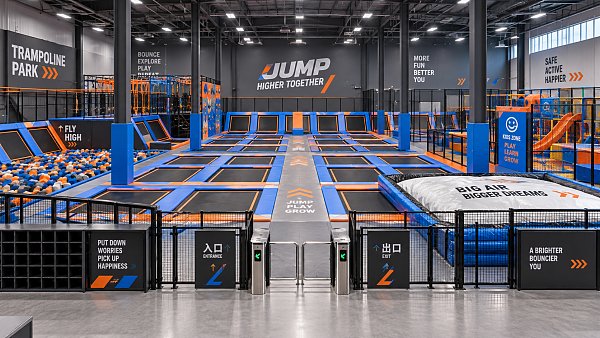
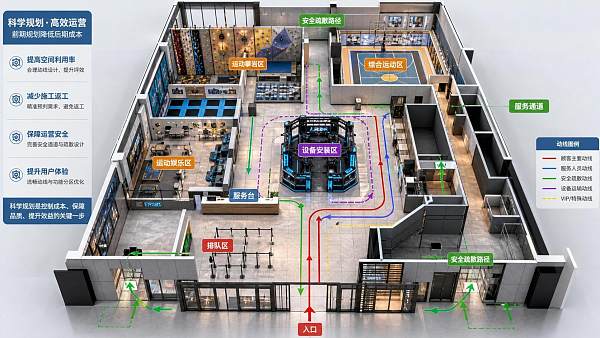
A profitable trampoline park design is easy to move through. Guests should understand where to check in, store shoes, wait, jump, rest, and exit without staff repeatedly correcting traffic conflicts.
Good flow also improves safety. The fewer blind spots and crossing paths in active zones, the easier it becomes to monitor behavior and respond quickly when issues happen.
- Separate high-energy zones from quieter waiting areas. Parents, spectators, and children moving at different speeds should not share the same narrow circulation spine.
- Keep staff sightlines open across core courts. If supervisors cannot see corners, transitions, or pit entries clearly, incident response slows and rule enforcement weakens.
- Design queue space at entrances to popular attractions. Backups near dodgeball, climbing features, or ninja elements often spill into emergency routes and reduce usable floor area.
- Place support spaces where they reduce conflict. Lockers, grip sock sales, waiver checks, and party staging should relieve pressure, not create bottlenecks at entry.
Two common operating patterns
If the venue relies on open jump sessions, central visibility matters most. A simplified court arrangement, wider pathways, and direct staff access usually outperform a dense mix of features.
If revenue depends on birthday events or group bookings, the layout should reduce overlap between private and public traffic. Dedicated rooms, storage, and staging zones help protect both capacity and guest experience.
Set capacity with real behavior, not brochure math
Capacity planning is where many projects become overly optimistic. Supplier charts may estimate theoretical throughput, but actual occupancy depends on age mix, supervision level, circulation width, and attraction turnover.
In solid trampoline park design, capacity is not just how many people fit. It is how many people can move, wait, jump, and evacuate safely while the venue still feels controlled.
- Use peak-hour behavior models, not average daily attendance. Weekend surges create very different loads on check-in, toilets, café seating, and active courts.
- Calculate attraction capacity by dwell time and turnover. A feature with strong visual appeal may still underperform if reset time is long or users hesitate.
- Reserve circulation and recovery space around active zones. Crowding often starts at edges, where users stop, watch, or prepare, not on the trampoline bed itself.
- Link staffing assumptions to occupancy targets. A layout that only works with ideal supervision ratios is fragile and risky during peak trading hours.
Safety planning should shape the design language
Safety is not a final inspection topic. In strong trampoline park design, safety controls are built into spacing, material selection, visibility, signage, and maintenance access from the beginning.
This is especially important in global sourcing. Different vendors may comply with different standards, so interface details between frames, pads, nets, decks, and soft play elements deserve careful coordination.
- Verify which safety standards govern each system and market. Documentation should cover structural integrity, impact protection, materials, and installation methods consistently.
- Allow enough separation between features with different risk profiles. Foam pits, performance lanes, and toddler areas should not depend on the same movement pattern.
- Design maintenance access without entering live play zones. Fast inspections and pad replacement become harder when every service task interrupts operations.
- Coordinate signage with behavior, not decoration. Rules need to appear where decisions are made, especially before pit entry, wall runs, and age-restricted zones.
A sourcing note that affects safety
Commercial buyers increasingly compare suppliers through verified documentation, project references, and after-sales support quality. That approach aligns with how GCT evaluates experience-driven sectors: product value is inseparable from compliance credibility and delivery reliability.
For a trampoline venue, inconsistent submittals can delay approvals more than fabrication itself. It is worth confirming test reports, installation manuals, spare part lead times, and warranty response during the design phase.
Do not separate commercial goals from technical decisions
Some layouts look exciting but underperform commercially. Others appear conservative yet deliver smoother turnover, lower staffing pressure, and fewer closures. The best trampoline park design sits between visual impact and operational discipline.
This balance matters across the broader experiential economy. Hospitality groups, education-linked recreation sites, and mixed-use developers often value durability, brand fit, and lifecycle cost more than headline attraction count.
- Prioritize flexible zones that can support changing programs. A court used for free jump, classes, or events has stronger long-term value than a fixed novelty feature.
- Check replacement cycles for pads, springs, nets, and graphics. A low initial price can become expensive if maintenance shuts premium areas too often.
- Align finishes and branding with the surrounding commercial environment. Family entertainment inside premium developments still needs a coherent visual and acoustic strategy.
- Review supply chain resilience before final approval. Critical spare parts, technical support, and installation sequencing affect launch timing as much as design intent.
A quick decision filter before sign-off
Before freezing the scheme, ask four simple questions. Does the layout flow naturally, does the capacity model reflect real use, does the safety strategy work at peak times, and can the supplier network support the venue after opening?
If any answer is uncertain, the design is probably not ready yet. Revisiting assumptions early is far cheaper than correcting circulation, supervision, or compliance problems after fabrication begins.
What to review next
A reliable trampoline park design comes from disciplined early review, not late-stage fixes. Building limits, layout logic, realistic capacity, and integrated safety planning should all be tested together.
The strongest commercial outcomes usually come from teams that compare design intent with documentation quality, supplier support, and full lifecycle performance. That is also where global sourcing intelligence adds real value.
As a next step, review the concept package against structural constraints, occupancy assumptions, supervision lines, and compliance documents at the same time. That single coordination pass often reveals the most important improvements before costs harden.
Search News
Hot Articles
- Outdoor RidesIAAPA Launches Insurance Solution for North American Attractions IndustryOct 21, 2026
- Watch OEM & SmartwatchesWatch Movement Parts: How to Check Compatibility With a Specific CaliberOct 21, 2026
- Outdoor RidesEnergylandia Announces Rokan, Set to Be Europe’s Tallest and Longest B&M Wing CoasterOct 20, 2026
Popular Tags
Need ExpertConsultation?
Connect with our specialized leisureengineering team for procurementstrategies.
Recommended News
 Oct 18, 2026Turnkey Playground Installation: What's Included and What Costs Extra?Turnkey playground installation: discover what's included, uncover extra costs, and compare quotes confidently. Learn how to avoid budget surprises before you sign.● Theme Park Strategist
 Oct 08, 2026How to Choose Animatronic Haunted House Props for High-Throughput AttractionsAnimatronic haunted house props for high-throughput attractions: compare motion, triggers, safety, and maintenance to create reliable scares that keep guests moving.● Theme Park Strategist
 Sep 29, 2026Poured Playground Safety Surfacing: How to Specify Thickness for Fall HeightsPoured playground safety surfacing: learn how to specify tested thickness by fall height, ASTM standards, substrate conditions, accessibility, and field verification.● Theme Park Strategist
 Sep 27, 2026Custom Trampoline Park Equipment: Planning Capacity, Safety, and LayoutCustom trampoline park equipment for safer capacity, smooth guest flow, and efficient layouts. Explore practical planning insights for a high-performing park.● Theme Park Strategist
 Aug 30, 2026Entertainment Venue Master Planning: How to Balance Capacity, Flow, and RevenueEntertainment venue development master planning: balance capacity, guest flow, and revenue with practical strategies for resilient, high-performing venues.● Theme Park Strategist
 Sep 07, 2026What Should Buyers Do When a Supplier Delivers Non-Compliant Products?What to do if a supplier delivers non-compliant commercial products: contain risks, document evidence, protect your project, and secure the right remedy.● Theme Park Strategist
 Sep 02, 2026Waterpark Capacity Management: Balancing Queue Times, Safety, and Guest ThroughputWaterpark capacity management strategies to reduce queue times, protect safety, optimize guest throughput, and build a smoother, more profitable park operation.● Theme Park Strategist
 Sep 01, 2026ASTM F2075 Explained: Testing Engineered Wood Fiber for Playground Impact SafetyASTM F2075 explained: learn how engineered wood fiber supports playground impact safety, smarter sourcing, compliance documentation, and reliable maintenance planning.● Theme Park Strategist
 Aug 24, 2026How to Evaluate an Indoor Ninja Warrior Course Supplier in Europe?indoor ninja warrior course Europe supplier guide: learn how to assess safety, EN compliance, engineering, installation, and maintenance support before you choose.● Theme Park Strategist
 Aug 20, 2026How to Choose Modular Indoor Play Equipment for Different Venue Sizes and Age GroupsModular indoor play equipment buying guide: learn how to match venue size, ceiling height, traffic flow, and age groups to create safer, smarter, and more profitable play spaces.● Theme Park Strategist
 Aug 14, 2026POB Push Lifts Overseas Pre-Registrations 45.74%POB boosts overseas pre-registrations for the 2026 China Sport Show by 45.74%, signaling stronger global buyer interest and smarter sourcing opportunities in sports manufacturing.● Theme Park Strategist
 Aug 02, 2026What to Check Before Buying Thick Gymnastic Mats Wholesale for Schools and GymsThick gymnastic mats wholesale buying guide for schools and gyms: learn how to check foam, cover durability, safety documents, samples, and true long-term value before placing a bulk order.● Theme Park Strategist
 Jul 28, 2026How to Design Inclusive Sensory Play Areas for Different Age Groups and NeedsInclusive sensory play starts with smart zoning, age planning, accessibility, and acoustics. Discover practical design tips to create safer, engaging spaces that truly work.● Theme Park Strategist
 Jul 26, 2026How to Evaluate a Bowling Alley Equipment Factory Before Requesting a QuoteBowling alley equipment factory evaluation starts before price. Learn how to check manufacturing scope, engineering, compliance, spare parts, and installation support to avoid costly sourcing mistakes.● Theme Park Strategist
 Jul 16, 2026EN 1176:2026 Takes Effect for Indoor PlaygroundsEN 1176:2026 takes effect for indoor playgrounds in the EU, making conformity assessment mandatory. Learn how this impacts certification, customs clearance, suppliers, and market access.● Theme Park Strategist
 Jul 15, 2026CPSC Sets New ASTM Impact Test for Indoor Playground Metal PartsCPSC sets new ASTM impact test rules for indoor playground metal parts effective Oct. 1, 2026. Learn how the 15kN requirement may affect compliance, testing timelines, and U.S. export delivery.● Theme Park Strategist
 Jul 14, 2026CPSC Tightens Phthalate Limit for Indoor Playground Soft MaterialsCPSC tightens phthalate limits for indoor playground soft materials from Aug 15, 2026. Learn how DIBP control, CBP detention risk, and testing changes impact sourcing, exports, and compliance.● Theme Park Strategist
 Jul 13, 2026Vietnam Tightens IoT Rule for Indoor Playground ImportsVietnam Tightens IoT Rule for Indoor Playground Imports: learn how VNSS-2025 gateway requirements affect exporters, buyers, installers, and delivery timelines before the 2026 deadline.● Theme Park Strategist
 Jul 13, 2026How a Recreational Facility Planning Company Helps Reduce Layout MistakesRecreational facility planning company insights: learn how early layout strategy reduces costly mistakes, improves flow, compliance, and buildability for smoother project delivery.● Theme Park Strategist
 Jul 12, 2026CPSC Halts Imports of Indoor Playground Soft PartsCPSC halts imports of indoor playground soft parts from China under ASTM F3432-26. Learn the compliance risks, testing requirements, and urgent steps importers must take now.● Theme Park Strategist
 Jul 11, 2026CPSC Import Alert Tightens Fire Test Rule for Indoor Playground PaddingCPSC import alert updates indoor playground padding rules to ASTM F3432-26. See how the new fire test affects foam mats, shipments, and U.S. market access.● Theme Park Strategist
 Jul 11, 2026Ice Bumper Cars Bulk Order Checklist for Indoor Parks: Space, Power, and Safety PointsIce bumper cars bulk order guide for indoor parks: learn how to assess space, power, safety, and throughput before buying, so you can avoid costly mistakes and choose the right fleet with confidence.● Theme Park Strategist
 Jul 10, 2026Commercial Playground Equipment for Campuses: Key Safety Standards and Planning TipsCommercial playground equipment for campuses: explore key safety standards, inclusive layout planning, durable materials, and smart procurement tips to avoid costly mistakes.● Theme Park Strategist
 Jul 09, 2026CPSC Recall Escalates Over Phthalates in Indoor Playground PadsCPSC recall escalates over phthalates in indoor playground pads as affected batches exceed CPSIA limits. Learn the risks, supply chain impact, and what buyers should monitor now.● Theme Park Strategist