Hotel tables that stay stable on uneven flooring
In hospitality procurement, unstable hotel tables are more than a minor maintenance issue. They affect guest comfort, service efficiency, safety, and even the perceived quality of a property. For buyers evaluating hotel furniture, commercial furniture, and luxury furniture for dining rooms, guestrooms, meeting areas, and lounge spaces, the key question is simple: which tables will remain stable in real-world conditions, including uneven flooring, frequent repositioning, and heavy daily use? The short answer is that reliable stability usually comes from engineering details rather than appearance alone. Procurement teams should focus on base design, leveling mechanisms, materials, load distribution, and supplier manufacturing consistency before making a sourcing decision.
What buyers are really looking for when they search for stable hotel tables
For procurement professionals, distributors, and commercial evaluators, the search intent behind “hotel tables that stay stable on uneven flooring” is highly practical. They are not just looking for table styles. They want a dependable commercial solution that reduces complaints, limits operational disruption, and protects brand standards.
In most cases, buyers want answers to four immediate questions:
- How can we prevent wobbling on imperfect floors without constant maintenance?
- Which table structures are most reliable in restaurants, guestrooms, banqueting spaces, and public areas?
- What specifications should be verified before placing a bulk order?
- How do we compare suppliers beyond surface-level design claims?
This means the most useful article is not one that talks broadly about furniture trends. It is one that helps commercial buyers judge product suitability, understand engineering differences, and reduce sourcing risk.
Why unstable tables are a bigger hospitality problem than many teams expect
A wobbly table may appear to be a small issue, but in hotel operations it creates a chain of negative effects. In food and beverage settings, unstable tables damage guest experience almost immediately. A fine-dining environment loses credibility if glassware shakes or table surfaces tilt. In guestrooms, occasional tables and work tables that feel unsteady reduce comfort and can undermine perceptions of room quality. In meeting and multifunctional spaces, poor table stability affects event setup efficiency and user confidence.
For operators and owners, the real cost is cumulative:
- More guest complaints and lower satisfaction scores
- Higher maintenance calls for floor shimming or temporary fixes
- Faster wear caused by repeated adjustments and misuse
- Service inefficiency in restaurants and banquet operations
- Potential safety concerns, especially for heavy tops or high-traffic areas
For premium and luxury hospitality projects, these issues also affect brand perception. Guests may not analyze table engineering, but they immediately notice when furniture does not feel solid.
What actually keeps a hotel table stable on uneven flooring
The most important procurement insight is this: stability is usually determined by structural design, not just table weight. A heavy table can still wobble if its base geometry, contact points, or top-to-base connection are poorly designed.
When evaluating hotel tables for uneven flooring, buyers should focus on the following technical factors:
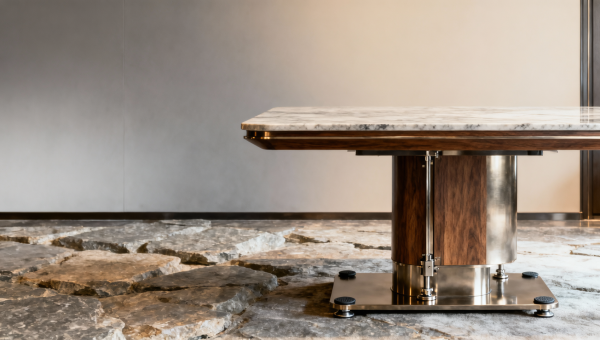
- Adjustable leveling glides: One of the most effective solutions for uneven floors. High-quality glides allow precise adjustment during installation and ongoing operation.
- Base footprint and geometry: A well-proportioned base distributes weight more evenly and reduces rocking. Undersized or poorly balanced bases are a common cause of instability.
- Rigid joinery and fastening systems: Weak connections between tabletop, column, and base plate often create movement over time.
- Material stiffness: Steel, cast iron, aluminum alloys, and engineered hardwood structures all behave differently under load. The right choice depends on application.
- Load balance relative to tabletop size: Large tops with inadequate support tend to flex or tip, especially in commercial dining environments.
- Floor-contact material: The contact surface should provide grip without damaging floor finishes, especially in luxury hotels.
For many commercial projects, adjustable feet combined with a properly engineered base are the most practical and scalable answer.
Which table types perform best in different hotel environments
Not every hotel area requires the same stability solution. Procurement teams should match table construction to the operational environment rather than standardizing purely for visual consistency.
Restaurant and all-day dining tables
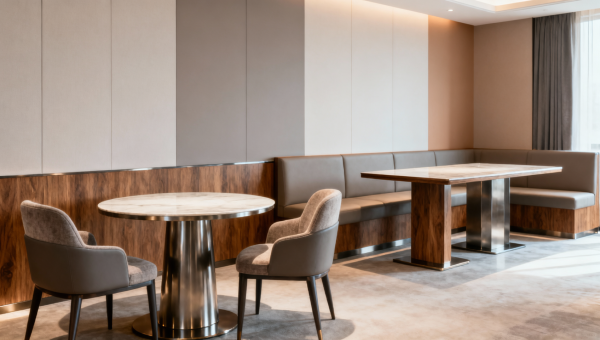
These usually need the highest level of stability because guests directly interact with the table surface throughout service. Pedestal tables can work well if the base plate is wide enough and includes commercial-grade leveling glides. Four-leg tables can also perform strongly, especially when built with reinforced joints and durable leg hardware.
Guestroom writing desks and side tables
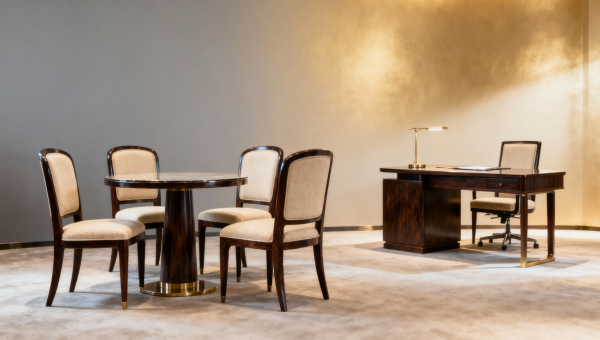
In guestrooms, stability matters for comfort and perceived quality. Here, buyers should prioritize precise assembly tolerances, anti-loosening fittings, and scratch-resistant floor interfaces. The need for mobility should not compromise structural rigidity.
Banquet and meeting tables
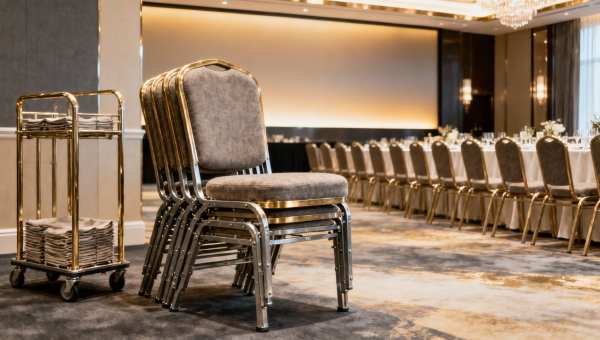
These tables are frequently moved, folded, stored, and reinstalled. Stability must be combined with easy setup. Locking mechanisms, frame reinforcement, and consistent leg deployment are more important than decorative features.
Lobby and lounge tables
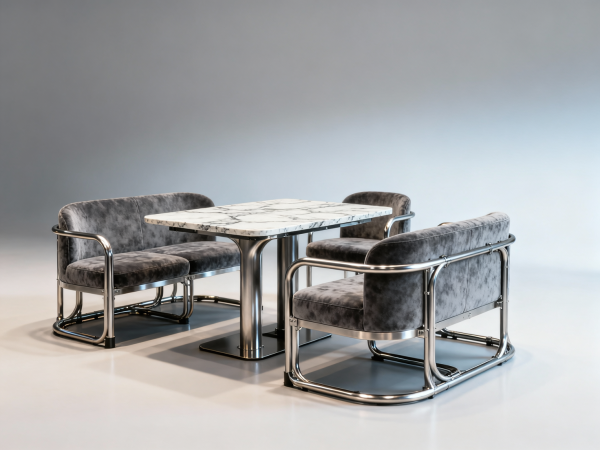
These often carry a strong design function, but visual impact should not override performance. Stone, sintered stone, or thick veneer tops must be matched to a suitable support structure to avoid rocking and long-term loosening.
Outdoor-adjacent or mixed-use hospitality spaces
Where flooring transitions occur, adjustable feet and corrosion-resistant components become especially important. Even slight slope variation can create noticeable instability if the design is not tolerant of floor irregularities.
How to evaluate a supplier beyond product photos and catalog claims
One of the most common sourcing mistakes is assuming that an attractive table in a catalog will perform well in commercial use. Stable hotel tables require manufacturing discipline, repeatable tolerances, and honest engineering specifications.
When comparing suppliers, ask questions such as:
- Are the leveling glides standard, optional, or project-customizable?
- What is the recommended maximum tabletop size for each base?
- Has the design been tested in hospitality or food-service environments?
- What materials are used for the base core, weld points, and fastening hardware?
- How is stability controlled in quality inspection before shipment?
- Can the supplier provide project references for hotels, restaurants, or serviced apartments?
- Are OEM or ODM modifications available for floor conditions, finish requirements, or brand standards?
Reliable suppliers should be able to explain not just what a table looks like, but why it remains stable under commercial use. That level of clarity is often a strong indicator of manufacturing maturity.
Key specifications procurement teams should verify before ordering
For bulk hospitality procurement, decision quality improves significantly when teams use a specification checklist. This reduces the risk of buying visually appealing tables that fail after installation.
Important points to verify include:
- Base dimensions relative to tabletop size and weight
- Adjustable glide range in millimeters
- Static and dynamic load capacity
- Frame or column wall thickness
- Weld quality or joint construction details
- Mounting plate thickness and screw pattern
- Anti-loosening hardware features
- Surface finish durability for hospitality cleaning routines
- Floor protection compatibility with wood, stone, tile, carpet, or mixed flooring
- Assembly consistency across production batches
If possible, request a pre-production sample and test it on actual site flooring conditions rather than only in a showroom or flat warehouse environment.
How stable table design affects total cost of ownership
Price-sensitive sourcing often focuses on unit cost, but hospitality buyers should also consider total cost of ownership. A cheaper table that requires constant adjustment, generates complaints, or needs early replacement is usually more expensive over the project lifecycle.
Stable, commercial-grade hotel tables can create value in several ways:
- Lower maintenance intervention
- Fewer replacement parts and service calls
- Better guest satisfaction and reduced operational friction
- Longer usable life in high-traffic settings
- Improved consistency across multiple properties or brand standards
For distributors and project specifiers, this also supports a stronger commercial proposition. Selling a table that solves a recurring operational problem is more valuable than selling on appearance alone.
Common mistakes to avoid when sourcing hotel tables for uneven floors
Several recurring procurement mistakes lead to instability issues after installation:
- Choosing tables primarily on visual design without verifying engineering details
- Ignoring site-specific floor conditions during specification
- Selecting oversized tops for undersized bases
- Assuming all adjustable feet offer the same performance quality
- Overlooking repeated-movement stress in banquet or multifunction applications
- Failing to test assembly consistency across production samples
- Using residential-grade products in commercial hotel settings
These mistakes are preventable when procurement teams define performance requirements early and involve operations, design, and technical stakeholders in supplier evaluation.
What a strong sourcing decision looks like
A strong sourcing decision balances aesthetics, operational performance, and supplier reliability. In practical terms, the best hotel tables for uneven flooring are usually those that combine:
- Commercial-grade structural design
- Integrated or customizable leveling capability
- Base-to-top proportions engineered for the intended application
- Durable materials suited to hospitality traffic and cleaning standards
- Verified production quality and repeatability
- Supplier transparency on specifications, testing, and project references
For buyers in hotel furniture, commercial furniture, and luxury furniture sourcing, this shifts the conversation from “Which table looks best?” to “Which table will perform consistently across the property and protect the guest experience?” That is the more valuable question.
Hotel tables that stay stable on uneven flooring are not a niche requirement. They are a core procurement concern in hospitality environments where guest comfort, operational efficiency, and brand standards all matter. The most effective solutions come from sound engineering: adjustable leveling glides, properly sized bases, rigid construction, and supplier quality control. For procurement teams, distributors, and evaluators, the right approach is to assess stability as a measurable performance criterion, not a secondary feature. When that standard is applied early, sourcing decisions become more reliable, lifecycle costs become easier to control, and the final furniture package delivers stronger long-term value.
Search News
Hot Articles
- Stage Lighting & TrussCCTV5 Snooker Broadcast Drives 37% Surge in Stage Lighting Export InquiriesApr 21, 2026
- Indoor PlaygroundVietnam Mandates Child Finger-Trap Sensors for Indoor Play EquipmentApr 21, 2026
- Stage Lighting & TrussGuangdong vs. Shanxi CBA Game Highlights Domestic Smart Arena LightingApr 21, 2026
Popular Tags
Need ExpertConsultation?
Connect with our specialized leisureengineering team for procurementstrategies.
Recommended News
 Apr 21, 2026Hotel tables that stay stable on uneven flooringHotel tables that stay stable on uneven flooring: a practical guide for hospitality procurement covering hotel furniture, commercial furniture, luxury furniture, and specs that reduce wobble, risk, and maintenance.● Hospitality Sourcing Dir
 Apr 21, 2026Round or rectangular hotel tables for tighter layouts?Hotel tables for tight layouts: compare round vs rectangular hotel furniture for better flow, seating, and hospitality procurement decisions. Find the best fit for compact hotel room furniture.● Hospitality Sourcing Dir
 Apr 21, 2026Why hotel chairs fail early in banquet spacesHotel chairs in banquet spaces fail early due to stacking, impact, and weak specs. Learn how hotel furniture and commercial furniture choices cut costs and improve hospitality procurement.● Hospitality Sourcing Dir
 Apr 21, 2026Hotel chairs that look elegant and still hold upHotel chairs that blend luxury furniture appeal with commercial furniture durability. Discover how hotel furniture works with hotel tables, hotel desks, and hotel room furniture for smarter hospitality procurement.● Hospitality Sourcing Dir
 Apr 20, 2026Hotel tables with edge seams that trap moisture and moldHotel tables, park benches & commercial furniture with mold-trapping edge seams? Discover seamless, moisture-resistant hotel furniture solutions—luxury, custom, and compliant.● Hospitality Sourcing Dir
 Apr 20, 2026Hotel chairs rated for 100,000 cycles—but tested how?Discover how top hotel chairs, park benches & commercial furniture are truly tested for 100,000 cycles—backed by BIFMA, EN & GB/T standards. Get verified luxury furniture insights.● Hospitality Sourcing Dir
 Apr 19, 2026Hotel tables that warp under daily cleaning chemicalsHotel tables, hotel chairs, hotel beds & park benches—discover why chemical warping fails luxury furniture & commercial furniture specs. Get expert OEM insights on durable hotel furniture & equipment.● Hospitality Sourcing Dir
 Apr 19, 2026Hotel chairs with hidden wear patterns no one tests forHotel chairs, luxury furniture & commercial furniture buyers: uncover hidden wear patterns in hotel chairs, hotel beds, and custom furniture—before failure hits ROI.● Hospitality Sourcing Dir
 Apr 18, 2026Custom furniture quoting errors—how small measurement gaps become big cost overrunsAvoid costly overruns: Fix custom furniture quoting errors before they derail hotel beds, theme park rides, playground structures & soundproofing materials.● Hospitality Sourcing Dir
 Apr 17, 2026Restaurant furniture that handles spills, scratches, and constant turnoverCommercial furniture built for spills, scratches & turnover—ideal for playground borders, sensory playgrounds, hotel tables, amusement equipment & more.● Hospitality Sourcing Dir
 Apr 16, 2026Custom fabrication for restaurant furniture: When ‘made-to-order’ becomes ‘wait-for-3-months’Custom fabrication for hotel furniture, designer eyewear & jewelry—solve supply chain delays with OEM manufacturing expertise. Get on-time, cross-sector solutions.● Hospitality Sourcing Dir
 Apr 15, 2026Restaurant furniture durability tests don’t match real dining room stressCommercial furniture, playground safety & amusement equipment tested for real-world stress—not just labs. Discover field-validated durability for hotel tables, sensory playgrounds, climbers & more.● Hospitality Sourcing Dir
 Apr 12, 2026Custom furniture for play spaces: When 'bespoke' means higher liability, not better fitOutdoor playground & inclusive playground design demands caution: custom furniture, playground swings, and theme park rides raise liability—discover safer, certified alternatives.● Hospitality Sourcing Dir
 Apr 12, 2026Custom furniture lead times ballooning in 2026—what’s really causing the 14-week delaysOutdoor playground, inclusive playground, and theme park rides face 14-week custom furniture delays in 2026—discover root causes & proven mitigation strategies now.● Hospitality Sourcing Dir
 Apr 07, 2026Custom furniture lead times in 2026: Why ‘standard’ finishes now take longer than premiumCustom furniture, outdoor playground & hotel furniture lead times surged in 2026—discover why standard finishes now lag premium. Get data-backed sourcing strategies for inclusive playground, soundproofing materials & instrument cables.● Hospitality Sourcing Dir
 Apr 04, 2026Restaurant Furniture Buyers Are Asking Office Supplies Factories for Modular Desk Systems — And Getting YesTop office supplies manufacturer & OEM supplier delivers NSF/BIFMA-certified modular desk systems for restaurants—fast, compliant, factory-direct.● Hospitality Sourcing Dir
 Apr 01, 2026What happens to hotel tables when placed on floating floors—real case data from 2026Discover how hotel tables, chairs, desks & sofas interact with soundproofing materials on floating floors—real 2026 data reveals critical acoustic & stability insights for hospitality furniture buyers.● Hospitality Sourcing Dir
 Mar 31, 2026Hotel tables that don’t rattle—what makes the difference in real roomsDiscover hotel tables engineered with soundproofing materials & precision construction—eliminate rattling, elevate guest experience. Premium hotel furniture, desks, chairs, sofas & more.● Hospitality Sourcing Dir
 Mar 31, 2026Hotel reception furniture that ships on time—then arrives with mismatched wood grain batchesCommercial sourcing for hotel reception furniture, amusement park lighting & playground development—guaranteed batch consistency, on-time delivery, and full compliance.● Hospitality Sourcing Dir
 Mar 30, 2026Restaurant furniture from Tier-2 suppliers: durability claims vs. real-world spill cyclesCommercial sourcing of hotel restaurant furniture, amusement park lighting & playground development gear—tested under real spill cycles. Discover durable Tier-2 suppliers.● Hospitality Sourcing Dir
 Mar 30, 2026Hotel bar furniture orders that pass QA—but fail the ‘three-drink test’Hotel bar furniture that passes QA—and the real-world 'three-drink test'. Trusted commercial sourcing for hotel restaurant & reception furniture, amusement park lighting, playground compliance, and electronic music gear.● Hospitality Sourcing Dir
 Mar 30, 2026Hotel reception furniture that looks premium—until the first guest leans on itDiscover durable hotel reception furniture built for real traffic—plus commercial sourcing support for amusement park lighting, playground development, and more.● Hospitality Sourcing Dir
 Mar 28, 2026Restaurant furniture ordered for 'luxury aesthetic'—then reconfigured three times before openingLuxury furniture, trampoline park fixtures, arcade games & park benches—engineered for iterative layouts and premium experiential integrity. Discover adaptive sourcing.● Hospitality Sourcing Dir
 Mar 27, 2026What restaurant furniture buyers overlook when evaluating commercial procurement terms for bulk ordersDiscover expert supply chain solutions, ODM services & OEM manufacturing for amusement park equipment, catering equipment, and commercial procurement—beyond price sheets.● Hospitality Sourcing Dir