Do Soundproofing Materials Really Work
Do soundproofing materials really work in commercial settings? For buyers comparing solutions across hotels, leisure park venues, and pro audio spaces, the answer depends on material type, installation quality, and project goals. From hotel beds and custom furniture to catering equipment zones, instrument cables areas, theme park rides, playground swings, playground structures, and inclusive playground environments, effective soundproofing materials can improve comfort, safety, and user experience.
What Soundproofing Materials Actually Do in Sports and Entertainment Projects
Soundproofing materials do work, but only when buyers match the right material to the right acoustic problem. In sports and entertainment facilities, noise rarely comes from one source alone. A venue may deal with airborne sound from music and crowd activity, impact noise from foot traffic or ride systems, and vibration transmitted through walls, floors, ceilings, or metal structures. A single foam panel cannot solve all three issues.
For procurement teams, the first useful distinction is between sound absorption, sound insulation, and vibration control. Absorptive products help reduce echo and reverberation inside a space. Insulating products help block sound transfer between spaces. Vibration-control products reduce structure-borne noise from machines, speaker mounts, ride mechanisms, or service equipment. Most commercial projects require a layered solution across at least 2–3 categories rather than one standalone product.
This is especially important in mixed-use hospitality and leisure environments. A hotel next to an entertainment zone, a family amusement center with food service, or a pro audio showroom connected to retail space all face competing requirements. Operators want lively guest experiences, yet they also need controlled background noise, better speech clarity, and fewer complaints from adjacent areas. In many cases, the target is not silence but predictable acoustic performance during peak operating hours.
For commercial buyers, practical performance should be evaluated over a 3-stage logic: source control, path control, and receiver protection. If the noise source is a ride motor, kitchen exhaust, amplifier rack, or service trolley route, solving the issue at the source often reduces downstream construction cost. If source treatment is limited, then wall assemblies, ceiling systems, doors, glazing, seals, and floor underlayments become critical path-control measures.
Three acoustic functions buyers should separate
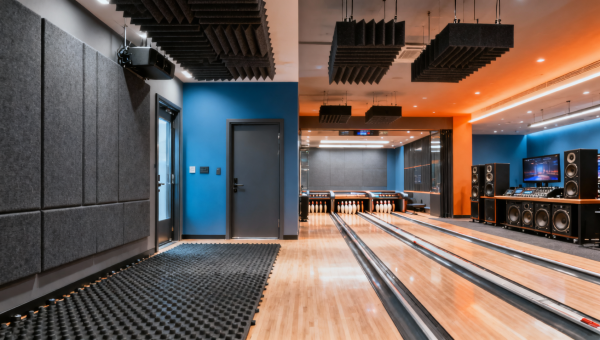
- Absorption: Used to reduce reflections, flutter echo, and excessive reverberation in music rooms, bowling lounges, indoor playground cafés, and entertainment lobbies.
- Blocking: Used in partitions, doors, glazing systems, and ceiling-floor assemblies to reduce sound transmission into guest rooms, offices, classrooms, or neighboring tenant areas.
- Isolation: Used for equipment pads, resilient channels, floating floors, and decoupled mountings to reduce vibration from subwoofers, rides, pumps, or mechanical units.
When a supplier or distributor claims that a product is “soundproof,” procurement teams should ask what specific function it addresses, under what installation conditions, and across what frequency range. Low-frequency rumble from large speakers or mechanical systems behaves very differently from mid- and high-frequency speech or clatter. That is why a technically correct specification matters more than a marketing label.
Which Materials Work Best for Hotels, Leisure Parks, and Pro Audio Spaces?
Different soundproofing materials serve different commercial objectives. In hotel corridors near entertainment amenities, dense barrier layers, acoustic doors, perimeter seals, and insulated partition systems are often more effective than decorative foam. In indoor recreation or amusement venues, ceiling baffles, wall absorbers, and vibration pads can help manage crowd noise and machine energy. In pro audio spaces, the solution may combine room treatment, decoupled framing, bass control, and cable-routing discipline around performance and recording areas.
Material selection should also reflect operating conditions. A leisure park dining zone may require surfaces that tolerate frequent cleaning, variable humidity, and long daily operating cycles of 10–14 hours. A music rehearsal or demonstration room may need materials with better acoustic consistency and lower visual distraction. A family entertainment center often needs impact-resistant finishes that still maintain acoustic performance after repeated contact.
The table below compares common categories used in sports and entertainment projects. It is not a substitute for project-specific engineering, but it helps procurement teams screen products before requesting quotations, samples, or installation drawings.
The key takeaway is that material performance cannot be judged in isolation. A good acoustic panel may reduce reverberation, yet it will not stop noise leakage through an unsealed door or shared duct. Likewise, a dense barrier may improve separation, but if vibration passes through steel framing or floor junctions, users will still perceive noise. Buyers should therefore review the full system, not just the product sample.
How to match material type to venue priority
If the priority is guest comfort in hospitality environments, focus on speech privacy, corridor noise control, and mechanical isolation. If the priority is family dwell time in amusement venues, focus on reducing harsh reflections and controlling peak-noise spillover between adjacent attractions. If the priority is demonstration accuracy in pro audio and musical instrument spaces, treat both room acoustics and transmission paths, especially at low frequencies.
This is where GCT adds value for global sourcing teams. Instead of comparing products only by brochure language, buyers can evaluate material categories against commercial use cases, installation constraints, supplier responsiveness, and project-readiness for international procurement. That reduces the risk of choosing a product that looks suitable on paper but underperforms on site.
How Should Buyers Evaluate Performance, Compliance, and Installation Risk?
Commercial evaluation should start with measurable criteria. For absorptive products, buyers often review acoustic coefficients or test-based performance across frequency bands. For partition systems, they usually focus on assembly-based sound reduction ratings rather than the core material alone. For impact and vibration control, load range, resilience, mounting method, and long-term compression stability matter. A procurement mistake often happens when a team compares unlike metrics across unlike products.
Installation quality has an outsized effect on results. Even a well-specified system can fail if gaps remain around penetrations, suspended elements are incorrectly fixed, or doors and access panels are not sealed. In hospitality and entertainment fit-outs, the critical failures are often small details: a 3–5 mm perimeter gap, an untreated service opening, or a rigid mechanical connection that bypasses the isolation layer.
Compliance should also be reviewed early. Sports and entertainment projects frequently require coordinated attention to fire behavior, indoor air considerations, cleaning protocols, and durability in public-use settings. In many international projects, buyers ask suppliers to clarify test documents, material composition information, maintenance requirements, and packaging suitability for export logistics over 2–6 weeks of transit, depending on route and mode.
The following table provides a practical checklist for B2B evaluation teams assessing soundproofing materials and system proposals.
For distributors and commercial evaluators, this checklist also improves supplier comparison. It moves the discussion from vague claims toward documented scope, execution risk, and realistic delivery planning. In cross-border sourcing, that clarity can be as important as acoustic performance itself.
A four-step review process before placing an order
- Define the noise problem by zone: guest room interface, arcade zone, backstage room, equipment enclosure, or food service area.
- Request system-level information, not just a product sheet, including installation details and adjacent construction requirements.
- Check project constraints such as fire behavior, cleanability, humidity exposure, maintenance access, and transport packaging.
- Align supply timing, sample approval, and replacement planning with the actual construction sequence, usually in 2–4 procurement stages.
This method helps avoid the common trap of overbuying decorative treatment while underfunding doors, seals, joints, or vibration isolation points that have greater impact on real-world results.
What Are the Most Common Misconceptions About Soundproofing Materials?
One common misconception is that thicker always means better. Thickness can matter, but density, mounting, air gaps, decoupling, and full assembly design often matter more. A thick decorative foam may visually suggest acoustic control while delivering limited benefit for noise transfer between rooms. By contrast, a thinner but correctly integrated barrier-and-isolation assembly can perform more effectively for commercial separation needs.
Another misconception is that “soundproofing” and “acoustic treatment” are interchangeable. They are not. Many leisure and entertainment spaces improve user comfort simply by reducing reverberation time and improving speech intelligibility. That is treatment, not full sound isolation. Buyers who expect absorptive panels alone to stop nightclub spillover into hotel rooms or restaurant zones are likely to be disappointed.
A third misconception is that product data alone guarantees project success. In reality, commercial outcomes depend on installation tolerances, coordination with MEP systems, door and glazing performance, and maintenance conditions over time. A product may test well in a controlled setup yet underperform in a venue with frequent access doors, exposed services, or poorly managed transitions between materials.
Budget assumptions also cause problems. Low initial material cost can lead to higher total project cost if the solution fails and requires retrofit. In hospitality and entertainment operations, retrofit often happens after opening, when labor, access restrictions, and guest disruption raise costs sharply. Spending slightly more during the first 1–2 installation phases may reduce later operational loss.
Risk signals buyers should notice early
- A supplier uses one performance term for every application and cannot explain whether the product absorbs, blocks, or isolates sound.
- The proposal omits details for edges, joints, penetrations, or contact points with ceilings, floors, and mechanical systems.
- The quoted solution ignores public-space durability, cleaning methods, or replacement logistics for high-traffic entertainment environments.
- The delivery promise seems too short for sampling, approval, production, and export preparation, especially when customized finishes are involved.
For sourcing teams, these warning signs are useful because they expose proposal gaps before contract commitment. GCT’s sector-focused approach helps buyers and channel partners compare offers through commercial filters such as application fit, specification clarity, and supply execution rather than price alone.
FAQ: What Should Procurement Teams and Distributors Ask Before Buying?
Do soundproofing materials work for indoor playgrounds and family entertainment centers?
Yes, but usually as part of a combined strategy. In these venues, the goal is often to reduce harsh reflections, improve comfort in adjacent seating or dining areas, and control noise transfer to neighboring tenants. Ceiling treatments, wall absorbers, resilient mounts, and strategic zoning are often more effective than relying on one wall product alone. Buyers should also consider cleanability and impact resistance because surfaces may face daily wear over 8–12 operating hours.
What matters most in hotel entertainment or mixed-use hospitality projects?
The priority is usually separation between active and quiet zones. Guest rooms, meeting rooms, bars, music lounges, and back-of-house equipment areas all have different acoustic expectations. Procurement teams should focus on door sets, seals, wall assemblies, ceiling paths, and flanking routes. Decorative acoustic finishes can improve ambience, but they rarely replace the need for proper partition detailing and vibration control.
How long does sourcing and implementation typically take?
For standard materials, sample review and quotation alignment may take 7–15 days. For custom colors, fabrics, shaped panels, or integrated commercial fit-out systems, the process can extend into a 3-stage cycle covering technical confirmation, production scheduling, and logistics planning. Total lead time often depends on whether the project requires mock-up approval, export packaging, or coordination with other finishes and MEP trades.
What are the top five checks before approving a supplier?
Buyers should verify 5 key points: product function, installation method, supporting documents, supply lead time, and replacement availability. If the vendor cannot explain system integration or cannot provide consistent technical communication, the project risk rises quickly. This is especially relevant for distributors and agents who need dependable documentation to support resale, local bidding, or end-customer presentations.
Is the cheapest solution a good choice for commercial venues?
Not always. Lower-cost materials may work for limited echo control in secondary spaces, but they may not hold up in public-facing leisure environments or satisfy project expectations for separation and durability. Total cost should include installation complexity, service life, replacement frequency, and the operational risk of unresolved noise complaints. In many B2B projects, the better decision is the solution that balances acoustic outcome, maintenance practicality, and supply reliability.
Why Work With GCT When Sourcing Soundproofing Solutions for Commercial Experiences?
For information researchers, procurement teams, business evaluators, and channel partners, the challenge is not just finding soundproofing materials. The real challenge is identifying commercially suitable solutions for hotels, amusement and leisure parks, pro audio environments, and mixed-use experience spaces where design, compliance, and delivery must align. That requires more than a product catalog. It requires market intelligence and sourcing structure.
GCT supports this process by connecting product categories with real commercial application logic. Buyers can assess where absorptive systems make sense, when isolation is necessary, how to compare supplier readiness, and which documentation matters before RFQ or sample approval. For distributors and agents, this shortens evaluation time and helps reduce avoidable specification mismatch during bid preparation or project negotiation.
If you are planning a hotel entertainment upgrade, an indoor leisure venue, a themed attraction support area, or a pro audio demonstration environment, you can consult GCT for practical sourcing support across 6 common decision areas: parameter confirmation, material selection, installation logic, lead time planning, documentation review, and supplier comparison. This is particularly useful when projects involve OEM or ODM requirements, finish customization, or multi-category procurement.
Contact us to discuss your project scope, target application, expected delivery window, sample needs, and quotation priorities. We can help you screen soundproofing materials for specific commercial zones, compare solution paths for budget and performance, review typical compliance concerns, and organize supplier conversations around the issues that matter most before purchase commitment.
Search News
Hot Articles
- Stage Lighting & TrussCCTV5 Snooker Broadcast Drives 37% Surge in Stage Lighting Export InquiriesApr 21, 2026
- Indoor PlaygroundVietnam Mandates Child Finger-Trap Sensors for Indoor Play EquipmentApr 21, 2026
- Stage Lighting & TrussGuangdong vs. Shanxi CBA Game Highlights Domestic Smart Arena LightingApr 21, 2026
Popular Tags
Need ExpertConsultation?
Connect with our specialized leisureengineering team for procurementstrategies.
Recommended News
 Apr 20, 2026Snooker World Championship: Xiao Guodong Secures Third Chinese SpotSnooker World Championship: Xiao Guodong secures third Chinese spot amid AI officiating & 4K HDR broadcast — tech and talent converge in elite cue sports.● Pro Audio Engineer
 Apr 20, 2026FDA Proposes Chinese Label Translation Requirements for Sports SupplementsFDA proposes Chinese label translation requirements for sports supplements—key for importers, manufacturers & global brands. Act now to ensure compliance by Jan 2027.● Pro Audio Engineer
 Apr 17, 2026FDA Drafts New Labeling Rule for Chinese-Labeled Sports SupplementsFDA's new draft rule for Chinese-labeled sports supplements mandates certified English translations—key for brands, CMOs & importers navigating U.S. market entry.● Pro Audio Engineer
 Apr 16, 20262026 Yangtze River Delta Triathlon Uses Certified Chinese Timing System2026 Yangtze River Delta Triathlon uses certified Chinese timing system — ChronoLink Pro, ITU-approved RFID+GPS dual-mode solution for global race organizers.● Pro Audio Engineer
 Apr 13, 2026Asian University Basketball League Secures Funding, Launches Smart Venue ProgramThe Asian University Basketball League (AUBL) secures Series A funding and launches its Smart Venue Program, partnering with tech firms for sustainable sports infrastructure. A key opportunity for sports tech exporters with ISO 50001 certification.● Pro Audio Engineer
 Apr 22, 2026China's UWB Timing System Gains ITU Certification at Haiwan EventChina's UWB timing system wins ITU-T Y.3506 certification—key for sports tech exporters targeting GCC & SADC stadium tenders.● Pro Audio Engineer
 Apr 22, 2026Do Soundproofing Materials Really WorkSoundproofing materials really work when matched to hotels, leisure park venues, and pro audio needs. Explore practical solutions for hotel beds, custom furniture, catering equipment, theme park rides, and inclusive playground projects.● Pro Audio Engineer
 Apr 19, 20262026 Shanghai Sailing Open Adopts ITU-Certified Chinese Timing System2026 Shanghai Sailing Open adopts ITU-certified Chinese timing system — a breakthrough for precision sports tech exporters, certifiers & event organizers.● Pro Audio Engineer
 Apr 20, 2026What Causes Early Failure in Pro Audio Equipment?Pro audio equipment fails early due to heat, dust, unstable power, and weak components. Learn how musical instruments, instrument cables, music accessories, and sourcing choices affect reliability.● Pro Audio Engineer
 Apr 20, 2026Instrument Cables: Shielding, Durability, and the Price Gap ExplainedInstrument cables guide for buyers of pro audio equipment and music accessories across musical instruments, string instruments, keyboard instruments, percussion instruments, wind instruments, and orchestral instruments.● Pro Audio Engineer
 Apr 20, 2026Pro Audio Equipment Upgrades That Improve Sound Without OverspendingPro audio equipment upgrades for musical instruments: improve sound with instrument cables, music stands, and music accessories for keyboard, percussion, wind, string, and orchestral instruments—without overspending.● Pro Audio Engineer
 Apr 20, 2026Instrument Cables: Why Cheap Options Often Fail During Live UseInstrument cables for musical instruments often fail live when cheap builds meet pro audio equipment demands. Compare smarter options for string, wind, percussion, and keyboard instruments.● Pro Audio Engineer
 Apr 18, 2026Instrument cables with gold-plated connectors: Do they improve tone—or just resale value?Instrument cables with gold-plated connectors boost reliability & resale value in theme parks, leisure parks, and hotels—proven for soundproofing, playground structures, and catering equipment.● Pro Audio Engineer
 Apr 18, 2026Instrument cables that degrade mid-show—what causes sudden signal drop?Instrument cables failing mid-show? Discover why—bending fatigue, EMI, corrosion & thermal stress—in theme parks, hotels, playgrounds & leisure venues.● Pro Audio Engineer
 Apr 17, 2026Pro stage audio setups where music accessories become acoustic liabilitiesDiscover how commercial furniture, playground borders, sensory playground gear & music accessories impact acoustic safety—avoid liability in pro audio environments.● Pro Audio Engineer
 Apr 16, 2026Pro stage audio gear warranties: What ‘lifetime’ really covers when used in hospitality venuesPro audio equipment & designer eyewear warranties decoded for hotels. See what ‘lifetime’ really covers—OEM manufacturing, custom fabrication, supply chain solutions & more.● Pro Audio Engineer
 Apr 16, 2026Recording studio gear sourcing: Why local compliance often overrides ‘best-in-class’ specsRecording studio gear sourcing for luxury spaces: compliance-first pro audio equipment, designer eyewear integration, and OEM manufacturing solutions—avoid costly delays.● Pro Audio Engineer
 Apr 16, 2026Pro audio equipment for boutique hotels: Why studio-grade gear doesn’t always translate to lobby soundPro audio equipment for boutique hotels must integrate with hotel furniture, designer eyewear & jewelry displays—discover why studio gear fails and how custom fabrication + supply chain solutions deliver sonic & material harmony.● Pro Audio Engineer
 Apr 16, 2026DJ equipment brands prioritizing repairability over replacementDJ equipment brands leading in repairability—trusted alongside luxury furniture, orchestral instruments, music stands & park benches for sustainable, high-ROI commercial procurement.● Pro Audio Engineer
 Apr 15, 2026DJ equipment setups that scale from club nights to festivalsDiscover scalable DJ equipment for clubs & festivals—engineered like luxury furniture, orchestral instruments & music stands. Premium, certified, ready to grow with your venue.● Pro Audio Engineer
 Apr 15, 2026Pro stage audio cabinets tested for 90dB+ continuous playback — not just peaksCommercial furniture & amusement equipment: Pro audio cabinets tested for 90dB+ continuous playback—ideal for sensory playgrounds, hotels, and educational supplies.● Pro Audio Engineer
 Apr 13, 2026Microphone systems for multi-room venues: why one-size-fits-all doesn’t workMicrophone systems for multi-room venues—optimized for hotel desks, commercial playgrounds, trampoline park manufacturer needs & hospitality furniture integration.● Pro Audio Engineer
 Apr 13, 2026Microphone systems for outdoor stages: wind noise reduction that actually worksMicrophone systems engineered for outdoor stages—wind noise reduction that works. Trusted by trampoline park manufacturers, commercial playground & hospitality venues.● Pro Audio Engineer
 Apr 13, 2026Recording studio gear service networks: Why local support beats global warranty claimsRecording studio gear, pro audio equipment & indoor playground equipment demand local service—not global warranties. Faster repairs, OEM manufacturing alignment, and supply chain solutions ensure zero downtime for hotels, studios & leisure venues.● Pro Audio Engineer