When do crossover networks affect real speaker performance?
Crossover networks audio performance is often discussed in theory, but real speaker results depend on more than textbook crossover frequencies. In commercial loudspeakers, the crossover network shapes how drivers share work, blend acoustically, and survive demanding use.
That matters in hospitality venues, education spaces, retail environments, leisure facilities, and professional audio installations. When evaluating systems, the real question is not whether a crossover exists. It is when crossover networks affect real speaker performance enough to change buying, tuning, and long-term operating outcomes.
What does a crossover network actually do in a loudspeaker?
A crossover network divides the audio signal into frequency bands. Each band is sent to the driver best suited for that range.
In simple terms, woofers handle lows, midrange units cover critical voice content, and tweeters reproduce high frequencies. Good crossover networks audio design keeps each driver inside its safe and efficient operating zone.
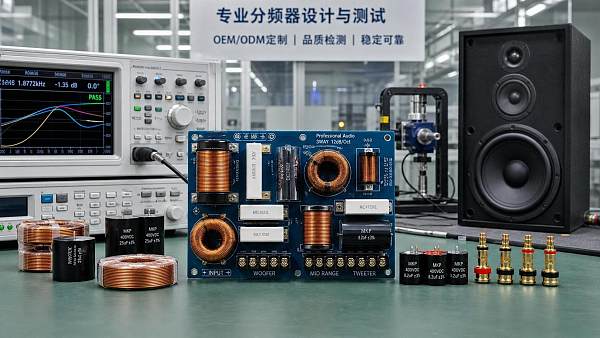
The network may be passive or active. Passive designs use capacitors, inductors, and resistors after amplification. Active designs split frequencies before power amplification, usually with DSP or dedicated electronics.
On paper, this sounds straightforward. In real speakers, crossover slope, component quality, impedance interaction, and acoustic driver behavior all affect the final result.
- Frequency allocation between drivers
- Phase alignment near crossover regions
- Protection against over-excursion or overheating
- Consistency of tonal balance at different levels
- Integration with enclosure and driver response
Because of these variables, crossover networks audio decisions are never isolated. They are part of the complete system architecture.
When do crossover networks affect real speaker performance the most?
Crossover networks affect real speaker performance most when drivers overlap in sensitive frequency regions. This usually happens around vocal presence, upper bass punch, or treble transition zones.
If the crossover point sits where both drivers beam differently, off-axis response can become uneven. A speaker may sound balanced directly in front, yet inconsistent across a room.
The effect becomes stronger in reflective commercial spaces. Glass, stone, open ceilings, and distributed seating expose tonal inconsistencies quickly.
Performance changes are also obvious at high playback levels. Poor crossover networks audio implementation can stress drivers, increase distortion, and shift tonal balance as components heat up.
Typical situations where impact is clearly audible
- Speech-focused rooms needing clear intelligibility
- Music venues requiring stable imaging and detail
- Background audio systems with wide listener movement
- High-SPL applications with long operating hours
- Compact cabinets pushing small drivers near limits
In these cases, crossover networks audio quality influences not only sound character, but also system reliability and coverage consistency.
How do crossover points, slopes, and phase change what listeners hear?
Listeners rarely hear a crossover point itself. They hear its consequences. Those consequences include holes in response, excessive overlap, harshness, weak vocal body, or unstable imaging.
A low crossover point may protect a tweeter less if the slope is shallow. A high crossover point may force the woofer to reproduce frequencies where its dispersion narrows too much.
Slope matters because it controls how quickly one driver fades while another takes over. Steeper slopes reduce overlap, but can increase phase rotation and design complexity.
Phase behavior is especially important near the crossover region. If acoustic centers are misaligned, summed output may dip or peak depending on listener position.
That is why two speakers with similar published crossover frequencies may sound very different. Identical numbers do not guarantee identical integration.
For anyone comparing crossover networks audio specifications, listening tests and measured polar response are usually more useful than the crossover number alone.
Do passive and active crossover networks affect performance differently?
Yes. The difference can be substantial, especially in professional and installed systems. Passive and active crossover networks audio solutions involve different tradeoffs in control, efficiency, cost, and serviceability.
Passive crossovers are common in compact speakers because they simplify wiring and amplifier setup. They can work very well when designed carefully around known drivers and enclosure behavior.
However, passive parts are affected by driver impedance, heat, and tolerance variation. This can alter performance under load, especially in demanding use.
Active crossovers usually offer better precision. DSP enables time alignment, equalization, protection, and steeper filters with greater repeatability.
That precision is valuable in larger venues, distributed systems, or premium listening spaces. Still, active systems require more channels, more setup discipline, and greater commissioning care.
Quick comparison
- Passive: simpler hardware path, less tuning flexibility
- Active: higher control, better protection, more complexity
- Passive: easier for compact packaged products
- Active: stronger for scalable professional systems
The best choice depends on application goals, not on a universal rule. In crossover networks audio evaluation, context matters more than labels.
What common mistakes cause crossover networks to underperform in real projects?
One frequent mistake is assuming a published frequency response tells the whole story. A smooth on-axis curve may hide off-axis lobing or poor crossover summation.
Another mistake is ignoring enclosure placement. Wall mounting, ceiling proximity, and boundary reinforcement change how crossover regions behave in practice.
It is also risky to compare only component lists. Expensive capacitors alone do not guarantee superior crossover networks audio performance if the acoustic design is weak.
In multi-speaker projects, inconsistent factory tolerances or replacement parts can create audible variation between zones. That weakens brand experience in customer-facing spaces.
A final error is overlooking power compression. As components heat up, crossover behavior and driver sensitivity can shift, changing tonal balance during long sessions.
How should crossover networks audio be evaluated before selecting a speaker system?
Start with application needs. Speech clarity, background music, live reinforcement, and immersive retail audio all prioritize different crossover outcomes.
Next, examine more than frequency response. Look for phase coherence, directivity data, distortion behavior, and protection strategy.
If possible, compare speakers at realistic levels. Low-volume demonstrations can hide driver stress and crossover compression effects.
It is also helpful to ask whether the design was optimized as a complete system. In well-engineered crossover networks audio products, drivers, cabinet, and network were developed together.
For installed commercial systems, consistency across units matters greatly. A speaker that sounds excellent alone but varies across production batches creates avoidable problems later.
Evaluation checklist
- Confirm intended use and coverage target
- Review crossover frequency, slope, and protection logic
- Check off-axis and phase-related measurements
- Listen at realistic operating levels
- Verify thermal stability and consistency
- Assess serviceability and replacement policy
This process leads to better decisions than relying on marketing shorthand. Strong crossover networks audio performance reveals itself through repeatable behavior, not just attractive specifications.
FAQ summary: what should be remembered most?
In the end, crossover networks affect real speaker performance when they change how drivers integrate across frequency, phase, dispersion, and power conditions. That influence becomes critical in commercial spaces where clarity, consistency, and reliability must hold over time.
For stronger speaker selection decisions, evaluate crossover networks audio as part of the whole system. Review measured behavior, test real-world playback, and match the design to the space, audience movement, and operating demand.
Search News
Hot Articles
- Fashion & Gem JewelryThermal Diamond Testers: How They Work and When They Can Misidentify StonesOct 07, 2026
- Commercial KitchenWhat Is Driving Demand for Commercial Hospitality Projects Across the GCC?Oct 06, 2026
- Hotel Room AmenitiesHow to Select Hotel Hair Dryers That Balance Guest Safety, Durability, and CostOct 05, 2026
Popular Tags
Need ExpertConsultation?
Connect with our specialized leisureengineering team for procurementstrategies.
Recommended News
 Sep 30, 2026How to Choose an Aluminum Projector Ceiling Mount for Load, Drop, and Ceiling TypeChoose an aluminum projector ceiling mount with confidence. Learn how load capacity, drop length, ceiling structure, safety retention, and service access shape a reliable commercial AV installation.● Pro Audio Engineer
 Sep 26, 2026How to Choose Dynamic Microphones for Vocals in Live Stage SettingsDynamic microphones for vocals: learn how to match polar patterns, feedback control, durability, and clarity to live stage needs for reliable, professional sound.● Pro Audio Engineer
 Sep 07, 2026How to Choose Wall Mount Speakers for Clear Audio in Commercial SpacesWall mount speakers for commercial spaces: learn how to optimize coverage, SPL, directivity, installation, and system design for clear, reliable audio.● Pro Audio Engineer
 Sep 03, 2026How to Choose Locking Speakon Speaker Cables for Reliable Live Sound ConnectionsLocking Speakon speaker cables: learn how to select the right gauge, connector pinout, strain relief, and durable construction for reliable live sound connections.● Pro Audio Engineer
 Sep 08, 2026Is It Worth Upgrading a Stage Sound System Mid-Project?Is it worth upgrading stage sound systems mid-project? Discover how to assess performance gaps, costs, compatibility, and long-term venue value.● Pro Audio Engineer
 Sep 04, 2026Can AV Systems Be Retrofitted Into Older Commercial Buildings?Can AV integration be retrofitted into older commercial buildings? Discover practical strategies for reliable, code-aware AV upgrades with minimal disruption.● Pro Audio Engineer
 Jul 17, 2026How to Choose a Crossover Networks Supplier: Key Specs, Quality Checks, and OEM FactorsFind the right crossover networks supplier with this practical guide to key specs, quality checks, OEM factors, and supply chain risks for better audio performance and sourcing confidence.● Pro Audio Engineer
 Jul 16, 2026How to Evaluate ODM Services for Pro Audio: Design, Certification, and Production CapabilitiesODM services for pro audio: learn how to assess design depth, certification readiness, and production strength to choose a reliable partner and launch better audio products with less risk.● Pro Audio Engineer
 Jul 15, 2026JETRO Flags Modular, Low-Power Shift in Pro Stage AudioPro Stage Audio buyers in Japan are shifting fast: JETRO flags modular amplifiers, IP65 line arrays, low standby power, and JIS compliance as key to channel entry.● Pro Audio Engineer
 Jul 15, 2026Paper Speaker Cones Explained: How Cone Weight and Stiffness Affect SoundPaper speaker cones explained: discover how cone weight and stiffness shape sensitivity, clarity, breakup control, and real-world speaker performance for smarter audio sourcing.● Pro Audio Engineer
 Jul 15, 2026Performance Venues Compliance Checklist: Fire Safety, Accessibility, and Crowd RulesPerformance venues compliance checklist covering fire safety, accessibility, and crowd rules. Learn how to reduce delays, improve approvals, and open safer, more resilient venues.● Pro Audio Engineer
 Jul 14, 2026Japan Adds EMC Immunity Test for Stage AmplifiersJapan Adds EMC Immunity Test for Stage Amplifiers: learn how Japan’s 2026 JIS update affects EMC testing, JIS marking, certification timing, and market access for exporters.● Pro Audio Engineer
 Jul 13, 2026CISCE 2026 Adds Pro Stage Audio ZoneCISCE 2026 Adds Pro Stage Audio Zone as free overseas pre-registration opens. Explore key updates for pro audio suppliers, distributors, and system integrators before the Shanghai expo.● Pro Audio Engineer
 Jul 12, 2026Japan Tightens Pro Stage Audio Efficiency Limits Under JIS C 8105-2026Japan Tightens Pro Stage Audio Efficiency Limits Under JIS C 8105-2026: learn how new PSE compliance rules reshape market access, product eligibility, and shipment planning in Japan.● Pro Audio Engineer
 Jul 12, 2026How to Choose Low Profile Ceiling Speakers for Hotels, Offices, and Retrofit ProjectsLow profile ceiling speakers for hotels, offices, and retrofit projects: learn how to compare depth, coverage, compliance, and installation factors to choose the right fit.● Pro Audio Engineer
 Jul 11, 2026Japan Tightens JIS C 8105-2026 for Pro AudioJapan Tightens JIS C 8105-2026 for Pro Audio: learn how stricter standby power, PSE diamond mark rules, and the 2026 deadline impact exports, compliance, and market access.● Pro Audio Engineer
 Jul 10, 2026JETRO Q2 Outlook Signals Higher Stage Audio DemandJETRO Q2 Outlook signals higher stage audio demand in Japan, with 37% procurement growth and stricter PSE Annex D compliance. See what importers, manufacturers, and rental channels must act on now.● Pro Audio Engineer
 Jul 10, 2026How to Choose Wall Mount Speakers for Restaurants by Layout, Coverage, and SPLWall mount speakers for restaurants should match layout, coverage, and SPL. Learn how to choose the right setup for even sound, guest comfort, and reliable performance.● Pro Audio Engineer
 Jul 09, 2026JIS T 9001:2026 Adds Mandatory AI Noise LabelsJIS T 9001:2026 adds mandatory AI noise labels for pro audio gear from October 2026. Learn how it impacts compliance, testing, exports, and product launches.● Pro Audio Engineer
 Jul 06, 2026Improving Sound Reinforcement Speech Clarity: Key Causes of Muddiness and How to Fix ThemSound reinforcement speech clarity starts with identifying reverberation, coverage, noise, and timing issues. Discover practical fixes that make announcements clearer and commercial spaces perform better.● Pro Audio Engineer
 Jul 05, 2026Saudi Rule Adds Arabic UI Requirement for Pro Audio ImportsSaudi Rule Adds Arabic UI Requirement for Pro Audio Imports: learn how SASO’s new Arabic UI mandate affects digital amplifiers, DSP processors, and network audio interfaces before Sept. 1, 2026.● Pro Audio Engineer
 Jul 02, 2026How to Choose Audio Mixing Consoles for Live Venues: Channels, Buses, and I/O ExplainedAudio mixing consoles explained for live venues: learn how to choose the right channels, buses, and I/O to improve workflow, support growth, and avoid costly mistakes.● Pro Audio Engineer
 Jul 01, 2026UL 62368-3:2026 Adds EMC Rules for Pro Stage AudioUL 62368-3:2026 adds EMC rules for Pro Stage Audio, requiring Level 4 immunity and manual labeling by Oct 1, 2026. See what exporters, makers, and buyers must do now.● Pro Audio Engineer
 Jun 30, 2026Sound Reinforcement Design Basics: How to Plan Coverage, SPL, and Speaker PlacementSound reinforcement design starts with smarter coverage, target SPL, and speaker placement. Learn how to plan clearer, more reliable audio performance for commercial spaces.● Pro Audio Engineer