What size hotel desks work in compact guest rooms
In compact guest rooms, choosing the right hotel desks is essential to balancing comfort, workflow, and space efficiency. For buyers comparing hotel furniture, hotel room furniture, and broader commercial furniture options, desk size directly affects guest satisfaction and project value. This guide explores practical dimensions, layout considerations, and hospitality procurement insights to help you select desks that fit small rooms without compromising luxury furniture appeal.
How large should hotel desks be in small guest rooms?
For compact rooms, the most practical hotel desk size usually falls within a narrow range rather than a single fixed number. In many projects, desk width between 800 mm and 1200 mm, depth between 450 mm and 600 mm, and height around 730 mm to 760 mm gives the best balance between usable work surface and circulation space. This range works well for business hotels, urban boutique properties, and mixed-use accommodation where every square meter must support more than one guest need.
Procurement teams should avoid selecting desk dimensions in isolation. A desk that looks correct on a product sheet can fail once paired with luggage benches, bedside tables, media panels, and task chairs. In compact guest rooms, a clear walking path of roughly 600 mm to 800 mm around key furniture zones is often more important than adding another 100 mm of desktop area. Guests forgive a smaller desk more easily than a cramped room that feels difficult to move through.
The real question is not simply what size hotel desks work, but what size supports the room’s intended use. If the room is designed for short-stay leisure travelers, a writing ledge or compact console desk may be enough. If the property targets long-stay guests or frequent business travelers, a full-function hotel room desk with integrated power access, bag clearance, and a comfortable seated position becomes more important, even in limited floor space.
For dealers, distributors, and project evaluators, the safest starting point is to define three layers of fit: ergonomic fit, spatial fit, and brand fit. Ergonomic fit means the desk can support a laptop, writing materials, and one hospitality accessory tray. Spatial fit means the desk does not compromise door swing, wardrobe access, or bed-side movement. Brand fit means the desk aligns with the visual language of the hotel furniture package, especially when the property sells a premium or luxury furniture experience in a smaller footprint.
Typical size ranges by room positioning
The table below gives practical desk sizing guidance for common compact guest room programs. These are not rigid rules, but they help buyers compare options during sourcing, mock-up review, and supplier discussions.
A common sourcing mistake is to specify a desk at the upper end of the range because it appears more generous on paper. In reality, many compact guest rooms perform better with a 900 mm to 1000 mm desk if the design includes smart cable access, a slim profile, and integrated storage discipline. A smaller desk with better detailing often creates more value than a larger one that disrupts room flow.
Three quick dimension checks before approval
- Check seated clearance. Guests should have enough knee space, typically around 600 mm width and 450 mm depth minimum, especially if drawers or modesty panels are added.
- Check chair storage. In compact hotel furniture layouts, the chair should tuck in fully so the desk zone does not permanently block circulation.
- Check edge profile. Slim desk tops, often around 25 mm to 40 mm visual thickness, can make compact rooms look lighter without sacrificing perceived quality.
Which desk formats save space without hurting guest experience?
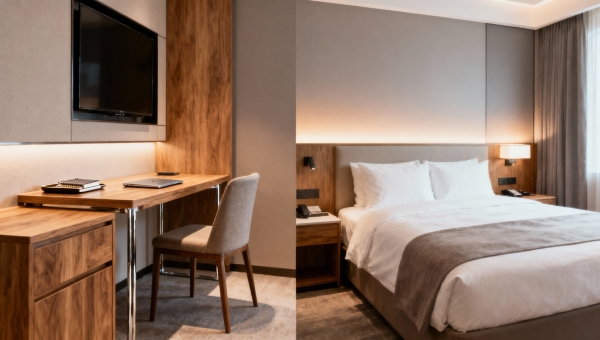
Not every compact guest room needs the same desk construction. The right format depends on whether the room is used mainly for overnight rest, hybrid work, or premium short stays. In hotel furniture sourcing, format choice matters as much as desk size. Wall-mounted desks, floating consoles, integrated TV-unit desks, and drawer-based writing desks each solve space problems differently.
Wall-mounted and floating designs are often effective when floor visibility is important. They visually open the room, simplify cleaning, and can reduce the bulky appearance common in older commercial furniture packages. However, they require reliable wall support coordination during installation and are less forgiving if building conditions vary across floors. For projects with renovation complexity, a freestanding but slim hotel desk may offer lower implementation risk.
Integrated desks combined with TV panels or minibar units can save 300 mm to 600 mm of redundant furniture frontage. This approach works especially well in guestrooms between roughly 18 m² and 24 m², where every linear meter matters. The trade-off is serviceability. If one combined unit is damaged, replacing or repairing it can be more disruptive than handling a standalone desk.
For upscale compact rooms, buyers often prefer desks that serve dual functions: work surface by day, vanity or display surface by night. In that case, edge finish, integrated mirror coordination, cable concealment, and lighting alignment become key selection points. A desk that looks elegant but fails to support charging, laptop placement, or housekeeping access will reduce guest satisfaction despite strong visual appeal.
Space-saving desk formats compared
The following comparison helps procurement teams assess which hotel desk format best matches room size, guest profile, and operational needs.
When evaluating these formats, commercial buyers should not rely only on drawings. A full-scale mock-up or at least a taped floor simulation can reveal whether guests can pull out the chair, access outlets, and open luggage at the same time. In practical hotel room furniture selection, these interaction points determine whether a desk truly works in a compact room.
Best-fit scenarios by project type
- New-build business hotels often benefit from integrated desks because MEP planning can be coordinated early and cable routing can be hidden cleanly.
- Renovation projects usually favor slim freestanding or semi-fixed units, which are easier to adapt within existing wall conditions and site tolerances.
- Boutique hotels with strong design goals often choose floating desks to create an upscale feel in rooms under 22 m² without making the space feel crowded.
What should procurement teams evaluate beyond size?
Desk dimensions are only one part of a successful hotel furniture specification. Buyers also need to review durability, cleanability, installation method, material performance, and service integration. In a hospitality environment, desks face repeated luggage impact, frequent wiping, occasional moisture exposure, and continuous guest turnover. A well-sized desk that chips easily or loses finish consistency after 12 to 24 months becomes a cost issue, not a value decision.
Surface material should match the hotel’s positioning and maintenance capacity. High-pressure laminate, engineered veneer, melamine-faced panels, and stone-accent combinations all appear in commercial furniture programs, but they behave differently in daily use. Procurement managers should request sample boards and compare edge quality, stain resistance, color repeatability, and repair practicality. In large room counts, consistency across production batches matters almost as much as the visual design itself.
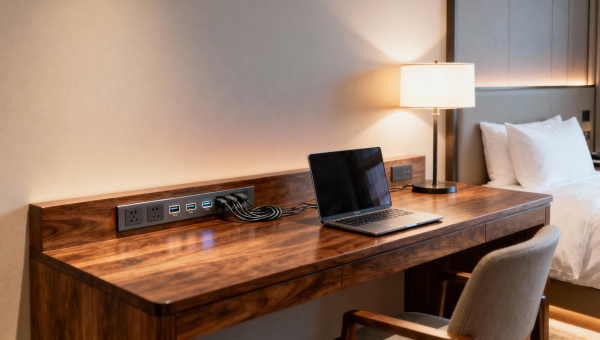
Power and connectivity planning is another decisive point. Compact guest rooms often cannot afford visible cable disorder. Integrated power modules, recessed charging points, or coordinated wall power access should be decided before final desk drawings are approved. If guests must crawl behind a desk to find a socket, the furniture has failed operationally. For many business-focused properties, desk usability now depends on charging convenience as much as on physical surface size.
Commercial buyers should also ask how the desk interacts with housekeeping cycles. Open leg space may improve visual lightness, but it can expose cables and dust. Deep drawers may look premium, but they may invite clutter and increase maintenance checks. The better approach is to define 5 key evaluation points during sourcing, then align them with room type, budget level, and lifecycle expectations.
A practical 5-point sourcing checklist
- Confirm dimension tolerance and fit with adjacent hotel room furniture, including wardrobe clearance, bedside circulation, and chair tuck-in depth.
- Review material specification for guest-use wear, edge impact resistance, and cleaning compatibility with standard housekeeping chemicals.
- Check power access strategy, including outlet location, cable management, and compatibility with local electrical planning.
- Ask about packaging, knock-down or assembled delivery, and site installation sequence, especially for multi-floor projects with phased room release.
- Verify after-sales practicality, including replacement lead time, finish matching for reorder batches, and spare component support.
Common lead time and project planning ranges
For standard hotel desks with limited customization, sample preparation may take around 7 to 15 days, while bulk production often falls within 4 to 8 weeks depending on finish complexity and order volume. Custom integrated casegoods usually need longer coordination because approval cycles cover drawings, material review, hardware details, and site interface checks. Buyers managing opening deadlines should always separate sample timing from production timing when building procurement schedules.
This is where GCT adds practical value for information researchers and commercial evaluators. Instead of comparing suppliers only by appearance or unit price, GCT helps structure sourcing decisions around manufacturability, specification clarity, and project-fit intelligence across hotel furniture categories. That is especially useful when dealers or procurement teams must compare multiple desk solutions for different hotel tiers in the same portfolio.
How do budget, customization, and compliance affect desk selection?
In compact guest room projects, budget pressure often pushes buyers toward smaller desks, but the lower-cost option is not always the better value. A narrow desk with poor edge durability, weak support structure, or badly placed power access may increase maintenance calls and negative guest feedback. The most effective sourcing strategy is to define a cost ceiling, then compare total room value: purchase cost, freight efficiency, installation complexity, expected maintenance, and replacement practicality over the first operating cycle.
Customization can improve room fit significantly when layouts are tight. Even a 50 mm adjustment in depth or a revised panel profile can unlock better circulation and easier chair storage. However, over-customization can create cost creep and schedule risk. For multi-property groups, it is often wiser to create 2 or 3 approved desk variants rather than a different model for every room type. This approach supports standardization while preserving layout flexibility across projects.
Compliance should also be part of the desk conversation, even if the desk itself seems straightforward. Depending on market destination and project type, buyers may need to review applicable fire performance expectations for composite materials, emissions considerations for panel products, and electrical conformity for integrated power units. Because hotel room furniture often crosses borders, documentation readiness can affect customs clearance, project approval, and distributor confidence.
Experienced sourcing teams therefore evaluate desks in three decision layers: standard product, light customization, or full custom solution. Each route has a different impact on unit cost, lead time, mock-up approval, and reorder consistency. GCT’s category intelligence is particularly useful here because it helps commercial buyers compare suppliers not only by catalog offer, but by real capability to execute hotel furniture programs under international project conditions.
Budget and customization path comparison
The table below summarizes how different sourcing paths typically affect compact guest room desk projects.
This comparison matters for dealers and agents as well. If your customer needs quick sampling and repeatable SKUs, standard or lightly customized hotel desks usually support easier quotation and inventory planning. If the project depends on design differentiation, full customization may win, but only if the supplier can maintain finish consistency and technical documentation across all production stages.
What mistakes do buyers make when choosing hotel desks for compact rooms?
One common mistake is treating the desk as an isolated furniture piece instead of part of the full guest room workflow. A desk may technically fit the wall, yet conflict with curtain operation, bedside access, minibar use, or suitcase opening. In compact room planning, the desk should be checked against at least 4 routine guest actions: entering with luggage, working seated, charging devices, and moving around the bed at night.
Another mistake is over-prioritizing decorative design. Hospitality buyers understandably want luxury furniture appeal, especially in premium urban hotels where room size is limited. But thick tops, oversized pedestals, and dramatic legs often consume visual and physical space. In small rooms, refined detailing usually creates a more premium result than large visual mass. Buyers should ask whether the desk expresses luxury through material quality and proportion, not just through size.
A third mistake involves underestimating installation and replacement realities. Built-in or semi-built-in desks may look seamless, but they require stronger planning discipline. If room conditions vary by even a small amount, site fitting can slow opening schedules. Likewise, replacement becomes harder if the desk is tied into multiple millwork components. For hotel operators planning phased refurbishment, maintainability should be discussed before final approval, not after installation.
Finally, some buyers use only price per unit as the decision metric. That approach is risky in hotel furniture sourcing because a desk influences guest comfort, room perception, and operational ease every day. Value should be measured across 3 time horizons: immediate procurement, opening readiness, and early operating performance. This broader lens helps business evaluators identify which desk option actually protects project ROI.
FAQ for procurement, sourcing, and distribution teams
Is a 1200 mm desk too large for a compact guest room?
Not always. A 1200 mm desk can work if the room layout is efficient, the desk profile is visually light, and circulation remains comfortable. However, in many compact rooms, 900 mm to 1000 mm width is easier to manage and still supports laptop use, writing, and charging. The right answer depends on the total furniture plan, not the desk dimension alone.
What desk depth is most practical for hotel room furniture in small spaces?
For compact rooms, 450 mm to 550 mm depth is often the most practical range. Below 450 mm, usability can become limited for business travelers. Above 600 mm, the desk may intrude too much into circulation unless the room has a very efficient layout or the desk serves additional functions such as vanity use.
Should compact hotel desks include drawers?
Only if storage use is clearly justified. A shallow drawer can help with guest convenience, but multiple drawers often add bulk, reduce knee clearance, and complicate housekeeping. In many modern hospitality projects, open shelves, slim accessory trays, or integrated cable boxes provide better function than traditional pedestal storage.
How long does it usually take to source custom hotel desks?
A common project pattern is 1 to 2 weeks for initial concept confirmation, 7 to 15 days for sampling depending on finish complexity, and 4 to 8 weeks for production after approval. More integrated or technically customized hotel furniture can require additional time for drawings, mock-up validation, and site coordination.
Why work with GCT when comparing hotel desk solutions?
For information researchers, procurement teams, commercial evaluators, and channel partners, the challenge is rarely finding hotel desks on the market. The real challenge is comparing options with enough depth to make a sound sourcing decision. GCT supports this process by combining sector-focused market intelligence with practical commercial sourcing insight, helping buyers assess hotel furniture not only by appearance, but by application fit, supplier readiness, and procurement logic.
This matters especially in compact guest room projects, where small specification errors can create repeated operational friction across dozens or hundreds of rooms. Through a commercially focused content framework, GCT helps buyers narrow down desk dimensions, evaluate customization paths, clarify delivery expectations, and understand where integrated solutions make sense. That is valuable for hotel groups, procurement consultants, distributors, and manufacturers preparing offers for international hospitality projects.
If you are reviewing hotel room furniture for a renovation, new-build opening, dealership portfolio, or sourcing comparison, you can use GCT to move the discussion beyond generic catalog selection. Instead of guessing which hotel desk size will work in a compact room, you can benchmark dimensions, compare formats, and screen options against project priorities such as budget, lead time, customization scope, and serviceability.
You can contact GCT to discuss desk dimensions, room layout fit, product selection logic, finish options, estimated lead times, sample coordination, and market-appropriate sourcing routes. If your team needs support comparing standard versus custom solutions, reviewing procurement risks, or preparing supplier conversations for hotel furniture projects, those are exactly the areas where focused B2B sourcing intelligence saves time and improves decision quality.
What you can consult on next
- Desk size confirmation for compact guest rooms, including width, depth, and circulation checks.
- Comparison of floating, freestanding, and integrated hotel desk solutions for different property tiers.
- Custom versus standard hotel furniture sourcing paths, including lead time and sampling implications.
- Material, finish, and power-access planning for hospitality use and cross-market project requirements.
- Quote preparation and supplier evaluation support for buyers, dealers, and project development teams.
Search News
Hot Articles
- Stage Lighting & TrussCCTV5 Snooker Broadcast Drives 37% Surge in Stage Lighting Export InquiriesApr 21, 2026
- Indoor PlaygroundVietnam Mandates Child Finger-Trap Sensors for Indoor Play EquipmentApr 21, 2026
- Stage Lighting & TrussGuangdong vs. Shanxi CBA Game Highlights Domestic Smart Arena LightingApr 21, 2026
Popular Tags
Need ExpertConsultation?
Connect with our specialized leisureengineering team for procurementstrategies.
Recommended News
 Apr 14, 2026Fuzhou Hospital's Office Supply Tender Fails Due to Lack of BiddersFuzhou Hospital's office supply tender failed due to lack of qualified bidders, exposing gaps in regional suppliers' compliance and procurement experience. Learn key considerations for international buyers evaluating Chinese vendors.● Institutional Buyer
 Apr 14, 2026Chongqing Launches Office Supplies Procurement with 2-Hour Delivery FocusChongqing's office supplies procurement (KZQ26A00105) sets new standards with 2-hour delivery focus and 60% SME quota. Discover how this 886,700 RMB tender impacts logistics and supply chains in China's evolving B2B market.● Institutional Buyer
 Apr 11, 2026Henan Justice Department Office Supplies Procurement: Kehai Smart Tech Wins BidHenan Kehai Smart Tech wins Henan Justice Department office supplies procurement bid, showcasing China's 'one-order, multi-point delivery' trend. Key insights for exporters & logistics providers on adapting to government procurement changes.● Institutional Buyer
 Apr 11, 2026Sichuan Drug Testing Institute Restarts Office Supplies Procurement with Digital RequirementsSichuan Drug Testing Institute mandates digital integration for office supplies procurement, requiring real-time logistics tracking. Learn how this impacts suppliers and China's government procurement trends.● Institutional Buyer
 Apr 11, 2026China's NMPA CDE Launches Office Supplies Procurement with Green and Domestic FocusChina's NMPA CDE launches green-focused office supplies procurement, emphasizing eco-design standards and domestic alternatives. Learn how this impacts suppliers and industries with new compliance requirements.● Institutional Buyer
 Apr 21, 2026What size hotel desks work in compact guest roomsHotel desks for compact guest rooms: discover the right hotel furniture sizes, layouts, and hospitality procurement tips to maximize space, comfort, and luxury furniture appeal.● Institutional Buyer
 Apr 21, 2026Hotel desks with built in power are now expectedHotel desks with built in power are redefining hotel furniture and hotel room furniture. Explore smarter commercial furniture choices for hospitality procurement and better guest satisfaction.● Institutional Buyer
 Apr 20, 2026Commercial furniture upholstery stains that won’t lift—even with pro cleanersCommercial furniture stains won’t lift? Discover stain-resistant solutions for hotel beds, park benches, luxury furniture & more—backed by lab data & real-world performance.● Institutional Buyer
 Apr 19, 2026Commercial furniture fire ratings that change mid-projectCommercial furniture fire ratings—especially for hotel beds, park benches, hotel chairs, and luxury custom furniture—can shift mid-project. Avoid delays, cost overruns, and non-compliance with real-time, E-E-A-T–validated fire safety intelligence.● Institutional Buyer
 Apr 17, 2026Why commercial furniture specs matter more than price in 2026Commercial furniture, playground borders, sensory playgrounds & more—why specs trump price in 2026 for safety, ROI & brand trust. Discover how.● Institutional Buyer
 Apr 17, 2026Office furniture & equip: How ‘modular’ claims fall apart after three reconfigurationscommercial furniture, playground safety & sensory playground systems—why 'modular' fails after 3 reconfigurations. Get data-backed validation for amusement equipment, hotel tables & educational supplies.● Institutional Buyer
 Apr 16, 2026Custom fabrication for office furniture: Why CAD files alone don’t guarantee fit-on-siteCustom fabrication for hotel furniture, designer eyewear & luxury watches demands real-world fit—not just CAD files. Discover why OEM manufacturing, supply chain solutions & precision matter on-site.● Institutional Buyer
 Apr 16, 2026Luxury furniture finishes that resist UV fading outdoorsDiscover UV-resistant luxury furniture finishes for park benches, music stands & outdoor playgrounds—engineered for colorfastness, compliance, and premium aesthetics under harsh sun.● Institutional Buyer
 Apr 15, 2026Luxury furniture materials that age well — and those that don’tDiscover luxury furniture materials that age gracefully—ideal for park benches, music stands, orchestral instruments & more. Avoid costly failures.● Institutional Buyer
 Apr 15, 2026Why commercial furniture specs matter more than price in 2026Commercial furniture specs—playground borders, sensory playgrounds, music accessories & more—drive safety, durability & experience in 2026. Stop choosing by price alone.● Institutional Buyer
") Apr 13, 2026Why contract furniture quotes vary by 40%—and what’s really included (or missing)Discover why hotel desks, commercial playgrounds & trampoline park manufacturer quotes vary by 40%—and what’s truly included in hospitality furniture, outdoor play structures, microphone systems & more.● Institutional Buyer
Apr 13, 2026Why contract furniture quotes vary by 40%—and what’s really included (or missing)Discover why hotel desks, commercial playgrounds & trampoline park manufacturer quotes vary by 40%—and what’s truly included in hospitality furniture, outdoor play structures, microphone systems & more.● Institutional Buyer Apr 13, 2026Contract furniture lead times in 2026: why ‘standard’ delivery now means 14+ weeksHotel desks, hospitality furniture & commercial playgrounds now face 14+ week lead times in 2026. Discover why—and how to mitigate delays for outdoor play structures, trampoline park manufacturing, stage equipment & more.● Institutional Buyer
 Apr 14, 2026Office furniture & equip that supports hybrid work—but fails silently in summer heatOffice supplies, arcade games & percussion instruments—engineered for hybrid work AND summer heat. Discover heat-resilient office furniture that won’t fail silently.● Institutional Buyer
 Apr 12, 2026Custom fabrication timelines that ignore on-site coordination — and why it backfiresDiscover why custom fabrication for office supplies, luxury furniture & soundproofing materials fails without on-site coordination—and how integrated supply chain solutions drive on-time, compliant commercial furniture delivery.● Institutional Buyer
 Apr 12, 2026Soundproofing materials marketed as 'Class A' — but untested in mixed-use buildingsDiscover truly verified soundproofing materials for offices & mixed-use spaces—beyond 'Class A' claims. Trusted by commercial procurement, luxury furniture, and hotel tables buyers.● Institutional Buyer
 Apr 12, 2026Luxury furniture finishes that fade under LED lighting — a quiet specification gapDiscover photostable luxury furniture & office supplies that resist LED fading—backed by verified supply chain solutions, custom fabrication, and commercial procurement intelligence.● Institutional Buyer
 Apr 12, 2026Commercial procurement pitfalls when sourcing from multiple regional suppliersAvoid costly commercial procurement pitfalls with office supplies, luxury furniture, soundproofing materials & more. Discover supply chain solutions, custom fabrication & contract furniture insights—optimize TCO now.● Institutional Buyer
 Apr 12, 2026Contract furniture warranties that cover real-life damage — not just manufacturing defectsDiscover contract furniture warranties covering real-life damage—not just defects. Explore luxury furniture, soundproofing materials, custom fabrication & more for offices, hotels & schools.● Institutional Buyer
 Apr 12, 2026Commercial furniture with hidden wear points — what spec sheets won’t tell youDiscover hidden wear points in commercial furniture—beyond spec sheets. Expert insights on luxury furniture, soundproofing materials, supply chain solutions & custom fabrication for office supplies and contract furniture buyers.● Institutional Buyer