Playground Surfacing Options Compared
Choosing the right playground surfacing is one of the most important decisions in any playground project because it directly affects injury risk, compliance, maintenance workload, and long-term replacement cost. For most commercial buyers, there is no single “best” option for every site. Poured-in-place rubber often delivers the strongest balance of accessibility, design flexibility, and safety performance for premium public projects. Engineered wood fiber remains a common budget-conscious choice but requires more ongoing maintenance. Rubber tiles can work well in controlled environments, while synthetic turf and bonded systems may suit specific aesthetic or recreational goals if performance specs are verified carefully. The right choice depends on fall height requirements, climate, drainage, usage intensity, maintenance capacity, and total lifecycle cost—not just upfront price.
This guide compares leading playground surfacing options so buyers, planners, and every reliable playground supplier can make smarter decisions on playground planning, compliance, and long-term value. If you are evaluating surfacing for schools, municipal parks, resorts, family entertainment venues, or recreation developments, the key is to compare each material against real-world operating conditions rather than brochure claims alone.
What commercial buyers really need to know before comparing playground surfacing options
When people search for “playground surfacing options compared,” they are usually not looking for a generic list. They want to know which surface is safest, which one will pass inspection, which one fits their budget, and which one will still perform after years of weather and heavy use.
For procurement teams, business evaluators, and distributors, the most important questions are usually these:
- Does the surface meet required playground safety surfacing standards?
- What is the critical fall height performance?
- How much maintenance will the operator realistically need to perform?
- What is the installed cost versus lifecycle cost?
- Will the surface remain accessible and attractive over time?
- How well does it handle drainage, UV exposure, heat, and freeze-thaw conditions?
- Is it suitable for schools, public parks, hospitality venues, or high-traffic recreational sites?
That is why a useful comparison should prioritize safety compliance, durability, maintenance burden, and commercial suitability before aesthetics alone.
How to compare playground surfaces the right way
Before selecting a material, buyers should evaluate playground surfacing using a consistent framework:
- Safety compliance: Check impact attenuation and conformance with applicable local and international standards, such as ASTM or EN requirements where relevant.
- Accessibility: Ensure the finished surface supports inclusive access and mobility device use where required.
- Drainage: Poor drainage can shorten service life and create safety or hygiene issues.
- Maintenance reality: Some surfaces perform well only if regularly topped up, cleaned, repaired, or re-leveled.
- Expected traffic: A neighborhood pocket park and a destination resort playground do not place the same demands on surfacing.
- Climate exposure: Heat, moisture, frost, and UV all affect surface aging differently.
- Total cost of ownership: Installation cost alone can be misleading.
Using this framework makes it much easier to compare options fairly and avoid a low-cost decision that becomes expensive later.
Poured-in-place rubber: best for premium safety, accessibility, and design flexibility
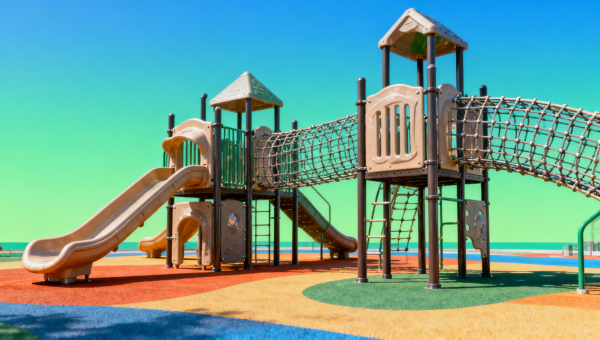
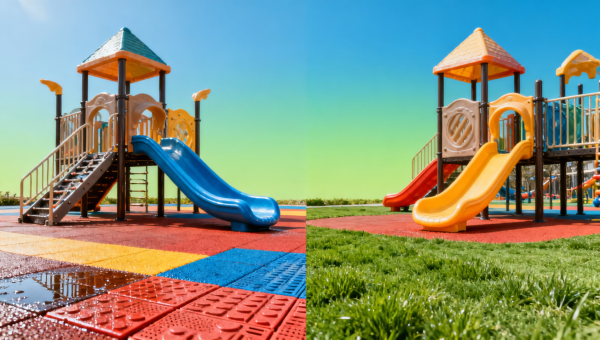
Poured-in-place rubber, often called PIP, is one of the most widely specified playground safety surfacing systems for public and commercial projects. It is installed in layers, usually with a shock-absorbing base and a colored wear layer on top.
Best for: municipalities, schools, destination parks, hospitality properties, inclusive playgrounds, and projects with high design expectations.
Main advantages:
- Excellent accessibility for wheelchairs, strollers, and mobility devices
- Strong impact attenuation when correctly specified and installed
- Seamless finish reduces trip hazards
- High visual customization with colors, patterns, and branding elements
- Works well for inclusive and premium environments
Main limitations:
- Higher upfront cost than loose-fill materials
- Installation quality is critical; poor workmanship can lead to premature wear
- Surface can heat up in direct sun depending on color choice and climate
- Spot repairs may be visible if color matching is inconsistent
Commercial judgment: If the project values accessibility, appearance, and reduced daily maintenance, poured-in-place rubber is often the strongest long-term choice despite higher initial cost. For high-visibility public-facing spaces, it is often easier to justify on lifecycle and user-experience grounds.
Engineered wood fiber: lower initial cost, but more maintenance over time
Engineered wood fiber, or EWF, is a common loose-fill option and remains popular where budget is a major decision factor. It can provide compliant impact protection when properly installed and maintained.
Best for: cost-sensitive schoolyards, community parks, and projects with maintenance staff available for regular upkeep.
Main advantages:
- Lower upfront cost than many unitary systems
- Widely available and familiar to many operators
- Natural appearance may suit park environments
Main limitations:
- Requires routine raking, leveling, replenishment, and depth checks
- Can migrate out of use zones and reduce effective protection
- Accessibility performance is generally weaker than seamless rubber systems
- May be affected by moisture, compaction, and decomposition over time
- Ongoing maintenance can erase some of the upfront savings
Commercial judgment: Engineered wood fiber can still be a practical solution, but only when the owner fully accepts the maintenance commitment. It is often chosen because of low purchase price, then later criticized because maintenance capacity was underestimated.
Rubber tiles: consistent installation and easier replacement in certain settings
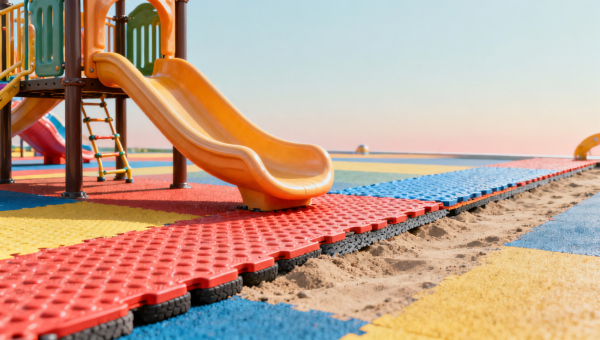
Rubber tiles are prefabricated units designed to provide impact protection with a modular installation approach. They can be a suitable alternative to poured-in-place rubber in some projects.
Best for: schools, rooftop recreation areas, indoor or semi-controlled environments, and sites where sectional replacement is attractive.
Main advantages:
- Factory-made units can offer more controlled consistency
- Damaged sections may be replaced individually
- Accessible and relatively clean-looking finish
- Can work well where on-site installation conditions are challenging
Main limitations:
- Seams may separate over time if substrate movement occurs
- Edges can become trip points if installation or maintenance is poor
- Visual wear between old and replacement tiles may be noticeable
- Not always ideal for highly irregular layouts or heavy vandalism exposure
Commercial judgment: Rubber tiles can be a smart middle-ground option when buyers want predictable safety performance and easier repair planning. However, substrate preparation and drainage remain critical to long-term performance.
Synthetic turf with padding: attractive appearance, but verify true safety performance
Synthetic turf systems are increasingly used around recreational and multi-use areas because they create a green, polished appearance. In playground applications, they typically require an impact-attenuating pad underneath and careful specification to meet fall protection needs.
Best for: mixed-use leisure environments, hospitality landscapes, themed recreation spaces, and projects prioritizing visual appeal.
Main advantages:
- Strong visual appeal and landscaped look
- Can integrate well into broader site design
- Generally more uniform in appearance than loose-fill materials
- May be appealing for resort, family entertainment, and branded environments
Main limitations:
- Safety depends heavily on the underlying pad system, not just the turf layer
- Infill migration, flattening, and wear can affect performance and appearance
- Surface temperature may become high in direct sun
- Requires cleaning and monitoring to maintain hygiene and drainage
Commercial judgment: Synthetic turf is often selected for aesthetics first, but buyers should reverse that logic and verify playground safety surfacing performance before approving it. Ask for tested system data, not generic turf claims.
Bonded rubber mulch and loose rubber: where they fit and where caution is needed
Rubber mulch systems, whether loose or bonded, are sometimes considered because they appear softer and can be installed in varied site conditions. Their suitability depends heavily on product quality, installation method, and local regulatory expectations.
Potential advantages:
- Can offer acceptable impact performance when properly tested
- May present a more textured, less formal look
- In some cases lower upfront cost than premium seamless systems
Potential concerns:
- Material movement or unevenness can affect consistency
- Product quality varies significantly by supplier
- Maintenance and visual aging may be less predictable
- Some buyers have concerns around cleanliness, loose particles, or long-term appearance
Commercial judgment: These systems may suit selective applications, but they require careful vetting. For institutional and premium public projects, buyers often prefer more proven, specification-driven systems with clearer long-term performance data.
Which playground surface is most cost-effective over the long term?
The cheapest installed option is not always the most cost-effective. Commercial buyers should look at lifecycle cost across at least five to ten years.
Typical cost logic:
- Engineered wood fiber: lower upfront cost, higher ongoing labor and replenishment cost
- Poured-in-place rubber: higher upfront cost, generally lower daily maintenance and stronger premium value
- Rubber tiles: moderate to high upfront cost, potentially easier localized repair
- Synthetic turf: moderate to high cost depending on system complexity, with cleaning and eventual replacement considerations
In public tenders and business evaluations, the better question is not “Which surface costs less today?” but “Which option gives the best compliance, usability, and appearance per year of service life?” That approach often changes the ranking.
How climate, drainage, and site usage change the best choice
A surface that performs well in one region may underperform in another. Site conditions matter as much as product category.
High rainfall or poor drainage: favor systems with strong drainage design and stable installation over options vulnerable to washout, saturation, or decomposition.
Very hot climates: pay close attention to heat retention, color selection, and user comfort.
Freeze-thaw regions: substrate preparation becomes especially important to prevent movement and damage.
Heavy public traffic: choose a surface that retains consistent impact protection and appearance under constant use.
Low-maintenance operating environments: avoid solutions that depend on frequent manual redistribution or topping up.
This is why experienced buyers often evaluate the surface as part of a full system: sub-base, drainage, edging, installation quality, inspection plan, and expected user volume.
What to ask a playground supplier before making a final decision
Working with a reliable playground supplier is just as important as choosing the material itself. Buyers should ask for evidence, not just product brochures.
- What tested fall height ratings does the complete system provide?
- Which safety and accessibility standards does it meet?
- What is included in the quoted system: base, wear layer, edging, drainage, installation, warranty?
- What maintenance is required monthly, seasonally, and annually?
- What is the expected service life under similar traffic conditions?
- Can the supplier provide project references in similar climates and applications?
- Who is responsible for installation quality control?
- What exclusions or limitations apply to the warranty?
These questions help procurement teams compare offers on a like-for-like basis and reduce the risk of selecting a system that looks compliant on paper but performs poorly in operation.
A practical selection guide by project type
Schools: prioritize safety compliance, accessibility, and manageable maintenance. Poured-in-place rubber or rubber tiles are often strong choices; engineered wood fiber may work where budgets are tighter and staff can maintain it consistently.
Municipal parks: balance capital budget, vandal resistance, lifecycle cost, and user inclusivity. Poured-in-place rubber is often preferred in flagship parks; EWF remains common in lower-budget sites.
Hospitality and leisure venues: visual finish, guest experience, and branding matter more. Poured-in-place rubber or well-specified synthetic turf systems are often considered.
High-traffic destination playgrounds: favor durable unitary systems with strong accessibility and lower daily maintenance burden.
Distributors and resellers: prioritize suppliers with reliable compliance documentation, installation support, and project reference depth across regions.
Final verdict: which playground surfacing option is best?
If the goal is the best overall combination of safety, accessibility, appearance, and commercial-grade performance, poured-in-place rubber is often the leading choice for premium projects. If the top priority is low initial spend, engineered wood fiber remains relevant, but buyers should go in with open eyes about maintenance and accessibility trade-offs. Rubber tiles fit projects that value modular repair and controlled installation, while synthetic turf can work well in design-led environments if safety testing is verified at the system level.
In short, the best playground surfacing is the one that matches the site’s fall height requirements, maintenance capacity, climate conditions, traffic level, and budget over the full service life. For procurement teams and project planners, the smartest decision comes from comparing total value—not just material price. A compliant, durable, and well-supported surface will protect users better, reduce operational friction, and deliver stronger long-term returns for any commercial or public recreation project.
Search News
Hot Articles
- Pro Stage AudioFIFA Adopts Chinese Mini-LED Displays for 2026 World Cup VAR SystemApr 24, 2026
- Outdoor RidesChina FA Warns Nanjing City Over Fan Conduct; ISO 20785 Compliance AcceleratesApr 24, 2026
- Pro Stage AudioFan Zhendong Visits Silicon Valley as MLTT Investor, AI Ping-Pong Tech Draws US InterestApr 24, 2026
Popular Tags
Need ExpertConsultation?
Connect with our specialized leisureengineering team for procurementstrategies.
Recommended News
 Apr 24, 2026Vietnam Mandates Child Finger-Trap Sensors for Indoor Playground EquipmentVietnam mandates child finger-trap sensors for indoor playground equipment—VINA-CE certified & third-party tested. Act now to ensure compliance, avoid shipment delays, and meet April 23, 2026 deadline.● Theme Park Strategist
 Apr 23, 2026Fan Zhendong Visits Silicon Valley as MLTT Investor, AI Ping-Pong Tech Draws AttentionAI ping-pong tech takes center stage as Fan Zhendong visits Silicon Valley as MLTT investor—key for smart sports hardware, AI coaching platforms & SaaS providers.● Theme Park Strategist
 Apr 23, 2026Vietnam Mandates Child Finger-Trap Sensors for Indoor Play EquipmentChild finger-trap sensors now mandatory for indoor play equipment in Vietnam—learn how QCVN 121:2026 impacts exporters, manufacturers & suppliers ahead of July 1, 2026 enforcement.● Theme Park Strategist
 Apr 22, 2026Vietnam Mandates Child Finger-Trap Sensors for Indoor Playground EquipmentVietnam mandates child finger-trap sensors for indoor playground equipment—comply with QCVN 128:2026 & TCVN 9350:2023 before Oct 2026!● Theme Park Strategist
 Apr 21, 2026Vietnam Mandates Child Finger-Trap Sensors for Indoor Play EquipmentVietnam mandates child finger-trap sensors for indoor play equipment—comply with TCVN 9507:2023 by July 1, 2026 to clear customs & protect kids.● Theme Park Strategist
 Apr 20, 2026NES Launches Sports Community Curator ProgramSports Community Curator program launched by NES — join global fitness studios, uni clubs & outdoor groups to co-create, test gear & grow with Chinese sports brands.● Theme Park Strategist
 Apr 17, 2026CPSC AI Safety Alert: 200ms Delay in Child Playground AI Systems = HazardCPSC AI Safety Alert: 200ms delay in child playground AI systems = hazard. Learn how latency compliance impacts Target/Walmart listings, testing, and supply chain.● Theme Park Strategist
 Apr 17, 20262026 Shanghai Sailing Open Adopts Domestic SeaChronos Pro Timing SystemSeaChronos Pro timing system debuts at 2026 Shanghai Sailing Open — ITU-certified, millisecond-accurate, wind- and tide-integrated. A game-changer for marine sports tech.● Theme Park Strategist
 Apr 16, 2026FDA Proposes New Labeling Rules for Sports Nutrition Supplements with Chinese LabelsFDA's new labeling rules for sports nutrition supplements with Chinese labels take effect April 2026—learn compliance must-dos for U.S. importers, manufacturers & brands.● Theme Park Strategist
 Apr 15, 2026Saudi SASO Updates Amusement Ride Standards: VR Devices Now Require Mandatory EMC TestingSaudi SASO's new 2026 standard mandates EMC testing for VR amusement rides, impacting exporters. Learn key compliance strategies for Saudi market access.● Theme Park Strategist
 Apr 14, 2026Japan Mandates Multilingual E-Manuals for Fitness Equipment from April 2026Japan mandates multilingual e-manuals for fitness equipment from April 2026. Learn how this impacts manufacturers & importers with JIS T 0601-1 compliance requirements. Stay ahead of the regulation!● Theme Park Strategist
 Apr 13, 2026WTT Taiyuan Adopts Chinese AI Table Tennis Analysis System with ITTF Export CertificationWTT Taiyuan adopts Chinese AI table tennis analysis system with ITTF export certification, enabling real-time ball speed & spin tracking. A game-changer for sports tech in emerging markets like Southeast Asia & Middle East.● Theme Park Strategist
 Apr 13, 2026First Female Snooker Player Achieves Multiple Century Breaks as Chinese Table Gains WPBSA CertificationChinese snooker player Bai Yulu makes history with multiple century breaks using WPBSA-certified 'Tournament Pro X7' table, marking a milestone for Chinese manufacturing in professional snooker equipment. Discover how this impacts global markets.● Theme Park Strategist
 Apr 13, 2026RCEP Zero Tariff on China's TPU Sports Protective Gear Boosts ASEAN TradeRCEP's zero-tariff policy on China's TPU sports protective gear boosts ASEAN trade, giving Chinese exporters cost advantages over Korean rivals. Learn how manufacturers and distributors can capitalize on this opportunity.● Theme Park Strategist
 Apr 10, 2026Japan's JIS T 9001:2026 Sports Flooring Anti-Slip Standard Mandatory from April 2026Japan's JIS T 9001:2026 standard mandates anti-slip sports flooring (SCOF ≥ 0.6) from April 2026. Chinese exporters must adapt to meet new requirements. Learn key compliance strategies.● Theme Park Strategist
 Apr 10, 2026Bai Yulu Makes History at Snooker World Championship, Sparks Surge in Women's Sports Equipment DemandBai Yulu makes history at Snooker World Championship with two century breaks, sparking 185% surge in women's sports equipment demand. Discover how manufacturers, e-commerce & supply chains can capitalize on this trend.● Theme Park Strategist
 Apr 10, 20262026 Badminton Asia Championships Quarterfinals Schedule Announced, Shi Yuqi to Compete; Southeast Asia Racket Orders Face 6-8 Week Delays2026 Badminton Asia Championships quarterfinals schedule revealed with Shi Yuqi competing, while Southeast Asia faces 6-8 week racket delays. Learn how supply chain issues impact manufacturers and get strategies to navigate equipment shortages.● Theme Park Strategist
 Apr 10, 2026WTT Taiyuan Challenge Sparks Smart Equipment Demand: Japan Buyers Scrutinize AI Training TechDiscover how the WTT Taiyuan Challenge boosts demand for AI training tech as Japanese buyers evaluate smart sports equipment. Learn key opportunities for manufacturers with JIS-certified solutions.● Theme Park Strategist
 Apr 10, 2026Chinese Snooker Players' Success Spurs Global Demand for Cue AccessoriesChinese snooker players' success drives 210% global demand surge for cue accessories. Explore how manufacturers & exporters can capitalize on this trend with UK, German & Australian markets leading inquiries.● Theme Park Strategist
 Apr 10, 2026EU Updates EN 16830:2026 Eyewear Safety Standard, Impacting China's Sports Goggle ExportsEU's updated EN 16830:2026 eyewear safety standard impacts China's sports goggle exports with stricter CE certification requirements. Learn how manufacturers and exporters can adapt to new impact resistance, UV400+, and blue light blocking standards before the September 2026 deadline.● Theme Park Strategist
 Apr 24, 2026Which Playground Supplier Suits Your Project?Playground supplier selection starts with safety, playground planning, and playground surfacing. Learn how to compare compliance, support, and total value for smarter procurement.● Theme Park Strategist
 Apr 24, 2026Playground Safety Surfacing: Cost vs ValuePlayground safety surfacing cost vs value explained: compare playground surfacing options, compliance, maintenance, and ROI for smarter playground planning and supplier decisions.● Theme Park Strategist
 Apr 24, 2026How to Choose Playground Safety SurfacingPlayground safety surfacing guide for smarter playground planning: compare compliant playground surfacing options, lifecycle cost, and how to choose a reliable playground supplier.● Theme Park Strategist
 Apr 24, 2026Playground Surfacing Options ComparedPlayground surfacing options compared: discover the best playground safety surfacing for smarter playground planning, lower lifecycle costs, and confident supplier selection.● Theme Park Strategist