ODM Watches: Costs, MOQ, and Lead Times
For buyers evaluating ODM watches, understanding unit costs, MOQ, and production lead times is essential to making profitable sourcing decisions. Whether you work in hospitality procurement, luxury retail, or broader commercial sourcing alongside categories like hotel room furniture, hotel sofas, or even playground supplier solutions, this guide explains the key factors that affect watch customization, supplier selection, and order planning for global B2B trade.
In the sports and entertainment sector, ODM watches are more than simple accessories. They can support resort gift programs, theme park merchandise, event branding, club retail, sports team licensing, and premium promotional campaigns. For procurement teams, the challenge is balancing aesthetic appeal, functional quality, realistic MOQ, and lead time reliability without losing margin.
A well-planned ODM watch order usually depends on 4 commercial variables: movement type, case and strap materials, customization depth, and production scale. Small changes in any of these areas can move unit pricing by 15% to 40%, push MOQ from 300 pieces to 1,000 pieces, or extend production by 2 to 5 weeks. That is why early specification control matters.
How ODM Watches Fit Sports and Entertainment Buying Programs
ODM watches are commonly selected by buyers who need a faster route to market than full custom development. Instead of engineering an entirely new product from zero, the buyer starts from an existing supplier platform and customizes visible and commercial elements such as dial design, logo placement, strap color, packaging, and retail presentation. This model is especially relevant in sports and entertainment, where seasonal launches and event deadlines are tight.
Typical use cases include branded merchandise for stadium stores, VIP watches for golf resorts, commemorative products for music festivals, and private-label collections for leisure retail chains. In these environments, buyers often need production windows of 30 to 60 days rather than long product development cycles of 90 to 150 days. ODM helps shorten decision time while maintaining enough design flexibility for brand identity.
For distributors and commercial evaluators, ODM sourcing also reduces technical risk. A proven watch platform usually has established tooling, known assembly processes, and repeatable quality checkpoints. That does not remove all risk, but it lowers the probability of delays caused by new mold development, unstable components, or repeated engineering revisions.
However, not every ODM watch program is equally suitable for entertainment and leisure retail. A watch intended for a high-traffic amusement destination may need stronger scratch resistance, water resistance of 3 ATM to 5 ATM, and packaging designed for impulse purchase displays. By contrast, a hotel boutique or luxury resort may prioritize polished steel cases, leather straps, and lower-volume gift-box presentation.
Common B2B application scenarios
- Theme parks and attractions using watches as licensed souvenir merchandise with medium-volume runs of 500 to 2,000 pieces.
- Hotels and resorts sourcing branded watches for loyalty gifts, executive welcome packages, or in-house retail displays.
- Sports clubs and event organizers creating limited-edition watches tied to tournaments, anniversaries, or seasonal campaigns.
- Distributors testing private-label watch collections across 3 to 10 regional retail channels before scaling reorder volumes.
ODM versus full OEM in commercial sourcing
The table below shows why many commercial buyers choose ODM for watch programs linked to sports and entertainment projects. It is not always the cheapest route per piece, but it is often the most practical route when launch timing, MOQ control, and design speed are key purchasing priorities.
For many B2B buyers, ODM offers the most balanced option. It usually supports moderate MOQ, acceptable customization, and quicker commercialization. That is particularly useful when the watch is part of a broader purchasing plan that may already include hospitality fixtures, leisure equipment, or branded retail products with competing deadlines.
What Drives ODM Watch Costs
Unit cost in ODM watches is rarely determined by one factor alone. Buyers often focus first on the quoted FOB price, but the real commercial picture includes sampling fees, packaging type, compliance testing needs, spare parts policy, and the cost effect of order volume. In practical sourcing, a watch quoted at US$9 may end closer to US$12 or US$14 once all required elements are added.
The first major price driver is movement selection. Quartz movements generally provide the lowest entry point and are common in promotional, event, and lifestyle watch programs. Automatic movements, dual-time functions, chronograph layouts, and special complications increase both material and assembly cost. For most leisure retail projects, the mainstream ODM range sits between basic 3-hand quartz and premium multi-layer dial quartz constructions.
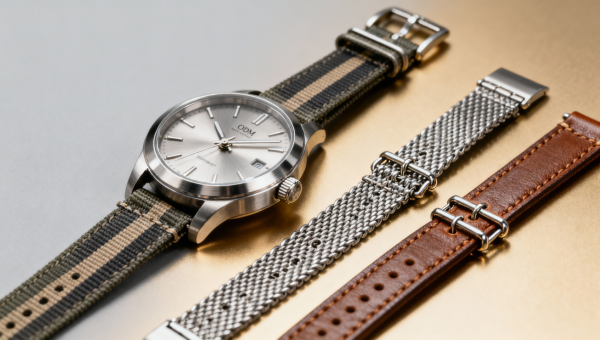
The second driver is exterior material. Zinc alloy cases tend to be lower cost, while stainless steel cases increase durability and visual value. Strap material also matters: silicone is popular in sports and water-adjacent leisure settings, PU is budget-friendly, genuine leather targets premium channels, and stainless mesh or bracelet designs generally increase both component cost and assembly time.
The third driver is customization depth. A simple dial logo and caseback engraving may add only a limited cost. But custom hands, bespoke indexes, special plating, unique crown design, or branded buckle hardware can trigger new tooling, color matching rounds, and lower line efficiency. Packaging is another hidden cost point. Retail-ready rigid gift boxes can cost 2 to 5 times more than standard paper boxes.
Typical ODM watch cost structure
The following table provides common commercial ranges used by buyers for preliminary evaluation. Actual pricing changes by order size, material specification, and supplier positioning, but these ranges are useful for early budgeting and margin planning in sports and entertainment retail programs.
For buyers building a resale business, the margin target should be set before design approval. A distributor who needs a 2.2x to 3x landed-cost multiple must evaluate not only factory price but also freight mode, duties, packaging volume, and defect allowance. On low-volume orders, these extra costs can materially change profitability.
Cost control tips for procurement teams
- Limit first-order customization to high-visibility elements such as dial, strap, and packaging rather than new case tooling.
- Standardize case sizes, often 38 mm to 42 mm, to reduce component complexity across SKUs.
- Ask for pricing at 3 breakpoints, such as 300, 500, and 1,000 pieces, to identify the real volume discount curve.
- Confirm whether sample charges, mold fees, and compliance-related testing are refundable or amortized into bulk orders.
MOQ Realities and How Buyers Should Plan Order Volume
MOQ is one of the most misunderstood parts of ODM watch sourcing. Many buyers assume MOQ is a fixed rule, but in practice it changes according to material sourcing, logo process, movement procurement, and packaging format. A supplier may quote 300 pieces for one standard watch, yet require 500 to 1,000 pieces if the buyer requests a custom color strap, special buckle, or retail box with multiple inserts.
For sports and entertainment projects, MOQ planning should begin with the sales channel rather than the factory minimum alone. A resort gift shop with one location may need only 300 to 500 pieces for a 6-month program, while a distributor serving 8 amusement venues may justify 2,000 pieces across multiple colorways. The important question is not simply “What is the MOQ?” but “What sell-through volume can this channel absorb within 90 to 180 days?”
Buyers should also separate production MOQ from per-design MOQ. In some cases, a supplier may accept 1,000 total pieces split into 2 or 3 dial variants, but only if the case, movement, and packaging remain common. This is useful for event organizers or multi-location leisure brands that want localized artwork without increasing every component cost.
Where MOQ is too high for first entry, negotiation should focus on simplification. Removing custom hardware, using standard stock straps, or consolidating packaging can reduce minimums meaningfully. Another option is phased purchasing: approve one base platform now, then create a second collection once reorder data proves market acceptance.
Typical MOQ ranges by customization level
The table below gives a realistic planning framework for procurement, evaluation, and distribution teams comparing different ODM watch strategies.
A useful rule for buyers is to target a first order that covers 1 selling season, not 2 or 3. In leisure and entertainment retail, overbuying creates aging inventory risk, especially when designs are tied to specific events, resort themes, or annual branding campaigns.
Questions to ask before accepting MOQ
- Is the MOQ per model, per color, or per total order?
- Can 2 to 3 dial artworks share one case and movement platform?
- Does the supplier allow mixed packaging within one purchase order?
- What reorder MOQ applies after the first bulk run?
Lead Times, Sampling, and Delivery Risk Control
Lead time is where many otherwise attractive ODM watch projects fail. Buyers often hear one headline number, such as 35 days, without understanding whether that includes artwork approval, pre-production sample confirmation, component sourcing, packaging completion, and final inspection. A reliable watch sourcing plan should divide timeline review into at least 3 stages: development, production, and shipment readiness.
For a straightforward ODM watch with standard components, sample development may take 7 to 15 days. If custom dial printing, color matching, or packaging mockups are involved, that stage can move to 15 to 25 days. Bulk production usually requires 25 to 45 days after sample approval, but special plating, non-stock straps, or peak-season capacity pressure can extend this by another 10 to 20 days.
Shipping adds another variable. Air freight is faster for urgent event launches, but sea freight is often preferred for larger commercial orders where landed cost matters more than speed. Buyers planning around a sports season, hotel opening, or entertainment event should build at least a 2-week safety buffer between promised ex-factory date and actual retail launch date.
The biggest timing risk usually comes from unclear approval cycles. If design teams, licensing departments, or regional distributors take 5 to 7 days per revision round, a project can lose 2 to 3 weeks before production even starts. This is why procurement should lock the approval workflow before requesting final quotation and mass production scheduling.
Typical ODM watch timeline
The timeline below reflects common commercial practice for ODM watches in gift, retail, and event-oriented programs. It helps buyers align internal milestones with factory execution.
For high-value or deadline-sensitive orders, buyers should request milestone updates at least once per week. A simple 4-point tracking format works well: artwork locked, sample approved, assembly in progress, final QC complete. This level of visibility is especially important when the watch order is linked to a broader commercial project launch.
Lead time risk reduction checklist
- Approve all artwork files in one final document set before sample release.
- Confirm whether packaging production runs in parallel with watch assembly or after it.
- Set one internal approval owner to avoid multi-department response delays.
- Reserve at least 10 to 14 days of schedule buffer for launch-critical programs.
Supplier Evaluation, Quality Checks, and Procurement Best Practice
Choosing an ODM watch supplier should go beyond price and catalog appearance. For commercial buyers in sports and entertainment, supplier value comes from consistency, communication speed, sampling accuracy, and their ability to execute brand-sensitive projects on time. A low initial quote can become expensive if defect rates rise, packaging arrives incorrect, or delivery slips past an event launch date.
A practical evaluation model includes 5 core areas: product fit, MOQ flexibility, lead time credibility, customization capability, and quality control process. Commercial evaluators should request clear information on watch movement source, case material, plating standard, water resistance target, packaging options, and pre-shipment inspection practice. Even basic ODM projects benefit from this structured review.
Sampling is the most efficient filter. A buyer can learn a great deal from 1 to 3 pre-production samples: print sharpness, crown feel, strap comfort, clasp alignment, packaging fit, and visual consistency. If the sample already shows weak finishing or unclear communication, the bulk order risk is high. In contrast, a supplier that resolves comments within 48 to 72 hours usually performs better during mass production.
Buyers should also define their acceptance standards before order confirmation. For example, acceptable timekeeping tolerance, minor surface finish limits, logo positioning tolerance, carton marking requirements, and spare unit expectations should all be written into the purchase order or quality appendix. This reduces disputes later and creates a more objective inspection process.
Key supplier screening points
- Can the supplier provide multiple ODM watch platforms suitable for sports, resort, or entertainment retail positioning?
- Do they quote clearly on sample lead time, bulk lead time, and packaging completion separately?
- Are there practical reorder options below the first-order MOQ once the watch is market validated?
- Can they manage mixed programs where watches form part of a wider merchandise or hospitality sourcing schedule?
FAQ for B2B buyers
How many samples should a buyer review before bulk production?
For most ODM watch projects, 1 confirmed pre-production sample is the minimum, but 2 to 3 samples are safer when color accuracy, packaging, or licensed branding is important. One sample may be retained by procurement, one by the supplier, and one by the distributor or brand owner for final sign-off.
What lead time should buyers expect for repeat orders?
Repeat orders are often faster if no material or design changes are made. A common range is 20 to 35 days for standard reorder production, but this still depends on movement stock, strap sourcing, and factory workload during peak periods.
Which watch type works best for sports and leisure channels?
Quartz watches remain the most practical choice for many leisure programs because they combine lower cost, broad styling flexibility, and simpler after-sales management. Silicone straps and 3 ATM to 5 ATM water resistance are often suitable for active lifestyle environments, while premium resort boutiques may prefer stainless steel and leather-oriented styles.
ODM watches can be a profitable and efficient sourcing option when buyers control the three essentials from the start: realistic cost structure, workable MOQ, and credible lead time. In sports and entertainment, success usually comes from aligning watch design with the sales channel, simplifying first-order customization, and selecting suppliers that can support both timing discipline and consistent product quality.
For procurement teams, commercial evaluators, and distributors, the best results come from treating the watch order as part of a full project plan rather than a stand-alone item. Clear specifications, structured sampling, staged approvals, and practical volume planning reduce risk and improve margin control. If you are preparing an ODM watch program for resort retail, event merchandise, or branded leisure distribution, contact GCT to discuss sourcing strategy, compare supplier options, and get a tailored solution for your next commercial project.
Search News
Hot Articles
- Pro Stage AudioFIFA Adopts Chinese Mini-LED Displays for 2026 World Cup VAR SystemApr 24, 2026
- Outdoor RidesChina FA Warns Nanjing City Over Fan Conduct; ISO 20785 Compliance AcceleratesApr 24, 2026
- Pro Stage AudioFan Zhendong Visits Silicon Valley as MLTT Investor, AI Ping-Pong Tech Draws US InterestApr 24, 2026
Popular Tags
Need ExpertConsultation?
Connect with our specialized leisureengineering team for procurementstrategies.
Recommended News
 Apr 14, 2026China's Berens Shines as Sole Domestic Brand at Watches & Wonders Geneva 2026China's Berens makes history as the only domestic brand at Watches & Wonders Geneva 2026, showcasing COSC-certified tourbillon movements and EU compliance. Discover how this milestone signals China's rising luxury watchmaking capabilities.● Luxury Retail Analyst
 Apr 13, 2026Watches & Wonders Geneva 2026: Audemars Piguet Returns, Behrens Makes History as First Chinese BrandWatches & Wonders Geneva 2026 marks Audemars Piguet's return and historic debut of Chinese brand Behrens. Discover how this event reshapes luxury watch sourcing with China's rising high-end watchmaking capabilities.● Luxury Retail Analyst
 Apr 13, 2026US CPSC Launches Review of New Fitness Tracker Regulations, Chinese Exporters Required to Submit UL/ETL ComplianceUS CPSC's new fitness tracker regulations require Chinese exporters to submit UL/ETL compliance. Learn how this impacts wearable device OEMs, logistics, and component suppliers. Stay ahead with key action items for 2026 compliance.● Luxury Retail Analyst
 Apr 11, 2026Watches & Wonders Geneva 2026: Audemars Piguet Returns, 10 New Brands Join, Behrens as Sole Chinese ExhibitorWatches & Wonders Geneva 2026 marks a historic event with Audemars Piguet's return & 10 new brands including China's Behrens. Discover luxury watch industry shifts & new opportunities in this groundbreaking exhibition.● Luxury Retail Analyst
 Apr 11, 2026EU EN 16830:2026 Eyewear Standard Mandatory from April 2026, Chinese Exporters Need Certification Within 6 MonthsEU EN 16830:2026 eyewear standard becomes mandatory April 2026. Chinese exporters must update CE certification within 6 months. Learn critical compliance steps for UV protection, impact resistance & labeling requirements to avoid market removal.● Luxury Retail Analyst
 Apr 24, 2026ODM Watches: Costs, MOQ, and Lead TimesODM watches guide: compare costs, MOQ, and lead times for sports and entertainment sourcing. Ideal for hospitality procurement, resort retail, and branded event merchandise buyers.● Luxury Retail Analyst
 Apr 24, 2026ODM Watches vs OEM: Which Fits Your Brand?ODM watches vs OEM: compare speed, cost, design control, MOQ, and brand value. A practical guide for hospitality procurement, retailers, and distributors.● Luxury Retail Analyst
 Apr 16, 2026Supply chain solutions for watch components: Why dual-sourcing isn’t automatic—even with same specSupply chain solutions for watch components & designer eyewear: Why dual-sourcing fails without validation—OEM manufacturing, custom fabrication, and compliance risks revealed.● Luxury Retail Analyst
 Apr 16, 2026Smartwatch OEM partners who handle firmware updates—and why that changes your support liabilityDiscover smartwatch OEM partners with true firmware stewardship—critical for designer eyewear, hotel furniture integrations, and pro audio equipment sync. Reduce support liability now.● Luxury Retail Analyst
 Apr 16, 2026OEM manufacturing for watches: When 'custom' means longer lead times, not just logo changesOEM manufacturing for watches demands precision—not just logos. Discover how custom fabrication impacts lead times across designer eyewear, hotel furniture & supply chain solutions.● Luxury Retail Analyst
 Apr 16, 2026Luxury timepieces with service networks outside major citiesLuxury timepieces with certified service networks in Tier-2+ cities—backed by calibration, warranty & parts support. Also: custom jewelry, luxury accessories, orchestral instruments, park benches, music stands & more.● Luxury Retail Analyst
 Apr 15, 2026Luxury timepieces built for daily wear — not just displayLuxury timepieces engineered for daily wear—precision, durability & style. Also explore custom jewelry, luxury accessories, orchestral instruments, DJ equipment, music stands, park benches, outdoor playgrounds & more.● Luxury Retail Analyst
 Apr 10, 2026Designer eyewear frames labeled 'acetate' may contain only 37% bio-acetate — and no one discloses itDiscover supply chain solutions for designer eyewear, OEM jewelry & ODM watches — verify true bio-acetate content, not just labels. Premium accessories, commercial procurement made transparent.● Luxury Retail Analyst
 Apr 10, 2026ODM watches with interchangeable straps: Who controls the tolerances — designer or factory?ODM watches with interchangeable straps demand precision tolerance control. Discover how top-tier supply chain solutions, OEM manufacturing, and designer eyewear partnerships ensure premium accessories quality and commercial watch reliability.● Luxury Retail Analyst
 Apr 10, 2026Supply chain solutions for watches often ignore regional after-sales logisticssupply chain solutions for commercial watch, OEM jewelry & designer eyewear—unlock regional after-sales logistics resilience with GCT’s E-E-A-T–validated benchmarks.● Luxury Retail Analyst
 Apr 10, 2026Designer eyewear production runs under 500 units: Is MOQ negotiation still realistic?Explore realistic MOQ negotiation for designer eyewear under 500 units—backed by agile OEM manufacturing, supply chain solutions, and premium accessories expertise.● Luxury Retail Analyst
 Apr 11, 2026OEM manufacturing for eyewear: Where do tooling revisions actually begin?OEM manufacturing for eyewear starts where tooling revisions begin—early design validation, compliance mapping & pilot diagnostics. Discover supply chain solutions, designer eyewear, ODM watches & OEM jewelry excellence.● Luxury Retail Analyst
 Apr 11, 2026Commercial watch procurement often overlooks service lifecycle costsDiscover integrated supply chain solutions for commercial watch, OEM jewelry & ODM watches—reduce TCO with premium accessories, designer eyewear & more.● Luxury Retail Analyst
 Apr 11, 2026ODM watches with full compliance tracking — rare or just under-marketed?ODM watches with full compliance tracking—discover premium accessories, OEM jewelry & designer eyewear suppliers verified for commercial procurement, supply chain solutions, and traceability.● Luxury Retail Analyst
 Apr 11, 2026Designer eyewear brands: When 'custom' really means 'compromised fit'Discover how supply chain solutions & OEM manufacturing impact designer eyewear fit—plus ODM watches, OEM jewelry & premium accessories sourcing.● Luxury Retail Analyst
 Apr 07, 2026EU Updates EN 16830:2026 Eyewear Safety Standards, Impacting Chinese ExportersEU's new EN 16830:2026 eyewear safety standards impact Chinese exporters with blue light limits, impact resistance tests & AI privacy labels. Learn how to comply and maintain EU market access.● Luxury Retail Analyst
 Apr 07, 2026US New Tariffs on Optical Lenses: Impact on Chinese ExportersExplore how US new tariffs on optical lenses impact Chinese exporters, with key insights on compliance strategies for high-index resin and photochromic lenses. Essential reading for eyewear manufacturers and supply chain professionals.● Luxury Retail Analyst
 Apr 07, 2026AR Glasses Under $500: Chinese Brands Enter Global MarketsDiscover affordable AR glasses under $500 from Chinese brands like RayNeo and INMO now in global markets. Explore how this price shift impacts retail, enterprise solutions, and distribution networks in 2024.● Luxury Retail Analyst
 Apr 07, 2026XREAL Aims for HK IPO as Global AR Glasses Leader with 24.8% Market Share by 2025XREAL, the global AR glasses leader with 24.8% projected market share by 2025, files for HK IPO. Discover how this impacts distributors, suppliers & logistics providers in the growing AR hardware sector.● Luxury Retail Analyst