ODM Watches vs OEM: Which Fits Your Brand?
Choosing between ODM watches and OEM production affects more than product development. It directly influences your launch speed, upfront investment, design ownership, quality control, and long-term brand positioning. For buyers in sports and entertainment, hospitality procurement, specialty retail, and distribution, the right choice depends on one central question: do you need faster market entry with lower development risk, or deeper product differentiation with stronger brand control? In most cases, ODM watches fit brands that want speed, tested manufacturing capability, and manageable minimums, while OEM is better for companies building a more distinctive watch line with custom specifications and strategic intellectual property value.
What Buyers Really Need to Know Before Choosing ODM or OEM
When sourcing watches for a brand, reseller program, event merchandise line, leisure venue retail offer, or hospitality gift collection, the decision is rarely about terminology alone. Buyers usually want clear answers to practical commercial questions:
- Which model gets products to market faster?
- Which option requires less capital and development effort?
- How much design control will the brand actually have?
- What are the risks around quality consistency, exclusivity, and margin?
- Which sourcing model better supports long-term growth?
This is why comparing ODM watches vs OEM should start with business goals, not factory vocabulary. If your team is evaluating suppliers, planning a private label line, or assessing category expansion, the best-fit model is the one that aligns with your timeline, product strategy, and channel position.
ODM Watches vs OEM: The Short Answer
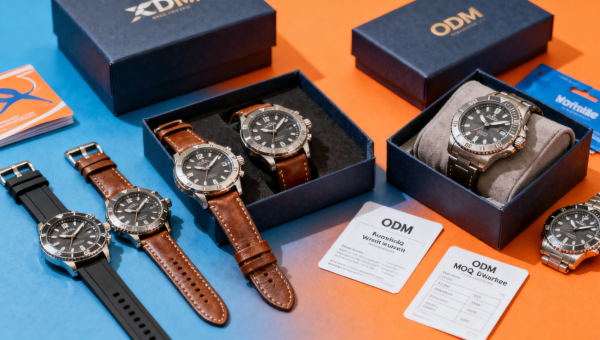
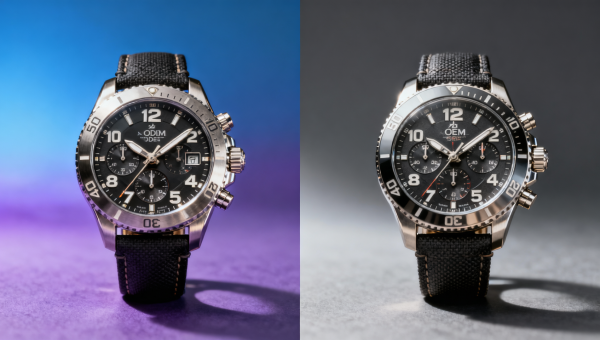
ODM watches are based on designs and product platforms already developed by the manufacturer. Your brand typically selects from existing models, then customizes elements such as logo, dial color, strap material, packaging, or small styling details.
OEM watches are produced by a manufacturer according to your brand’s own specifications. You provide the concept, drawings, performance requirements, material direction, and branding standards, and the factory manufactures the product accordingly.
In simple terms:
- Choose ODM if you want speed, lower development complexity, and a practical route into the market.
- Choose OEM if you need stronger product differentiation, more technical control, and a watch line that feels unique to your brand.
When ODM Watches Make More Business Sense
ODM is often the preferred route for importers, distributors, promotional product buyers, leisure retailers, and newer watch brands that want to launch efficiently. It works especially well when the commercial objective is to validate demand quickly without carrying the burden of a fully custom development process.
ODM watches are usually the better choice if your priorities include:
- Shorter time to market: Existing product platforms reduce design and engineering lead time.
- Lower upfront development cost: Tooling, prototyping, and technical design effort are often reduced.
- More predictable manufacturing: Proven watch designs tend to come with fewer early-stage production issues.
- Simplified supplier communication: Buyers can evaluate ready-made structures instead of defining every component from scratch.
- Testing new sales channels: Useful for retail pilots, event merchandise, or distributor-led market entry.
For example, a sports and entertainment retailer launching a branded lifestyle accessory line may benefit from ODM watches because it can move from concept to sellable product faster. A hotel gift shop chain or attraction-based retail operator may also prefer ODM when it needs visually appealing watches with reliable quality and branded packaging rather than full product engineering ownership.
That said, ODM is not only for entry-level strategies. It can also be a smart sourcing solution for mature buyers who understand that not every category requires full custom design to deliver profit.
When OEM Is the Better Fit for Brand Building
OEM is typically the stronger option for companies that see watches as a strategic branded product rather than a fast-turn accessory. If your watch line needs to reflect a unique brand language, technical specification, premium positioning, or product story, OEM gives you more room to build a differentiated offer.
OEM may be the right model if you need:
- Distinctive industrial or aesthetic design
- Custom case sizes, materials, movement choices, or component combinations
- A stronger premium brand identity
- Exclusive product architecture not easily replicated by competitors
- Greater control over technical standards and user experience
This matters for luxury-adjacent retail concepts, licensed sports collections, entertainment collaborations, or brands targeting higher-value specialty retail channels. If a brand wants to avoid looking similar to generic market offerings, OEM gives it more control over how the final watch expresses its identity.
However, more control usually means more responsibility. OEM projects often require more detailed specifications, longer development timelines, more sampling rounds, and closer factory management.
How Design Control Actually Differs in Real Sourcing Projects
One of the most common misconceptions is that ODM means no customization and OEM means complete freedom. In reality, the difference is more nuanced.
With ODM watches, buyers often can customize:
- Dial graphics and branding
- Hands, markers, and colorways
- Straps or bracelets
- Packaging and presentation
- Select cosmetic case details
But the base product architecture usually belongs to the manufacturer. That means the core design may also be offered, in similar form, to other clients.
With OEM watches, your team can usually influence:
- Case construction and dimensions
- Material selection
- Movement specifications
- Water resistance targets
- Surface finishing and detailing
- Brand-specific packaging systems
For procurement teams and commercial evaluators, the key issue is not just “Can we customize it?” but “Can we customize what actually matters to our buyers?” If your end customers mainly respond to logo, color, packaging, and price point, ODM may be sufficient. If your market values originality, construction details, and premium storytelling, OEM is usually more appropriate.
Cost, Margin, and MOQ: What Procurement Teams Should Compare
From a sourcing perspective, the financial comparison between ODM watches and OEM should go beyond unit price. Buyers should evaluate total project economics.
ODM usually offers:
- Lower non-recurring development costs
- Faster quotation and sampling cycles
- Lower barriers for initial order placement
- Potentially lower minimum order quantities on proven models
OEM usually involves:
- Higher design and development investment
- Possible tooling or mold-related expenses
- Longer pre-production approval timelines
- Higher MOQ requirements depending on customization depth
But a higher-cost OEM project is not automatically less profitable. If the final product commands better pricing, supports stronger brand loyalty, or reduces direct comparison with competing offers, OEM may deliver better margins over time.
For distributors and resellers, this is especially important. ODM can be excellent for fast inventory turnover and broad channel testing. OEM may be better if channel partners need exclusivity, stronger pricing power, or protection from commoditization.
Supply Chain Risk, Quality Control, and Reliability Considerations
For B2B buyers, the sourcing model also affects operational risk. ODM products often benefit from established manufacturing routines because the supplier has already built and refined the watch platform. That can reduce early quality issues and improve production predictability.
OEM projects, while more flexible, require stronger supplier coordination. The more customized the watch, the more critical it becomes to manage:
- Prototype approval
- Material consistency
- Component sourcing stability
- Assembly quality standards
- Testing protocols
- Production change control
Neither model is inherently safer. The real difference lies in process maturity. A capable ODM supplier with transparent quality systems may outperform a weak OEM supplier offering customization without engineering discipline.
When evaluating watch manufacturers, buyers should ask for:
- Quality control documentation
- Testing standards and inspection procedures
- Past export market experience
- Lead time stability data
- Compliance capability for target markets
- Sample-to-bulk consistency processes
Which Model Fits Different Buyer Types?
The best answer often depends on who is buying and why.
Information researchers should use ODM vs OEM as a framework for understanding market entry models, supplier maturity, and category competitiveness.
Procurement teams should focus on lead time, MOQ, quality assurance, customization limits, and total landed cost.
Business evaluators should compare brand value creation, margin structure, development risk, and channel differentiation.
Distributors, dealers, and agents should assess exclusivity needs, reorder potential, speed of assortment expansion, and price segmentation opportunities.
In practical terms:
- ODM fits fast launches, private label programs, event retail, gift channels, and lower-risk assortment expansion.
- OEM fits premium branding, long-term product strategy, exclusive channel programs, and stronger IP-led differentiation.
A Practical Decision Framework for Choosing ODM Watches or OEM
If your team is deciding between ODM watches and OEM production, use the following questions:
- How quickly do we need to launch?
If speed matters most, ODM usually wins. - Do we need a truly unique product?
If yes, OEM is often the better fit. - What level of development budget can we support?
Lower budgets tend to align better with ODM. - Is this a market test or a long-term brand play?
Test projects often work well with ODM; strategic lines often justify OEM. - How much internal product management capability do we have?
OEM requires stronger technical and project coordination resources. - Will exclusivity materially improve our market position?
If exclusivity affects pricing and channel relationships, OEM deserves serious consideration.
For many brands, the smartest path is not strictly one or the other. A company may start with ODM watches to validate demand, then transition to OEM once it has proven product-market fit and built clearer insight into customer preferences.
Final Verdict: Which Fits Your Brand?
If your brand values speed, lower complexity, and a cost-efficient route to launch, ODM watches are often the more practical choice. If your brand needs stronger differentiation, deeper design control, and a more defensible long-term position, OEM is usually the better investment.
The right answer depends on your commercial objective, not just your product category. For sports and entertainment buyers, hospitality-linked retail programs, and specialty distributors, the smartest sourcing decision is the one that balances time to market, customization needs, operational risk, and expected brand return.
In other words, choose ODM when efficiency creates value. Choose OEM when uniqueness creates value. The better you define that value upfront, the easier it becomes to select the right manufacturing model and the right supplier.
Search News
Hot Articles
- Pro Stage AudioFIFA Adopts Chinese Mini-LED Displays for 2026 World Cup VAR SystemApr 24, 2026
- Outdoor RidesChina FA Warns Nanjing City Over Fan Conduct; ISO 20785 Compliance AcceleratesApr 24, 2026
- Pro Stage AudioFan Zhendong Visits Silicon Valley as MLTT Investor, AI Ping-Pong Tech Draws US InterestApr 24, 2026
Popular Tags
Need ExpertConsultation?
Connect with our specialized leisureengineering team for procurementstrategies.
Recommended News
 Apr 14, 2026China's Berens Shines as Sole Domestic Brand at Watches & Wonders Geneva 2026China's Berens makes history as the only domestic brand at Watches & Wonders Geneva 2026, showcasing COSC-certified tourbillon movements and EU compliance. Discover how this milestone signals China's rising luxury watchmaking capabilities.● Luxury Retail Analyst
 Apr 13, 2026Watches & Wonders Geneva 2026: Audemars Piguet Returns, Behrens Makes History as First Chinese BrandWatches & Wonders Geneva 2026 marks Audemars Piguet's return and historic debut of Chinese brand Behrens. Discover how this event reshapes luxury watch sourcing with China's rising high-end watchmaking capabilities.● Luxury Retail Analyst
 Apr 13, 2026US CPSC Launches Review of New Fitness Tracker Regulations, Chinese Exporters Required to Submit UL/ETL ComplianceUS CPSC's new fitness tracker regulations require Chinese exporters to submit UL/ETL compliance. Learn how this impacts wearable device OEMs, logistics, and component suppliers. Stay ahead with key action items for 2026 compliance.● Luxury Retail Analyst
 Apr 11, 2026Watches & Wonders Geneva 2026: Audemars Piguet Returns, 10 New Brands Join, Behrens as Sole Chinese ExhibitorWatches & Wonders Geneva 2026 marks a historic event with Audemars Piguet's return & 10 new brands including China's Behrens. Discover luxury watch industry shifts & new opportunities in this groundbreaking exhibition.● Luxury Retail Analyst
 Apr 11, 2026EU EN 16830:2026 Eyewear Standard Mandatory from April 2026, Chinese Exporters Need Certification Within 6 MonthsEU EN 16830:2026 eyewear standard becomes mandatory April 2026. Chinese exporters must update CE certification within 6 months. Learn critical compliance steps for UV protection, impact resistance & labeling requirements to avoid market removal.● Luxury Retail Analyst
 Apr 24, 2026ODM Watches: Costs, MOQ, and Lead TimesODM watches guide: compare costs, MOQ, and lead times for sports and entertainment sourcing. Ideal for hospitality procurement, resort retail, and branded event merchandise buyers.● Luxury Retail Analyst
 Apr 24, 2026ODM Watches vs OEM: Which Fits Your Brand?ODM watches vs OEM: compare speed, cost, design control, MOQ, and brand value. A practical guide for hospitality procurement, retailers, and distributors.● Luxury Retail Analyst
 Apr 16, 2026Supply chain solutions for watch components: Why dual-sourcing isn’t automatic—even with same specSupply chain solutions for watch components & designer eyewear: Why dual-sourcing fails without validation—OEM manufacturing, custom fabrication, and compliance risks revealed.● Luxury Retail Analyst
 Apr 16, 2026Smartwatch OEM partners who handle firmware updates—and why that changes your support liabilityDiscover smartwatch OEM partners with true firmware stewardship—critical for designer eyewear, hotel furniture integrations, and pro audio equipment sync. Reduce support liability now.● Luxury Retail Analyst
 Apr 16, 2026OEM manufacturing for watches: When 'custom' means longer lead times, not just logo changesOEM manufacturing for watches demands precision—not just logos. Discover how custom fabrication impacts lead times across designer eyewear, hotel furniture & supply chain solutions.● Luxury Retail Analyst
 Apr 16, 2026Luxury timepieces with service networks outside major citiesLuxury timepieces with certified service networks in Tier-2+ cities—backed by calibration, warranty & parts support. Also: custom jewelry, luxury accessories, orchestral instruments, park benches, music stands & more.● Luxury Retail Analyst
 Apr 15, 2026Luxury timepieces built for daily wear — not just displayLuxury timepieces engineered for daily wear—precision, durability & style. Also explore custom jewelry, luxury accessories, orchestral instruments, DJ equipment, music stands, park benches, outdoor playgrounds & more.● Luxury Retail Analyst
 Apr 10, 2026Designer eyewear frames labeled 'acetate' may contain only 37% bio-acetate — and no one discloses itDiscover supply chain solutions for designer eyewear, OEM jewelry & ODM watches — verify true bio-acetate content, not just labels. Premium accessories, commercial procurement made transparent.● Luxury Retail Analyst
 Apr 10, 2026ODM watches with interchangeable straps: Who controls the tolerances — designer or factory?ODM watches with interchangeable straps demand precision tolerance control. Discover how top-tier supply chain solutions, OEM manufacturing, and designer eyewear partnerships ensure premium accessories quality and commercial watch reliability.● Luxury Retail Analyst
 Apr 10, 2026Supply chain solutions for watches often ignore regional after-sales logisticssupply chain solutions for commercial watch, OEM jewelry & designer eyewear—unlock regional after-sales logistics resilience with GCT’s E-E-A-T–validated benchmarks.● Luxury Retail Analyst
 Apr 10, 2026Designer eyewear production runs under 500 units: Is MOQ negotiation still realistic?Explore realistic MOQ negotiation for designer eyewear under 500 units—backed by agile OEM manufacturing, supply chain solutions, and premium accessories expertise.● Luxury Retail Analyst
 Apr 11, 2026OEM manufacturing for eyewear: Where do tooling revisions actually begin?OEM manufacturing for eyewear starts where tooling revisions begin—early design validation, compliance mapping & pilot diagnostics. Discover supply chain solutions, designer eyewear, ODM watches & OEM jewelry excellence.● Luxury Retail Analyst
 Apr 11, 2026Commercial watch procurement often overlooks service lifecycle costsDiscover integrated supply chain solutions for commercial watch, OEM jewelry & ODM watches—reduce TCO with premium accessories, designer eyewear & more.● Luxury Retail Analyst
 Apr 11, 2026ODM watches with full compliance tracking — rare or just under-marketed?ODM watches with full compliance tracking—discover premium accessories, OEM jewelry & designer eyewear suppliers verified for commercial procurement, supply chain solutions, and traceability.● Luxury Retail Analyst
 Apr 11, 2026Designer eyewear brands: When 'custom' really means 'compromised fit'Discover how supply chain solutions & OEM manufacturing impact designer eyewear fit—plus ODM watches, OEM jewelry & premium accessories sourcing.● Luxury Retail Analyst
 Apr 07, 2026EU Updates EN 16830:2026 Eyewear Safety Standards, Impacting Chinese ExportersEU's new EN 16830:2026 eyewear safety standards impact Chinese exporters with blue light limits, impact resistance tests & AI privacy labels. Learn how to comply and maintain EU market access.● Luxury Retail Analyst
 Apr 07, 2026US New Tariffs on Optical Lenses: Impact on Chinese ExportersExplore how US new tariffs on optical lenses impact Chinese exporters, with key insights on compliance strategies for high-index resin and photochromic lenses. Essential reading for eyewear manufacturers and supply chain professionals.● Luxury Retail Analyst
 Apr 07, 2026AR Glasses Under $500: Chinese Brands Enter Global MarketsDiscover affordable AR glasses under $500 from Chinese brands like RayNeo and INMO now in global markets. Explore how this price shift impacts retail, enterprise solutions, and distribution networks in 2024.● Luxury Retail Analyst
 Apr 07, 2026XREAL Aims for HK IPO as Global AR Glasses Leader with 24.8% Market Share by 2025XREAL, the global AR glasses leader with 24.8% projected market share by 2025, files for HK IPO. Discover how this impacts distributors, suppliers & logistics providers in the growing AR hardware sector.● Luxury Retail Analyst