How to Choose Playground Swings for Parks, Schools, and Community Spaces
Choosing playground swings for parks, schools, and community spaces is not a minor equipment decision. It shapes safety performance, daily usability, maintenance pressure, and the long-term value of a public investment.
In commercial and institutional projects, the right swing system must do more than look appealing. It needs to meet compliance standards, suit the intended age groups, withstand climate exposure, and fit the operational realities of busy shared spaces.
That is why playground swings remain a practical sourcing topic across amusement and leisure parks, educational campuses, and mixed-use civic developments. The decision sits at the intersection of design, procurement, risk control, and user experience.
Why playground swings deserve careful specification
Swings are often seen as basic playground elements, yet they generate high use, repetitive motion, and constant wear. In real projects, these factors make them one of the most scrutinized pieces of outdoor play equipment.
A poorly matched product can create several issues at once. Clearance problems, weak corrosion resistance, awkward seat selection, or difficult maintenance routines can quickly reduce site performance.
From a broader sourcing perspective, playground swings also reflect a larger trend in commercial environments. Buyers increasingly expect equipment that combines safety, durability, visual quality, and reliable supplier documentation.
This is especially relevant in the kind of decision framework highlighted by Global Commercial Trade, where procurement is tied to verified standards, long-term asset quality, and confidence in supply chain execution.
Start with the function of the site
The best playground swings are chosen in relation to the site, not in isolation. A school courtyard, a municipal park, and a community leisure zone can share similar equipment categories, but their operational needs are rarely the same.
Parks
Public parks usually require high-capacity playground swings with strong vandal resistance and broad age appeal. Traffic can be unpredictable, so equipment must tolerate intensive use and varied supervision levels.
Schools
School settings often prioritize age alignment, timetable efficiency, and easy monitoring. The swing layout should support safe circulation, organized play, and straightforward inspection by facility teams.
Community spaces
Community developments typically need inclusive playground swings that serve families, mixed age ranges, and flexible recreational use. Here, accessibility and social interaction tend to matter as much as capacity.
Simple product matching works best when these use patterns are clarified early. Without that step, even a compliant swing set may feel wrong in daily operation.
Age range changes the right product choice
Not all playground swings are suitable for every child group. Seat type, chain height, frame configuration, and transfer access should reflect realistic user behavior rather than generic assumptions.
Where several age groups use one site, it is often wiser to combine swing types. That creates better flow and reduces misuse caused by one-size-fits-all equipment.
Materials influence lifecycle cost more than first price
Commercial buyers often compare playground swings on unit price, but lifecycle performance usually tells the more useful story. Frame material, coating quality, chain protection, and seat composition all affect total ownership cost.
Galvanized and powder-coated steel remains a common choice for heavy-duty installations. It offers structural strength, but coating quality must be consistent if the equipment will face moisture, salt air, or strong sun.
Stainless steel components can improve corrosion resistance in coastal or premium public environments. They may raise initial cost, yet can reduce premature replacement in demanding climates.
Seat materials also deserve close review. Rubber seats are familiar and durable, while molded polymer or inclusive support seats may improve comfort and usability for specific populations.
In practice, the question is not which material is best in theory. The better question is which specification fits the exposure conditions, maintenance capacity, and expected service life of the project.
Safety is about system design, not only certification
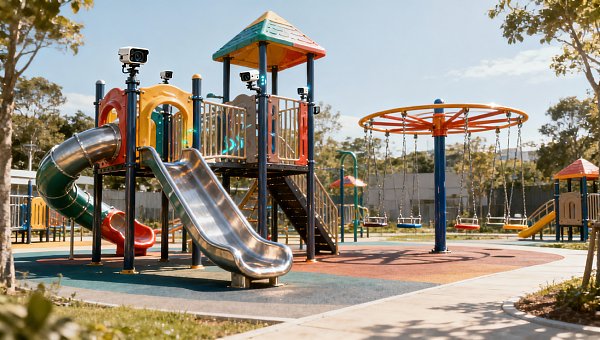
Certification matters, but compliant playground swings still need careful placement and integration. Safety performance depends on the full play environment, including spacing, surfacing, sightlines, and user flow.
- Check the applicable safety standards for the target market, such as ASTM, EN, or other local playground regulations.
- Confirm use zones and fall zones before finalizing equipment counts.
- Match surfacing depth and impact attenuation to the swing height and movement pattern.
- Review pinch points, entanglement risks, and chain connection details.
- Assess supervision lines so the swing bay does not create blind spots.
This systems view is one reason experienced sourcing teams request detailed drawings, test reports, installation guidance, and maintenance documentation before approval.
Capacity, layout, and user flow often determine project success
Play value is not created by equipment count alone. On active sites, the layout of playground swings has a direct effect on queuing, circulation, and conflict reduction.
A two-bay frame may work for a compact campus corner, but it may underperform in a regional park where visitor peaks are significant. The result can be crowding and unsafe waiting behavior.
There is also a design balance to consider. Too many swings can dominate the site and reduce diversity of play, while too few can turn a popular feature into a persistent bottleneck.
The most effective layouts typically account for three things at once: expected occupancy, movement around the swing zone, and how the swings relate to nearby climbing, sensory, or shaded areas.
Supplier evaluation should go beyond the catalog
In commercial sourcing, specification quality and supplier quality are closely linked. A swing may appear similar across catalogs, yet differences in welding, finish control, testing records, and spare part availability can be substantial.
This is where a data-backed sourcing approach becomes valuable. Buyers increasingly look for suppliers that can demonstrate manufacturing consistency, documented compliance, project references, and reliable after-sales support.
That approach aligns with the wider GCT perspective on commercial procurement: the goal is not simply to source a product, but to source confidence across design intent, regulatory fit, and delivery performance.
- Request test reports, material specifications, and coating details.
- Review installation requirements and spare part lead times.
- Check whether the supplier supports OEM or site-specific modifications.
- Ask for comparable project case studies in similar climates or public settings.
A practical selection framework
When comparing playground swings, it helps to narrow the decision through a structured review rather than brand preference alone.
Define the operating conditions
Map user ages, climate exposure, peak occupancy, supervision model, and maintenance frequency. These points shape the right frame type and material level.
Set non-negotiable compliance requirements
Identify the target standards and confirm whether the entire swing system, not only isolated parts, is supported by documentation.
Compare lifecycle implications
Estimate replacement intervals, inspection demands, coating performance, and spare part access. A slightly higher upfront cost can be justified by lower disruption later.
Test the fit within the wider play plan
Review how playground swings support inclusion, circulation, visual balance, and overall play diversity. Good selection improves the whole site, not only one activity zone.
What to do next before placing an order
A strong decision usually comes from disciplined comparison. Start by listing the site conditions that cannot be changed, then rank the performance factors that matter most.
From there, compare playground swings by safety documentation, material suitability, layout efficiency, and service support. If two options appear similar, the better one is usually the product with clearer evidence behind it.
For parks, schools, and community spaces, the most dependable swing choice is rarely the most generic one. It is the one that fits the site, respects compliance, and remains workable long after installation.
That makes the next step straightforward: refine the project brief, verify the required standards, and evaluate suppliers with the same rigor used for any long-life public asset.
Search News
Hot Articles
- Pro Stage AudioAudio Production for Streaming: How to Build a Dedicated Live Event MixOct 22, 2026
- Outdoor RidesIAAPA Launches Insurance Solution for North American Attractions IndustryOct 21, 2026
- Watch OEM & SmartwatchesWatch Movement Parts: How to Check Compatibility With a Specific CaliberOct 21, 2026
Popular Tags
Need ExpertConsultation?
Connect with our specialized leisureengineering team for procurementstrategies.
Recommended News
 Oct 21, 2026IAAPA Launches Insurance Solution for North American Attractions IndustryExplore IAAPA Insurance Solution, a dedicated insurance and risk management offering for North American attractions operators, and discover what it could mean for your business.● Theme Park Strategist
 Oct 20, 2026Energylandia Announces Rokan, Set to Be Europe’s Tallest and Longest B&M Wing CoasterDiscover Energylandia’s Rokan, set to become Europe’s tallest and longest B&M wing coaster. Explore the 62-metre thrill ride planned for spring 2027 in the new Volana themed area.● Theme Park Strategist
 Oct 03, 2026How to Select Leisure Park Equipment for Safe, High-Throughput Visitor AreasLeisure park equipment selection guide for safe, high-throughput venues—explore capacity, supervision, durability, accessibility, and supplier criteria.● Theme Park Strategist
 Sep 18, 2026What Drives Animatronic Dinosaur Manufacturer Prices for Theme Park Projects?Animatronic dinosaurs manufacturer price guide: compare motion, materials, controls, installation, and lifecycle costs to plan a durable theme park attraction.● Theme Park Strategist
 Sep 06, 2026Do Amusement Ride Safety Compliance Requirements Change Every Year?Do amusement safety compliance requirements change annually? Learn what really changes, from standards and inspections to permits, upgrades, and local approvals.● Theme Park Strategist
 Sep 02, 2026How Long Does It Take to Receive Full Safety Documents From an OEM?How long does it take to get full safety documentation from OEM partners? Discover realistic timelines, common delays, and practical steps to secure compliant files faster.● Theme Park Strategist
 Sep 03, 2026Designing Adventure Park Safety Systems for Zip Lines, Ropes Courses, and Daily InspectionsAdventure park safety systems: learn how to design safer zip lines and ropes courses with daily inspections, defect controls, rescue readiness, and staff training.● Theme Park Strategist
 Aug 22, 2026What to Look for When Choosing Three Seat Jet Skis for Rental or Resort UseThree seat jet skis for rental or resort use should balance stability, safety, maintenance, and guest comfort. Learn how to choose models that boost uptime and guest satisfaction.● Theme Park Strategist
 Aug 17, 2026What Parts Matter Most in a Roller Coaster and How Do They Affect Ride Safety?Roller coaster parts determine ride safety more than most riders realize. Explore how tracks, restraints, brakes, wheels, and control systems work together to protect every ride.● Theme Park Strategist
 Aug 15, 20262026 China Sports Expo Sees 45.74% More Overseas Pre-registered Buyers as POB Expands Procurement Matching2026 China Sports Expo boosts overseas pre-registered buyers by 45.74% as POB expands procurement matching for fitness, outdoor, and venue suppliers.● Theme Park Strategist
 Aug 14, 2026What Should Buyers Check Before Choosing a Flying Chair Ride Exporter?Flying chair ride exporter buyers should check safety, structure, export support, and spare parts before purchase to reduce risk and choose a reliable supplier.● Theme Park Strategist
 Aug 04, 2026EU Issues EN 1176-1:2026 for Playground SafetyEU Issues EN 1176-1:2026 for Playground Safety: learn how the new standard impacts Outdoor Rides, CE certification, inventory checks, and EU compliance before March 2027.● Theme Park Strategist
 Aug 03, 2026CPSC Adopts ASTM F1487-26 for Imported Outdoor RidesOutdoor Rides face a major U.S. compliance shift as CPSC adopts ASTM F1487-26. Learn the new certification, testing, and customs risks before November 1, 2026.● Theme Park Strategist
 Jul 26, 2026Revised EN 1176:2026 Triggers Re-Certification for Outdoor RidesOutdoor Rides face immediate EN 1176:2026 re-certification for new CE applications. Learn how testing, documentation, and EU market access rules now affect exports and delivery plans.● Theme Park Strategist
 Jul 21, 2026CPSC Recall Flags Structural Risk in Outdoor RidesCPSC recall flags structural risk in outdoor rides: learn how ASTM F1487-23 failures affect importers, distributors, and compliance teams across the U.S., Canada, and Australia.● Theme Park Strategist
 Jul 19, 2026How to Choose Outdoor Fitness Equipment for Parks Based on Users, Space, and BudgetOutdoor fitness equipment for parks: learn how to choose the right mix based on users, space, and budget to improve safety, usage, and long-term value.● Theme Park Strategist
 Jul 15, 2026Ocean Freight Spike Pressures Outdoor Rides ExportsOcean Freight Spike Pressures Outdoor Rides Exports as Shanghai-Rotterdam rates surge 42%. See how rising freight costs, delays, and rerouting risks could reshape Europe-bound delivery plans.● Theme Park Strategist
 Jul 14, 2026EN 1176 Revision Takes Effect for Outdoor Ride Weld TestingEN 1176 revision takes effect for outdoor ride weld testing from Sept 1, 2026. Learn ISO 5817 level B, third-party NDT report rules, and key EU compliance steps.● Theme Park Strategist
 Jul 12, 2026Vietnam Requires AI Anti-Collision Systems for Imported Outdoor RidesVietnam Requires AI Anti-Collision Systems for Imported Outdoor Rides from Sept. 15, 2026. Learn compliance rules, VAST certification needs, and how importers can avoid delays.● Theme Park Strategist
 Jul 11, 2026Vietnam Tightens Rules for Imported Outdoor RidesVietnam Tightens Rules for Imported Outdoor Rides: learn how Vietnam’s 2026 compliance update adds AI anti-collision, Vietnamese logs, and local maintenance duties for importers and manufacturers.● Theme Park Strategist
 Jul 09, 2026How to Evaluate a Lazy River Equipment Supplier for Safety, Flow Design, and MaintenanceLazy river equipment supplier selection affects safety, flow design, and maintenance costs. Learn what to compare, what to ask, and how to choose a reliable partner.● Theme Park Strategist
 Jul 08, 2026RCEP Update Cuts ASEAN Tariffs to Zero for Outdoor RidesRCEP update cuts ASEAN tariffs to zero for outdoor rides from China. Learn how FSC-CoC, PEFC traceability, and e-CO compliance affect exports, sourcing, and buyer decisions.● Theme Park Strategist
 Jul 07, 2026RCEP Guide Adds Dual Wood Traceability for Outdoor RidesOutdoor Rides exporters face a new RCEP traceability rule: dual FSC-CoC and PEFC-STS 2023 codes for wood components. See what changes before Oct. 1, 2026.● Theme Park Strategist
 Jul 06, 2026Vietnam Tightens RCEP Rules for Wooden Ride PartsVietnam Tightens RCEP Rules for Wooden Ride Parts: learn how FSC Chain-of-Custody and QR code requirements now affect outdoor rides, RCEP imports, and shipment compliance.● Theme Park Strategist