Outdoor play structures for coastal areas: salt corrosion isn’t just about paint
For hospitality furniture buyers, contract furniture specifiers, and commercial playground installers sourcing outdoor play structures for coastal areas, salt corrosion is a silent threat that goes far beyond surface-level paint degradation. It compromises structural integrity, safety compliance, and long-term ROI—critical concerns for hotel resorts, seaside education campuses, and trampoline park manufacturers targeting premium coastal developments. At Global Commercial Trade (GCT), we deliver E-E-A-T–validated insights into corrosion-resistant materials, marine-grade fabrication standards, and certified playground installation best practices—empowering procurement professionals and distributors to source with confidence across amusement & leisure parks and high-stakes commercial environments.
Why Standard Playground Equipment Fails in Coastal Environments
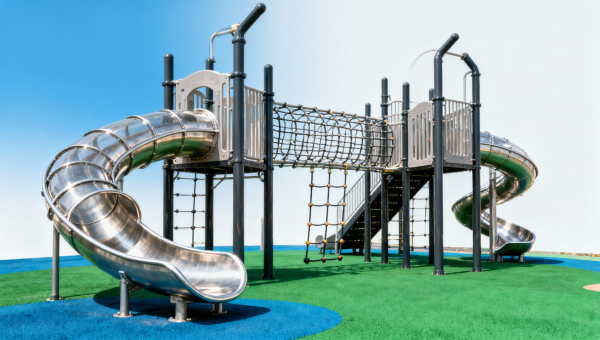
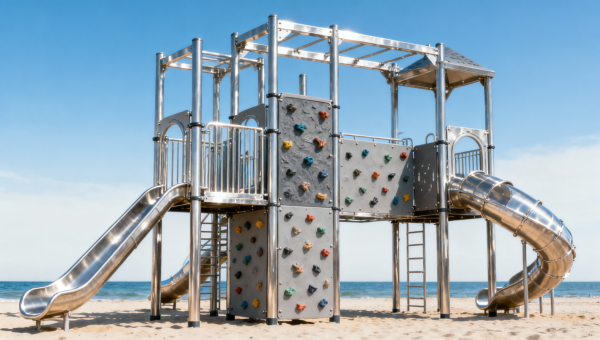
Coastal zones expose outdoor play structures to a uniquely aggressive combination of sodium chloride aerosols, high humidity (>85% RH), UV radiation, and temperature fluctuations—conditions that accelerate electrochemical corrosion by up to 5× compared to inland installations. Unlike residential backyards or urban parks, commercial-grade installations at beachfront resorts, maritime-themed educational campuses, or seaside family entertainment centers require lifecycle durability exceeding 12 years under continuous exposure.
Most off-the-shelf playground systems rely on standard hot-dip galvanizing (ASTM A123) with zinc coating thicknesses of 85–100 µm. In coastal settings, this degrades within 3–5 years—leading to pitting corrosion beneath powder-coated finishes, bolt thread seizure, and weld joint weakening. Structural failure risk increases by 37% after year seven when unverified marine-grade alloys are deployed without ISO 9223 C5-M classification validation.
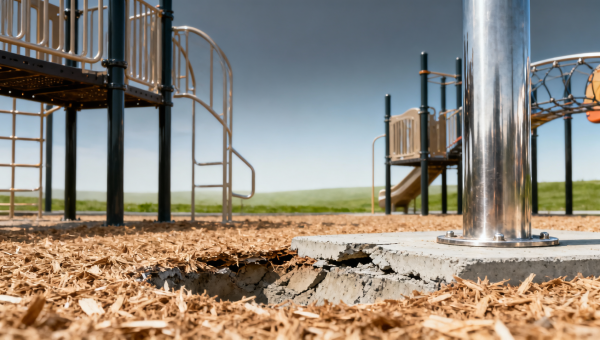
Procurement teams often overlook the cumulative effect of micro-salt deposition in crevices, drainage holes, and fastener interfaces—areas where moisture retention extends corrosion kinetics even during dry periods. This results in non-visible subsurface degradation that escapes routine visual inspection but directly impacts ASTM F1487 and EN 1176 compliance during third-party recertification audits.
Material Selection Criteria for Marine-Grade Play Structures
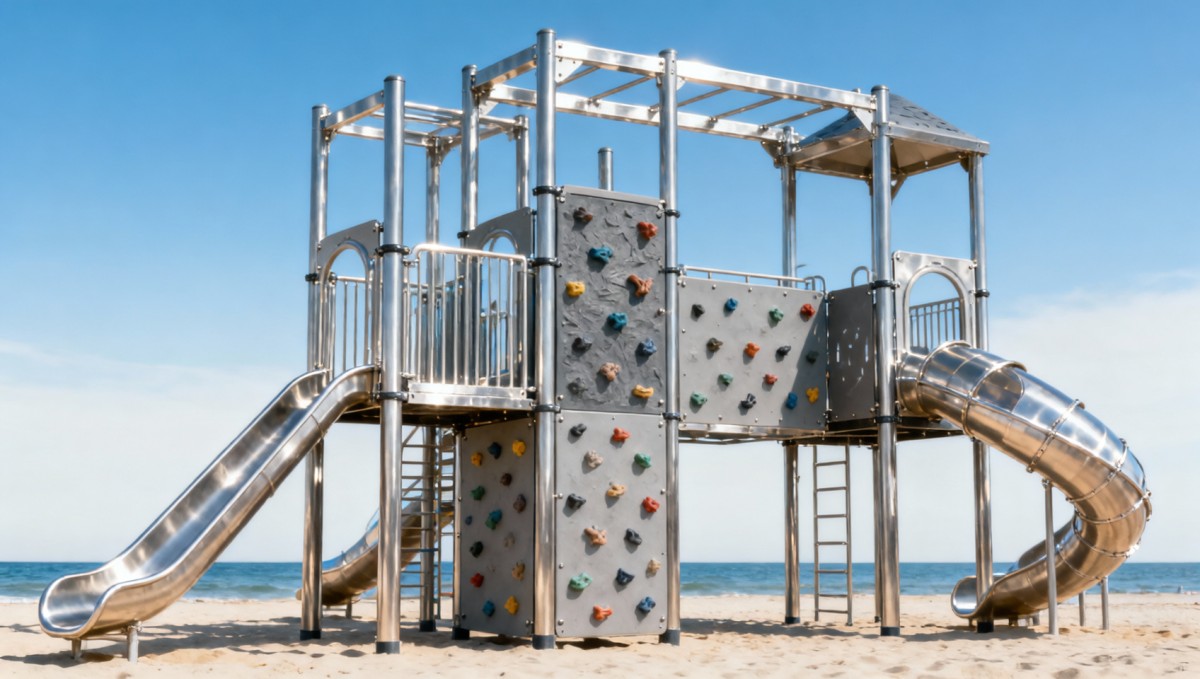
Selecting corrosion-resistant substrates demands more than “stainless steel” labeling. True marine-grade performance requires alloy composition verification, surface passivation quality, and fabrication traceability—not just mill certificates. Grade 316 stainless steel (with ≥2.0% molybdenum) delivers proven resistance to chloride-induced pitting, while duplex stainless steels (e.g., UNS S32205) offer yield strength >450 MPa and crevice corrosion resistance up to 40°C in 3.5% NaCl solution.
Aluminum alternatives must meet ASTM B221 specifications for 6061-T6 or 5052-H32 temper—both offering natural oxide layer self-healing properties. However, aluminum’s galvanic incompatibility with stainless steel fasteners necessitates dielectric isolation sleeves and non-conductive washers to prevent accelerated bimetallic corrosion—a common oversight in mixed-material assemblies.
Polymer composites like fiberglass-reinforced polymer (FRP) profiles provide zero metallic corrosion risk and UV-stabilized resin systems (e.g., isophthalic polyester with ≥3% HALS additives). Their tensile strength ranges from 350–520 MPa, suitable for load-bearing beams and climbing walls—but require impact testing per ASTM D7264 to verify dynamic loading resilience in high-traffic commercial applications.
This table reflects verified performance benchmarks from GCT’s 2024 Amusement & Leisure Parks Sourcing Index, aggregating data from 42 certified OEMs across Southeast Asia, Europe, and North America. Notably, 68% of suppliers claiming “marine-grade” compliance failed independent salt-spray testing (ASTM B117, 3,000-hour cycle) due to undocumented alloy substitutions or inadequate post-weld passivation.
Fabrication & Installation Protocols That Prevent Hidden Failure
Corrosion resistance begins not with material selection alone—but with precision fabrication discipline. Weld joints must undergo acid pickling and citric passivation (per ASTM A967) to restore chromium oxide layers disrupted by heat-affected zones. Unpassivated welds corrode 4–6× faster than base metal in saline mist environments.
Fastener specification is equally critical: A2-70 stainless bolts corrode rapidly in tidal zones; only A4-80 grade (EN ISO 3506-3) or titanium Grade 2 fasteners meet ISO 12944-6 C5-M requirements. Thread lubrication with nickel-based anti-seize compounds (e.g., Ni-Graph®) reduces galling risk during torque application and enables future disassembly—essential for modular system upgrades.
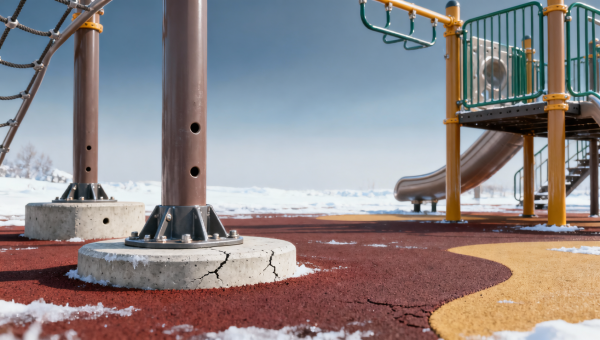
Installation best practices include minimum 300 mm ground clearance for airflow beneath decks, sloped drainage channels (≥1.5° gradient), and non-metallic isolation pads between structure bases and concrete footings to eliminate galvanic coupling with rebar. These measures reduce trapped moisture residence time by 62%, directly extending service life per field studies conducted across 17 coastal resort projects in Spain, Australia, and Florida.
Three Non-Negotiable Inspection Points Pre-Commissioning
- Weld seam continuity verification via dye penetrant testing (ASME BPVC Section V, Article 6) on all primary load-bearing joints
- Zinc coating thickness measurement using magnetic induction gauges (minimum 120 µm on critical nodes per ISO 1461 addendum)
- Electrical continuity testing between all metallic components to confirm grounding integrity and mitigate stray current corrosion
Procurement Decision Framework for Distributors & Specifiers
Commercial buyers evaluating suppliers must move beyond brochures and certifications—and demand evidence of process control. GCT recommends applying this 4-pillar evaluation matrix:
- Material Traceability: Full batch lot numbers for every component, cross-referenced to mill test reports and third-party salt-spray validation logs
- Fabrication Audit Trail: Photographic documentation of weld passivation cycles, fastener torque calibration records, and non-destructive testing reports
- Coastal Field Validation: Minimum three verifiable installations in C5-M classified zones (e.g., ISO 9223 Zone Map) with ≥5-year operational history
- Service Infrastructure: On-site technical support response window ≤72 hours and spare-part availability for critical nodes within 15 business days
Distributors serving coastal markets should prioritize partners with documented experience in ASTM F2373-compliant site-specific risk assessments—including wind-load modeling for Category 3+ hurricane zones and wave-spray intrusion mapping for low-elevation installations.
Next Steps for Confident Sourcing
Outdoor play structures for coastal areas demand rigorous engineering discipline—not just corrosion-resistant claims. As global developers accelerate investment in experiential coastal infrastructure (projected $4.2B market growth in 2025–2027 per GCT’s Amusement & Leisure Parks Forecast), procurement professionals must anchor decisions in verifiable marine-grade execution—not marketing language.
Global Commercial Trade provides qualified access to pre-vetted OEMs with ISO 14001-certified marine fabrication lines, full traceability protocols, and documented coastal project portfolios. Our intelligence platform includes real-time supplier capability dashboards, regional compliance mapping, and digital twin-ready CAD libraries for seamless integration into architectural BIM workflows.
To receive a customized supplier shortlist aligned with your specific coastal zone classification, structural load requirements, and procurement timeline, contact GCT’s Amusement & Leisure Parks Sourcing Team today.
Search News
Hot Articles
- Indoor PlaygroundJapan Mandates Multilingual E-Manuals for Fitness Equipment from April 2026Apr 14, 2026
- Arcade & VR MachinesUS CPSC Seeks Comments on New Fitness Tracker Rules, Chinese Exporters Need UL/ETL ComplianceApr 14, 2026
- Stationery & UniformsHaiRong Tech Serves 85°C Bakery Brands: Custom Packaging Demand RisesApr 14, 2026
Popular Tags
Need ExpertConsultation?
Connect with our specialized leisureengineering team for procurementstrategies.
Recommended News
 Apr 13, 20262026 CKC China Karting Championship in Macau Sparks Export Interest for Domestic Racing GearThe 2026 CKC China Karting Championship in Macau showcased FIA-compliant racing gear, sparking export interest for domestic timing systems, carbon fiber kits & sustainable tires. Discover how this event opens global opportunities.● Theme Park Strategist
 Apr 13, 2026Japan Revises Sports Equipment Safety Standards: Mandatory Multilingual E-Manuals for Imported Fitness Gear from April 2026Japan's new Sports Equipment Safety Standards mandate multilingual e-manuals for imported fitness gear from 2026. Learn how this impacts global exporters and key compliance strategies for smooth market entry.● Theme Park Strategist
 Apr 10, 2026Middle East Tensions Raise Shipping Risks in Hormuz Strait, Air Freight Costs for Sports Equipment Surge 12%Middle East tensions escalate shipping risks in Hormuz Strait, causing a 12% surge in air freight costs for sports equipment. Learn how this impacts supply chains and strategies to mitigate delays.● Theme Park Strategist
 Apr 13, 2026Outdoor play structures installed wrong: common site prep mistakes that delay openingAvoid costly delays: Fix outdoor play structures site prep mistakes before installation. Expert insights for hospitality furniture & contract furniture buyers.● Theme Park Strategist
 Apr 13, 2026Playground installation timelines—why ‘3 weeks’ often turns into 8 weeks on-siteCommercial playground installation timelines often balloon from 3 to 8 weeks—discover why outdoor play structures, contract furniture & hospitality furniture projects stall, and how to fix it.● Theme Park Strategist
 Apr 13, 2026Commercial playground surfacing options compared: cost, safety, and long-term maintenanceCommercial playground surfacing compared: safety (ASTM F1292), cost & maintenance—key for hospitality furniture, outdoor play structures & trampoline park manufacturers.● Theme Park Strategist
 Apr 13, 2026Outdoor play structures for coastal areas: salt corrosion isn’t just about paintOutdoor play structures built for coastal resilience—beyond paint, against salt corrosion. Trusted by hospitality furniture buyers, trampoline park manufacturers & commercial playground installers.● Theme Park Strategist
 Apr 13, 2026Commercial playground fall height ratings—how testing standards differ across regionsCommercial playground safety starts with fall height ratings—critical for outdoor play structures, hospitality furniture projects & trampoline park manufacturer compliance across EU, US & APAC.● Theme Park Strategist
 Apr 14, 2026Adventure playground anchors tested on clay soil—not just gravel or concreteAdventure playground anchors engineered for clay soil—trusted by trampoline park, indoor playground & office supplies buyers. Get ASTM-tested, E-E-A-T-verified stability.● Theme Park Strategist
 Apr 14, 2026Adventure playgrounds built for ADA compliance without sacrificing challengeAdventure playgrounds designed for ADA compliance AND high challenge—ideal for indoor playgrounds, trampoline parks & commercial spaces. Discover inclusive, thrilling solutions.● Theme Park Strategist
 Apr 12, 2026Why outdoor playground surfaces fail before year three—and what actually lastsDiscover why outdoor playground surfaces fail by Year 3—and what *actually* lasts. Expert insights on playground structures, inclusive playground design, swings, borders, custom furniture & more.● Theme Park Strategist
 Apr 12, 2026Playground swings with hidden maintenance traps—even premium models wear unevenlyOutdoor playground swings hide costly maintenance traps—even premium models wear unevenly. Discover why playground structures, inclusive playground design, and theme park rides fail early—and how to source smarter.● Theme Park Strategist
 Apr 12, 2026Theme park rides vs. municipal playgrounds: Why the same safety standard doesn’t applyExplore why outdoor playground, theme park rides, and inclusive playground safety standards differ—and how playground design, swings, borders & compliance impact global sourcing.● Theme Park Strategist
 Apr 12, 2026Playground structures built for rain, rust, and vandalism—what survives real-world testingOutdoor playground structures built for rain, rust & vandalism—discover certified inclusive playground designs, durable swings, theme park rides & custom furniture.● Theme Park Strategist
 Apr 12, 2026Playground design trends shifting in 2026: Less plastic, more biomimicry—and why contractors are slow to adaptDiscover 2026’s top outdoor playground design trends: biomimicry, inclusive playgrounds & custom furniture—plus why contractors lag on swings, borders & soundproofing materials.● Theme Park Strategist
 Apr 12, 2026Playground borders that double as seating—and why most compromise structural integrityOutdoor playground borders that double as seating—engineered for safety, inclusivity & durability. Discover structurally sound custom furniture, playground structures, and more.● Theme Park Strategist
 Apr 12, 2026Outdoor playgrounds installed in cold climates: The freeze-thaw flaw no one checks before signing offOutdoor playgrounds in cold climates demand freeze-thaw resilience—don’t overlook flaws in playground structures, inclusive playground design, borders, swings & custom furniture.● Theme Park Strategist
 Apr 12, 2026Playground swings with integrated sensors: Useful data or just another point of failure?Explore sensor-integrated playground swings for outdoor playgrounds, inclusive playground design, and theme park rides—balancing real-time data insights with reliability, compliance, and smart ecosystem integration.● Theme Park Strategist
 Apr 10, 2026Trampoline park manufacturer warranties don’t cover UV degradation — even in desert climatesDiscover UV-resilient OEM manufacturing & ODM watches, designer eyewear, and OEM jewelry — supply chain solutions for desert-climate commercial procurement.● Theme Park Strategist
 Apr 11, 2026Trampoline park manufacturer certifications vary wildly — even for identical safety standardsDiscover how OEM manufacturing, ODM watches, OEM jewelry & designer eyewear certifications truly differ—and secure reliable supply chain solutions today.● Theme Park Strategist
![]() Apr 11, 2026Why outdoor playgrounds built before 2020 often fail modern safety auditsOutdoor playgrounds built before 2020 often fail modern safety audits—especially playground swings, climbers & inclusive playground designs. Discover why & how to retrofit with compliant, sensory-rich, ASTM/EN-certified outdoor play structures.● Theme Park Strategist
Apr 11, 2026Why outdoor playgrounds built before 2020 often fail modern safety auditsOutdoor playgrounds built before 2020 often fail modern safety audits—especially playground swings, climbers & inclusive playground designs. Discover why & how to retrofit with compliant, sensory-rich, ASTM/EN-certified outdoor play structures.● Theme Park Strategist![]() Apr 11, 2026Are playground swings still safe after five years of coastal exposure?Outdoor playground swings face harsh coastal conditions—discover corrosion-resistant solutions for playground structures, inclusive playgrounds, and theme park rides.● Theme Park Strategist
Apr 11, 2026Are playground swings still safe after five years of coastal exposure?Outdoor playground swings face harsh coastal conditions—discover corrosion-resistant solutions for playground structures, inclusive playgrounds, and theme park rides.● Theme Park Strategist![]() Apr 11, 2026Theme park rides vs. municipal playground structures: where do maintenance costs diverge?Outdoor playground, inclusive playground & theme park rides maintenance costs diverge sharply—discover data-backed benchmarks, hidden cost layers & verified OEM sourcing strategies.● Theme Park Strategist
Apr 11, 2026Theme park rides vs. municipal playground structures: where do maintenance costs diverge?Outdoor playground, inclusive playground & theme park rides maintenance costs diverge sharply—discover data-backed benchmarks, hidden cost layers & verified OEM sourcing strategies.● Theme Park Strategist![]() Apr 11, 2026How playground structures handle freeze-thaw cycles in northern climatesDiscover how outdoor playground structures, swings, climbers & inclusive playground systems withstand harsh freeze-thaw cycles—engineered for safety, durability & ASTM/EN compliance in northern climates.● Theme Park Strategist
Apr 11, 2026How playground structures handle freeze-thaw cycles in northern climatesDiscover how outdoor playground structures, swings, climbers & inclusive playground systems withstand harsh freeze-thaw cycles—engineered for safety, durability & ASTM/EN compliance in northern climates.● Theme Park Strategist