Theme park rides vs. municipal playgrounds: Why the same safety standard doesn’t apply
When specifying playground swings, outdoor playground structures, or inclusive playground designs for municipal spaces—or sourcing theme park rides for high-capacity commercial venues—procurement professionals quickly realize: safety compliance isn’t one-size-fits-all. Unlike custom furniture, catering equipment, or soundproofing materials governed by sector-agnostic standards, playground borders and theme park rides operate under radically different risk profiles, testing protocols, and regulatory frameworks. This article unpacks why ASTM F1487 (playground structures) and ASTM F2291 (theme park rides) coexist—not converge—and what it means for global buyers evaluating playground design, OEM capabilities, and supply chain reliability.
Why Risk Profile Dictates Compliance Architecture
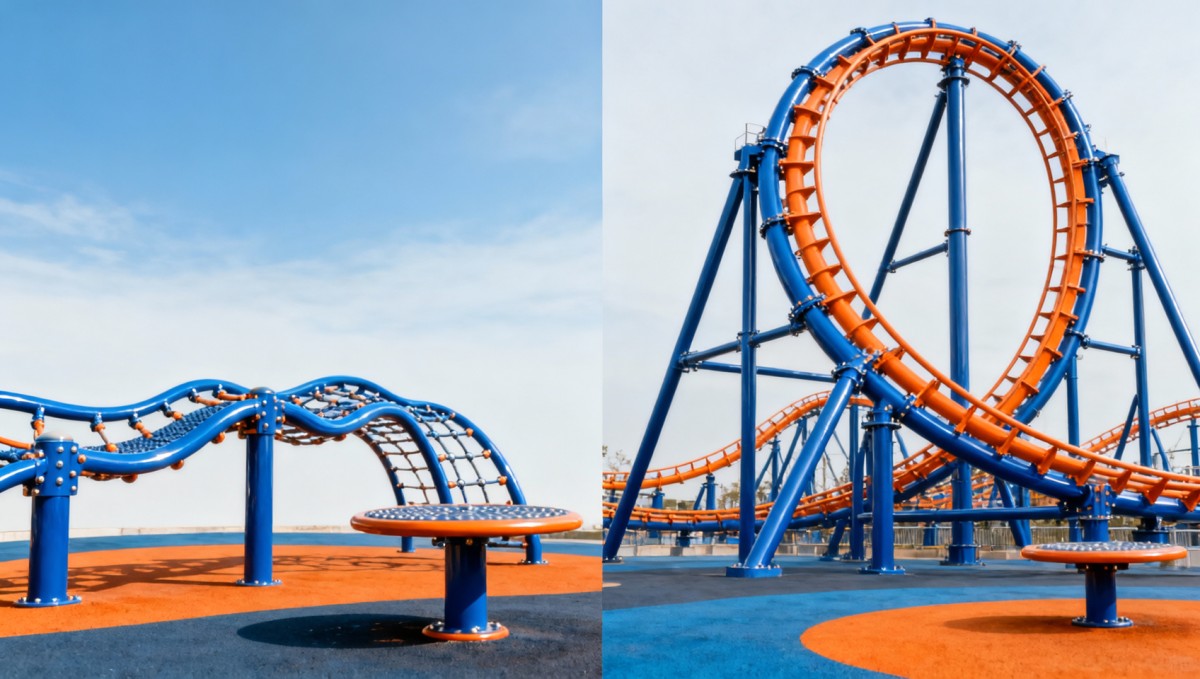
A municipal playground serves children aged 2–12 in low-frequency, unsupervised use—typically 3–5 hours per day, with peak occupancy rarely exceeding 20 users. In contrast, a Tier-1 theme park ride operates 14–16 hours daily, cycles 800–1,200 riders per hour, and sustains dynamic loads exceeding 4G during operation. These divergent operational envelopes demand fundamentally distinct engineering philosophies.
ASTM F1487 focuses on static load capacity, impact attenuation (critical fall height ≤ 6 ft), and entrapment prevention. Its testing cycle includes 3,000 cycles of simulated child use over 7 days—a benchmark aligned with municipal maintenance schedules and budget cycles. ASTM F2291, however, mandates fatigue testing across 10 million operational cycles, real-time sensor validation of structural strain, and redundant braking systems certified to ISO 13849-1 PL e (Performance Level e).
This isn’t regulatory overreach—it’s physics-driven necessity. A swing set failure may result in localized injury; a ride restraint system failure poses systemic liability exposure across jurisdictions, insurers, and international licensing bodies like IAAPA and EN 13814.
How Procurement Teams Map Standards to Sourcing Strategy
Global procurement directors don’t evaluate compliance documents in isolation—they map them to three concrete decision vectors: OEM certification depth, supply chain traceability, and post-installation support infrastructure. For example, ASTM F1487-compliant playground suppliers must demonstrate third-party verification of surfacing IPEMA certification and ASTM F1292 impact testing reports dated within the last 12 months.
Theme park ride procurement, however, requires full lifecycle documentation: UL 61476 electrical safety certification, ASME B30.19 rigging validation, and FAT (Factory Acceptance Testing) sign-off logs witnessed by licensed mechanical engineers. Lead times reflect this rigor: municipal playgrounds ship in 6–10 weeks; certified ride systems require 26–36 weeks from PO to commissioning.
This table reveals why cross-category sourcing is operationally unviable: a supplier qualified for municipal projects lacks the QA infrastructure to meet ride-level documentation requirements—and vice versa. Buyers who conflate these tiers risk non-acceptance at site commissioning, insurance voidance, or regulatory stop-work orders.
Where Global Sourcing Adds Value Beyond Certification
Certification is necessary—but insufficient—for global procurement. Leading buyers now prioritize three value-add layers: regional compliance harmonization, multilingual technical documentation, and modular design adaptability. For instance, EU municipalities require EN 1176 + EN 1177 alignment alongside ASTM F1487; APAC clients often mandate JIS T 9001–2019 compatibility.
GCT’s Amusement & Leisure Parks intelligence hub delivers verified OEM capability reports that cross-map 12+ regional standards against each manufacturer’s active certifications—validated quarterly by our panel of commercial space safety auditors. This eliminates manual standard reconciliation, reducing RFQ turnaround time by 3–5 business days per project.
Moreover, top-tier suppliers now embed “compliance-by-design”: adjustable anchoring kits for varying soil types (ASTM D1883 CBR ≥ 15 vs. ≥ 50), dual-language installation manuals (EN/ES/ZH), and ride control firmware pre-loaded with local language UI and emergency protocol overrides.
What to Verify Before Signing Your Next Sourcing Agreement
Procurement teams should treat compliance as a live, auditable process—not a static document stamp. Prior to contract finalization, verify these five checkpoints:
- Request dated copies of current third-party lab reports—not just certificates—with visible test dates, sample IDs, and scope statements matching your exact product configuration.
- Confirm FAT/SAT witness protocols: Are tests conducted on identical serial-numbered units destined for your site? Is remote witnessing via encrypted video accepted?
- Validate spare parts availability: Theme park ride OEMs must stock critical components (e.g., hydraulic actuators, PLC modules) for ≥ 15 years post-delivery per ASTM F2291 Annex C.
- Review warranty terms: Municipal playground warranties typically cover 10 years on structure and 5 years on surfacing; ride systems require minimum 24-month comprehensive coverage with 72-hour SLA for critical failures.
- Assess documentation architecture: Does the supplier provide structured XML/JSON data exports for your CMMS or asset management platform?
Why Partner With GCT for Your Next Commercial Experience Sourcing Cycle
Global Commercial Trade doesn’t aggregate generic catalogs—we curate commercially actionable intelligence for experiential infrastructure procurement. Our Amusement & Leisure Parks vertical features:
- Verified OEM/ODM capability matrices, updated biannually and cross-referenced with on-site audits across 11 manufacturing hubs in China, Turkey, Poland, and Mexico.
- Standard-specific sourcing guides—including ASTM F1487/F2291 gap analysis templates and regional compliance roadmaps for EU, GCC, ASEAN, and LATAM markets.
- Direct access to GCT-certified technical reviewers who conduct pre-bid compliance reviews and generate redline-ready specification documents.
If you’re evaluating playground design for a smart campus rollout, specifying rides for a new integrated resort, or building a distributor portfolio for commercial play equipment—contact GCT to request: (1) OEM capability report for your target compliance tier, (2) lead-time forecast based on your delivery window, or (3) regional certification mapping for your next RFP.
Search News
Hot Articles
- Watch OEM & SmartwatchesWatches & Wonders Geneva 2026: Audemars Piguet Returns, 10 New Brands Join, Behrens as Sole Chinese ExhibitorApr 11, 2026
- Watch OEM & SmartwatchesEU EN 16830:2026 Eyewear Standard Mandatory from April 2026, Chinese Exporters Need Certification Within 6 MonthsApr 11, 2026
- Smart Campus Tech2026 China Intl Education Expo: AI & Green Tech in SpotlightApr 11, 2026
Popular Tags
Need ExpertConsultation?
Connect with our specialized leisureengineering team for procurementstrategies.
Recommended News
 Apr 10, 2026Middle East Tensions Raise Shipping Risks in Hormuz Strait, Air Freight Costs for Sports Equipment Surge 12%Middle East tensions escalate shipping risks in Hormuz Strait, causing a 12% surge in air freight costs for sports equipment. Learn how this impacts supply chains and strategies to mitigate delays.● Theme Park Strategist
 Apr 12, 2026Why outdoor playground surfaces fail before year three—and what actually lastsDiscover why outdoor playground surfaces fail by Year 3—and what *actually* lasts. Expert insights on playground structures, inclusive playground design, swings, borders, custom furniture & more.● Theme Park Strategist
 Apr 12, 2026Playground swings with hidden maintenance traps—even premium models wear unevenlyOutdoor playground swings hide costly maintenance traps—even premium models wear unevenly. Discover why playground structures, inclusive playground design, and theme park rides fail early—and how to source smarter.● Theme Park Strategist
 Apr 12, 2026Theme park rides vs. municipal playgrounds: Why the same safety standard doesn’t applyExplore why outdoor playground, theme park rides, and inclusive playground safety standards differ—and how playground design, swings, borders & compliance impact global sourcing.● Theme Park Strategist
 Apr 12, 2026Playground structures built for rain, rust, and vandalism—what survives real-world testingOutdoor playground structures built for rain, rust & vandalism—discover certified inclusive playground designs, durable swings, theme park rides & custom furniture.● Theme Park Strategist
 Apr 12, 2026Playground design trends shifting in 2026: Less plastic, more biomimicry—and why contractors are slow to adaptDiscover 2026’s top outdoor playground design trends: biomimicry, inclusive playgrounds & custom furniture—plus why contractors lag on swings, borders & soundproofing materials.● Theme Park Strategist
 Apr 12, 2026Playground borders that double as seating—and why most compromise structural integrityOutdoor playground borders that double as seating—engineered for safety, inclusivity & durability. Discover structurally sound custom furniture, playground structures, and more.● Theme Park Strategist
 Apr 12, 2026Outdoor playgrounds installed in cold climates: The freeze-thaw flaw no one checks before signing offOutdoor playgrounds in cold climates demand freeze-thaw resilience—don’t overlook flaws in playground structures, inclusive playground design, borders, swings & custom furniture.● Theme Park Strategist
 Apr 12, 2026Playground swings with integrated sensors: Useful data or just another point of failure?Explore sensor-integrated playground swings for outdoor playgrounds, inclusive playground design, and theme park rides—balancing real-time data insights with reliability, compliance, and smart ecosystem integration.● Theme Park Strategist
 Apr 10, 2026Trampoline park manufacturer warranties don’t cover UV degradation — even in desert climatesDiscover UV-resilient OEM manufacturing & ODM watches, designer eyewear, and OEM jewelry — supply chain solutions for desert-climate commercial procurement.● Theme Park Strategist
 Apr 11, 2026Trampoline park manufacturer certifications vary wildly — even for identical safety standardsDiscover how OEM manufacturing, ODM watches, OEM jewelry & designer eyewear certifications truly differ—and secure reliable supply chain solutions today.● Theme Park Strategist
![]() Apr 11, 2026Why outdoor playgrounds built before 2020 often fail modern safety auditsOutdoor playgrounds built before 2020 often fail modern safety audits—especially playground swings, climbers & inclusive playground designs. Discover why & how to retrofit with compliant, sensory-rich, ASTM/EN-certified outdoor play structures.● Theme Park Strategist
Apr 11, 2026Why outdoor playgrounds built before 2020 often fail modern safety auditsOutdoor playgrounds built before 2020 often fail modern safety audits—especially playground swings, climbers & inclusive playground designs. Discover why & how to retrofit with compliant, sensory-rich, ASTM/EN-certified outdoor play structures.● Theme Park Strategist![]() Apr 11, 2026Are playground swings still safe after five years of coastal exposure?Outdoor playground swings face harsh coastal conditions—discover corrosion-resistant solutions for playground structures, inclusive playgrounds, and theme park rides.● Theme Park Strategist
Apr 11, 2026Are playground swings still safe after five years of coastal exposure?Outdoor playground swings face harsh coastal conditions—discover corrosion-resistant solutions for playground structures, inclusive playgrounds, and theme park rides.● Theme Park Strategist![]() Apr 11, 2026Theme park rides vs. municipal playground structures: where do maintenance costs diverge?Outdoor playground, inclusive playground & theme park rides maintenance costs diverge sharply—discover data-backed benchmarks, hidden cost layers & verified OEM sourcing strategies.● Theme Park Strategist
Apr 11, 2026Theme park rides vs. municipal playground structures: where do maintenance costs diverge?Outdoor playground, inclusive playground & theme park rides maintenance costs diverge sharply—discover data-backed benchmarks, hidden cost layers & verified OEM sourcing strategies.● Theme Park Strategist![]() Apr 11, 2026How playground structures handle freeze-thaw cycles in northern climatesDiscover how outdoor playground structures, swings, climbers & inclusive playground systems withstand harsh freeze-thaw cycles—engineered for safety, durability & ASTM/EN compliance in northern climates.● Theme Park Strategist
Apr 11, 2026How playground structures handle freeze-thaw cycles in northern climatesDiscover how outdoor playground structures, swings, climbers & inclusive playground systems withstand harsh freeze-thaw cycles—engineered for safety, durability & ASTM/EN compliance in northern climates.● Theme Park Strategist![]() Apr 11, 2026Inclusive playgrounds that pass ADA audits — and those that don’tInclusive playground, outdoor playground & sensory playground designs that pass ADA audits—avoid costly retrofits. See why playground swings, climbers, music accessories & theme park rides fail.● Theme Park Strategist
Apr 11, 2026Inclusive playgrounds that pass ADA audits — and those that don’tInclusive playground, outdoor playground & sensory playground designs that pass ADA audits—avoid costly retrofits. See why playground swings, climbers, music accessories & theme park rides fail.● Theme Park Strategist![]() Apr 11, 2026Playground design mistakes that delay municipal approvals by 3+ monthsAvoid 3+ month delays! Fix outdoor playground, inclusive playground & sensory playground design mistakes—get ASTM/EN-compliant playground structures, swings, climbers & music accessories now.● Theme Park Strategist
Apr 11, 2026Playground design mistakes that delay municipal approvals by 3+ monthsAvoid 3+ month delays! Fix outdoor playground, inclusive playground & sensory playground design mistakes—get ASTM/EN-compliant playground structures, swings, climbers & music accessories now.● Theme Park Strategist![]() Apr 11, 2026Sensory playgrounds with real therapeutic input — or just marketing buzz?Sensory playground, inclusive playground & outdoor playground designs with clinical validation—not just buzz. Discover evidence-based playground swings, climbers, music accessories & more.● Theme Park Strategist
Apr 11, 2026Sensory playgrounds with real therapeutic input — or just marketing buzz?Sensory playground, inclusive playground & outdoor playground designs with clinical validation—not just buzz. Discover evidence-based playground swings, climbers, music accessories & more.● Theme Park Strategist![]() Apr 11, 2026Playground climbers installed on slopes: what the engineering reports rarely mentionOutdoor playground climbers on slopes demand expert engineering—discover hidden risks in inclusive playground, sensory playground & outdoor play structures design.● Theme Park Strategist
Apr 11, 2026Playground climbers installed on slopes: what the engineering reports rarely mentionOutdoor playground climbers on slopes demand expert engineering—discover hidden risks in inclusive playground, sensory playground & outdoor play structures design.● Theme Park Strategist![]() Apr 11, 2026Outdoor play structures rated for high-wind zones — and why most spec sheets hide the dataOutdoor playground structures rated for high-wind zones — discover certified outdoor play structures, inclusive playgrounds, sensory playgrounds & more.● Theme Park Strategist
Apr 11, 2026Outdoor play structures rated for high-wind zones — and why most spec sheets hide the dataOutdoor playground structures rated for high-wind zones — discover certified outdoor play structures, inclusive playgrounds, sensory playgrounds & more.● Theme Park Strategist![]() Apr 11, 2026Do inclusive playgrounds really reduce supervision ratios — or increase liability risk?Inclusive playground, outdoor playground, and sensory playground designs impact supervision ratios & liability risk—discover evidence-based sourcing strategies for playground swings, climbers, theme park rides, and music accessories.● Theme Park Strategist
Apr 11, 2026Do inclusive playgrounds really reduce supervision ratios — or increase liability risk?Inclusive playground, outdoor playground, and sensory playground designs impact supervision ratios & liability risk—discover evidence-based sourcing strategies for playground swings, climbers, theme park rides, and music accessories.● Theme Park Strategist![]() Apr 11, 2026The hidden corrosion risk in galvanized steel playground swingsOutdoor playground swings & structures face hidden corrosion risks—discover why galvanized steel fails in real-world conditions and how to specify safer, longer-lasting playground design, inclusive playgrounds, and theme park rides.● Theme Park Strategist
Apr 11, 2026The hidden corrosion risk in galvanized steel playground swingsOutdoor playground swings & structures face hidden corrosion risks—discover why galvanized steel fails in real-world conditions and how to specify safer, longer-lasting playground design, inclusive playgrounds, and theme park rides.● Theme Park Strategist![]() Apr 11, 2026Sensory playgrounds using recycled rubber — does performance degrade after 4 seasons?Outdoor playground & sensory playground systems using recycled rubber — tested for 4-season durability, safety, and inclusivity. Explore real performance data on playground swings, climbers, and inclusive playground design.● Theme Park Strategist
Apr 11, 2026Sensory playgrounds using recycled rubber — does performance degrade after 4 seasons?Outdoor playground & sensory playground systems using recycled rubber — tested for 4-season durability, safety, and inclusivity. Explore real performance data on playground swings, climbers, and inclusive playground design.● Theme Park Strategist![]() Apr 11, 2026Playground design for multi-generational use: what ‘accessible’ misses in practiceDiscover truly inclusive outdoor playground design—beyond compliance. Explore sensory playgrounds, playground swings for all ages, theme park rides-inspired engagement, and accessible playground structures with music accessories & climbers.● Theme Park Strategist
Apr 11, 2026Playground design for multi-generational use: what ‘accessible’ misses in practiceDiscover truly inclusive outdoor playground design—beyond compliance. Explore sensory playgrounds, playground swings for all ages, theme park rides-inspired engagement, and accessible playground structures with music accessories & climbers.● Theme Park Strategist