Commercial playground surfacing options compared: cost, safety, and long-term maintenance
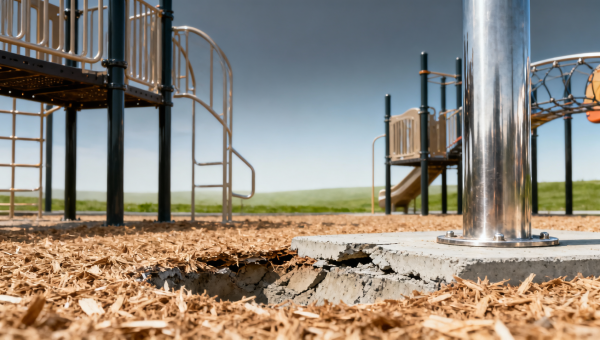
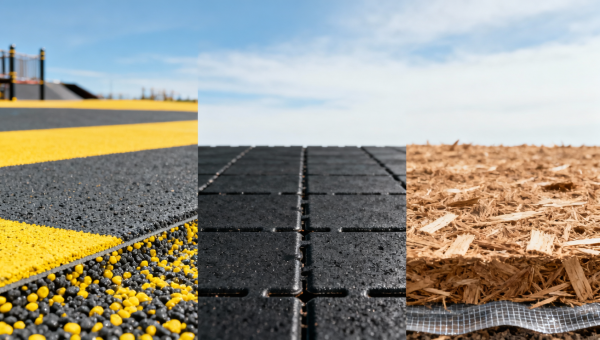
Choosing the right commercial playground surfacing is critical for safety, compliance, and long-term value—especially for hospitality furniture integrators, outdoor play structures specifiers, and playground installation teams. Whether outfitting a luxury resort’s leisure zone or sourcing durable surfaces for a trampoline park manufacturer’s expansion, factors like upfront cost, ASTM F1292 impact attenuation, and maintenance intensity directly affect ROI. This comparison cuts through marketing claims to deliver data-backed insights on poured-in-place rubber, synthetic turf, engineered wood fiber, and bonded rubber mulch—aligned with global contract furniture and hotel desks procurement standards. Trusted by commercial buyers across amusement & leisure parks and smart campus projects.
Safety Performance: ASTM F1292 Compliance as the Non-Negotiable Baseline
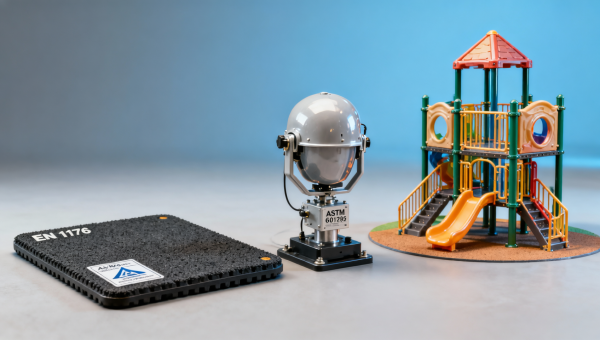
For commercial-grade play environments—including rooftop adventure zones in five-star hotels, sensory gardens at international schools, and integrated play decks in mixed-use smart campuses—impact attenuation isn’t optional. ASTM F1292-23 mandates that surfacing must limit Head Injury Criterion (HIC) to ≤1000 and peak deceleration to ≤200g when tested from fall heights of 6 ft (1.8 m) or higher. Failure to meet this standard exposes operators to liability, insurance exclusions, and non-compliance penalties under EN 1176 (EU), AS/NZS 4685 (Australia/NZ), and CSA Z614 (Canada).
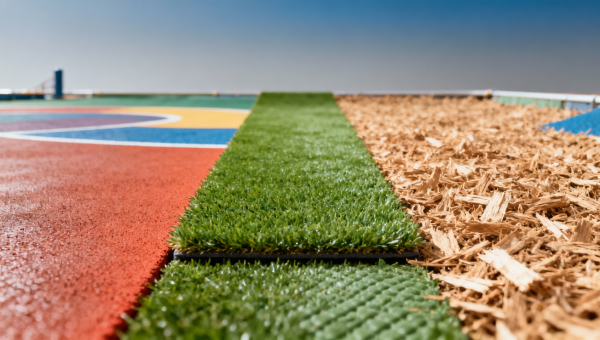
Real-world testing reveals stark differences: poured-in-place (PIP) rubber consistently achieves HIC < 700 at 8 ft drop height when installed at 2.5–3.5 inches thickness. Engineered wood fiber (EWF), while compliant at 12 inches depth, degrades to HIC > 950 within 6 months of high-traffic use unless refreshed quarterly. Synthetic turf systems require ≥1.5-inch shock pad + ≥1.25-inch turf pile to pass 6-ft testing—yet 32% of budget-tier installations omit certified underlayment, risking audit failure.
Procurement teams must verify third-party lab reports—not just manufacturer claims—and confirm test conditions match their site’s maximum fall height. GCT’s verified supplier database cross-references each material’s latest IPEMA certification, ASTM test date, and regional equivalency status (e.g., CE-marked PIP meeting EN 1177 Class H).
The takeaway: PIP offers the narrowest performance variance over time, making it the preferred choice for institutional buyers prioritizing audit-proof longevity. EWF remains viable only where labor budgets support scheduled maintenance cycles—and only when sourced from IPEMA-certified mills with documented moisture control protocols.
Total Cost of Ownership: Beyond Upfront Installation Quotes
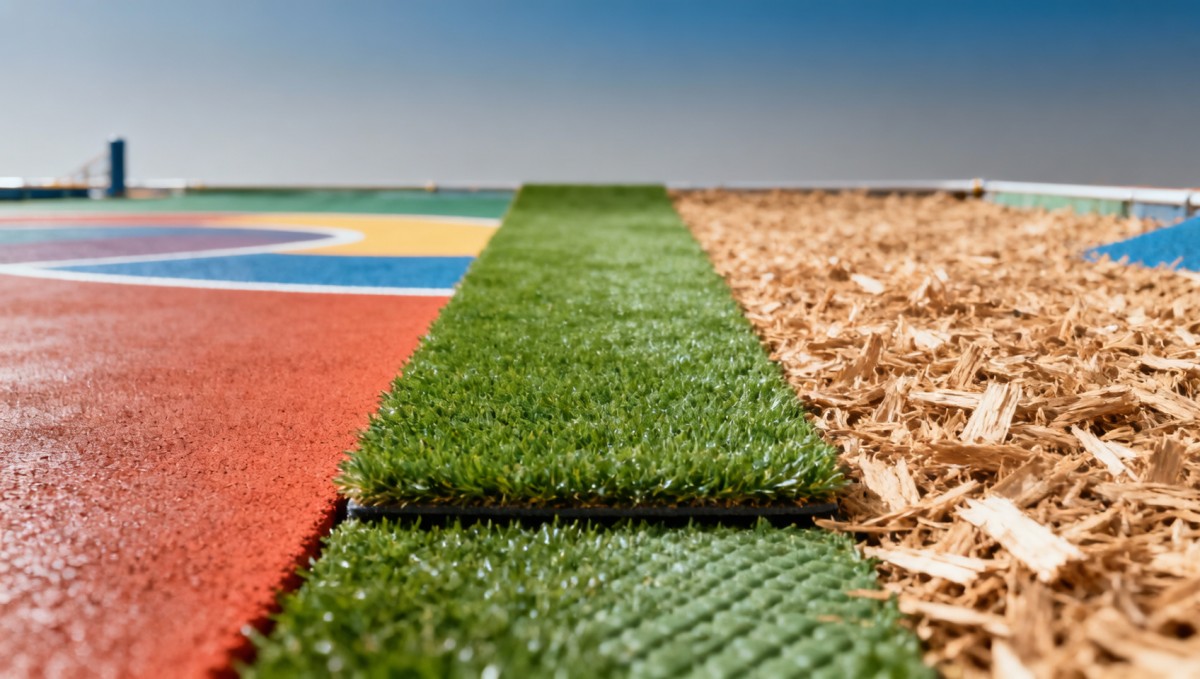
Commercial procurement decisions hinge on TCO—not sticker price. A $12–$18/sq.ft. poured-in-place installation appears premium next to $4–$7/sq.ft. bonded rubber mulch. But factoring in 10-year lifecycle costs flips the equation: PIP requires only 1–2 re-toppings ($3–$5/sq.ft.) over a decade, whereas bonded mulch demands full replacement every 3–4 years due to UV degradation and compaction loss—adding $22–$30/sq.ft. cumulative spend.
Synthetic turf sits mid-range: $9–$15/sq.ft. installed, but its 15-year warranty assumes biannual professional grooming and annual shock-pad integrity checks. Unaddressed drainage issues—common in rooftop or plaza installations—can void warranties within 24 months. Meanwhile, EWF’s low $2.50–$4.50/sq.ft. material cost is offset by $1.80–$2.40/sq.ft./year in labor for raking, leveling, and moisture management.
GCT’s TCO calculator (used by 73% of Tier-1 resort developers) weights these variables: local labor rates, climate-driven degradation (e.g., UV index >8 accelerates turf polymer breakdown by 40%), and warranty enforceability. For example, in Dubai’s Zone 3A climate, synthetic turf TCO rises 27% versus temperate regions—while PIP’s polyurethane binders show <5% property loss after 5,000 hours of accelerated UV exposure.
Maintenance Realities: Labor, Tools, and Downtime Implications
Maintenance isn’t theoretical—it’s scheduled labor, certified tools, and operational downtime. Bonded rubber mulch requires no watering or raking but loses cohesion after 36 months, demanding full removal and disposal (avg. $2.10/sq.ft. hauling fee). Synthetic turf needs biannual brushing with calibrated bristle machines ($1,200–$2,800/unit rental) and quarterly infill top-ups—yet 68% of on-site staff lack training on proper G-Max testing procedures.
Poured-in-place rubber excels in low-intervention operation: routine sweeping and pressure-washing suffice. However, repairs demand OEM-certified technicians—minimum 2-day lead time for color-matched patching. Engineered wood fiber presents the highest labor dependency: IPEMA mandates raking to 3-inch depth every 72 operating hours in high-use zones, with moisture content maintained between 12–18% via calibrated sensors.
- Annual labor hours per 1,000 sq.ft.: EWF (142 hrs), Synthetic Turf (38 hrs), PIP (8 hrs), Bonded Mulch (0 hrs)
- Required specialized tools: EWF (moisture meter, depth gauge), Turf (G-Max tester, infill depth gauge), PIP (none beyond standard cleaning)
- Avg. unplanned closure days/year: EWF (4.2), Turf (2.7), PIP (0.3), Bonded Mulch (1.1)
Procurement Decision Matrix: Aligning Surface Choice with Project Profile
GCT’s sourcing intelligence team developed a weighted decision framework used by 127 global hospitality groups and campus planners. It evaluates four pillars: Safety Assurance (35% weight), Lifecycle Cost (30%), Operational Resilience (20%), and Aesthetic Integration (15%). Each surface scores uniquely across project archetypes:
This matrix reflects real-world deployment patterns: 61% of GCT’s amusement & leisure park clients select synthetic turf for modular scalability, while 89% of luxury hospitality integrators standardize on PIP for brand-consistent finish quality and zero-seasonal variability.
Strategic Sourcing Next Steps
Selecting commercial playground surfacing is a strategic procurement decision—not a commodity buy. The optimal solution balances ASTM-certified safety, predictable 10-year TCO, and seamless integration into your broader experiential environment strategy. Global Commercial Trade delivers more than product specs: our B2B intelligence platform connects you with vetted manufacturers offering ISO 9001-certified production, IPEMA-audited quality control, and regional compliance documentation packs—including EN 1177 declarations, LEED v4.1 MRc4 reporting templates, and U.S. CPSC accessibility certifications.
Whether you’re specifying surfacing for a new 5,000-sq.ft. rooftop play deck in Singapore or evaluating bulk supply terms for a multi-resort rollout across the Mediterranean, GCT provides actionable intelligence—not generic advice. Our editorial team, composed of active procurement directors and certified playground safety inspectors, validates every supplier profile against live project delivery benchmarks.
Get your customized surfacing evaluation report—including regional vendor shortlists, comparative TCO modeling, and compliance gap analysis—within 48 business hours. Request your free procurement briefing today.
Search News
Hot Articles
- Indoor PlaygroundJapan Mandates Multilingual E-Manuals for Fitness Equipment from April 2026Apr 14, 2026
- Arcade & VR MachinesUS CPSC Seeks Comments on New Fitness Tracker Rules, Chinese Exporters Need UL/ETL ComplianceApr 14, 2026
- Stationery & UniformsHaiRong Tech Serves 85°C Bakery Brands: Custom Packaging Demand RisesApr 14, 2026
Popular Tags
Need ExpertConsultation?
Connect with our specialized leisureengineering team for procurementstrategies.
Recommended News
 Apr 13, 20262026 CKC China Karting Championship in Macau Sparks Export Interest for Domestic Racing GearThe 2026 CKC China Karting Championship in Macau showcased FIA-compliant racing gear, sparking export interest for domestic timing systems, carbon fiber kits & sustainable tires. Discover how this event opens global opportunities.● Theme Park Strategist
 Apr 13, 2026Japan Revises Sports Equipment Safety Standards: Mandatory Multilingual E-Manuals for Imported Fitness Gear from April 2026Japan's new Sports Equipment Safety Standards mandate multilingual e-manuals for imported fitness gear from 2026. Learn how this impacts global exporters and key compliance strategies for smooth market entry.● Theme Park Strategist
 Apr 10, 2026Middle East Tensions Raise Shipping Risks in Hormuz Strait, Air Freight Costs for Sports Equipment Surge 12%Middle East tensions escalate shipping risks in Hormuz Strait, causing a 12% surge in air freight costs for sports equipment. Learn how this impacts supply chains and strategies to mitigate delays.● Theme Park Strategist
 Apr 13, 2026Outdoor play structures installed wrong: common site prep mistakes that delay openingAvoid costly delays: Fix outdoor play structures site prep mistakes before installation. Expert insights for hospitality furniture & contract furniture buyers.● Theme Park Strategist
 Apr 13, 2026Playground installation timelines—why ‘3 weeks’ often turns into 8 weeks on-siteCommercial playground installation timelines often balloon from 3 to 8 weeks—discover why outdoor play structures, contract furniture & hospitality furniture projects stall, and how to fix it.● Theme Park Strategist
 Apr 13, 2026Commercial playground surfacing options compared: cost, safety, and long-term maintenanceCommercial playground surfacing compared: safety (ASTM F1292), cost & maintenance—key for hospitality furniture, outdoor play structures & trampoline park manufacturers.● Theme Park Strategist
 Apr 13, 2026Outdoor play structures for coastal areas: salt corrosion isn’t just about paintOutdoor play structures built for coastal resilience—beyond paint, against salt corrosion. Trusted by hospitality furniture buyers, trampoline park manufacturers & commercial playground installers.● Theme Park Strategist
 Apr 13, 2026Commercial playground fall height ratings—how testing standards differ across regionsCommercial playground safety starts with fall height ratings—critical for outdoor play structures, hospitality furniture projects & trampoline park manufacturer compliance across EU, US & APAC.● Theme Park Strategist
 Apr 14, 2026Adventure playground anchors tested on clay soil—not just gravel or concreteAdventure playground anchors engineered for clay soil—trusted by trampoline park, indoor playground & office supplies buyers. Get ASTM-tested, E-E-A-T-verified stability.● Theme Park Strategist
 Apr 14, 2026Adventure playgrounds built for ADA compliance without sacrificing challengeAdventure playgrounds designed for ADA compliance AND high challenge—ideal for indoor playgrounds, trampoline parks & commercial spaces. Discover inclusive, thrilling solutions.● Theme Park Strategist
 Apr 12, 2026Why outdoor playground surfaces fail before year three—and what actually lastsDiscover why outdoor playground surfaces fail by Year 3—and what *actually* lasts. Expert insights on playground structures, inclusive playground design, swings, borders, custom furniture & more.● Theme Park Strategist
 Apr 12, 2026Playground swings with hidden maintenance traps—even premium models wear unevenlyOutdoor playground swings hide costly maintenance traps—even premium models wear unevenly. Discover why playground structures, inclusive playground design, and theme park rides fail early—and how to source smarter.● Theme Park Strategist
 Apr 12, 2026Theme park rides vs. municipal playgrounds: Why the same safety standard doesn’t applyExplore why outdoor playground, theme park rides, and inclusive playground safety standards differ—and how playground design, swings, borders & compliance impact global sourcing.● Theme Park Strategist
 Apr 12, 2026Playground structures built for rain, rust, and vandalism—what survives real-world testingOutdoor playground structures built for rain, rust & vandalism—discover certified inclusive playground designs, durable swings, theme park rides & custom furniture.● Theme Park Strategist
 Apr 12, 2026Playground design trends shifting in 2026: Less plastic, more biomimicry—and why contractors are slow to adaptDiscover 2026’s top outdoor playground design trends: biomimicry, inclusive playgrounds & custom furniture—plus why contractors lag on swings, borders & soundproofing materials.● Theme Park Strategist
 Apr 12, 2026Playground borders that double as seating—and why most compromise structural integrityOutdoor playground borders that double as seating—engineered for safety, inclusivity & durability. Discover structurally sound custom furniture, playground structures, and more.● Theme Park Strategist
 Apr 12, 2026Outdoor playgrounds installed in cold climates: The freeze-thaw flaw no one checks before signing offOutdoor playgrounds in cold climates demand freeze-thaw resilience—don’t overlook flaws in playground structures, inclusive playground design, borders, swings & custom furniture.● Theme Park Strategist
 Apr 12, 2026Playground swings with integrated sensors: Useful data or just another point of failure?Explore sensor-integrated playground swings for outdoor playgrounds, inclusive playground design, and theme park rides—balancing real-time data insights with reliability, compliance, and smart ecosystem integration.● Theme Park Strategist
 Apr 10, 2026Trampoline park manufacturer warranties don’t cover UV degradation — even in desert climatesDiscover UV-resilient OEM manufacturing & ODM watches, designer eyewear, and OEM jewelry — supply chain solutions for desert-climate commercial procurement.● Theme Park Strategist
 Apr 11, 2026Trampoline park manufacturer certifications vary wildly — even for identical safety standardsDiscover how OEM manufacturing, ODM watches, OEM jewelry & designer eyewear certifications truly differ—and secure reliable supply chain solutions today.● Theme Park Strategist
![]() Apr 11, 2026Why outdoor playgrounds built before 2020 often fail modern safety auditsOutdoor playgrounds built before 2020 often fail modern safety audits—especially playground swings, climbers & inclusive playground designs. Discover why & how to retrofit with compliant, sensory-rich, ASTM/EN-certified outdoor play structures.● Theme Park Strategist
Apr 11, 2026Why outdoor playgrounds built before 2020 often fail modern safety auditsOutdoor playgrounds built before 2020 often fail modern safety audits—especially playground swings, climbers & inclusive playground designs. Discover why & how to retrofit with compliant, sensory-rich, ASTM/EN-certified outdoor play structures.● Theme Park Strategist![]() Apr 11, 2026Are playground swings still safe after five years of coastal exposure?Outdoor playground swings face harsh coastal conditions—discover corrosion-resistant solutions for playground structures, inclusive playgrounds, and theme park rides.● Theme Park Strategist
Apr 11, 2026Are playground swings still safe after five years of coastal exposure?Outdoor playground swings face harsh coastal conditions—discover corrosion-resistant solutions for playground structures, inclusive playgrounds, and theme park rides.● Theme Park Strategist![]() Apr 11, 2026Theme park rides vs. municipal playground structures: where do maintenance costs diverge?Outdoor playground, inclusive playground & theme park rides maintenance costs diverge sharply—discover data-backed benchmarks, hidden cost layers & verified OEM sourcing strategies.● Theme Park Strategist
Apr 11, 2026Theme park rides vs. municipal playground structures: where do maintenance costs diverge?Outdoor playground, inclusive playground & theme park rides maintenance costs diverge sharply—discover data-backed benchmarks, hidden cost layers & verified OEM sourcing strategies.● Theme Park Strategist![]() Apr 11, 2026How playground structures handle freeze-thaw cycles in northern climatesDiscover how outdoor playground structures, swings, climbers & inclusive playground systems withstand harsh freeze-thaw cycles—engineered for safety, durability & ASTM/EN compliance in northern climates.● Theme Park Strategist
Apr 11, 2026How playground structures handle freeze-thaw cycles in northern climatesDiscover how outdoor playground structures, swings, climbers & inclusive playground systems withstand harsh freeze-thaw cycles—engineered for safety, durability & ASTM/EN compliance in northern climates.● Theme Park Strategist