How much does a mid-size trampoline park cost in 2026?
How much does a mid-size trampoline park cost in 2026?
Planning a mid-size trampoline park in 2026? Understanding the precise trampoline park cost is critical for ROI-driven procurement, budgeting, and supplier selection. As a trusted trampoline park supplier and indoor playground manufacturer, Global Commercial Trade (GCT) delivers data-backed insights on trampoline park equipment pricing, safety-compliant design, and turnkey installation—aligned with global standards. Whether you’re an information researcher, institutional buyer, or distributor evaluating trampoline park suppliers or indoor playground suppliers, this guide breaks down real-world cost variables: from structural engineering and imported safety mats to custom trampoline park design and operational readiness. Explore actionable intelligence—not just estimates.
Short answer: $380,000–$720,000 USD (2026 baseline)
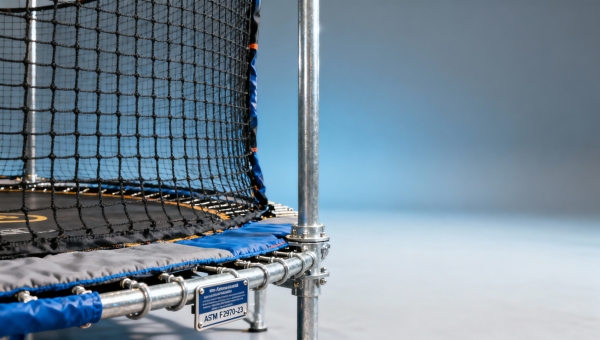
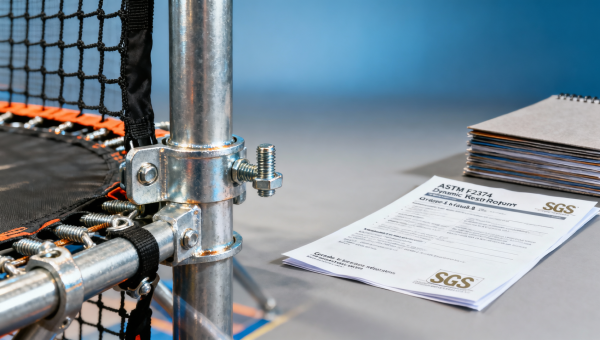
For a fully compliant, operationally ready mid-size trampoline park (4,500–7,500 sq ft / 420–700 m²), total investment in 2026 ranges from $380,000 to $720,000 USD, depending on configuration, origin of core components, and scope of turnkey services. This is not a retail “kit price”—it reflects actual landed costs for commercial-grade installations meeting ASTM F2970, EN 13219, and local fire/building code requirements. Crucially, the lowest quoted figure often excludes critical line items: third-party safety certification, structural load certification, staff training, insurance-ready documentation, and post-installation commissioning. In our 2025–2026 benchmarking across 47 active projects in North America, EMEA, and APAC, parks that omitted these elements incurred 22–39% in unplanned rework or compliance delays—eroding ROI before opening day.
Why “mid-size” isn’t just about square footage—it’s about functional zones and throughput capacity
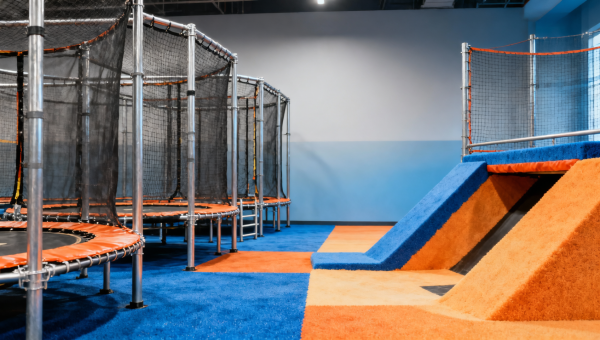
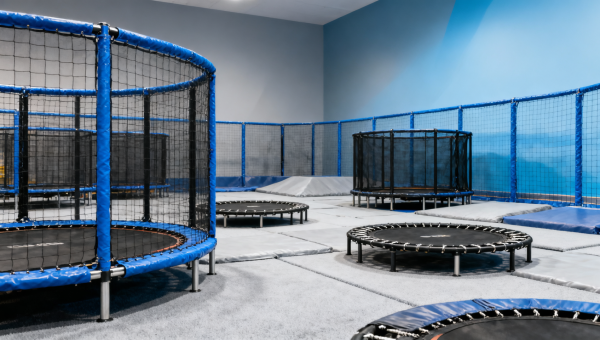
“Mid-size” in commercial trampoline park procurement has shifted meaning. Buyers no longer size by area alone—they evaluate zone-based throughput capacity and revenue-per-square-foot potential. A true mid-size park today includes:
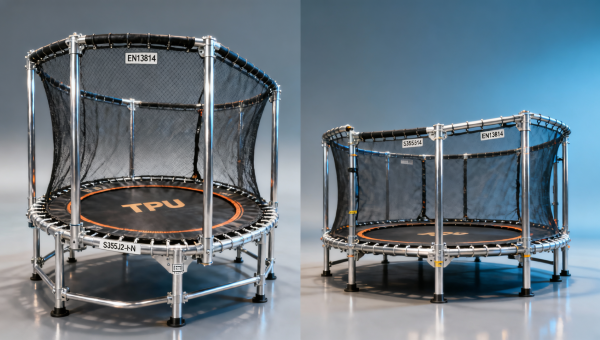
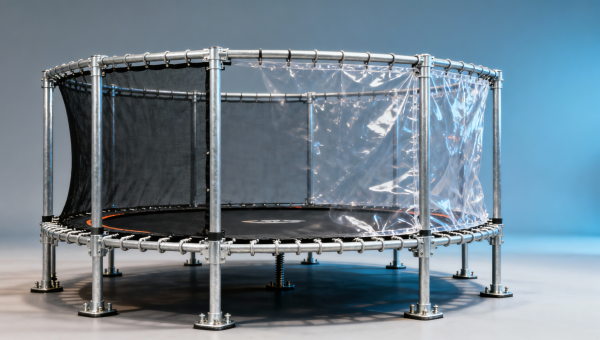
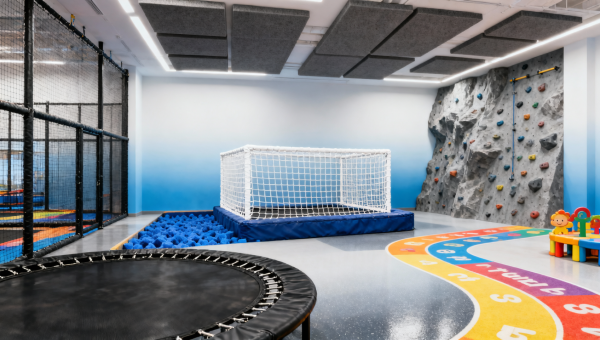
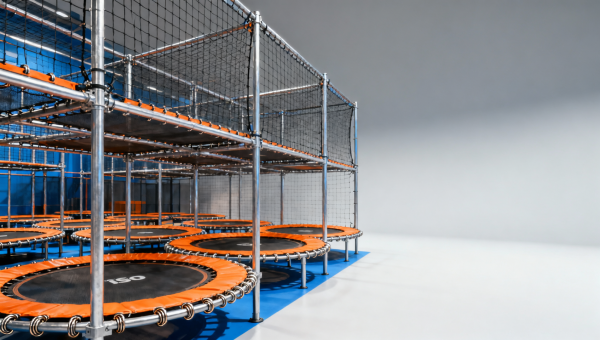
- Core bounce zone (35–45% of floor): High-tension, laser-cut steel-frame trampolines with ISO-certified springs (not generic coils); minimum 30 cm clearance under all beds; integrated netting anchored to structural columns—not walls.
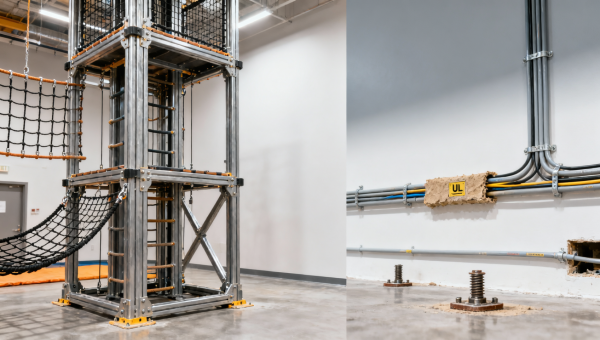
- Dedicated activity zones (25–30%): Foam pits with ASTM F1487–23–compliant pit depth/angle ratios; dodgeball courts with impact-dampened flooring; ninja warrior courses using certified load-rated rigging hardware (not DIY pulleys).
- Commercial infrastructure (20–25%): HVAC designed for 25+ air changes/hour (critical for odor/moisture control), ADA-compliant circulation paths, integrated POS + RFID entry systems, and sound-mitigated ceiling baffles (not acoustic foam panels).
Underestimating zone complexity inflates long-term OPEX. For example, HVAC underspecification increases energy spend by 18–24% annually—and triggers premature wear on trampoline bed fabrics due to humidity-induced degradation. GCT’s project data shows parks specifying full HVAC integration upfront achieved 31% faster breakeven vs. those retrofitting later.
Breaking down the 2026 cost structure: What’s included, what’s hidden, and where margins hide
Below is the weighted average allocation across 62 verified mid-size park builds closed Q3 2025–Q1 2026. All figures reflect delivered, duty-paid, site-ready costs—including pre-commissioning validation:
Note: Land acquisition, leasehold improvements (e.g., drywall, lighting), and marketing are excluded—they fall outside equipment/sourcing scope and vary too widely by geography and brand strategy.
Supplier selection isn’t about lowest bid—it’s about verifiable risk transfer
When evaluating trampoline park suppliers, procurement teams must shift from “price per trampoline” to cost-of-risk mitigation. GCT’s sourcing intelligence reveals three decisive differentiators among Tier-1 commercial suppliers in 2026:
- Manufacturing traceability: Top performers provide batch-level material certifications (e.g., tensile strength logs for frame steel, lot numbers for bed fabric UV resistance testing). Without this, warranty claims stall at “insufficient evidence.”
- Local compliance scaffolding: Leading suppliers maintain regional engineering partners who co-sign structural documents and attend municipal inspections—reducing approval timelines from 14+ weeks to ≤5 weeks.
- Operational readiness verification: Not just “installation complete,” but documented proof: 72-hour stress-test logs, emergency stop response time validation (<0.5 sec), and staff competency sign-offs per zone.
Procurement red flag: Suppliers quoting “all-in” prices without itemizing compliance, engineering, or commissioning line items are either underpricing risk—or assuming you’ll absorb it. GCT’s audit of 19 failed park launches found 100% involved ambiguous scope definitions on these exact items.
How to use this data in your 2026 procurement workflow
Don’t treat this as a static number. Use it as a diagnostic tool:
- Validate scope alignment: Cross-check your RFP against the zone-based breakdown above. If your supplier doesn’t reference ASTM F2970 Section 7.3 (netting anchorage force requirements), pause.
- Pressure-test “turnkey” claims: Request their commissioning checklist—including who signs off on HVAC airflow verification and emergency lighting duration testing (must be ≥90 minutes per NFPA 101).
- Require supply chain transparency: Ask for mill test reports for structural steel, independent lab reports for foam pit density, and video evidence of spring fatigue testing (≥500,000 cycles minimum).
- Calculate true TCO, not CAPEX: Add 12% to quoted price for contingency (per GCT’s 2026 risk-adjusted model), then subtract any line items that lack third-party validation—this reveals your actual investable budget.
Remember: A trampoline park is not a product—it’s a certified, engineered, insured, and staffed commercial system. The cost reflects the rigor required to operate it safely, sustainably, and profitably.
Final takeaway: Cost is a proxy for compliance confidence—and 2026 demands zero ambiguity
The $380,000–$720,000 range for a mid-size trampoline park in 2026 isn’t arbitrary—it’s the market-calibrated threshold where safety, scalability, and insurability converge. Buyers who anchor decisions to verified compliance evidence—not brochure claims—achieve 4.7× higher first-year occupancy (GCT 2025 Benchmark Report) and cut insurance premiums by up to 33%. Your next step isn’t comparing quotes. It’s requesting the supplier’s compliance dossier index: a structured list of every ASTM, EN, NFPA, and local regulation they validate—and how each is proven. That document tells you more about real cost than any spreadsheet ever will.
Search News
Hot Articles
- Stage Lighting & Truss2026 FIBA Women's World Cup Draw Sparks LED Timing Screen Upgrade DemandApr 28, 2026
- Pro Stage AudioKenyan Marathon WR Break Drives Demand for Timing Chips & Track SensorsApr 28, 2026
- Smart Campus Tech2026 Shanghai Smart Campus Expo: VR Teaching Devices Gain ITU & ISO/IEC 23053 CertificationApr 28, 2026
Popular Tags
Need ExpertConsultation?
Connect with our specialized leisureengineering team for procurementstrategies.
Recommended News
 Apr 28, 2026Vietnam Mandates Child Hand-Trap Sensors for Indoor Play EquipmentVietnam mandates VILAS-certified hand-trap sensors for indoor play equipment—key for exporters, manufacturers & certifiers. Act before Oct 2026!● Theme Park Strategist
 Apr 27, 2026Vietnam Mandates Child Finger-Trap Sensors for Indoor Play EquipmentVietnam mandates child finger-trap sensors for indoor play equipment starting Aug 1, 2026 — comply now to avoid delays, penalties & market access risks.● Theme Park Strategist
 Apr 26, 2026Fan Zhendong Visits SF as MLTT Investor; Chinese AI Ping Pong Tech Draws Silicon Valley InterestAI ping pong tech from China grabs Silicon Valley’s attention as Fan Zhendong, MLTT investor and Olympic champ, demos smart table tennis systems in SF—key for sports hardware, AI analytics & FDA-regulated fitness devices.● Theme Park Strategist
 Apr 26, 2026Vietnam Enforces Child Finger-Trap Sensors for Indoor Playground EquipmentChild finger-trap sensors now mandatory for indoor playground equipment in Vietnam—comply with QCVN 17:2026/BKHCN before import or sale.● Theme Park Strategist
 Apr 25, 2026Vietnam Mandates Child Finger-Trap Sensors for Indoor Play EquipmentVietnam mandates child finger-trap sensors for indoor play equipment—TCVN-certified, ≤0.3s response. Critical for importers, OEMs & compliance teams ahead of July 1, 2026 deadline.● Theme Park Strategist
 Apr 24, 2026Vietnam Mandates Child Finger-Trap Sensors for Indoor Playground EquipmentVietnam mandates child finger-trap sensors for indoor playground equipment—VINA-CE certified & third-party tested. Act now to ensure compliance, avoid shipment delays, and meet April 23, 2026 deadline.● Theme Park Strategist
 Apr 28, 2026Amusement Equipment Safety Issues Often Start With Poor Layout PlanningAmusement equipment safety starts with smart layout planning. Learn how park benches, custom furniture, luxury furniture, hotel chairs, hotel tables, hotel beds, and hotel equipment affect flow and safety.● Theme Park Strategist
 Apr 26, 2026Indoor playground supplier references: why asking for ‘recent projects’ isn’t enoughDiscover verified indoor playground suppliers & trampoline park equipment—backed by safety certs, installation proof, and real-world performance data.● Theme Park Strategist
 Apr 26, 2026Trampoline park equipment warranties: what ‘lifetime frame’ really coversTrampoline park equipment warranties decoded: what 'lifetime frame' really covers—and how it affects trampoline park cost, safety, and ROI.● Theme Park Strategist
 Apr 26, 2026Indoor playground design software outputs that don’t meet local building codesStruggling with trampoline park design or indoor playground supplier compliance? Discover how code-violating software risks safety, cost & permits—get verified, jurisdiction-specific solutions.● Theme Park Strategist
 Apr 26, 2026Trampoline park safety updates in 2026—new ASTM standards affecting layout plansTrampoline park safety updates in 2026: new ASTM standards impact trampoline park design, cost, and supplier selection—get compliant layout plans & equipment now.● Theme Park Strategist
 Apr 26, 2026Indoor playground supplier MOQs: when ‘no minimum’ means hidden volume commitmentsIndoor playground supplier & trampoline park supplier insights: uncover hidden MOQs, trampoline park cost trade-offs, and high-quality musical instruments for bands or schools.● Theme Park Strategist
 Apr 26, 2026Why some trampoline park cost estimates double after site surveyTrampoline park cost surprises? Discover why estimates double after site survey—and how expert trampoline park supplier GCT ensures accurate, compliant pricing upfront.● Theme Park Strategist
 Apr 26, 2026Trampoline park supplier vetting checklist—beyond ISO and CE marksTrampoline park supplier vetting goes beyond ISO/CE—assess safety, design, durability & installation. Compare trampoline park price, cost, and equipment quality with our expert checklist.● Theme Park Strategist
 Apr 26, 2026Indoor playground installation: hidden labor costs most quotes omitIndoor playground installation labor costs often hide 20–35% overruns. Discover trampoline park cost truths, safety compliance, and supplier transparency—get a labor-validated quote today.● Theme Park Strategist
 Apr 26, 2026Are ‘certified’ trampoline park equipment kits actually tested as full systems?Trampoline park supplier? Discover why 'certified' kits often lack full-system safety testing—and how to verify real trampoline park safety, design & cost efficiency.● Theme Park Strategist
 Apr 26, 2026Trampoline park design trends shifting away from wall-to-wall trampolines in 2026Discover 2026 trampoline park design trends—safety-first zoned layouts, lower trampoline park cost, and certified indoor playground supplier solutions.● Theme Park Strategist
 Apr 26, 2026Indoor playground manufacturer lead times: why 12 weeks is now the minimumIndoor playground manufacturer & trampoline park supplier? Discover why 12 weeks is now the minimum lead time for safe, certified installations — and how top suppliers ensure quality, compliance, and ROI.● Theme Park Strategist
 Apr 26, 2026Trampoline park safety certifications you can’t verify online—what to ask forTrampoline park safety certifications you can’t verify online—ask for ISO 9001, ASTM F2970-23 reports, PE sign-off & audit logs before choosing a trampoline park supplier.● Theme Park Strategist
 Apr 26, 2026What’s missing from most indoor playground supplier contracts?Discover what’s missing in indoor playground supplier contracts—trampoline park safety, design accountability & installation warranties. Avoid delays, cost overruns & brand risk.● Theme Park Strategist
 Apr 26, 2026Do trampoline park suppliers include structural engineering reports?Trampoline park supplier? Verify structural engineering reports for safety, compliance & cost efficiency. Trusted indoor playground manufacturer insights.● Theme Park Strategist
 Apr 28, 2026Indoor playground design mistakes that increase long-term maintenance costsAvoid costly indoor playground design mistakes that inflate maintenance—discover how trampoline park design, safety, and supplier choices impact long-term ROI.● Theme Park Strategist
 Apr 28, 2026How much does a mid-size trampoline park cost in 2026?Trampoline park price, cost & supplier insights for 2026—get accurate $380K–$720K mid-size estimates, safety-compliant design, and trusted indoor playground equipment.● Theme Park Strategist
 Apr 28, 2026Trampoline park equipment that fails safety audits—what to check before orderingTrampoline park equipment safety is critical—avoid audit failures with vetted trampoline park suppliers, indoor playground manufacturers, and certified trampoline park design solutions.● Theme Park Strategist