When catering equipment saves labor but slows service
Labor-saving catering equipment can streamline back-of-house tasks, yet in hotels and premium venues it may also create bottlenecks that slow guest service. For buyers evaluating hotel equipment, hospitality procurement strategies, and commercial furniture integration, understanding this tradeoff is essential. This article explores how catering equipment decisions affect workflow, service speed, staff efficiency, and the overall performance of modern hotel furniture environments.
Why labor-saving equipment can still reduce service speed in hotel environments
In hotel dining, banquet service, executive lounges, and all-day restaurants, labor-saving catering equipment is often purchased to reduce manual handling, standardize output, and ease staffing pressure. However, a machine that saves 1 or 2 staff hours per shift does not automatically improve front-of-house speed. If the equipment cycle time is too long, if loading and unloading interrupts circulation, or if the unit does not fit the surrounding hotel furniture layout, service response can become slower at peak periods.
This issue appears most clearly in premium hospitality settings where guest expectations are measured in minutes rather than hours. A banquet warming cabinet, automated beverage station, dish handling system, or compact combi solution may perform well on paper, yet if the queue length exceeds the output rhythm during a 30–60 minute breakfast rush, the operation experiences delay even when labor use declines. Procurement teams therefore need to assess total service flow, not just isolated equipment efficiency.
For the hotel furniture sector, the problem is broader than kitchen technology. Catering equipment interacts with service counters, storage cabinetry, pass stations, mobile trolleys, buffet islands, and circulation widths. When furniture and equipment are specified separately, operators often discover that labor-saving tools create physical choke points, visual clutter, or awkward staff movements. The result is a mismatch between operational design and guest-facing experience.
Information researchers, procurement managers, commercial evaluators, and distributors usually ask the same practical question: where is the real bottleneck? In most projects, the answer lies in 3 connected layers: machine throughput, human interaction time, and space integration. A unit that reduces prep labor but adds 15–20 seconds per transaction can damage service speed more than it helps payroll efficiency during high-volume windows.
The difference between labor efficiency and service efficiency
Labor efficiency focuses on staffing input per task. Service efficiency focuses on guest waiting time, order fulfillment speed, and operational continuity. These are not the same metric. A hotel may reduce staff from 4 attendants to 3 in one station, but if average transaction time rises from 45 seconds to 70 seconds, the visible service outcome worsens. In upscale venues, this tradeoff can affect guest satisfaction, event timing, and table turnover.
- Labor-saving gains often occur in repetitive tasks such as holding, dispensing, portioning, or transport.
- Service slowdowns often appear in high-contact moments such as plating, payment-adjacent service, replenishment, or custom guest requests.
- The most reliable purchasing decisions consider both back-of-house productivity and front-of-house response within the same workflow model.
This is why hotel procurement cannot treat catering equipment as a standalone purchase. The right question is not simply whether the equipment saves labor, but whether it supports the service promise of the property type, from business hotel breakfast operations to luxury banquet sequencing.
Which hotel scenarios are most vulnerable to equipment-driven bottlenecks?
Not every hospitality project faces the same risk. In limited-service hotels with predictable menus and lower customization, labor-saving equipment may improve consistency without harming speed. In contrast, premium restaurants, live buffet stations, conference catering, and multifunction event venues often operate with fluctuating demand, tight replenishment windows, and more complex movement paths. In these spaces, the wrong specification creates delays that spread across the service chain.
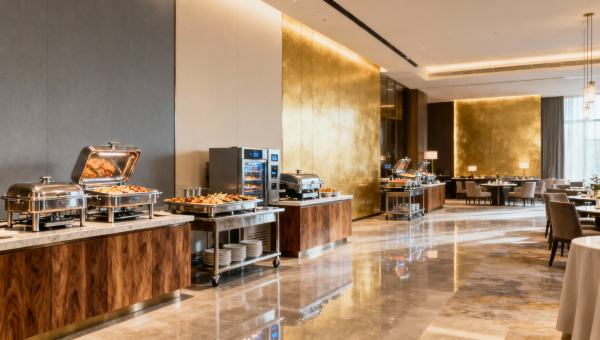
Breakfast is a classic example. A hotel may install automated beverage dispensers or centralized heating equipment to reduce staffing needs. Yet if 80–150 guests arrive within the same 20–30 minute window, refill time, cup retrieval, tray handling, and cleaning access become critical. A compact unit with limited capacity might save one operator, but it can also trigger queues that affect seating turnover and buffet circulation.
Banquet service creates another challenge. During weddings, conferences, or gala dinners, service timing is synchronized with speeches, presentations, and entertainment. Equipment that requires longer batching cycles can force staff to stage trolleys in guest-visible corridors or overload holding furniture. That creates operational friction and weakens the visual standard expected in upscale hospitality interiors.
For distributors and commercial evaluators, scenario-based specification is therefore more reliable than a one-size-fits-all product pitch. The following table highlights where labor-saving catering equipment supports performance and where it may slow service if hotel furniture planning is weak.
The table shows that service speed depends on demand shape, not only equipment specification. In hotel furniture planning, the most resilient solutions leave enough buffer space for loading, replenishment, and temporary overflow. A machine with strong nominal output may still underperform if the surrounding joinery, counter height, and staff movement path are poorly coordinated.
Common scenario signals that indicate risk
Procurement teams should flag a project when any of these signs appear during planning or site review. Early detection reduces rework, avoids costly furniture modification, and helps distributors position more suitable configurations.
- The service peak is compressed into less than 45 minutes, but the equipment relies on refill or recovery cycles longer than the guest arrival rhythm.
- The furniture design prioritizes appearance while leaving limited rear access for cleaning, maintenance, and stock loading.
- The operation depends on mixed tasks such as dispensing, plating, and personalized requests at one counter.
- The selected unit saves labor only when run in full batches, while the hotel requires flexible small-batch service across breakfast, lounge, and event use.
When two or more of these conditions exist, buyers should request a revised workflow review rather than approving the equipment list based only on purchase price or headline capacity.
What should buyers compare before specifying catering equipment with hotel furniture?
A sound procurement decision compares at least 5 dimensions: output rate, cycle time, operator touchpoints, furniture compatibility, and maintenance access. Many sourcing mistakes happen because catalog specifications emphasize capacity or power consumption while ignoring how many seconds staff spend loading, resetting, cleaning, or walking around the station. In real hotel operations, those micro-delays accumulate quickly.
For example, a compact dispenser or hot holding unit may fit the design brief, but if it requires frequent door opening or rear replenishment, it can conflict with fixed millwork, buffet skirting, or decorative stone tops. This is especially relevant in hotel furniture projects where visual consistency matters as much as function. The right solution often balances modest automation with better ergonomic access.
Procurement teams should also compare service consequences at low, medium, and peak volume. A machine that performs well at 30 covers may be unsuitable at 120 covers if refill frequency becomes excessive. Commercial evaluators and agents can create stronger bid recommendations by translating equipment data into operational language: transactions per minute, reload interval, and staff steps per service cycle.
The comparison table below gives a practical framework for selecting labor-saving catering equipment in hotel furniture environments without sacrificing service flow.
The strongest buying decisions happen when hotel operators, furniture fabricators, and equipment suppliers review this matrix together before procurement is frozen. That coordination reduces post-install conflict between aesthetic design, service circulation, and utility access. In many projects, a slightly different furniture layout solves the speed problem without requiring more labor or a larger equipment budget.
A practical 4-step procurement check
1. Map the peak service window
Use the busiest 15–30 minute period, not average hourly demand, as the baseline. This reveals whether the selected equipment can maintain speed when guest arrivals cluster.
2. Count operator touchpoints
Record every action required per cycle: refill, reset, wipe, unload, and transport. If labor-saving equipment still needs frequent manual intervention, the benefit may be smaller than expected.
3. Check joinery and furniture interfaces
Review ventilation space, door opening, cable routing, and service-side clearance before hotel furniture production begins. This step prevents delays that can add 1–2 weeks during fit-out.
4. Test the fallback plan
Ask what happens if the unit pauses, requires cleaning, or cannot meet a sudden demand spike. The hotel should still be able to serve guests through manual or secondary stations.
How cost, compliance, and lifecycle planning change the decision
Purchase price alone rarely shows the full value of labor-saving catering equipment. A lower-cost unit can become expensive if it forces custom furniture modification, additional ventilation work, or unplanned staffing during peak service. In hotel furniture projects, cost must include joinery adjustment, utility coordination, access panels, spare parts planning, and the time impact of maintenance shutdowns.
Compliance also matters. Depending on market and installation type, buyers may need to verify electrical safety conformity, food-contact suitability, hygiene-friendly material choices, and fire-aware placement in relation to surrounding furniture finishes. While exact requirements vary by region, commercial hospitality projects typically require documentation checks before import approval, installation sign-off, or operator acceptance. Ignoring this can delay commissioning by several days or even a full project phase.
From a lifecycle perspective, buyers should evaluate whether a flexible semi-automated solution may outperform a fully automated one. In many hotel applications, especially where menu changes or event formats vary week to week, moderate automation offers a better balance of speed, adaptability, and maintenance simplicity. That is particularly relevant for dealers and agents serving multiple property types across different star ratings.
The next table helps procurement teams compare cost and implementation implications beyond the initial quotation.
The financial lesson is clear: the cheapest equipment line item is not always the most economical solution for a hotel project. When service speed, furniture compatibility, and operational continuity are considered together, the better long-term option is often the one that prevents bottlenecks and reduces retrofit risk.
Compliance and acceptance checkpoints
- Confirm utility requirements before finalizing hotel furniture drawings, including power, drainage, ventilation, and service-side access.
- Check whether food-contact materials, cleanability, and surface finishes are appropriate for hospitality use and local hygiene expectations.
- Review installation and commissioning sequence early; commercial projects often need 3 stages: delivery check, fit-out integration, and operational acceptance.
- Plan spare parts and service support according to property type, especially for hotels with daily continuous operation or multiple meal periods.
These checkpoints are particularly important for international sourcing. Buyers working across regions need not only product information but also coordination support between equipment suppliers, furniture manufacturers, and local project teams.
FAQ: what do buyers, evaluators, and distributors ask most often?
How can we tell whether labor-saving equipment is actually slowing service?
Look at service rhythm rather than staffing numbers alone. If guest queues grow during a 15–30 minute peak, if staff must intervene repeatedly every few minutes, or if replenishment blocks the counter path, the equipment may be reducing labor but damaging service speed. A quick workflow review should compare transaction time, refill frequency, and station congestion before purchase approval.
What types of hotel furniture most influence equipment performance?
Buffet counters, back bars, service credenzas, undercounter cabinetry, mobile banquet stations, and pass counters have the greatest impact. Their depth, opening direction, heat resistance, concealed service access, and circulation clearance determine whether equipment can be loaded, cleaned, and maintained without slowing staff movement. In premium venues, furniture aesthetics must also support guest experience while hiding operational complexity.
What is a reasonable delivery and implementation expectation for this type of project?
Lead times vary by customization level and sourcing origin, but buyers should typically separate the process into 3 phases: technical confirmation, production and logistics, and on-site integration. For projects involving both catering equipment and custom hotel furniture, coordination lead time often matters as much as manufacturing time. Even when products are available, drawing approval and site readiness can add 2–4 weeks if not managed early.
Should buyers choose fully automated or semi-automated solutions?
That depends on service pattern. Fully automated systems can help in stable, repetitive, high-volume environments. Semi-automated solutions often work better in hotels where guest interaction, menu changes, and mixed-use spaces are common. For many hospitality projects, the best option is not maximum automation but the most balanced combination of speed, flexibility, maintenance ease, and furniture compatibility.
Why work with GCT when evaluating hotel catering equipment and furniture integration?
Global Commercial Trade supports buyers who need more than a catalog comparison. In hotel and catering equipment sourcing, the real challenge is aligning product capability with guest experience, design standards, compliance needs, and supply chain reliability. That is why research, procurement, and commercial evaluation must connect equipment data with layout logic, furniture design, and project delivery risk.
For information researchers, GCT helps clarify the market language behind labor-saving claims, throughput assumptions, and implementation constraints. For procurement managers and business evaluators, GCT supports structured comparison across sourcing options, integration requirements, and fit-out implications. For distributors and agents, this creates a stronger basis for recommending solutions that perform well in real hospitality environments rather than only in product literature.
If you are assessing hotel furniture and catering equipment for a new build, refurbishment, branded hotel rollout, banquet upgrade, or buffet optimization project, the most valuable next step is a coordinated review. Key discussion points usually include 5 items: equipment parameters, service peak assumptions, counter or joinery dimensions, delivery schedule, and compliance documentation expectations. Clarifying these early can prevent specification errors and reduce downstream delay.
You can contact GCT to discuss product selection, layout coordination, lead time planning, OEM or customization possibilities, sample support, certification-related document checks, and quotation comparison for multi-supplier sourcing. This is especially useful when your project involves both hotel furniture integration and catering equipment performance, and when the goal is not just to save labor, but to protect service speed and commercial value at the same time.
Search News
Hot Articles
- Stage Lighting & TrussCCTV5 Snooker Broadcast Drives 37% Surge in Stage Lighting Export InquiriesApr 21, 2026
- Indoor PlaygroundVietnam Mandates Child Finger-Trap Sensors for Indoor Play EquipmentApr 21, 2026
- Stage Lighting & TrussGuangdong vs. Shanxi CBA Game Highlights Domestic Smart Arena LightingApr 21, 2026
Popular Tags
Need ExpertConsultation?
Connect with our specialized leisureengineering team for procurementstrategies.
Recommended News
 Apr 15, 2026SASO Updates Playground Standard SASO 2770:2026 with VR EMC RequirementsSASO 2770:2026 now mandates VR EMC testing for playground equipment — vital for Chinese exporters & VR-integrated system suppliers targeting Saudi Arabia.● Hospitality Sourcing Dir
 Apr 15, 2026Global VR Fitness Equipment Export Prices Up 12% MoMVR fitness equipment export prices surge 12% MoM—driven by XR2 Gen3 chip shortages & TÜV certification costs. Key insights for global trade & manufacturing stakeholders.● Hospitality Sourcing Dir
 Apr 15, 2026Vietnam Requires Local TUV SUD Type Testing for VR Fitness Cabins from Q2 2026VR fitness cabins for Vietnam must pass local TUV SUD Hanoi type testing from July 2026—no more CNAS reports. Act now to avoid delays & extra costs.● Hospitality Sourcing Dir
 Apr 15, 2026FDA Proposes Chinese Label Translation Requirement for Sports Nutrition SupplementsFDA proposes Chinese label translation requirements for sports nutrition supplements—learn how protein powders, creatine & electrolyte drinks are affected and what exporters must do now.● Hospitality Sourcing Dir
 Apr 15, 2026RCEP Round 3 Tariff Cuts Effective: China Optical Lenses 0% Duty to ASEANRCEP Round 3 cuts China optical lenses duty to 0% for ASEAN—boosting exports of sports goggles, ride lenses & stage optics. Faster Pingxiang Port clearance too!● Hospitality Sourcing Dir
 Apr 15, 2026CPSC Proposes New Fitness Tracker RF/Bio-Sensor Compliance RuleCPSC proposes new RF/bio-sensor compliance rule for fitness trackers—learn how heart rate, SpO₂ & exercise algorithm devices must prepare for UL/ETL dual-mode certification.● Hospitality Sourcing Dir
 Apr 21, 2026How hospitality procurement plans reduce replacement costsHospitality procurement cuts replacement costs by sourcing durable hotel furniture, hotel beds, hotel chairs, and hotel tables with long-term planning. Explore smarter commercial furniture strategies.● Hospitality Sourcing Dir
 Apr 21, 2026Hospitality procurement delays often start with approvalsHospitality procurement delays often begin with approvals. Learn how hotel furniture, luxury furniture, hotel beds, hotel chairs, and hotel tables sourcing can stay on schedule.● Hospitality Sourcing Dir
 Apr 21, 2026When catering equipment saves labor but slows serviceExplore how catering equipment can save labor yet slow service in hotel furniture environments. Learn smarter hospitality procurement for luxury furniture, hotel equipment, and smoother guest flow.● Hospitality Sourcing Dir
 Apr 21, 2026Catering equipment costs that often get missed at launchCatering equipment costs often missed at launch: uncover hidden expenses in hotel furniture, hotel beds, hotel chairs, soundproofing materials, and hospitality procurement to avoid delays and overspending.● Hospitality Sourcing Dir
 Apr 18, 2026FDA Proposes Chinese Label Translation Requirement for US Sports SupplementsFDA proposes Chinese label translation requirements for US sports supplements—impacting protein powders, BCAAs & energy gels. Learn compliance steps, costs, and what brands must do before April 2026.● Hospitality Sourcing Dir
 Apr 18, 2026Catering equipment with dual-voltage capability: A real flexibility boost or just extra wiring?Dual-voltage catering equipment delivers real flexibility for leisure parks, theme park rides & hotels—cutting downtime, simplifying custom furniture integration, and boosting ROI. Discover if it’s worth the premium.● Hospitality Sourcing Dir
 Apr 18, 2026Catering equipment that fails quietly—why noise isn’t the only red flagCatering equipment, hotel beds, playground structures & theme park rides can fail silently—discover hidden risks in soundproofing materials, custom furniture & instrument cables.● Hospitality Sourcing Dir
 Apr 17, 2026Commercial kitchen furniture vs. office furniture: Why load ratings differ so muchCommercial furniture load ratings ensure safety for playground borders, sensory playgrounds, amusement equipment & hotel tables—discover why they far exceed office standards.● Hospitality Sourcing Dir
 Apr 15, 2026Commercial kitchen furniture that handles steam, spills, and 18-hour shiftsCommercial furniture built for steam, spills & 18-hour shifts—ideal for playground borders, sensory playgrounds, hotel tables, amusement equipment & more.● Hospitality Sourcing Dir
 Apr 12, 2026Catering equipment that survives festival chaos—what commercial kitchens won’t tell youOutdoor playgrounds, theme park rides & inclusive playgrounds demand rugged catering equipment—discover NSF-certified, soundproofing-ready, modular solutions built for festival chaos.● Hospitality Sourcing Dir
 Apr 12, 2026Catering equipment rated for indoor use—why it fails fast when moved outdoorsOutdoor playground & theme park rides need certified outdoor catering equipment—not indoor-rated gear. Avoid failures with UV-, salt-, and thermal-resistant solutions for playground structures, inclusive playgrounds, and custom furniture.● Hospitality Sourcing Dir
 Apr 10, 2026Commercial sound systems with Dante support—do they require certified switches to avoid dropouts?Discover why commercial sound systems with Dante support need certified switches—plus pro audio equipment, microphone systems, and soundproofing materials for drop-free live sound.● Hospitality Sourcing Dir
 Apr 10, 2026Commercial sound systems rated for 10,000 sq ft—but what happens at 35°C ambient temperature?Discover thermal-resilient commercial sound systems, pro audio equipment & soundproofing materials engineered for 35°C—plus instrument cables, microphone systems, and music production tools tested to 96-hour IEC standards.● Hospitality Sourcing Dir
 Apr 07, 2026Catering equipment energy labels: Why kWh/year doesn’t reflect peak-load realityCatering equipment energy labels mislead—discover why kWh/year fails luxury retail. Explore real-world peak-load insights for hotel furniture, soundproofing materials & custom furniture.● Hospitality Sourcing Dir
 Apr 07, 2026Catering equipment specs that get overlooked in commercial kitchen layout planningDiscover overlooked catering equipment specs critical for luxury retail—outdoor playground safety, custom furniture integration, soundproofing materials, hotel chairs & more.● Hospitality Sourcing Dir
 Apr 04, 2026Commercial Kitchen Equipment Orders Include More Office Supplies Than You’d Expect — Here’s the PatternOffice supplies supplier? Discover how top office supplies wholesalers & OEM manufacturers win commercial kitchen-linked orders—get cross-category verified now!● Hospitality Sourcing Dir
 Apr 02, 2026The hidden cost of choosing cheaper soundproofing materials for high-occupancy hotel corridorsDiscover why budget soundproofing materials undermine hotel furniture, hospitality procurement, and guest satisfaction—learn the true ROI of premium acoustic solutions.● Hospitality Sourcing Dir
") Apr 02, 2026Soundproofing materials that pass fire codes—and ones that don’t (but still get installed)Discover fire-code-compliant soundproofing materials for hotel furniture, recording studio gear & outdoor play structures—plus risky non-compliant picks still in use.● Hospitality Sourcing Dir
Apr 02, 2026Soundproofing materials that pass fire codes—and ones that don’t (but still get installed)Discover fire-code-compliant soundproofing materials for hotel furniture, recording studio gear & outdoor play structures—plus risky non-compliant picks still in use.● Hospitality Sourcing Dir