EU Launches EPR Digital Portal for Arcade & VR Machines
The European Union officially launched its centralized Extended Producer Responsibility (EPR) digital reporting platform on 12 May 2026, introducing binding compliance deadlines for importers and producers of arcade and VR machines across 12 member states. This regulatory shift directly impacts global exporters—particularly those in China—whose supply chains intersect with EU environmental accountability frameworks.
Event Overview
The EU EPR Digital Portal went live at 00:00 CET on 12 May 2026. All companies placing arcade and VR machines on the market in Germany, France, Italy, and nine other participating EU countries must register and submit an annual recycling plan within 72 hours of their first shipment. Failure to comply triggers automatic high-risk classification, resulting in average customs clearance delays of 11 working days. Exporters are required to provide EU customers with a valid EPR ID and a signed compliance commitment letter.
Industries Affected
Direct Trading Enterprises
Export-oriented trading firms handling arcade/VR machine distribution into the EU face immediate operational pressure: registration is tied to shipment timing—not annual turnover or brand ownership—and cannot be backdated. Delays in securing EPR IDs disrupt order fulfillment cycles, especially for just-in-time B2B deliveries. The requirement to issue both EPR IDs and legally binding commitment letters adds administrative overhead previously unaccounted for in standard export documentation workflows.
Raw Material Procurement Enterprises
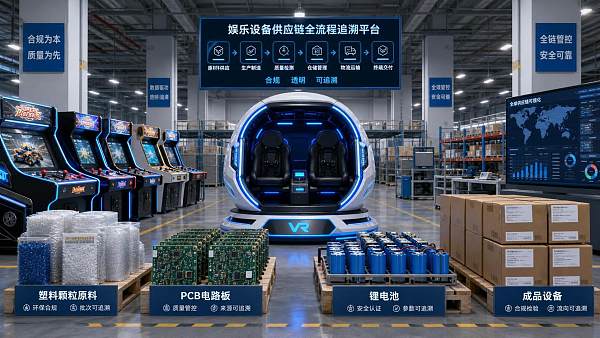
Suppliers of PCBs, display modules, plastic casings, and power components used in arcade/VR devices are indirectly affected through cascading contractual obligations. Major OEMs now include EPR compliance clauses in procurement agreements, requiring upstream vendors to verify material recyclability data and supply chain traceability documentation—especially for plastics subject to upcoming EU recycled content mandates. While not directly liable for portal registration, procurement entities must adapt sourcing criteria to support downstream EPR reporting requirements.
Manufacturing Enterprises
OEMs and contract manufacturers producing arcade/VR hardware must now integrate EPR-related data collection into production planning: batch-level material composition records, packaging weight/volume metrics, and end-of-life take-back cost estimates must be compiled for annual submission. Unlike prior national schemes, the unified portal demands standardized, machine-readable formats—increasing IT system integration needs and internal cross-departmental coordination between engineering, logistics, and sustainability teams.
Supply Chain Service Providers
Courier services, customs brokers, and freight forwarders report heightened scrutiny from EU border authorities post-12 May. Documentation checks now include real-time validation of EPR ID validity via API-linked verification tools. Some logistics partners have introduced pre-clearance screening fees; others require EPR ID confirmation before accepting consignments destined for Germany or France. Third-party compliance consultants are seeing surge demand for ‘EPR readiness audits’—a new service line distinct from traditional REACH or RoHS support.
Key Focus Areas and Response Measures
Confirm Registration Window Alignment
Companies must treat ‘first shipment’ as the triggering event—not invoice date or contract signing. Internal logistics teams should coordinate closely with sales and warehouse operations to identify the precise dispatch timestamp qualifying as ‘first shipment’ under EU definition (i.e., goods physically crossing an EU external border). A 72-hour window leaves no margin for internal approval delays.
Validate EPR ID Format and Jurisdiction Scope
EPR IDs issued via the portal are country-specific and non-transferable—even for pan-EU shipments. A German-issued ID does not satisfy French requirements. Exporters serving multiple markets must register separately in each jurisdiction, using local legal entities or authorized representatives where required. The portal currently supports only direct registration by EU-established entities or via appointed ‘authorized representatives’—no third-party proxy submissions.
Prepare Compliance Commitment Letters with Legal Review
The mandated commitment letter is not a template document. It must explicitly reference the registered EPR ID, confirm responsibility for financing and organizing collection/recycling, and affirm adherence to national take-back targets. Legal counsel should review wording to avoid unintended liability exposure—particularly around joint producer responsibility or historical stock liabilities.
Editorial Perspective / Industry Observation
Observably, the portal’s strict temporal trigger—72 hours from first shipment—represents a departure from previous EPR rollouts, which typically allowed grace periods or phased implementation. Analysis shows this design prioritizes enforcement immediacy over transitional capacity building, suggesting EU authorities anticipate widespread non-compliance among non-EU exporters. From industry perspective, the move consolidates fragmented national systems but raises the bar for SMEs lacking dedicated regulatory affairs staff. Current evidence indicates early adopters are leveraging API integrations with ERP systems to auto-generate required reports—a capability still rare among mid-tier Chinese exporters.
Conclusion
This initiative marks a structural tightening of environmental accountability in consumer electronics trade—not merely an administrative update. Its significance lies less in novelty than in enforceability: real-time customs linkage, automated risk flagging, and jurisdiction-specific IDs collectively reduce loopholes historically exploited under decentralized regimes. For the arcade and VR sector, it signals that sustainability compliance is now inseparable from market access—not a parallel certification track.
Source Attribution
Official source: European Commission Directorate-General for Environment, ‘EPR Digital Portal Operational Launch Notice’, published 10 May 2026 (Ref: ENV/EPR/2026/05). Additional guidance issued by national authorities including Germany’s Zentrale Stelle Verpackungsregister (ZSVR), France’s Eco-Organisme ADEME, and Italy’s CONAI. Note: Portal functionality for multi-country reporting harmonization remains under development; full interoperability across all 12 states is scheduled for Q4 2026 and remains subject to ongoing technical validation.

Search News
Hot Articles
- Restaurant FurnitureFast-Casual Restaurant Interiors: Design Choices That Improve Speed and Guest FlowOct 04, 2026
- Outdoor RidesHow to Select Leisure Park Equipment for Safe, High-Throughput Visitor AreasOct 03, 2026
- Fashion & Gem JewelryDiamond Tester Wholesale: How to Vet Accuracy, Calibration, and MOQ Before OrderingOct 02, 2026
Popular Tags
Need ExpertConsultation?
Connect with our specialized leisureengineering team for procurementstrategies.
Recommended News
 Sep 15, 2026How to Choose Coin-Operated Pool Tables for Bars, Hotels, and Arcade VenuesCoin operated pool tables for bars, hotels, and arcades: compare sizes, payment systems, durability, service access, and revenue potential.● Theme Park Strategist
 Sep 08, 2026What to Look for in a Flight Simulator Chair Manufacturer for Commercial VR CentersChoose a flight simulator chair manufacturer that delivers durable, safe, customizable seating for commercial VR centers. Explore key sourcing criteria now.● Theme Park Strategist
 Aug 25, 2026What to Evaluate Before Buying Commercial Self Service Photo Booths for VenuesCommercial self service photo booths for venues: learn how to evaluate durability, software stability, branding flexibility, support, and total ROI before you buy.● Theme Park Strategist
 Aug 23, 2026How to Evaluate Wholesale Vending Machines for Multi-Location Business DeploymentWholesale vending machines for multi-location deployment require more than low unit cost. Learn how to compare reliability, payments, telemetry, and supplier support to scale smarter.● Theme Park Strategist
 Aug 17, 2026U.S. CPSC Urges Bilingual Warnings for Arcade and VR MachinesU.S. CPSC urges bilingual safety warnings for Arcade & VR Machines—learn what exporters, importers, and distributors must do now to avoid delays and returns.● Theme Park Strategist
 Aug 16, 2026EU Enforces EN IEC 62368-1:2026 Certification for Arcade and VR MachinesEU Enforces EN IEC 62368-1:2026 certification for arcade and VR machines, reshaping EU market access, customs clearance, and compliance planning for exporters and distributors.● Theme Park Strategist
 Aug 13, 2026UFLPA’s new guidelines take effect: Exports of Arcade and VR equipment face full-link labor compliance requirementsUFLPA’s new guide takes effect: Arcade and VR machine exports to the U.S. now face full-chain labor compliance checks. Discover key risks and action steps.● Theme Park Strategist
 Aug 12, 2026EU PPWR takes effect, Arcade and VR packaging incorporate heavy metal and PFAS restrictionsEU PPWR now applies to Arcade and VR packaging, tightening heavy metal and PFAS compliance. Learn how exporters can avoid delays, fines, and customs risks.● Theme Park Strategist
 Aug 11, 2026CPSC Sets Bilingual Labels for Arcade and VR ImportsCPSC bilingual labels for arcade and VR imports become mandatory on October 1, 2026. Learn the new English-Spanish warning rules, customs risks, and key compliance steps now.● Theme Park Strategist
 Aug 10, 2026EU Rule Takes Effect for Arcade & VR Machine ClearanceArcade & VR Machine clearance in the EU now depends on EN IEC 62368-1:2026+A11:2026 compliance. Learn what changed, who is affected, and how to avoid customs delays.● Theme Park Strategist
 Aug 09, 2026CPSC Requires New Labels for Arcade and VR ImportsCPSC requires new labels for Arcade and VR imports starting Oct 1, 2026. Learn the multilingual warning rules, compliance risks, and key steps exporters and buyers must take now.● Theme Park Strategist
 Aug 08, 2026EU Entry Rule Tightens for Arcade & VR MachinesArcade & VR Machines entering the EU now face stricter CE compliance under EN IEC 62368-1:2026+A11:2026. Learn the new rule, risks, and what exporters must do now.● Theme Park Strategist
 Aug 07, 2026CPSC Notice Tightens U.S. Entry Rules for Arcade and VR MachinesCPSC Notice Tightens U.S. Entry Rules for Arcade and VR Machines: learn the new labeling, FCC, UN38.3, and compliance document requirements before October 1, 2026.● Theme Park Strategist
 Aug 06, 2026EU Rule Takes Effect for CE-UKCA Labels on Arcade & VR MachinesArcade & VR Machines face new CE-UKCA label and ECPD filing rules in the EU and UK. Learn what manufacturers, importers, and distributors must do now to avoid delays.● Theme Park Strategist
 Aug 05, 2026CPSC Recalls Arcade and VR Machines Over UL 62368-1CPSC recalls arcade and VR machines over UL 62368-1 non-compliance. Learn how this 2026 safety action may affect imports, distribution, customs clearance, and market access.● Theme Park Strategist
 Aug 02, 2026EU Sets New Certification Rule for Arcade and VR MachinesArcade and VR Machines face a new EU certification rule from Oct 1, 2026. Learn how EN IEC 62368-1:2026+A11:2026 affects CE marking, customs clearance, and market access.● Theme Park Strategist
 Aug 01, 2026CPSC Moves to Require Bilingual Warnings on Arcade and VR MachinesCPSC bilingual warnings for Arcade and VR Machines may reshape U.S. import compliance. Learn how English-Spanish labels affect packaging, customs risk, and shipment readiness.● Theme Park Strategist
 Jul 31, 2026EU Sets EN IEC 62368-1:2025 Rule for Arcade and VR MachinesEU Sets EN IEC 62368-1:2025 Rule for Arcade and VR Machines. Learn the new EU compliance deadlines, safety updates, and key actions for manufacturers, OEMs, and distributors.● Theme Park Strategist
 Jul 30, 2026CPSC Sets New Warning Label Rule for Arcade & VR MachinesCPSC sets a new warning label rule for Arcade & VR Machines effective August 15, 2026. Learn key compliance risks, multilingual label requirements, and shipment actions now.● Theme Park Strategist
 Jul 29, 2026EU Enforces New Safety Standard for Arcade and VR MachinesEU Enforces New Safety Standard for Arcade and VR Machines: learn how EN IEC 62368-1 affects CE compliance, customs clearance, and EU market access for exporters and buyers.● Theme Park Strategist
 Jul 28, 2026CPSC Sets ASTM F3472-26 Rule for Arcade & VR ImportsCPSC ASTM F3472-26 rule reshapes Arcade & VR imports to the U.S. Learn key compliance deadlines, certification risks, and what exporters, OEM/ODM suppliers, and buyers should do now.● Theme Park Strategist
 Jul 27, 2026EU Rule Takes Effect for Arcade & VR Machine CybersecurityEU Rule Takes Effect for Arcade & VR Machine Cybersecurity: learn how EN IEC 62443-3-3:2025 affects compliance, customs clearance, sales continuity, and supplier planning in the EU market.● Theme Park Strategist
 Jul 25, 2026CPSC Sets Bilingual Warning Rule for Arcade and VR ImportsCPSC bilingual warning rule for arcade and VR imports takes effect August 1, 2026. Learn how OEM/ODM exporters can avoid CBP delays, relabel shipments, and protect U.S. delivery timelines.● Theme Park Strategist
 Jul 24, 2026EU Enforces New Safety Standard for Arcade and VR MachinesEU Enforces New Safety Standard for Arcade and VR Machines: learn how EN IEC 62368-1:2026+A11:2026 reshapes EU compliance, CE documentation, testing timelines, and export readiness.● Theme Park Strategist