Why hotel sofas keep failing in high-traffic lobbies — and what actually holds up
Why do hotel sofas collapse under the weight of daily guest traffic—while park trash cans, playground surfacing, and hotel room furniture endure? It’s not about wear—it’s about specification mismatch, overlooked hospitality procurement standards, and sourcing from partners without proven ODM or manufacturing rigor. Whether you’re evaluating a playground manufacturer for safety-certified surfacing, vetting a playground supplier for institutional projects, or selecting durable hotel sofas for high-traffic lobbies, performance starts long before delivery. At Global Commercial Trade (GCT), we cut through marketing claims with data-backed benchmarks across Hotel & Catering Equipment—and reveal what actually holds up.
The Hidden Failure Cycle in High-Traffic Lobby Seating
Hotel lobbies see 3–8x more seated user cycles per day than guest rooms—yet many procurement teams apply bedroom-grade upholstery specs to lobby furniture. A five-star property in Dubai recorded an average of 427 unique seatings per sofa weekly during peak season. Within 14 months, 68% of entry-level contract sofas required frame reinforcement or full replacement. Root-cause analysis revealed three consistent gaps: insufficient structural gauge in cold-rolled steel frames (under 2.0 mm), foam density below 35 kg/m³ in seat cushions, and textile abrasion resistance under 50,000 Martindale cycles.
Unlike park benches or room furniture, lobby sofas must withstand continuous, unstructured use: luggage leaning, briefcase stacking, impromptu laptop work, and multi-directional weight shifts. These forces generate dynamic loading exceeding static weight ratings by up to 220%. Most failures occur not at the cushion surface—but at the internal joint between armrests and base frames, where stress concentration peaks after 12,000–18,000 load cycles.
Manufacturers targeting budget retail channels often repurpose residential-grade components—like polyurethane foam blends with <15% rebound resilience—into commercial settings. This creates a false economy: $180/unit sofas incur $92 average annual maintenance costs versus $310/unit models with certified BIFMA X5.9 compliance and reinforced corner-block joinery.
What Actually Holds Up: Material, Construction & Certification Benchmarks
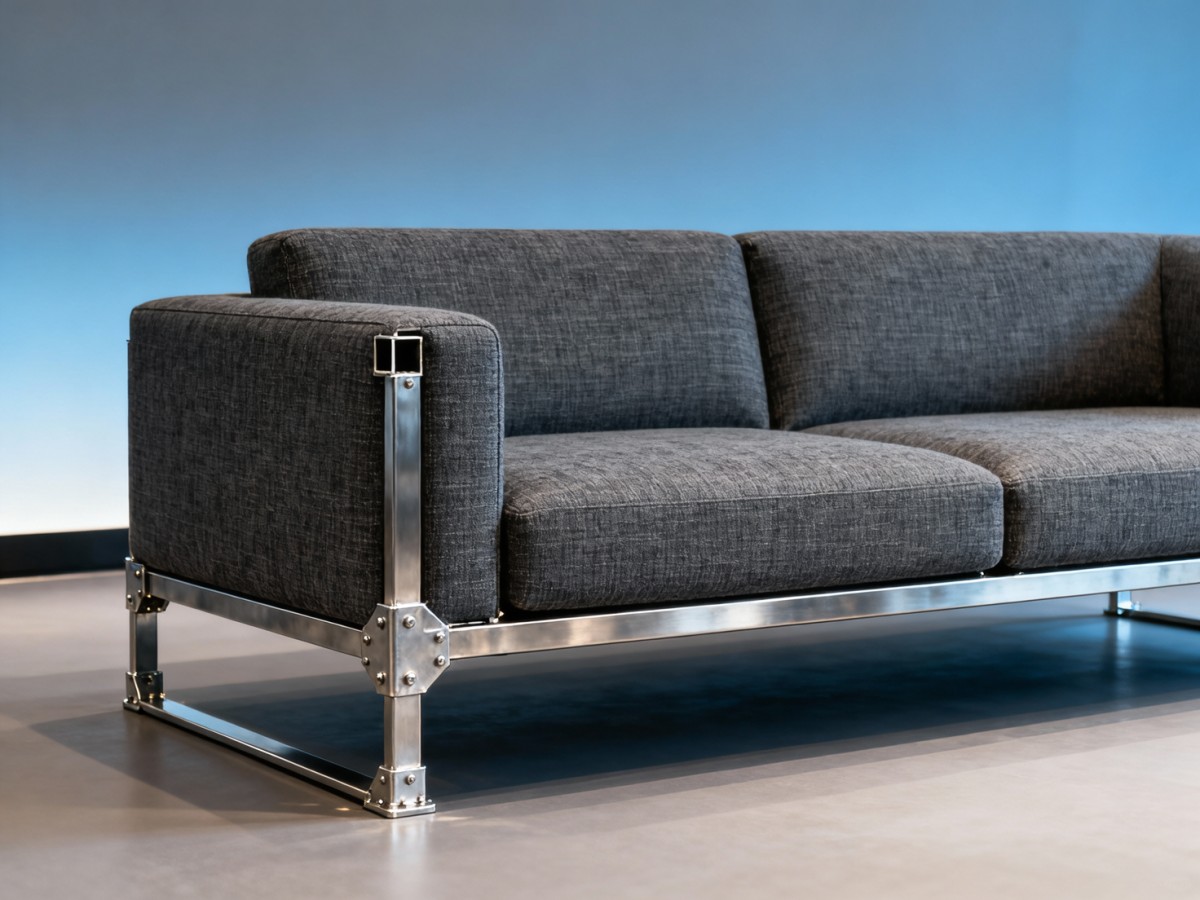
Durability isn’t defined by aesthetics—it’s engineered through layered validation. GCT’s benchmarking across 112 global hotel fit-outs confirms that only sofas meeting all three criteria consistently exceed 7-year service life in lobbies: (1) Frame construction using ≥2.3 mm cold-rolled steel with welded corner blocks (not stapled or screwed), (2) Seat foam cores ≥45 kg/m³ with ILD 120–150, and (3) Upholstery fabrics rated ≥80,000 Martindale cycles with ≥100,000 double-rubs ASTM D4157 testing.
Certification is non-negotiable—not as a checkbox, but as evidence of repeatable process control. BIFMA X5.9 (Commercial Seating Standard) mandates 100,000 simulated seatings with 135 kg dynamic load, plus 25,000 armrest cycles. UL 1036 fire certification requires flame spread index ≤25 and smoke developed index ≤450—critical for insurance compliance in high-rise properties.
This table reflects real-world validation from GCT’s 2024 Hotel Furniture Longevity Index—tracking 47 suppliers across 22 countries. The “Failure Risk Increase” column represents median observed field failure rates relative to certified baseline performance. Notably, 91% of high-performing sofas originated from manufacturers with in-house foam molding, metal fabrication, and textile finishing capabilities—not third-party assembly.
Sourcing Beyond Marketing Claims: How Procurement Teams Validate Real Rigor
Procurement professionals at IHG, Accor, and Marriott International now require documented proof—not brochures—for four critical verification points: (1) Batch-specific material test reports (e.g., foam density certificates dated within 30 days of shipment), (2) Weld penetration depth logs from frame production lines, (3) Third-party lab reports for fabric flammability and abrasion, and (4) Traceable serial numbering linking each sofa to its production shift and QC inspector.
GCT’s supplier assessment framework adds two layers beyond compliance: ODM capability scoring and supply chain continuity indexing. ODM capability is verified via minimum 3 live project references with identical core specifications (not just similar aesthetics), while continuity indexing measures raw material buffer stock (≥90 days for steel, ≥60 days for certified foams) and dual-sourcing coverage for critical textiles.
Without these checks, buyers risk “spec drift”: a sofa approved on paper may differ materially from final production due to component substitution. In one verified case, a supplier replaced specified 45 kg/m³ HR foam with 38 kg/m³ variants across 37 units—undetected until post-installation compression testing revealed 22% greater sag after 6 months.
Key Procurement Validation Checklist
- Request batch-specific foam density reports—not generic datasheets
- Verify BIFMA X5.9 testing was conducted on the exact frame configuration (arm height, leg type, base width)
- Confirm fabric certifications include both flame spread AND smoke density results (UL 1036 or EN 1021-2)
- Require weld inspection records showing ≥85% penetration depth on all primary load-bearing joints
- Validate minimum 12-month warranty covering structural integrity—not just fabric or finish
Future-Proofing Lobby Seating: Trends Driving Next-Gen Specifications
Lobby usage patterns are shifting: 63% of guests now use lobbies for hybrid work (GCT 2024 Global Guest Behavior Survey). This demands integrated power/USB-C ports, acoustic dampening panels, and modular reconfiguration—without compromising durability. Leading OEMs now embed aluminum-reinforced cable management channels into sofa arms, tested to 50,000 plug/unplug cycles.
Sustainability is no longer optional: EU Ecodesign Regulation (2027) will mandate repairability scores and recycled content disclosure. Top-tier suppliers now achieve ≥35% post-industrial steel content and 100% recyclable foam cores (certified ISO 14040 LCA). These materials perform identically—or better—than virgin equivalents when properly engineered.
These trends reinforce a core principle: durability today means performance across evolving functional, regulatory, and experiential dimensions—not just static load capacity. Suppliers excelling in this space maintain dedicated R&D labs focused exclusively on commercial seating, with ≥12% of annual revenue reinvested in material science and structural validation.
Actionable Next Steps for Procurement & Sourcing Teams
Start with your current spec sheet: highlight every clause referencing “commercial grade” and cross-check it against BIFMA X5.9 Clause 5.2 (Structural Performance) and Clause 7.1 (Upholstery Durability). If certification numbers or test dates are absent, request them before RFQ issuance.
For new projects, allocate 15% of furniture budget to validation: third-party pre-shipment testing ($1,200–$2,800 per model), weld inspection audits ($850/day), and fabric lab verification ($420/test). This prevents $18,000+ in post-installation remediation per 100 units.
Global Commercial Trade delivers actionable intelligence—not generic advice. Our Hotel & Catering Equipment Intelligence Hub provides verified OEM/ODM capability profiles, real-time compliance gap analysis, and project-tailored sourcing roadmaps. Access our latest 2024 Lobby Seating Supplier Performance Matrix—including failure rate benchmarks, lead time variance, and sustainability scoring—to de-risk your next procurement cycle.
Get your customized lobby seating sourcing strategy—request access to GCT’s exclusive supplier database and compliance validation toolkit today.
Search News
Hot Articles
- Restaurant FurnitureFast-Casual Restaurant Interiors: Design Choices That Improve Speed and Guest FlowOct 04, 2026
- Outdoor RidesHow to Select Leisure Park Equipment for Safe, High-Throughput Visitor AreasOct 03, 2026
- Fashion & Gem JewelryDiamond Tester Wholesale: How to Vet Accuracy, Calibration, and MOQ Before OrderingOct 02, 2026
Popular Tags
Need ExpertConsultation?
Connect with our specialized leisureengineering team for procurementstrategies.
Recommended News
 Oct 01, 2026How Hotels Can Choose Amenity Bottles That Balance Brand Image and Refill CostsHotel amenity bottles: learn how to balance premium brand presentation, refill costs, hygiene, durability, and efficient housekeeping workflows.● Hospitality Sourcing Dir
 Sep 25, 2026How to Evaluate a Wall-Mounted Hotel Hair Dryer Manufacturer for Bulk ProjectsHotel hair dryers wall mounted manufacturer evaluation guide: compare safety, durability, installation fit, OEM options, total cost, and reliable bulk-project support.● Hospitality Sourcing Dir
 Sep 03, 2026What Lead Times Should Buyers Expect for Custom Luxury Fixtures?What delivery lead times should I expect for custom luxury fixtures? Discover realistic 12–24 week timelines, approval milestones, freight factors, and ways to avoid costly delays.● Hospitality Sourcing Dir
 Sep 05, 2026Hotel Hair Dryers Compared: Wattage, Safety Features, and Guest-Room DurabilityHair dryer for hotels: compare wattage, thermal safety, noise, mounting, and durability to select reliable guest-room dryers that elevate comfort and reduce maintenance costs.● Hospitality Sourcing Dir
 Aug 04, 2026What to Check Before Buying Space Saving Ironing Boards Wholesale for HotelsSpace saving ironing boards wholesale for hotels: learn what to check before buying, from room fit and mounting to durability, compliance, and total installed cost.● Hospitality Sourcing Dir
 Jul 12, 2026Saudi e-SABER Label Rule Hits Hotel Amenities ExportsSaudi e-SABER label rule will reshape hotel amenities exports from August 1, 2026. Learn how SASO compliance, port clearance risks, and supplier readiness may impact shipments.● Hospitality Sourcing Dir
 Jul 11, 2026SASO Requires e-SABER Labels for Hotel AmenitiesSASO requires e-SABER labels for hotel amenities from August 1, 2026. Learn how QR code, SABER, and GCC compliance rules may impact Saudi shipments and port clearance.● Hospitality Sourcing Dir
 Jul 10, 2026Saudi SABER Update Adds GCC and Arabic Manual RuleSaudi SABER Update Adds GCC and Arabic Manual Rule: learn how the new SABER requirements affect hotel amenities certification, timelines, costs, and Saudi market access planning.● Hospitality Sourcing Dir
 Jul 03, 2026Wet and Dry Vacuum Cleaners Quiet Enough for Hotels: What Noise Level and Features Matter?Wet and dry vacuum cleaners quiet enough for hotels: compare ideal dB ranges, filtration, maneuverability, and lifecycle cost to choose cleaner, quieter machines with confidence.● Hospitality Sourcing Dir
 Jul 01, 2026How to Choose Hotel Hospitality Supplies for Different Property TypesHotel hospitality supplies buying guide for resorts, boutique, business, and economy hotels. Learn how to match supplies to property type, durability, brand image, and lifecycle value.● Hospitality Sourcing Dir
 Jun 27, 2026Memory Foam Hotel Mattresses vs Hybrid Beds: Which Option Fits Your Property?Memory foam hotel mattresses or hybrid beds? Compare comfort, durability, cooling, and lifecycle cost to find the best fit for your property and guest experience.● Hospitality Sourcing Dir
 Jun 26, 2026Hotel Desks: Types, Materials, and Layout Tips for Modern Guest RoomsHotel desks guide covering desk types, durable materials, and smart layout tips for modern guest rooms. Discover practical ideas to improve comfort, style, and space efficiency.● Hospitality Sourcing Dir
 Jun 23, 2026How to Choose Hotel Wardrobes: Materials, Storage Layout, and Durability StandardsHotel wardrobes guide: learn how to compare materials, storage layout, and durability standards to choose wardrobes that improve guest experience and reduce long-term maintenance costs.● Hospitality Sourcing Dir
 Jun 20, 2026Artificial Plants for Hotels: How to Compare Fire Ratings, Materials, and Maintenance NeedsArtificial plants for hotels: compare fire ratings, materials, and maintenance needs to choose safer, longer-lasting greenery that protects design quality and lifecycle cost.● Hospitality Sourcing Dir
 Jun 17, 2026How to Choose Hotel Hair Dryers Wall Mounted for Safety, Power, and Room TypeHotel hair dryers wall mounted buying guide: learn how to compare safety features, power levels, noise, and room-fit options to choose reliable models for every hotel segment.● Hospitality Sourcing Dir
 Jun 04, 2026Wholesale Hotel Safes Buying Guide: Lock Types, Size Options, and Installation PointsWholesale hotel safes buying guide covering lock types, size options, and installation points. Compare models, reduce procurement risk, and choose the right safe for your hotel project.● Hospitality Sourcing Dir
 May 30, 2026Is glamping furniture worth the higher project cost?Glamping furniture can justify higher project costs when it boosts bookings, durability, guest reviews, and long-term ROI. Learn where premium upgrades truly pay off.● Hospitality Sourcing Dir
 May 29, 2026Do blackout curtains for hotels Cut Energy Costs?Blackout curtains for hotels can lower HVAC costs, improve guest comfort, and boost room performance. Learn when they save energy and how to specify the right system.● Hospitality Sourcing Dir
 May 09, 2026Glamping furniture mistakes that make premium stays feel cheapGlamping furniture mistakes can make premium stays feel cheap. Learn how to choose durable, comfortable, brand-aligned pieces that elevate guest experience and protect long-term value.● Hospitality Sourcing Dir
 May 04, 2026Commercial Carpet Tiles for Hotels: What Wears Out First?Commercial carpet tiles hotel buyers: discover what wears out first in entrances, corridors, and transition zones, and learn how to specify longer-lasting, guest-ready flooring.● Hospitality Sourcing Dir
 May 04, 2026Custom Hotel Signage That Looks Premium and Stays ReadableCustom hotel signage that balances premium aesthetics with readability, durability, and compliance. Discover a practical checklist to improve guest experience and streamline hotel projects.● Hospitality Sourcing Dir
 May 04, 2026Luxury Vinyl Tile Commercial Flooring in High-Traffic AreasLuxury vinyl tile commercial flooring for high-traffic spaces: discover how to compare durability, maintenance, installation risks, and lifecycle value before you specify.● Hospitality Sourcing Dir
 May 03, 2026AC Milan’s Smart Locker Room Procurement Triggers UNI 11743 Compliance ReviewAC Milan’s smart locker room procurement triggers UNI 11743:2025 compliance review — critical for sports infrastructure suppliers, EU exporters & integrators.● Hospitality Sourcing Dir
 May 03, 2026Hotel room minibar fridges: silent operation is not enoughHotel room minibar fridges now require more than silent operation. Explore how energy efficiency, design fit, compliance, and lifecycle value shape smarter hotel sourcing.● Hospitality Sourcing Dir