Guangzhou Fair Opens With Compliance Pack for Arcade & VR Exports
On June 16, 2026, the China (Guangzhou) Cross-Border E-Commerce Fair opened with a notable new service aimed at the Arcade & VR Machines segment: a global compliance package introduced by Temu together with SGS, TÜV Rheinland, and the Guangdong WTO/TBT Notification and Inquiry Center. For factories already selling cross-border or preparing to enter overseas markets, the development is worth watching because it links market access certification, multilingual documentation, and EPR filing support to actual export preparation rather than treating compliance as a separate afterthought.
A New Compliance Offer Debuts in the Arcade & VR Machines Zone
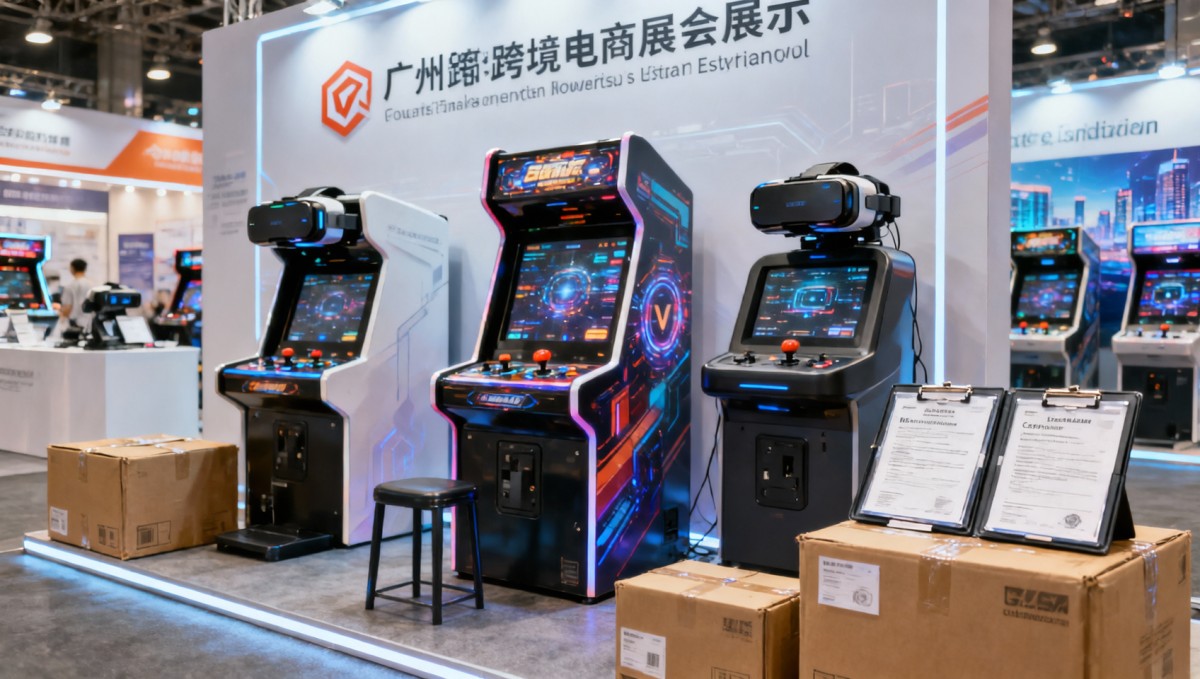
At the opening of the 2026 China (Guangzhou) Cross-Border E-Commerce Fair, Temu launched a “global compliance export service package” in the Arcade & VR Machines exhibition area. The service was introduced in cooperation with SGS, TÜV Rheinland, and the Guangdong WTO/TBT Notification and Inquiry Center.
According to the event summary provided, the package covers fast-track access to admission certifications for 12 countries, including CE and UKCA for Europe, FCC and UL for the United States, SASO for the Middle East, and TISI for Southeast Asia. It also includes multilingual instruction manual templates and EPR agency filing services.
The service is open to both factories that have already joined the platform and those that are considering overseas expansion.
Why This Matters Across the Export Chain
For manufacturers, compliance moves closer to early production planning
From an industry perspective, Arcade & VR equipment factories may be affected first because certification and documentation requirements directly influence whether products can move into target markets. The practical impact is likely to be felt in product preparation, technical document readiness, user manual localization, and market-specific filing work.
What deserves closer attention is whether factories treat this as a pre-shipment efficiency tool or as part of earlier product development planning. The difference can affect timelines, document completeness, and communication with overseas buyers or platform channels.
For cross-border sellers, market access may become a more visible operating condition
Direct trading companies and cross-border sellers may feel the impact in listing readiness, onboarding speed, and destination-market selection. A service package that combines certification fast-track channels with multilingual documentation support suggests that compliance is being integrated more closely into export operations.
Analysis shows that sellers targeting multiple markets may need to pay closer attention to which certification path applies to which destination, rather than assuming one set of documents can support all market entries.
For service providers, documentation and filing support gain operational weight
Supply chain service firms, testing and certification partners, and filing agents may also be affected because the package explicitly includes EPR agency filing and instruction manual templates. That means supporting services are not limited to laboratory testing or certificate issuance, but extend to paperwork quality and filing execution.
Observably, this raises the importance of coordination between manufacturing, certification, and documentation workflows, especially for products that may face different entry requirements across regions.
What Companies Should Watch Next
Track how the service scope is described in practice
Companies should watch for subsequent official wording or operational details around the “fast-track” element, especially how coverage across the stated 12-country framework is translated into actual application procedures, materials lists, and processing expectations. The current information confirms the service scope at a high level, but not the detailed workflow.
Check whether target markets match product documentation readiness
For factories and sellers, a key operational issue is whether existing product files, manuals, labels, and technical materials are already suitable for CE/UKCA, FCC/UL, SASO, TISI, or related entry processes. The presence of multilingual manual templates is useful, but companies still need to assess whether their internal product information is consistent and complete enough to support translation and submission.
Separate platform support from final market-entry responsibility
Analysis shows that businesses should distinguish between the availability of a service package and the final responsibility for compliant export. A fast-track or agency support arrangement may improve process efficiency, but it does not remove the need for companies to verify product specifications, required documents, and filing accuracy for each destination market.
Prepare supplier and delivery coordination earlier
Where factories rely on upstream component sourcing, outsourced assembly, or third-party documentation support, it becomes important to align internal and external partners earlier in the export cycle. What deserves closer attention is whether supplier qualifications, technical files, and delivery timing can support certification and filing schedules without delaying outbound sales plans.
A Signal About How Export Readiness Is Being Framed
Observably, this development is more meaningful as a signal about export readiness than as a completed market outcome. The notable point is not only that certification pathways are being highlighted, but that they are presented together with multilingual manuals and EPR filing support in a product-specific exhibition context.
Analysis shows that the industry may read this as a sign that overseas expansion for Arcade & VR Machines is being framed less as a simple sales opportunity and more as a process that depends on structured compliance preparation. At this stage, however, it is more appropriate to understand the news as an operational signal rather than proof of a settled long-term shift, because detailed implementation results were not provided in the input.
How This News Is Best Understood Now
At present, this update is best understood as a practical and closely watched development in cross-border export services for Arcade & VR Machines. It indicates that market access certification, multilingual product information, and EPR-related filing are being brought into a more unified service framework for factories exploring overseas business.
A neutral reading is that the announcement may help reduce friction in export preparation for some participants, but its full significance will depend on how the service is used in real transactions and how clearly its procedures are defined over time. For the industry, the main takeaway is to watch the connection between compliance support and actual export execution.
Basis of This Article and Ongoing Verification
This article is based on the user-provided news title, event date, and event summary concerning the June 16, 2026 opening of the China (Guangzhou) Cross-Border E-Commerce Fair and the debut of a global compliance export service package in the Arcade & VR Machines zone.
For this type of industry update, commonly relevant source categories may include official event announcements, company statements, industry association releases, authoritative media coverage, and documents from certification or standards-related organizations. A specific official source link was not provided in the input, so further verification remains necessary.
Follow-up attention should focus on whether additional official details clarify application procedures, service boundaries, and the practical rollout of certification, documentation, and EPR filing support across the markets mentioned in the event summary.
Search News
Hot Articles
- Outdoor RidesWhat Drives Animatronic Dinosaur Manufacturer Prices for Theme Park Projects?Sep 18, 2026
- Stationery & UniformsHow to Source Wholesale Packing Tape Without Compromising Carton Seal StrengthSep 17, 2026
- Smart Campus TechHow to Source Educational Furniture Worldwide for Safe, Flexible Learning SpacesSep 16, 2026
Popular Tags
Need ExpertConsultation?
Connect with our specialized leisureengineering team for procurementstrategies.
Recommended News
 Sep 15, 2026How to Choose Coin-Operated Pool Tables for Bars, Hotels, and Arcade VenuesCoin operated pool tables for bars, hotels, and arcades: compare sizes, payment systems, durability, service access, and revenue potential.● Theme Park Strategist
 Sep 08, 2026What to Look for in a Flight Simulator Chair Manufacturer for Commercial VR CentersChoose a flight simulator chair manufacturer that delivers durable, safe, customizable seating for commercial VR centers. Explore key sourcing criteria now.● Theme Park Strategist
 Aug 25, 2026What to Evaluate Before Buying Commercial Self Service Photo Booths for VenuesCommercial self service photo booths for venues: learn how to evaluate durability, software stability, branding flexibility, support, and total ROI before you buy.● Theme Park Strategist
 Aug 23, 2026How to Evaluate Wholesale Vending Machines for Multi-Location Business DeploymentWholesale vending machines for multi-location deployment require more than low unit cost. Learn how to compare reliability, payments, telemetry, and supplier support to scale smarter.● Theme Park Strategist
 Aug 17, 2026U.S. CPSC Urges Bilingual Warnings for Arcade and VR MachinesU.S. CPSC urges bilingual safety warnings for Arcade & VR Machines—learn what exporters, importers, and distributors must do now to avoid delays and returns.● Theme Park Strategist
 Aug 16, 2026EU Enforces EN IEC 62368-1:2026 Certification for Arcade and VR MachinesEU Enforces EN IEC 62368-1:2026 certification for arcade and VR machines, reshaping EU market access, customs clearance, and compliance planning for exporters and distributors.● Theme Park Strategist
 Aug 13, 2026UFLPA’s new guidelines take effect: Exports of Arcade and VR equipment face full-link labor compliance requirementsUFLPA’s new guide takes effect: Arcade and VR machine exports to the U.S. now face full-chain labor compliance checks. Discover key risks and action steps.● Theme Park Strategist
 Aug 12, 2026EU PPWR takes effect, Arcade and VR packaging incorporate heavy metal and PFAS restrictionsEU PPWR now applies to Arcade and VR packaging, tightening heavy metal and PFAS compliance. Learn how exporters can avoid delays, fines, and customs risks.● Theme Park Strategist
 Aug 11, 2026CPSC Sets Bilingual Labels for Arcade and VR ImportsCPSC bilingual labels for arcade and VR imports become mandatory on October 1, 2026. Learn the new English-Spanish warning rules, customs risks, and key compliance steps now.● Theme Park Strategist
 Aug 10, 2026EU Rule Takes Effect for Arcade & VR Machine ClearanceArcade & VR Machine clearance in the EU now depends on EN IEC 62368-1:2026+A11:2026 compliance. Learn what changed, who is affected, and how to avoid customs delays.● Theme Park Strategist
 Aug 09, 2026CPSC Requires New Labels for Arcade and VR ImportsCPSC requires new labels for Arcade and VR imports starting Oct 1, 2026. Learn the multilingual warning rules, compliance risks, and key steps exporters and buyers must take now.● Theme Park Strategist
 Aug 08, 2026EU Entry Rule Tightens for Arcade & VR MachinesArcade & VR Machines entering the EU now face stricter CE compliance under EN IEC 62368-1:2026+A11:2026. Learn the new rule, risks, and what exporters must do now.● Theme Park Strategist
 Aug 07, 2026CPSC Notice Tightens U.S. Entry Rules for Arcade and VR MachinesCPSC Notice Tightens U.S. Entry Rules for Arcade and VR Machines: learn the new labeling, FCC, UN38.3, and compliance document requirements before October 1, 2026.● Theme Park Strategist
 Aug 06, 2026EU Rule Takes Effect for CE-UKCA Labels on Arcade & VR MachinesArcade & VR Machines face new CE-UKCA label and ECPD filing rules in the EU and UK. Learn what manufacturers, importers, and distributors must do now to avoid delays.● Theme Park Strategist
 Aug 05, 2026CPSC Recalls Arcade and VR Machines Over UL 62368-1CPSC recalls arcade and VR machines over UL 62368-1 non-compliance. Learn how this 2026 safety action may affect imports, distribution, customs clearance, and market access.● Theme Park Strategist
 Aug 02, 2026EU Sets New Certification Rule for Arcade and VR MachinesArcade and VR Machines face a new EU certification rule from Oct 1, 2026. Learn how EN IEC 62368-1:2026+A11:2026 affects CE marking, customs clearance, and market access.● Theme Park Strategist
 Aug 01, 2026CPSC Moves to Require Bilingual Warnings on Arcade and VR MachinesCPSC bilingual warnings for Arcade and VR Machines may reshape U.S. import compliance. Learn how English-Spanish labels affect packaging, customs risk, and shipment readiness.● Theme Park Strategist
 Jul 31, 2026EU Sets EN IEC 62368-1:2025 Rule for Arcade and VR MachinesEU Sets EN IEC 62368-1:2025 Rule for Arcade and VR Machines. Learn the new EU compliance deadlines, safety updates, and key actions for manufacturers, OEMs, and distributors.● Theme Park Strategist
 Jul 30, 2026CPSC Sets New Warning Label Rule for Arcade & VR MachinesCPSC sets a new warning label rule for Arcade & VR Machines effective August 15, 2026. Learn key compliance risks, multilingual label requirements, and shipment actions now.● Theme Park Strategist
 Jul 29, 2026EU Enforces New Safety Standard for Arcade and VR MachinesEU Enforces New Safety Standard for Arcade and VR Machines: learn how EN IEC 62368-1 affects CE compliance, customs clearance, and EU market access for exporters and buyers.● Theme Park Strategist
 Jul 28, 2026CPSC Sets ASTM F3472-26 Rule for Arcade & VR ImportsCPSC ASTM F3472-26 rule reshapes Arcade & VR imports to the U.S. Learn key compliance deadlines, certification risks, and what exporters, OEM/ODM suppliers, and buyers should do now.● Theme Park Strategist
 Jul 27, 2026EU Rule Takes Effect for Arcade & VR Machine CybersecurityEU Rule Takes Effect for Arcade & VR Machine Cybersecurity: learn how EN IEC 62443-3-3:2025 affects compliance, customs clearance, sales continuity, and supplier planning in the EU market.● Theme Park Strategist
 Jul 25, 2026CPSC Sets Bilingual Warning Rule for Arcade and VR ImportsCPSC bilingual warning rule for arcade and VR imports takes effect August 1, 2026. Learn how OEM/ODM exporters can avoid CBP delays, relabel shipments, and protect U.S. delivery timelines.● Theme Park Strategist
 Jul 24, 2026EU Enforces New Safety Standard for Arcade and VR MachinesEU Enforces New Safety Standard for Arcade and VR Machines: learn how EN IEC 62368-1:2026+A11:2026 reshapes EU compliance, CE documentation, testing timelines, and export readiness.● Theme Park Strategist