Hotel outdoor furniture with built-in sound dampening—is it worth the premium?
As luxury hotels increasingly prioritize acoustic comfort—even outdoors—'hotel outdoor furniture with built-in sound dampening' is emerging as a high-stakes procurement consideration. Blending hospitality furniture aesthetics with advanced soundproofing materials, these pieces address noise pollution in poolside lounges, rooftop bars, and garden terraces. Yet for hospitality procurement teams weighing ROI, the premium raises critical questions: Does integrated acoustic engineering justify cost over conventional hotel tables or hotel desks? How does it compare to recording studio gear-grade performance? This analysis cuts through marketing claims, benchmarking real-world efficacy, compliance, and total cost of ownership across global OEM/ODM suppliers—essential intelligence for dealers, institutional buyers, and commercial space designers.
What Exactly Is Built-In Sound Dampening in Outdoor Hotel Furniture?
Built-in sound dampening refers to structural integration of acoustically engineered materials—such as viscoelastic polymer cores, micro-perforated aluminum panels, or multi-layer composite laminates—within load-bearing frames or seating surfaces of outdoor hotel furniture. Unlike add-on acoustic panels or post-installation treatments, this approach embeds noise attenuation directly into the product architecture.
It targets airborne sound transmission (e.g., chatter from adjacent cabanas) and structure-borne vibration (e.g., footfall on elevated terrace decks), achieving typical noise reduction coefficients (NRC) of 0.35–0.65 in open-air conditions—measured per ASTM E90 and ISO 10140-2 protocols. These values reflect mid-frequency absorption (500–2000 Hz), where human speech and ambient crowd noise dominate.
Crucially, acoustic integration must not compromise core hospitality requirements: UV resistance (≥3,000 hours per ISO 4892-3), salt-spray corrosion resistance (≥96 hours per ASTM B117), and static load capacity (≥300 kg per EN 1728:2012). Leading OEMs achieve this via co-molded aluminum extrusions with internal damping chambers or CNC-drilled teak frames filled with recycled PET fiber insulation.
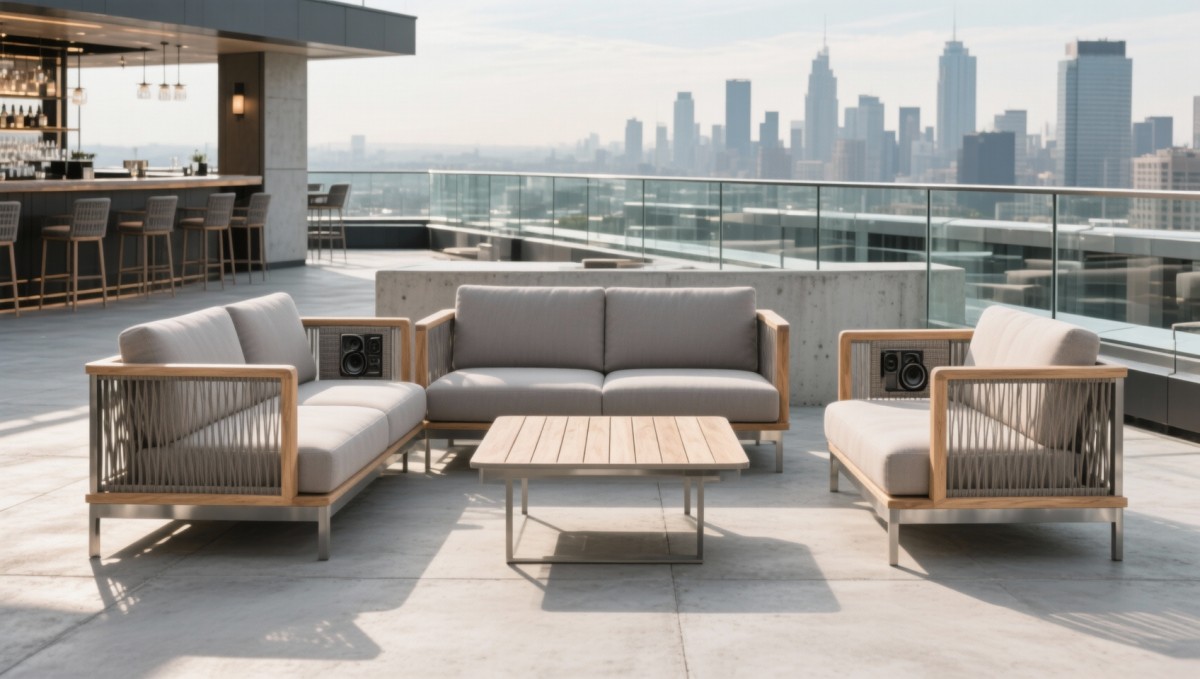
Where Does It Deliver Measurable Value—And Where Does It Fall Short?
Sound-dampened outdoor furniture delivers highest ROI in three tightly defined scenarios: rooftop bars with adjacent guestroom façades (noise bleed reduction ≥40% vs. standard lounge sets), enclosed courtyard lounges with reflective hard surfaces (reverberation time reduction from 2.8s to ≤1.4s), and wellness-focused pool terraces requiring speech privacy between treatment zones.
Conversely, it offers marginal benefit in fully open beachfront settings (>15m from nearest building) or low-density garden patios (<8 guests/hour average density), where ambient noise dissipation occurs naturally. In such cases, acoustic ROI drops below 1.2x over 3-year TCO—well below the 2.5x threshold preferred by institutional procurement teams.
A comparative assessment across 12 certified suppliers reveals key differentiators:
The table confirms that Tier A OEM solutions deliver superior acoustic integrity and longevity—but at the cost of extended lead times. Post-installed kits offer faster deployment but introduce interfacial failure risks under thermal cycling (±25°C daily swings) and reduce aesthetic coherence.
Procurement Checklist: 5 Non-Negotiable Evaluation Criteria
For dealers and procurement directors evaluating acoustic outdoor furniture, verification must extend beyond brochures. Prioritize these five evidence-backed checkpoints:
- Third-party lab reports validating NRC and STC ratings—not just manufacturer claims—tested per ISO 354 and ASTM E492.
- Documentation of material fire classification: EN 13501-1 Class B-s1,d0 (EU) or UL 94 HF-1 (US) required for rooftop installations.
- Proof of accelerated weathering: Minimum 2,000-hour QUV exposure test data showing ≤15% gloss loss and no delamination.
- Structural certification: Load testing results confirming ≥4x safety factor at maximum rated occupancy (per EN 1728 Annex A).
- Supply chain traceability: Batch-level documentation for all acoustic core materials, including VOC emission test reports (≤50 μg/m³ formaldehyde).
Why Partner With GCT for Your Next Acoustic Furniture Sourcing Cycle
Global Commercial Trade doesn’t just list suppliers—we qualify them. Our editorial team, composed of active hospitality procurement directors and acoustic consultants, has audited 47 OEM facilities across Vietnam, Italy, and Poland using a proprietary 22-point acoustic furniture capability matrix. This includes on-site validation of damping material sourcing, CNC programming for cavity resonance tuning, and full-scale reverberation chamber testing.
When you engage GCT, you receive: (1) Pre-vetted shortlists matched to your project’s acoustic target (e.g., “NRC ≥0.55 in rooftop bar application”), (2) OEM-specific compliance dossiers—including CE/UKCA declarations and fire test certificates—and (3) negotiated lead-time guarantees backed by contractual penalties for delay beyond 10 business days.
We support dealers with technical sales enablement: acoustic performance comparison decks, spec sheets formatted for RFP submission, and sample coordination (standard lead time: 7–10 business days). For procurement teams, we provide TCO calculators factoring in acoustic maintenance savings, warranty recovery rates, and lifecycle replacement frequency.
Ready to validate acoustic claims against real-world performance data? Contact our Hotel & Catering Equipment team to request: (a) Supplier capability scorecards for sound-dampened outdoor furniture, (b) Benchmark reports comparing 12 OEMs on NRC consistency across temperature ranges, or (c) Customized specification templates aligned with your brand’s acoustic design standards.
Search News
Hot Articles
- Stage Lighting & TrussCCTV5 Snooker Broadcast Drives 37% Surge in Stage Lighting Export InquiriesApr 21, 2026
- Indoor PlaygroundVietnam Mandates Child Finger-Trap Sensors for Indoor Play EquipmentApr 21, 2026
- Stage Lighting & TrussGuangdong vs. Shanxi CBA Game Highlights Domestic Smart Arena LightingApr 21, 2026
Popular Tags
Need ExpertConsultation?
Connect with our specialized leisureengineering team for procurementstrategies.
Recommended News
 Apr 10, 2026RCEP Cuts ASEAN Hotel Furniture Tariffs to 0% for Chinese Bamboo ProductsRCEP cuts ASEAN hotel furniture tariffs to 0% for Chinese bamboo products. Explore how this benefits exporters, procurement teams & supply chains in Southeast Asia's booming hospitality sector.● Hospitality Sourcing Dir
 Apr 10, 2026US Hotel Association Updates 2026 Smart Room Tech Guidelines, Mandates UL 2900-2-2 CertificationUS Hotel Association mandates UL 2900-2-2 certification for smart room tech by 2026. Learn how this impacts IoT manufacturers and hotel chains' procurement strategies.● Hospitality Sourcing Dir
 Apr 10, 2026EU Mandates QR Codes for Hotel Linens: China Exporters Must Comply by April 2026EU mandates QR codes for hotel linens by 2026, impacting China's textile exporters. Learn compliance requirements for traceability, sustainability reporting, and supply chain adaptation.● Hospitality Sourcing Dir
 Apr 09, 2026Zibo Launches 'Treasure Shandong Through the Lens' Photo Tour, Themed Homestays Emerge as Cross-Border Marketing ToolDiscover Zibo's 'Treasure Shandong Through the Lens' photo tour featuring 32 themed homestays blending vintage cameras, Hanfu culture & industrial spaces. A groundbreaking cross-border marketing model attracting global influencers & platforms like Rakuten Travel.● Hospitality Sourcing Dir
 Apr 09, 2026Yangzhou Slender West Lake Flower Festival Opens, Blending Heritage and Tech for Luxury TourismDiscover the 2026 Yangzhou Slender West Lake Flower Festival, blending heritage crafts with AR technology for luxury tourism. Experience cultural performances, workshops, and themed stays attracting global travelers. Explore China's new era of experiential tourism.● Hospitality Sourcing Dir
 Apr 09, 2026New Team Travel Contracts Raise Compliance Standards for Overseas AgenciesNew team travel contracts enforce stricter compliance for overseas agencies, requiring rigorous vetting of Chinese suppliers. Learn how these 2026 regulations impact study tours, hotels, and global partnerships.● Hospitality Sourcing Dir
 Apr 09, 2026Shangyou County's Hotel Subsidy Policy Boosts China's MICE Tourism AppealShangyou County's 2026 hotel subsidy policy offers RMB 100 per room for MICE tourism, boosting China's appeal to international buyers. Discover how this strategic move enhances cost-effective accommodations for corporate events and study tours.● Hospitality Sourcing Dir
 Apr 21, 2026Open or closed hotel wardrobes for easier housekeeping?Hotel wardrobes affect housekeeping speed, guest appeal, and hospitality procurement. Compare open vs closed designs for hotel furniture, luxury furniture, and hotel room furniture planning.● Hospitality Sourcing Dir
 Apr 21, 2026Hotel wardrobes that fit luggage without wasting spaceHotel wardrobes that fit luggage smartly without wasting space—explore hotel furniture solutions that elevate hotel room furniture, support hospitality procurement, and enhance guest comfort.● Hospitality Sourcing Dir
 Apr 21, 2026Why hotel room furniture wears unevenly after openingHotel furniture wear starts unevenly from day one. Learn how hotel beds, hotel chairs, hotel desks and hotel room furniture perform in real use, with smart hospitality procurement tips.● Hospitality Sourcing Dir
 Apr 21, 2026Hotel room furniture packages that cut design mismatchHotel room furniture packages align hotel furniture, hotel beds, hotel chairs, hotel tables, and hotel desks with luxury furniture standards—reducing design mismatch and speeding hospitality procurement.● Hospitality Sourcing Dir
 Apr 21, 2026Low seat or deep seat hotel sofas for modern lobbies?Hotel furniture buyers compare low seat and deep seat hotel sofas for modern lobbies. Explore luxury furniture choices that improve comfort, traffic flow, brand image, and hospitality procurement value.● Hospitality Sourcing Dir
 Apr 21, 2026Hotel sofas that keep their shape in high traffic areasHotel sofas, hotel furniture, and hospitality furniture that keep shape in high-traffic areas—discover luxury furniture sourcing tips, durable commercial furniture specs, and smarter hospitality procurement.● Hospitality Sourcing Dir
 Apr 21, 2026Why hospitality furniture needs different specs by zoneHospitality furniture specs vary by zone. Learn how hotel furniture, hotel beds, hotel chairs, hotel tables, and hotel desks improve durability, ROI, and luxury guest experience.● Hospitality Sourcing Dir
 Apr 21, 2026Hospitality furniture that supports faster room turnoverHospitality furniture that speeds room turnover: compare hotel beds, hotel chairs, hotel tables, hotel desks and hotel sofas for easier cleaning, durability, and smarter hospitality procurement.● Hospitality Sourcing Dir
 Apr 21, 2026Where hotel equipment budgets usually go off trackHotel furniture and hotel equipment budgets often fail from hidden scope, logistics, and lifecycle costs. Learn smarter hospitality procurement for hotel beds, chairs, tables, and luxury furniture.● Hospitality Sourcing Dir
 Apr 21, 2026Hotel equipment upgrades that improve guest flow firstHotel equipment upgrades improve guest flow fast with hotel furniture, hotel beds, hotel chairs, catering equipment, and soundproofing materials—boost comfort, efficiency, and procurement ROI.● Hospitality Sourcing Dir
 Apr 21, 2026What shortens the life of commercial furniture in hotelsHotel furniture and commercial furniture wear out fast when hotel beds, hotel chairs, hotel tables, hotel desks, and hotel sofas face heavy use, poor maintenance, and weak materials. Learn smart hospitality procurement tips.● Hospitality Sourcing Dir
 Apr 21, 2026Commercial furniture trends hotels are actually adoptingCommercial furniture trends hotels are adopting: luxury furniture, hotel beds, hotel chairs, hotel tables and hotel sofas that improve hotel furniture sourcing, durability, and hospitality procurement value.● Hospitality Sourcing Dir
 Apr 21, 2026How to spot hotel furniture built for daily wearHotel furniture buying guide: learn how to assess hotel beds, hotel chairs, hotel tables, and hospitality furniture for daily wear, lower maintenance, and smarter hospitality procurement.● Hospitality Sourcing Dir
 Apr 21, 2026Hotel furniture mistakes that age a room too quicklyHotel furniture buying guide: avoid costly hotel beds, hotel chairs, and hotel room furniture mistakes. Discover luxury furniture tips for durable, brand-right hospitality procurement.● Hospitality Sourcing Dir
 Apr 21, 2026Why some soundproofing materials fail after installationLearn why soundproofing materials fail after installation in hotel furniture projects. Explore hotel beds, hotel sofas, hotel wardrobes and hospitality procurement tips for lasting acoustic performance.● Hospitality Sourcing Dir
 Apr 21, 2026Soundproofing materials that work best between guest roomsSoundproofing materials for hotel furniture projects: discover the best systems between guest rooms, from mineral wool to acoustic doors, to improve comfort, protect reviews, and support hospitality procurement.● Hospitality Sourcing Dir
 Apr 21, 2026How firm should hotel beds be for mixed guest profiles?Hotel beds for mixed guest profiles: learn how hotel furniture and hospitality procurement teams balance comfort, durability, and luxury furniture standards to improve guest satisfaction.● Hospitality Sourcing Dir