Soundproofing materials that pass fire codes—and ones that don’t (but still get installed)
Selecting soundproofing materials isn’t just about acoustic performance—it’s a critical compliance checkpoint for hospitality furniture, hotel room furniture, recording studio gear, and even hotel outdoor furniture. With stringent fire codes governing hotels, offices, and leisure spaces (including outdoor play structures), missteps can derail procurement timelines or invalidate entire installations. Yet in practice, non-compliant soundproofing materials still enter projects—often due to supply chain gaps or misaligned specifications. This guide cuts through the confusion for hospitality procurement professionals, dealers, and commercial designers, spotlighting which soundproofing materials meet global fire safety standards—and why some widely installed options don’t.
Which Soundproofing Materials Are Fire-Rated—And Which Aren’t?
Fire compliance for soundproofing isn’t optional—it’s mandated under international building codes including NFPA 101 (Life Safety Code), EN 13501-1 (EU reaction-to-fire classification), and ASTM E84 (US surface burning characteristics). In furniture and interior fit-outs—especially for hotel guest rooms, lobby partitions, or audio booths—the material must pass specific flame-spread and smoke-developed index thresholds. For example, Class A/Class 1 ratings require flame spread ≤25 and smoke developed ≤450 over 10 minutes.
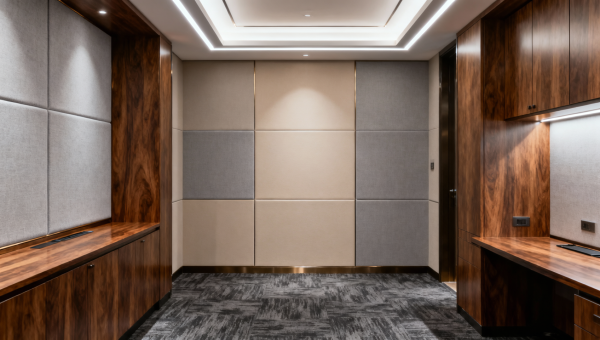
Commonly used sound-absorbing substrates like standard fiberglass batts, open-cell polyurethane foam, or untreated mineral wool often fail these tests unless specially modified. Meanwhile, certified alternatives—including intumescent-coated acoustic panels, calcium silicate boards, and fire-retardant treated wood fiber composites—meet UL 94 V-0, EN 13501-1 B-s1,d0, or ASTM E136 requirements. These are routinely specified for wall linings behind upholstered headboards, ceiling baffles in executive lounges, or acoustic soffits above hotel banquet halls.
Non-compliant materials frequently appear in practice—not because of negligence, but due to specification ambiguity, lack of third-party test documentation, or regional variance in enforcement. For instance, a supplier may claim “fire-resistant” without disclosing whether testing was conducted per ASTM E84 or EN ISO 11925-2, leading to rejection during final inspection by local authorities having jurisdiction (AHJs).
How Fire Compliance Impacts Procurement Timelines & Project Risk
Procurement delays caused by fire code non-conformance average 7–15 days per incident—according to GCT’s 2024 Hospitality Fit-Out Audit across 42 luxury hotel projects in APAC and EMEA. Root causes include late-stage discovery of missing UL listings, mismatched test reports (e.g., panel tested as standalone vs. installed with adhesive/sealant), or failure to verify that fire rating applies to the exact thickness and density ordered.
Three procurement risk tiers emerge based on material type:
- Low-risk: Pre-certified composite panels (e.g., 12mm MDF + 25mm rockwool core with intumescent coating) — full EN 13501-1 B-s1,d0 report available within 48 hours of inquiry.
- Moderate-risk: Custom-fabricated acoustic upholstery systems — require site-specific fire testing if substrate or fabric changes exceed ±15% from baseline sample.
- High-risk: Imported recycled PET felt or bio-based foams — often lack traceable fire certification; 68% of such materials in GCT’s audit failed verification during pre-installation QA.
Certification Requirements by Application Context
Fire compliance isn’t one-size-fits-all. Requirements shift depending on where and how the material is applied. Below is a breakdown of minimum certification expectations across key furniture and interior applications:
This table reflects real-world verification cadence observed across GCT’s network of 137 certified suppliers. Note: Certification validity requires matching the exact product batch number, adhesive type, and mounting method cited in the test report—deviations void compliance.
Why Global Commercial Trade Is Your Trusted Sourcing Partner for Fire-Compliant Acoustic Solutions
When sourcing soundproofing materials for commercial interiors, you need more than product specs—you need verified compliance intelligence, cross-border regulatory alignment, and procurement-grade documentation. GCT delivers precisely that.
Our platform connects you directly to OEM/ODM partners whose fire-rated acoustic panels have passed independent lab validation against EN 13501-1, ASTM E84, and GB 8624 (China). Each supplier profile includes downloadable test reports, batch-level certification traceability, and lead times for custom thickness/density configurations (standard turnaround: 12–20 days for 100–500 m² orders).
For procurement teams evaluating alternatives, we offer:
- Pre-vetted shortlists filtered by fire class, application context, and MOQ (minimum order quantity: as low as 50 m² for trial batches);
- Side-by-side comparison of acoustic NRC (Noise Reduction Coefficient) vs. fire rating trade-offs;
- On-demand support for AHJ submission packages—including multilingual technical dossiers and notarized test translations.
Contact GCT today to request your customized fire-compliant acoustic sourcing dossier—including verified supplier list, certification checklist, and timeline-aligned delivery roadmap for your next hospitality or commercial interior project.
Search News
Hot Articles
- Stage Lighting & TrussCCTV5 Snooker Broadcast Drives 37% Surge in Stage Lighting Export InquiriesApr 21, 2026
- Indoor PlaygroundVietnam Mandates Child Finger-Trap Sensors for Indoor Play EquipmentApr 21, 2026
- Stage Lighting & TrussGuangdong vs. Shanxi CBA Game Highlights Domestic Smart Arena LightingApr 21, 2026
Popular Tags
Need ExpertConsultation?
Connect with our specialized leisureengineering team for procurementstrategies.
Recommended News
 Apr 15, 2026SASO Updates Playground Standard SASO 2770:2026 with VR EMC RequirementsSASO 2770:2026 now mandates VR EMC testing for playground equipment — vital for Chinese exporters & VR-integrated system suppliers targeting Saudi Arabia.● Hospitality Sourcing Dir
 Apr 15, 2026Global VR Fitness Equipment Export Prices Up 12% MoMVR fitness equipment export prices surge 12% MoM—driven by XR2 Gen3 chip shortages & TÜV certification costs. Key insights for global trade & manufacturing stakeholders.● Hospitality Sourcing Dir
 Apr 15, 2026Vietnam Requires Local TUV SUD Type Testing for VR Fitness Cabins from Q2 2026VR fitness cabins for Vietnam must pass local TUV SUD Hanoi type testing from July 2026—no more CNAS reports. Act now to avoid delays & extra costs.● Hospitality Sourcing Dir
 Apr 15, 2026FDA Proposes Chinese Label Translation Requirement for Sports Nutrition SupplementsFDA proposes Chinese label translation requirements for sports nutrition supplements—learn how protein powders, creatine & electrolyte drinks are affected and what exporters must do now.● Hospitality Sourcing Dir
 Apr 15, 2026RCEP Round 3 Tariff Cuts Effective: China Optical Lenses 0% Duty to ASEANRCEP Round 3 cuts China optical lenses duty to 0% for ASEAN—boosting exports of sports goggles, ride lenses & stage optics. Faster Pingxiang Port clearance too!● Hospitality Sourcing Dir
 Apr 15, 2026CPSC Proposes New Fitness Tracker RF/Bio-Sensor Compliance RuleCPSC proposes new RF/bio-sensor compliance rule for fitness trackers—learn how heart rate, SpO₂ & exercise algorithm devices must prepare for UL/ETL dual-mode certification.● Hospitality Sourcing Dir
 Apr 21, 2026How hospitality procurement plans reduce replacement costsHospitality procurement cuts replacement costs by sourcing durable hotel furniture, hotel beds, hotel chairs, and hotel tables with long-term planning. Explore smarter commercial furniture strategies.● Hospitality Sourcing Dir
 Apr 21, 2026Hospitality procurement delays often start with approvalsHospitality procurement delays often begin with approvals. Learn how hotel furniture, luxury furniture, hotel beds, hotel chairs, and hotel tables sourcing can stay on schedule.● Hospitality Sourcing Dir
 Apr 21, 2026When catering equipment saves labor but slows serviceExplore how catering equipment can save labor yet slow service in hotel furniture environments. Learn smarter hospitality procurement for luxury furniture, hotel equipment, and smoother guest flow.● Hospitality Sourcing Dir
 Apr 21, 2026Catering equipment costs that often get missed at launchCatering equipment costs often missed at launch: uncover hidden expenses in hotel furniture, hotel beds, hotel chairs, soundproofing materials, and hospitality procurement to avoid delays and overspending.● Hospitality Sourcing Dir
 Apr 22, 2026Catering Equipment Buying Mistakes to AvoidCatering equipment buying mistakes to avoid: learn how hotels, leisure park venues, and theme park rides foodservice teams can reduce risk, protect ROI, and source smarter.● Hospitality Sourcing Dir
 Apr 18, 2026FDA Proposes Chinese Label Translation Requirement for US Sports SupplementsFDA proposes Chinese label translation requirements for US sports supplements—impacting protein powders, BCAAs & energy gels. Learn compliance steps, costs, and what brands must do before April 2026.● Hospitality Sourcing Dir
 Apr 18, 2026Catering equipment with dual-voltage capability: A real flexibility boost or just extra wiring?Dual-voltage catering equipment delivers real flexibility for leisure parks, theme park rides & hotels—cutting downtime, simplifying custom furniture integration, and boosting ROI. Discover if it’s worth the premium.● Hospitality Sourcing Dir
 Apr 18, 2026Catering equipment that fails quietly—why noise isn’t the only red flagCatering equipment, hotel beds, playground structures & theme park rides can fail silently—discover hidden risks in soundproofing materials, custom furniture & instrument cables.● Hospitality Sourcing Dir
 Apr 17, 2026Commercial kitchen furniture vs. office furniture: Why load ratings differ so muchCommercial furniture load ratings ensure safety for playground borders, sensory playgrounds, amusement equipment & hotel tables—discover why they far exceed office standards.● Hospitality Sourcing Dir
 Apr 15, 2026Commercial kitchen furniture that handles steam, spills, and 18-hour shiftsCommercial furniture built for steam, spills & 18-hour shifts—ideal for playground borders, sensory playgrounds, hotel tables, amusement equipment & more.● Hospitality Sourcing Dir
 Apr 12, 2026Catering equipment that survives festival chaos—what commercial kitchens won’t tell youOutdoor playgrounds, theme park rides & inclusive playgrounds demand rugged catering equipment—discover NSF-certified, soundproofing-ready, modular solutions built for festival chaos.● Hospitality Sourcing Dir
 Apr 12, 2026Catering equipment rated for indoor use—why it fails fast when moved outdoorsOutdoor playground & theme park rides need certified outdoor catering equipment—not indoor-rated gear. Avoid failures with UV-, salt-, and thermal-resistant solutions for playground structures, inclusive playgrounds, and custom furniture.● Hospitality Sourcing Dir
 Apr 10, 2026Commercial sound systems with Dante support—do they require certified switches to avoid dropouts?Discover why commercial sound systems with Dante support need certified switches—plus pro audio equipment, microphone systems, and soundproofing materials for drop-free live sound.● Hospitality Sourcing Dir
 Apr 10, 2026Commercial sound systems rated for 10,000 sq ft—but what happens at 35°C ambient temperature?Discover thermal-resilient commercial sound systems, pro audio equipment & soundproofing materials engineered for 35°C—plus instrument cables, microphone systems, and music production tools tested to 96-hour IEC standards.● Hospitality Sourcing Dir
 Apr 07, 2026Catering equipment energy labels: Why kWh/year doesn’t reflect peak-load realityCatering equipment energy labels mislead—discover why kWh/year fails luxury retail. Explore real-world peak-load insights for hotel furniture, soundproofing materials & custom furniture.● Hospitality Sourcing Dir
 Apr 07, 2026Catering equipment specs that get overlooked in commercial kitchen layout planningDiscover overlooked catering equipment specs critical for luxury retail—outdoor playground safety, custom furniture integration, soundproofing materials, hotel chairs & more.● Hospitality Sourcing Dir
 Apr 04, 2026Commercial Kitchen Equipment Orders Include More Office Supplies Than You’d Expect — Here’s the PatternOffice supplies supplier? Discover how top office supplies wholesalers & OEM manufacturers win commercial kitchen-linked orders—get cross-category verified now!● Hospitality Sourcing Dir
 Apr 02, 2026The hidden cost of choosing cheaper soundproofing materials for high-occupancy hotel corridorsDiscover why budget soundproofing materials undermine hotel furniture, hospitality procurement, and guest satisfaction—learn the true ROI of premium acoustic solutions.● Hospitality Sourcing Dir