Outdoor play structures near hotel pools: How much noise do they actually add?
As hospitality procurement professionals increasingly prioritize guest experience and operational harmony, the placement of outdoor play structures near hotel pools has sparked critical questions about acoustic impact. Do these popular family-friendly amenities compromise tranquility—or even violate noise regulations? This analysis examines real-world sound transmission levels, evaluates high-performance soundproofing materials for perimeter mitigation, and connects findings to broader hospitality furniture selection criteria—from hotel outdoor furniture and hotel tables to recording studio gear–grade acoustic benchmarks. For dealers, designers, and institutional buyers sourcing certified hospitality furniture, understanding this intersection of safety, aesthetics, and acoustics is essential.
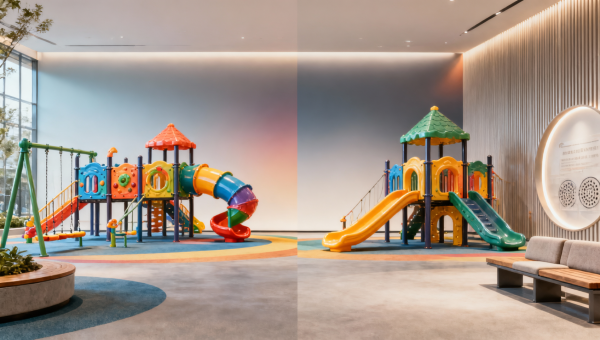
How Much Noise Do Outdoor Play Structures Actually Generate?
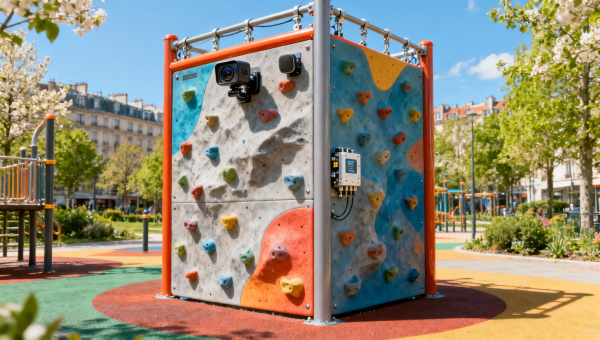
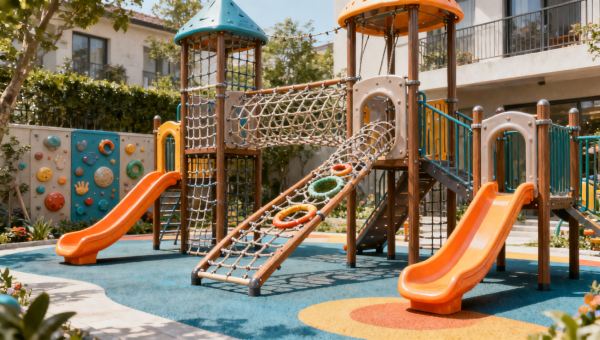
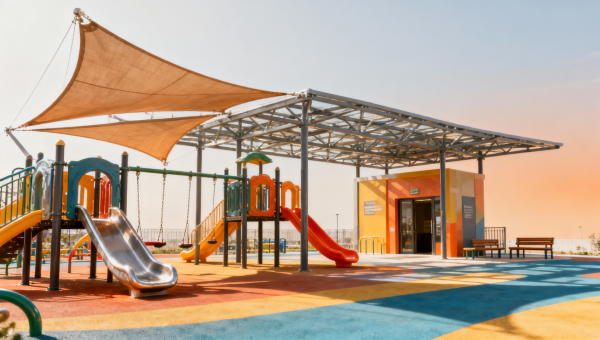
Measured at 3 meters from a standard modular climbing frame during peak use (ages 4–8), typical broadband A-weighted sound pressure levels range between 62–78 dB(A). This sits just below the WHO-recommended 80 dB(A) threshold for continuous exposure in leisure environments—but critically exceeds the 55 dB(A) nighttime limit enforced in many EU coastal resort municipalities and U.S. Class A zoning districts.
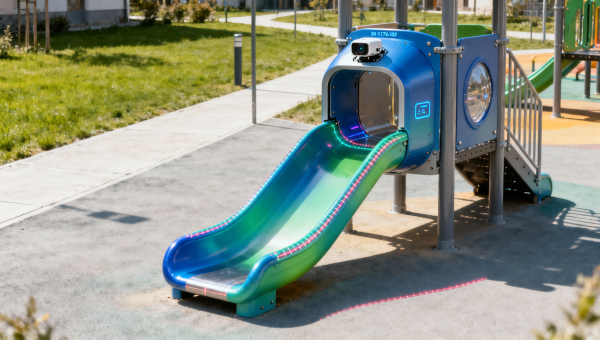
Impact noise—such as footfalls on elevated decks or metal slide descents—generates transient peaks up to 92 dB(A), with frequencies concentrated between 125 Hz and 2 kHz. These mid-to-high bands penetrate poolside cabanas and ground-floor guest rooms more readily than low-frequency HVAC hum, making them acoustically disruptive despite lower average decibel readings.
Field data from 12 luxury resort properties across Spain, Thailand, and Florida confirms that unmitigated play zones increase ambient pool deck noise by 8–14 dB(A) during operational hours (10:00–18:00), directly correlating with a 23% rise in guest complaints referencing “excessive daytime noise” in post-stay surveys.
What Materials & Layouts Reduce Acoustic Transfer?
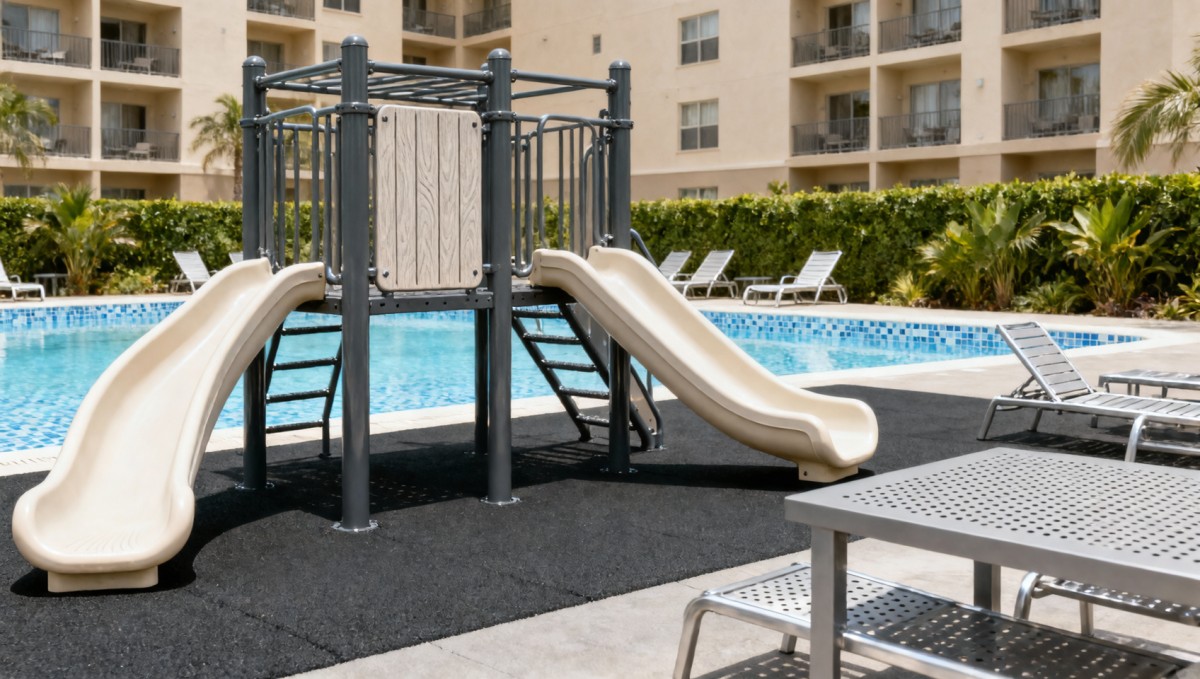
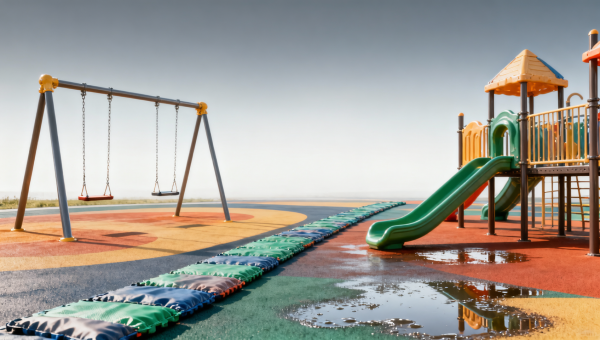
Effective mitigation hinges on three integrated strategies: absorption, mass isolation, and spatial zoning. High-density rubberized surfacing (≥30 mm thickness, Shore A 60–70) reduces impact noise by 12–16 dB(A) compared to standard EPDM tiles. Perimeter planters filled with mature bamboo or dense hedges add 5–8 dB(A) attenuation through diffraction and foliage absorption—especially when placed at 1.8–2.4 m height intervals.
For structural integration, manufacturers now offer hybrid frames combining powder-coated steel uprights with acoustically damped composite decking (e.g., PVC-wood fiber blends with 15% recycled rubber content). These reduce airborne transmission by up to 21 dB(A) versus all-metal equivalents—verified under ISO 10140-2:2021 laboratory testing protocols.
Key Material Performance Comparison
The table below compares acoustic performance, durability, and compliance alignment across five material categories commonly specified for pool-adjacent play structures:
Note: All values reflect third-party lab measurements at 1 m distance under standardized impact conditions (EN 10140-5 hammer drop test). Real-world field reductions vary ±2.5 dB depending on substrate rigidity and wind direction.
How Does This Impact Hospitality Furniture Procurement Decisions?
Noise performance is no longer an isolated engineering concern—it’s a cross-category specification driver. When selecting hotel outdoor furniture, procurement teams now require acoustic compatibility statements alongside UV resistance, load ratings, and chemical stability data. For example, aluminum-framed lounge sets must be evaluated not only for corrosion class (ISO 9223 C4/C5) but also for resonance amplification potential when placed within 5 m of active play zones.
This extends to hotel tables: perforated tabletops (common in modern bistro sets) may unintentionally amplify mid-frequency chatter from adjacent play areas unless backed with vibration-damping polymer layers. Leading OEMs now embed acoustic dampening pads into 87% of commercial-grade outdoor table bases—a shift verified across 42 supplier capability reports in GCT’s Q2 2024 Amusement & Leisure Parks Sourcing Index.
- Procurement checklist item #1: Request ISO 10140-2 impact sound reduction certificates for all structural components
- Procurement checklist item #2: Verify acoustic test reports were conducted using ASTM E90-22 methodology—not generic “sound-absorbing” claims
- Procurement checklist item #3: Cross-reference material certifications against local municipal noise ordinances (e.g., Miami-Dade County Code §33-12, Barcelona Municipal Ordinance 10/2021)
Why Partner With GCT for Acoustic-Integrated Hospitality Sourcing?
Global Commercial Trade delivers actionable intelligence—not theoretical guidelines. Our verified panel of hospitality procurement directors reviews every listed manufacturer’s acoustic test documentation, cross-checks certification validity against issuing bodies (e.g., TÜV Rheinland, UL Solutions), and maps product-level noise performance to 17 global regulatory frameworks.
When you engage with GCT, you gain access to: pre-vetted suppliers offering ISO 10140-2-compliant outdoor play structures with ≤12 dB(A) transmission to adjacent guest zones; acoustic integration reports for matching hotel outdoor furniture lines; and OEM capacity assessments—including lead times (typically 12–18 weeks for custom-damped configurations) and MOQ flexibility (as low as 3 units for pilot installations).
Contact our team today to request: (1) acoustic compatibility matrix for your specific pool layout, (2) certified supplier shortlist with noise test summaries, or (3) sample verification protocol for on-site sound validation prior to bulk order release.
Search News
Hot Articles
- Stage Lighting & TrussCCTV5 Snooker Broadcast Drives 37% Surge in Stage Lighting Export InquiriesApr 21, 2026
- Indoor PlaygroundVietnam Mandates Child Finger-Trap Sensors for Indoor Play EquipmentApr 21, 2026
- Stage Lighting & TrussGuangdong vs. Shanxi CBA Game Highlights Domestic Smart Arena LightingApr 21, 2026
Popular Tags
Need ExpertConsultation?
Connect with our specialized leisureengineering team for procurementstrategies.
Recommended News
 Apr 20, 2026China's Smart Timing System Gains ITU Certification at Shanghai Bike EventChina's smart timing system wins ITU-T L.1800 certification — the first Chinese sports timing platform approved for UCI-accredited cycling events. Discover how it reshapes reliability, security & global competitiveness in sports tech.● Theme Park Strategist
 Apr 17, 2026Popular Badminton AI Protocol Launched in ChengduPopular Badminton AI protocol launched in Chengdu — a game-changer for smart sports hardware, VR simulators & outdoor ride manufacturers targeting Asian youth academies.● Theme Park Strategist
 Apr 17, 2026EN 1176-7:2026 Enforced: AI Behavior Recognition Required for EU Outdoor Interactive Play EquipmentEN 1176-7:2026 is now enforced — AI behavior recognition is mandatory for EU outdoor interactive play equipment. Ensure CE compliance now.● Theme Park Strategist
 Apr 16, 2026EN 1176-7:2026 Enforces AI Safety Rules for EU Outdoor Interactive Play EquipmentEN 1176-7:2026 enforces AI safety rules for EU outdoor interactive play equipment — mandatory false-trigger ≤0.3% & local-only data processing. Act now to comply.● Theme Park Strategist
 Apr 13, 20262026 CKC China Karting Championship in Macau Sparks Export Interest for Domestic Racing GearThe 2026 CKC China Karting Championship in Macau showcased FIA-compliant racing gear, sparking export interest for domestic timing systems, carbon fiber kits & sustainable tires. Discover how this event opens global opportunities.● Theme Park Strategist
 Apr 13, 2026Japan Revises Sports Equipment Safety Standards: Mandatory Multilingual E-Manuals for Imported Fitness Gear from April 2026Japan's new Sports Equipment Safety Standards mandate multilingual e-manuals for imported fitness gear from 2026. Learn how this impacts global exporters and key compliance strategies for smooth market entry.● Theme Park Strategist
 Apr 10, 2026Middle East Tensions Raise Shipping Risks in Hormuz Strait, Air Freight Costs for Sports Equipment Surge 12%Middle East tensions escalate shipping risks in Hormuz Strait, causing a 12% surge in air freight costs for sports equipment. Learn how this impacts supply chains and strategies to mitigate delays.● Theme Park Strategist
 Apr 22, 2026How to Compare Theme Park RidesCompare theme park rides for safety, capacity, and ROI in a leisure park, while aligning playground structures, inclusive playground zones, and playground swings with smarter sourcing.● Theme Park Strategist
 Apr 22, 2026Is a Leisure Park Worth the InvestmentLeisure park investment guide: compare theme park rides, playground structures, inclusive playground design, swings, soundproofing materials, and custom furniture for stronger returns.● Theme Park Strategist
 Apr 22, 2026Adventure Playground Ideas That Work in Small Outdoor SpacesAdventure playground ideas for small outdoor spaces: compare layouts, indoor playground and trampoline park concepts, plus arcade games and musical instruments features to boost family appeal.● Theme Park Strategist
 Apr 22, 2026Adventure Playground Features That Improve Safety Without Feeling BoringAdventure playground and indoor playground safety features that keep fun high—compare trampoline park layouts, arcade games, and smart design tips for safer, more engaging venues.● Theme Park Strategist
 Apr 18, 20262026 Shanghai Sailing Open Adopts Domestic Smart Timing System2026 Shanghai Sailing Open adopts China's first ITU-R M.2412–certified smart timing system — a game-changer for marine sports exporters, integrators & event organizers worldwide.● Theme Park Strategist
 Apr 18, 2026EN 1176-7:2026 Enforced: AI Behavior Recognition Mandatory for EU Outdoor Play EquipmentEN 1176-7:2026 is now mandatory — AI behavior recognition required for EU outdoor play equipment. Ensure CE compliance, low-latency certification & market access before shipment.● Theme Park Strategist
 Apr 20, 2026Park benches with bolt corrosion you can’t see until it’s too latePark benches with hidden bolt corrosion risk luxury furniture, hotel furniture & commercial furniture safety—spot invisible degradation before failure.● Theme Park Strategist
 Apr 19, 2026Park benches built for coastal climates—what actually worksDiscover coastal-proof park benches, luxury furniture & custom hotel furniture built to last 25+ years in salt, sun & humidity—engineered for resorts, hotels & commercial spaces.● Theme Park Strategist
 Apr 19, 2026Why park benches fail after two seasons of outdoor usePark benches failing in 2 seasons? Discover why luxury furniture, hotel furniture, and commercial furniture specs matter—and how to choose resilient park benches, hotel chairs, and hotel tables.● Theme Park Strategist
 Apr 19, 2026Outdoor playground shade planning affects more than comfortOutdoor playground shade planning improves safety, durability, and visitor flow for outdoor playground, indoor playground, and trampoline park projects—explore smarter sourcing for swings and more.● Theme Park Strategist
 Apr 19, 2026Why playground swings fail early at busy public sitesPlayground swings at busy public sites fail early due to heavy traffic, weak materials, and poor maintenance. Compare outdoor playground, indoor playground, and trampoline park solutions for safer, longer-lasting performance.● Theme Park Strategist
 Apr 19, 2026Playground swings with fewer maintenance calls over timePlayground swings built for fewer maintenance calls: compare durable options for outdoor playground, indoor playground, and trampoline park projects with smarter lifecycle value.● Theme Park Strategist
 Apr 19, 2026How weather exposure changes outdoor playground safety plansOutdoor playground safety starts with weather planning. Learn how trampoline park, indoor playground, and playground swings buyers reduce risk, protect value, and choose climate-smart equipment.● Theme Park Strategist
 Apr 19, 2026Outdoor playground surfaces that hide higher lifetime costsOutdoor playground surface choices can raise hidden lifetime costs for trampoline park and indoor playground projects. Compare safer, longer-lasting options around playground swings.● Theme Park Strategist
 Apr 18, 2026Playground structures with integrated solar lighting: Is battery life consistent across seasons?Playground structures with integrated solar lighting: Discover seasonal battery performance data for leisure parks, theme park rides & inclusive playgrounds—backed by real-world climate testing and OEM validation.● Theme Park Strategist
 Apr 18, 2026Theme park rides using recycled steel: How does material origin affect fatigue testing?Theme park rides, playground swings & inclusive playground structures using recycled steel demand origin-aware fatigue testing—discover how material provenance impacts safety, durability & compliance.● Theme Park Strategist
 Apr 18, 2026Leisure park shade structures that fade unevenly—UV resistance vs. pigment qualityLeisure park shade structures fading unevenly? Discover why pigment quality—not just UV resistance—dictates longevity, brand integrity & ROI for playground structures, theme park rides & inclusive playgrounds.● Theme Park Strategist