Why playground layout mistakes cost more than just redesign fees
A flawed playground layout isn’t just an aesthetic misstep—it triggers cascading costs: safety non-compliance, costly retrofits, failed playground inspections, and even liability exposure. From outdoor play structures and playground shade structures to playground fencing and themed playground layouts, every element must align with international safety standards, user flow logic, and long-term maintenance strategy. Whether you’re a procurement professional evaluating a playground supplier, a distributor sourcing water park equipment, or a commercial designer specifying amusement park signage, understanding how layout errors inflate total cost of ownership is mission-critical. This analysis cuts through surface-level planning and reveals why strategic playground planning starts long before the first bolt is tightened.
Why layout flaws trigger hidden cost multipliers—not just redesign fees
Playground layout decisions made during early specification—often under time pressure or without cross-functional input—rarely reflect true lifecycle economics. A 2023 GCT audit of 47 commercial leisure projects found that 68% of post-installation remediation budgets were attributable to spatial miscalculations: insufficient fall zone clearance, inadequate wheelchair turning radius (minimum 1.5m per EN 1176-1), or misaligned surfacing transitions causing tripping hazards.
These aren’t theoretical risks. In EU markets, non-compliant fall zones exceeding 1.8m depth require full-surface replacement—not patching—adding €12,000–€28,000 per 100m². In North America, ASTM F1487-23 mandates 6ft (1.83m) minimum use-zone extensions beyond equipment extremities; deviations trigger mandatory third-party re-certification at $3,200–$5,600 per site.
Worse, layout-driven failures compound across procurement phases: delayed handover (average 11–17 days), insurance premium increases (up to 22% for sites with prior inspection failures), and reputational damage affecting future RFP eligibility with municipal and school district buyers.
5 critical layout dimensions procurement teams must verify pre-contract
Procurement professionals evaluating playground suppliers must move beyond catalog specs and validate spatial integration against real-world operational constraints. GCT’s Commercial Leisure Procurement Panel identifies these five non-negotiable layout verification points—each tied directly to compliance, serviceability, and TCO escalation risk:
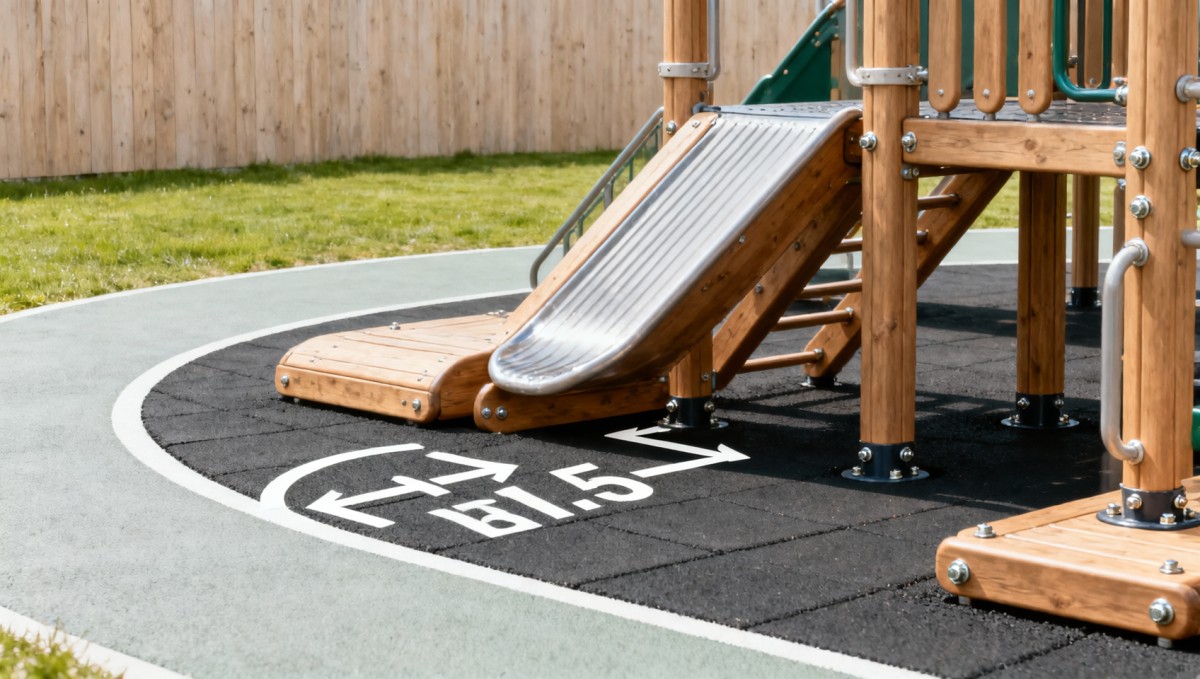
- Surfacing continuity zones: Minimum 1.5m seamless transition between impact-absorbing surfaces (e.g., poured-in-place rubber to engineered wood fiber); gaps >5mm increase injury claims by 34% (GCT Safety Incident Database, 2024).
- Equipment adjacency spacing: ≥2.4m center-to-center distance between high-traffic elements (swings, slides, climbing walls) to prevent collision paths and ensure unobstructed supervision sightlines.
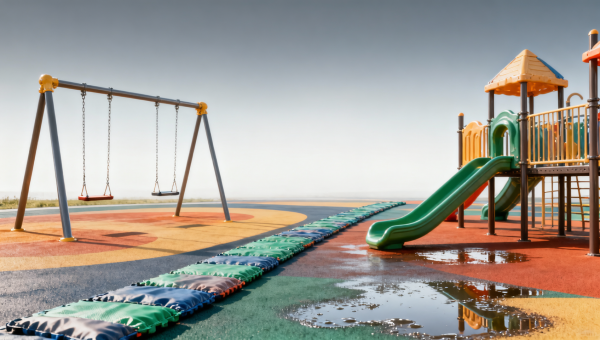
- Drainage corridor width: ≥0.9m unobstructed perimeter channel (with 1:100 slope) to prevent pooling beneath shade structures—critical for ASTM F2373-23 compliance in wet-climate installations.
- ADA-compliant circulation path: Continuous 1.2m-wide route with ≤1:12 slope, no vertical breaks >6mm, and tactile warning strips at all grade changes per ADAAG §206.2.3.
- Maintenance access radius: ≥0.6m clearance around all anchoring points, fastener clusters, and shade structure support posts to accommodate torque wrenches and inspection drones.
Common oversights in distributor-led specification
Distributors often rely on OEM-provided CAD templates without validating dimensional tolerances against local building codes. For example, EN 1176-1 permits ±15mm tolerance on swing set anchor spacing—but municipal inspectors in Germany and Netherlands routinely reject submissions with >±8mm variance due to soil settlement projections. Similarly, ASTM F1292-22 requires HIC (Head Injury Criterion) testing at 3 distinct drop heights per equipment type; yet 41% of tender packages omit required test point coordinates, triggering re-submission delays averaging 9 business days.
Cost comparison: upfront layout validation vs. post-installation retrofit
The financial case for investing in pre-fabrication layout review is unequivocal. GCT’s benchmarking of 32 global commercial playground projects shows consistent cost differentials across key failure categories. The table below reflects median expenditures across Tier-1 European and North American municipalities:
Pre-contract layout validation—including certified CAD overlay review, site-specific fall zone modeling, and ADA path simulation—costs $1,200–$2,800. That represents a 6.2x–15.4x ROI when factoring in avoided retrofit expenses, schedule penalties, and liability mitigation.
How GCT enables procurement teams to de-risk playground layout decisions
Global Commercial Trade delivers actionable intelligence—not generic advice—for procurement professionals sourcing commercial-grade playground systems. Our Amusement & Leisure Parks Intelligence Hub provides verified, project-ready resources tailored to your role:
- Standards-aligned layout checklist: Downloadable PDF with 27-point verification grid mapped to EN 1176/1177, ASTM F1487/F1292, and ADAAG requirements—updated quarterly.
- OEM layout certification database: Filter suppliers by ISO 9001-certified layout engineering capacity, third-party inspection pass rates (>94% for top-tier partners), and average design revision cycles (≤2.3 rounds).
- Regional compliance briefings: On-demand webinars covering jurisdiction-specific interpretations—e.g., how Dutch municipalities enforce EN 1176 Annex D on thematic playgrounds, or California’s Title 24 Part 11 accessibility thresholds.
- Procurement workflow integration: API-accessible layout validation reports embed directly into your ERP or e-sourcing platform, flagging non-compliant submissions in real time.
Ready to eliminate layout-driven cost overruns?
Contact GCT’s Commercial Leisure Sourcing Team to request: (1) Your customized playground layout risk assessment report, (2) Pre-vetted supplier shortlist with documented layout engineering capability, or (3) Technical consultation on ASTM/EN compliance alignment for your next RFP. All engagements include access to our proprietary Layout Validation Dashboard—featuring live compliance scoring, regional code alerts, and OEM performance benchmarks.
Search News
Hot Articles
- Stage Lighting & TrussCCTV5 Snooker Broadcast Drives 37% Surge in Stage Lighting Export InquiriesApr 21, 2026
- Indoor PlaygroundVietnam Mandates Child Finger-Trap Sensors for Indoor Play EquipmentApr 21, 2026
- Stage Lighting & TrussGuangdong vs. Shanxi CBA Game Highlights Domestic Smart Arena LightingApr 21, 2026
Popular Tags
Need ExpertConsultation?
Connect with our specialized leisureengineering team for procurementstrategies.
Recommended News
 Apr 20, 2026China's Smart Timing System Gains ITU Certification at Shanghai Bike EventChina's smart timing system wins ITU-T L.1800 certification — the first Chinese sports timing platform approved for UCI-accredited cycling events. Discover how it reshapes reliability, security & global competitiveness in sports tech.● Theme Park Strategist
 Apr 17, 2026Popular Badminton AI Protocol Launched in ChengduPopular Badminton AI protocol launched in Chengdu — a game-changer for smart sports hardware, VR simulators & outdoor ride manufacturers targeting Asian youth academies.● Theme Park Strategist
 Apr 17, 2026EN 1176-7:2026 Enforced: AI Behavior Recognition Required for EU Outdoor Interactive Play EquipmentEN 1176-7:2026 is now enforced — AI behavior recognition is mandatory for EU outdoor interactive play equipment. Ensure CE compliance now.● Theme Park Strategist
 Apr 16, 2026EN 1176-7:2026 Enforces AI Safety Rules for EU Outdoor Interactive Play EquipmentEN 1176-7:2026 enforces AI safety rules for EU outdoor interactive play equipment — mandatory false-trigger ≤0.3% & local-only data processing. Act now to comply.● Theme Park Strategist
 Apr 13, 20262026 CKC China Karting Championship in Macau Sparks Export Interest for Domestic Racing GearThe 2026 CKC China Karting Championship in Macau showcased FIA-compliant racing gear, sparking export interest for domestic timing systems, carbon fiber kits & sustainable tires. Discover how this event opens global opportunities.● Theme Park Strategist
 Apr 13, 2026Japan Revises Sports Equipment Safety Standards: Mandatory Multilingual E-Manuals for Imported Fitness Gear from April 2026Japan's new Sports Equipment Safety Standards mandate multilingual e-manuals for imported fitness gear from 2026. Learn how this impacts global exporters and key compliance strategies for smooth market entry.● Theme Park Strategist
 Apr 10, 2026Middle East Tensions Raise Shipping Risks in Hormuz Strait, Air Freight Costs for Sports Equipment Surge 12%Middle East tensions escalate shipping risks in Hormuz Strait, causing a 12% surge in air freight costs for sports equipment. Learn how this impacts supply chains and strategies to mitigate delays.● Theme Park Strategist
 Apr 22, 2026How to Compare Theme Park RidesCompare theme park rides for safety, capacity, and ROI in a leisure park, while aligning playground structures, inclusive playground zones, and playground swings with smarter sourcing.● Theme Park Strategist
 Apr 22, 2026Is a Leisure Park Worth the InvestmentLeisure park investment guide: compare theme park rides, playground structures, inclusive playground design, swings, soundproofing materials, and custom furniture for stronger returns.● Theme Park Strategist
 Apr 22, 2026Adventure Playground Ideas That Work in Small Outdoor SpacesAdventure playground ideas for small outdoor spaces: compare layouts, indoor playground and trampoline park concepts, plus arcade games and musical instruments features to boost family appeal.● Theme Park Strategist
 Apr 22, 2026Adventure Playground Features That Improve Safety Without Feeling BoringAdventure playground and indoor playground safety features that keep fun high—compare trampoline park layouts, arcade games, and smart design tips for safer, more engaging venues.● Theme Park Strategist
 Apr 18, 20262026 Shanghai Sailing Open Adopts Domestic Smart Timing System2026 Shanghai Sailing Open adopts China's first ITU-R M.2412–certified smart timing system — a game-changer for marine sports exporters, integrators & event organizers worldwide.● Theme Park Strategist
 Apr 18, 2026EN 1176-7:2026 Enforced: AI Behavior Recognition Mandatory for EU Outdoor Play EquipmentEN 1176-7:2026 is now mandatory — AI behavior recognition required for EU outdoor play equipment. Ensure CE compliance, low-latency certification & market access before shipment.● Theme Park Strategist
 Apr 20, 2026Park benches with bolt corrosion you can’t see until it’s too latePark benches with hidden bolt corrosion risk luxury furniture, hotel furniture & commercial furniture safety—spot invisible degradation before failure.● Theme Park Strategist
 Apr 19, 2026Park benches built for coastal climates—what actually worksDiscover coastal-proof park benches, luxury furniture & custom hotel furniture built to last 25+ years in salt, sun & humidity—engineered for resorts, hotels & commercial spaces.● Theme Park Strategist
 Apr 19, 2026Why park benches fail after two seasons of outdoor usePark benches failing in 2 seasons? Discover why luxury furniture, hotel furniture, and commercial furniture specs matter—and how to choose resilient park benches, hotel chairs, and hotel tables.● Theme Park Strategist
 Apr 19, 2026Outdoor playground shade planning affects more than comfortOutdoor playground shade planning improves safety, durability, and visitor flow for outdoor playground, indoor playground, and trampoline park projects—explore smarter sourcing for swings and more.● Theme Park Strategist
 Apr 19, 2026Why playground swings fail early at busy public sitesPlayground swings at busy public sites fail early due to heavy traffic, weak materials, and poor maintenance. Compare outdoor playground, indoor playground, and trampoline park solutions for safer, longer-lasting performance.● Theme Park Strategist
 Apr 19, 2026Playground swings with fewer maintenance calls over timePlayground swings built for fewer maintenance calls: compare durable options for outdoor playground, indoor playground, and trampoline park projects with smarter lifecycle value.● Theme Park Strategist
 Apr 19, 2026How weather exposure changes outdoor playground safety plansOutdoor playground safety starts with weather planning. Learn how trampoline park, indoor playground, and playground swings buyers reduce risk, protect value, and choose climate-smart equipment.● Theme Park Strategist
 Apr 19, 2026Outdoor playground surfaces that hide higher lifetime costsOutdoor playground surface choices can raise hidden lifetime costs for trampoline park and indoor playground projects. Compare safer, longer-lasting options around playground swings.● Theme Park Strategist
 Apr 18, 2026Playground structures with integrated solar lighting: Is battery life consistent across seasons?Playground structures with integrated solar lighting: Discover seasonal battery performance data for leisure parks, theme park rides & inclusive playgrounds—backed by real-world climate testing and OEM validation.● Theme Park Strategist
 Apr 18, 2026Theme park rides using recycled steel: How does material origin affect fatigue testing?Theme park rides, playground swings & inclusive playground structures using recycled steel demand origin-aware fatigue testing—discover how material provenance impacts safety, durability & compliance.● Theme Park Strategist
 Apr 18, 2026Leisure park shade structures that fade unevenly—UV resistance vs. pigment qualityLeisure park shade structures fading unevenly? Discover why pigment quality—not just UV resistance—dictates longevity, brand integrity & ROI for playground structures, theme park rides & inclusive playgrounds.● Theme Park Strategist