EU PPWR Rule Takes Effect July 1 for Arcade and VR Shipments
On July 1, 2026, the transition provision of the EU Packaging and Packaging Waste Regulation (PPWR) takes effect for packaged electronic entertainment equipment sold in the EU market, including arcade cabinets, VR headset bundles, and packaged accessories. The immediate point of attention for exporters, importers, distributors, and supply-chain coordinators is that customs clearance now depends on completed EPR registration and payment of the required eco-fee, making this a practical compliance issue rather than a distant policy topic, especially ahead of summer delivery schedules.
What Changes on July 1
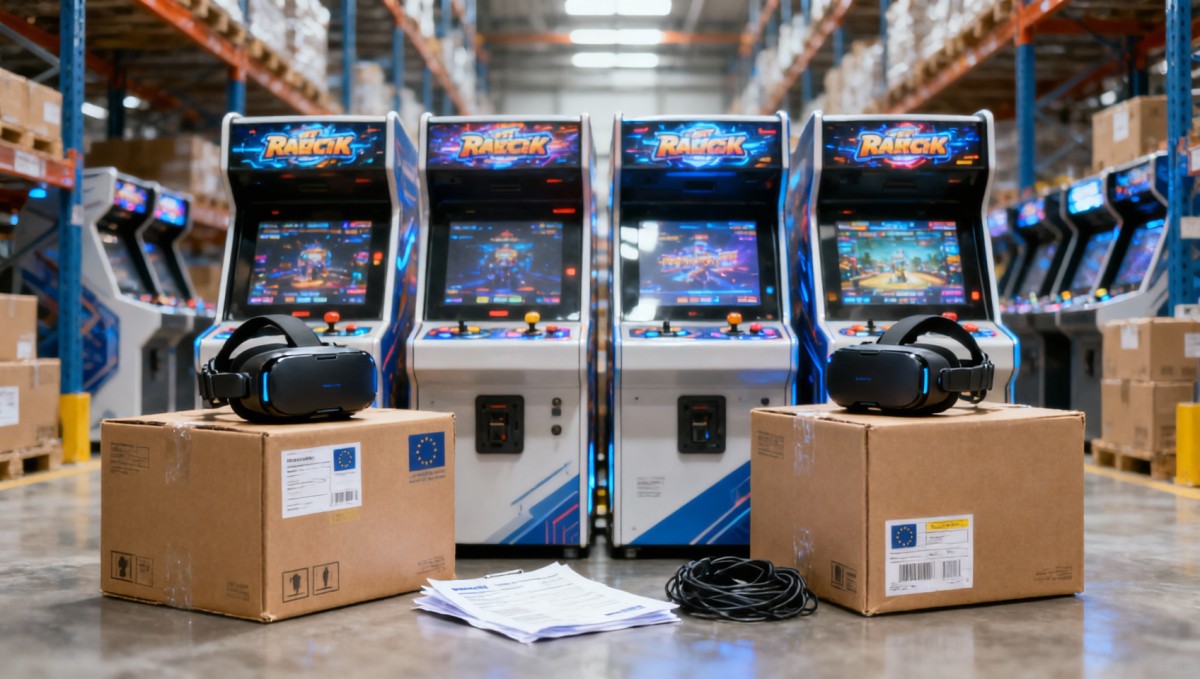
According to the provided information, the PPWR transition provision becomes effective on July 1, 2026. It requires all packaged electronic entertainment products sold in the EU market to complete registration with a producer responsibility organization under EPR and to pay the related eco-treatment fee. The scope described in the input includes arcade machines, VR headset sets, and accessory packaging. Products that are not registered will be stopped by customs. For Chinese suppliers, binding a local authorized representative in the relevant EU member state must be completed by June 30.
Where the Immediate Pressure Falls
Export shipments facing customs release risk
From an industry perspective, companies directly shipping arcade and VR products into the EU may be affected first because customs clearance is explicitly tied to registration status. The operational impact is concentrated in shipment timing, documentation readiness, and delivery execution during the summer peak period.
Manufacturers packaging complete machines and accessory sets
Analysis shows that manufacturers are not only dealing with the device itself, but also with the fact that the requirement applies to packaged products. This means attention may need to extend to complete machine packaging, bundled headset kits, and separately packed accessories where market placement in the EU is involved.
Importers, distributors, and channel operators managing EU market entry
Observably, businesses responsible for placing goods into EU channels may need to pay closer attention to whether registration, authorized representative binding, and fee payment have been completed before goods move into customs processes. The pressure here is less about product demand and more about whether market access steps are in place on time.
Supply-chain and logistics service providers coordinating peak-season delivery
What deserves closer attention is the delivery-side effect of non-compliance. If unregistered products are intercepted by customs, logistics schedules, warehousing coordination, and customer delivery commitments may all come under strain, particularly for time-sensitive summer orders.
What Companies Should Review Now
Check whether the affected product scope matches actual shipments
Companies should first review whether their EU-bound goods fall within the packaged electronic entertainment equipment scope described in the input, including complete arcade cabinets, VR headset packages, and packaged accessories. The practical issue is whether the shipped form of the product triggers the requirement.
Confirm local authorized representative binding before the deadline
For Chinese suppliers, the stated deadline is June 30 for binding a local authorized representative in the relevant member state. In practical terms, this places urgency on compliance preparation before the rule is enforced at customs from July 1.
Align documents, compliance status, and shipment planning
Analysis shows that policy compliance and shipping execution now need to be handled together. Companies may need to verify that registration status, fee payment, and shipment documentation are consistent before dispatch, rather than treating compliance as a separate back-office matter.
Prepare customer communication around delivery risk
Where orders are tied to summer sales windows, businesses may need to communicate early with buyers, distributors, or project partners about registration status and possible customs-related delays. The key issue is managing expectations if compliance steps are still incomplete close to shipment cutoffs.
Why This Looks Like an Operational Signal, Not Just a Policy Update
As an editorial observation, this development is more appropriate to understand as an immediate operating threshold for EU-bound arcade and VR shipments, because the consequence described in the input is direct customs interception for non-registered products. At the same time, it should not be overstated beyond the provided facts. The current signal is clear on compliance timing and customs relevance, while the broader market effect still needs to be observed through actual implementation and follow-up guidance.
How the Industry May Read This Moment
Based on the provided information, the significance of this update lies in its direct link between packaging compliance and physical market entry. For the arcade and VR supply chain, this is not merely a background regulatory adjustment; it is a near-term checkpoint that can affect delivery execution. At this stage, it is more appropriate to understand the development as a concrete short-term compliance change with possible longer-term implications that still require continued observation.
Basis of This Article
This article is generated based on the user-provided news title, event date, and event summary. For developments of this type, commonly relevant source categories may include official announcements, company notices, industry association updates, authoritative media reporting, and standard or regulatory documents. A specific official source link was not provided in the input, so the exact official text and any later implementation updates still need continued verification. Follow-up attention should remain on any further official wording, member-state execution details, and practical customs enforcement developments related to EPR registration and authorized representative binding.
Search News
Hot Articles
- Outdoor RidesWhat Drives Animatronic Dinosaur Manufacturer Prices for Theme Park Projects?Sep 18, 2026
- Stationery & UniformsHow to Source Wholesale Packing Tape Without Compromising Carton Seal StrengthSep 17, 2026
- Smart Campus TechHow to Source Educational Furniture Worldwide for Safe, Flexible Learning SpacesSep 16, 2026
Popular Tags
Need ExpertConsultation?
Connect with our specialized leisureengineering team for procurementstrategies.
Recommended News
 Sep 15, 2026How to Choose Coin-Operated Pool Tables for Bars, Hotels, and Arcade VenuesCoin operated pool tables for bars, hotels, and arcades: compare sizes, payment systems, durability, service access, and revenue potential.● Theme Park Strategist
 Sep 08, 2026What to Look for in a Flight Simulator Chair Manufacturer for Commercial VR CentersChoose a flight simulator chair manufacturer that delivers durable, safe, customizable seating for commercial VR centers. Explore key sourcing criteria now.● Theme Park Strategist
 Aug 25, 2026What to Evaluate Before Buying Commercial Self Service Photo Booths for VenuesCommercial self service photo booths for venues: learn how to evaluate durability, software stability, branding flexibility, support, and total ROI before you buy.● Theme Park Strategist
 Aug 23, 2026How to Evaluate Wholesale Vending Machines for Multi-Location Business DeploymentWholesale vending machines for multi-location deployment require more than low unit cost. Learn how to compare reliability, payments, telemetry, and supplier support to scale smarter.● Theme Park Strategist
 Aug 17, 2026U.S. CPSC Urges Bilingual Warnings for Arcade and VR MachinesU.S. CPSC urges bilingual safety warnings for Arcade & VR Machines—learn what exporters, importers, and distributors must do now to avoid delays and returns.● Theme Park Strategist
 Aug 16, 2026EU Enforces EN IEC 62368-1:2026 Certification for Arcade and VR MachinesEU Enforces EN IEC 62368-1:2026 certification for arcade and VR machines, reshaping EU market access, customs clearance, and compliance planning for exporters and distributors.● Theme Park Strategist
 Aug 13, 2026UFLPA’s new guidelines take effect: Exports of Arcade and VR equipment face full-link labor compliance requirementsUFLPA’s new guide takes effect: Arcade and VR machine exports to the U.S. now face full-chain labor compliance checks. Discover key risks and action steps.● Theme Park Strategist
 Aug 12, 2026EU PPWR takes effect, Arcade and VR packaging incorporate heavy metal and PFAS restrictionsEU PPWR now applies to Arcade and VR packaging, tightening heavy metal and PFAS compliance. Learn how exporters can avoid delays, fines, and customs risks.● Theme Park Strategist
 Aug 11, 2026CPSC Sets Bilingual Labels for Arcade and VR ImportsCPSC bilingual labels for arcade and VR imports become mandatory on October 1, 2026. Learn the new English-Spanish warning rules, customs risks, and key compliance steps now.● Theme Park Strategist
 Aug 10, 2026EU Rule Takes Effect for Arcade & VR Machine ClearanceArcade & VR Machine clearance in the EU now depends on EN IEC 62368-1:2026+A11:2026 compliance. Learn what changed, who is affected, and how to avoid customs delays.● Theme Park Strategist
 Aug 09, 2026CPSC Requires New Labels for Arcade and VR ImportsCPSC requires new labels for Arcade and VR imports starting Oct 1, 2026. Learn the multilingual warning rules, compliance risks, and key steps exporters and buyers must take now.● Theme Park Strategist
 Aug 08, 2026EU Entry Rule Tightens for Arcade & VR MachinesArcade & VR Machines entering the EU now face stricter CE compliance under EN IEC 62368-1:2026+A11:2026. Learn the new rule, risks, and what exporters must do now.● Theme Park Strategist
 Aug 07, 2026CPSC Notice Tightens U.S. Entry Rules for Arcade and VR MachinesCPSC Notice Tightens U.S. Entry Rules for Arcade and VR Machines: learn the new labeling, FCC, UN38.3, and compliance document requirements before October 1, 2026.● Theme Park Strategist
 Aug 06, 2026EU Rule Takes Effect for CE-UKCA Labels on Arcade & VR MachinesArcade & VR Machines face new CE-UKCA label and ECPD filing rules in the EU and UK. Learn what manufacturers, importers, and distributors must do now to avoid delays.● Theme Park Strategist
 Aug 05, 2026CPSC Recalls Arcade and VR Machines Over UL 62368-1CPSC recalls arcade and VR machines over UL 62368-1 non-compliance. Learn how this 2026 safety action may affect imports, distribution, customs clearance, and market access.● Theme Park Strategist
 Aug 02, 2026EU Sets New Certification Rule for Arcade and VR MachinesArcade and VR Machines face a new EU certification rule from Oct 1, 2026. Learn how EN IEC 62368-1:2026+A11:2026 affects CE marking, customs clearance, and market access.● Theme Park Strategist
 Aug 01, 2026CPSC Moves to Require Bilingual Warnings on Arcade and VR MachinesCPSC bilingual warnings for Arcade and VR Machines may reshape U.S. import compliance. Learn how English-Spanish labels affect packaging, customs risk, and shipment readiness.● Theme Park Strategist
 Jul 31, 2026EU Sets EN IEC 62368-1:2025 Rule for Arcade and VR MachinesEU Sets EN IEC 62368-1:2025 Rule for Arcade and VR Machines. Learn the new EU compliance deadlines, safety updates, and key actions for manufacturers, OEMs, and distributors.● Theme Park Strategist
 Jul 30, 2026CPSC Sets New Warning Label Rule for Arcade & VR MachinesCPSC sets a new warning label rule for Arcade & VR Machines effective August 15, 2026. Learn key compliance risks, multilingual label requirements, and shipment actions now.● Theme Park Strategist
 Jul 29, 2026EU Enforces New Safety Standard for Arcade and VR MachinesEU Enforces New Safety Standard for Arcade and VR Machines: learn how EN IEC 62368-1 affects CE compliance, customs clearance, and EU market access for exporters and buyers.● Theme Park Strategist
 Jul 28, 2026CPSC Sets ASTM F3472-26 Rule for Arcade & VR ImportsCPSC ASTM F3472-26 rule reshapes Arcade & VR imports to the U.S. Learn key compliance deadlines, certification risks, and what exporters, OEM/ODM suppliers, and buyers should do now.● Theme Park Strategist
 Jul 27, 2026EU Rule Takes Effect for Arcade & VR Machine CybersecurityEU Rule Takes Effect for Arcade & VR Machine Cybersecurity: learn how EN IEC 62443-3-3:2025 affects compliance, customs clearance, sales continuity, and supplier planning in the EU market.● Theme Park Strategist
 Jul 25, 2026CPSC Sets Bilingual Warning Rule for Arcade and VR ImportsCPSC bilingual warning rule for arcade and VR imports takes effect August 1, 2026. Learn how OEM/ODM exporters can avoid CBP delays, relabel shipments, and protect U.S. delivery timelines.● Theme Park Strategist
 Jul 24, 2026EU Enforces New Safety Standard for Arcade and VR MachinesEU Enforces New Safety Standard for Arcade and VR Machines: learn how EN IEC 62368-1:2026+A11:2026 reshapes EU compliance, CE documentation, testing timelines, and export readiness.● Theme Park Strategist