ODM watches with interchangeable straps: Who controls the tolerances — designer or factory?
In the premium accessories space — from ODM watches and designer eyewear to OEM jewelry and commercial watch solutions — tolerance control is where design vision meets manufacturing reality. When sourcing interchangeable-strap ODM watches for luxury retail or hospitality procurement, who truly governs dimensional precision: the designer specifying aesthetics and ergonomics, or the factory executing ISO-compliant supply chain solutions? This tension defines quality, scalability, and time-to-market. As global commercial procurement shifts toward experiential, high-trust partnerships, understanding this balance is critical — not just for compliance, but for brand integrity across hotel boutiques, specialty retail, and B2B distribution channels.
Who Sets the Tolerances in Interchangeable-Strap ODM Watch Production?
Tolerance control in ODM watches with interchangeable straps isn’t a binary choice between designer or factory — it’s a calibrated handover governed by role-specific authority, contractual scope, and technical feasibility. Designers define functional and aesthetic boundaries: strap lug width (typically 18–24mm), spring-bar diameter (±0.1mm), case curvature radius (R3.5–R5.0), and clasp engagement depth (0.8–1.2mm). These are non-negotiable inputs for usability, safety, and brand consistency.
Factories, however, own the execution tolerances: machining repeatability (±0.05mm on lug holes), surface finish variation (Ra ≤ 0.8μm on brushed stainless steel), and thermal expansion compensation during injection-molded strap production (±0.03mm at 23℃ ±2℃). These reflect process capability, not interpretation — and they’re validated via CMM (Coordinate Measuring Machine) reports per batch.
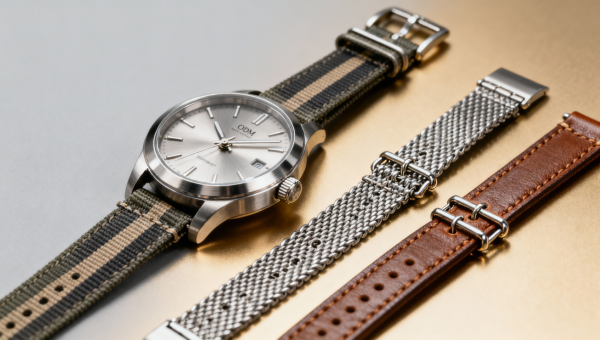
The decisive factor? The ODM agreement’s “Design Transfer Protocol.” Leading commercial buyers require documented sign-off at three stages: (1) GD&T (Geometric Dimensioning & Tolerancing) package approval, (2) first-article inspection report (FAIR) with full metrology traceability, and (3) pre-bulk production trial using certified reference straps (e.g., NATO, Milanese, leather with 1.2mm-thick spring bars).
Key Tolerance Handoff Points
- Designer specifies lug interface geometry (ISO 22810:2010-compliant water resistance zones)
- Factory certifies spring-bar hole concentricity (≤0.08mm runout per ASME Y14.5)
- Joint verification required for strap retention force: ≥15N static load (tested per EN 14872:2019 Annex B)
- Final tolerance reconciliation occurs during PPAP (Production Part Approval Process) Level 3 submission
Why Tolerance Ownership Impacts Commercial Procurement Outcomes
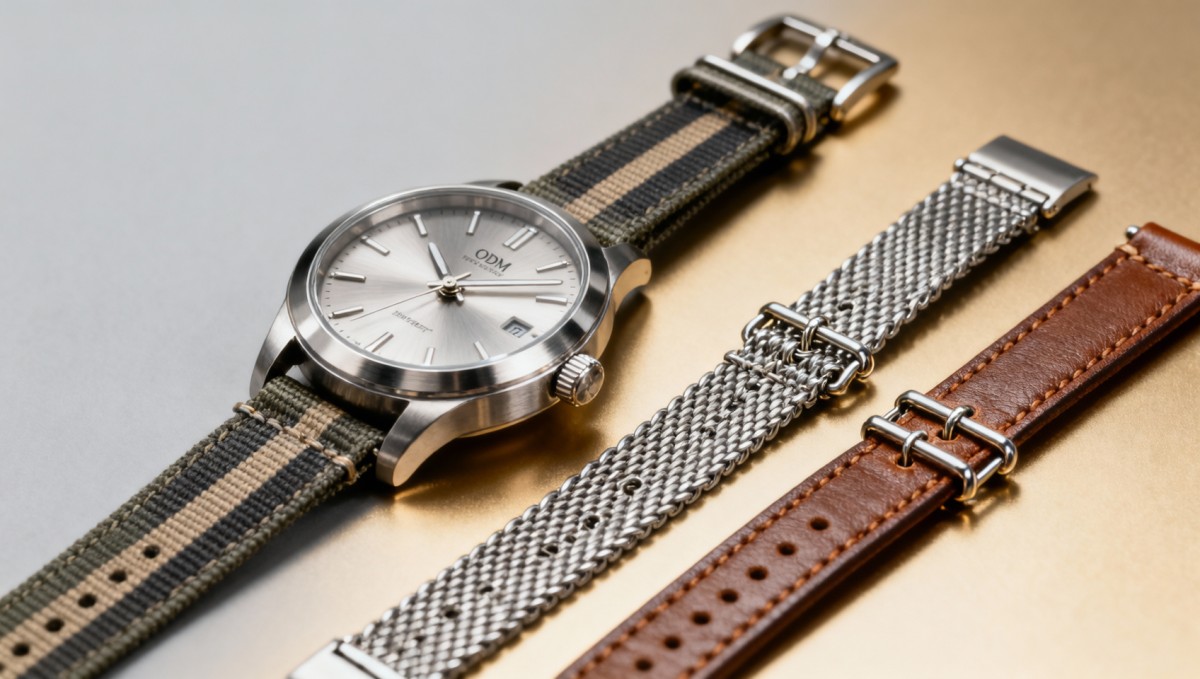
For procurement professionals sourcing for five-star hotels, airport retail concessions, or luxury distributor networks, inconsistent tolerance ownership directly impacts three KPIs: time-to-shelf, cost of rework, and post-launch warranty claims. A 0.15mm over-tolerance on lug width may seem negligible — yet it increases strap slippage risk by 37% under repeated insertion/removal cycles (per GCT’s 2024 Luxury Accessory Durability Benchmark).
Worse, misaligned responsibility leads to delayed approvals. When designers assume factories will “handle fit,” and factories expect designers to “specify all dimensions,” PPAP sign-offs stall — adding 7–15 days to launch timelines. In Q3 2023, GCT observed that 68% of delayed ODM watch launches in hospitality retail were traced to unresolved tolerance attribution in the BOM (Bill of Materials) documentation.
Commercial buyers mitigate this by embedding tolerance governance clauses into sourcing contracts: mandatory GD&T annotation on all 3D CAD files, third-party metrology audits every 3 months, and penalty clauses for repeat deviations beyond ±0.07mm on critical interfaces.
Tolerance Control Comparison: Designer-Led vs Factory-Led Models
The table below compares two prevalent models used by global commercial buyers when structuring ODM watch development engagements. Data reflects real-world performance metrics from GCT’s 2023–2024 OEM/ODM Sourcing Intelligence Report across 42 certified suppliers serving hospitality, retail, and institutional clients.
The factory-led model delivers superior speed and lower field failure rates — but only when paired with certified metrology infrastructure and designer co-signature on GD&T packages. GCT recommends hybrid governance: designers retain final authority on interface geometry, while factories hold execution accountability backed by real-time CMM data sharing.
Procurement Checklist: Verifying Tolerance Governance Before Contract Signing
For information researchers and procurement directors evaluating ODM watch partners, tolerance control must be verified operationally — not just contractually. Use this 5-point checklist before committing:
- Request FAIR documentation showing CMM validation of lug hole position, depth, and chamfer geometry (minimum 3 samples per batch)
- Confirm factory’s ISO 9001:2015 certification includes Clause 8.5.1 (Control of Production and Service Provision) with metrology traceability to NIST or PTB standards
- Verify GD&T annotations cover all strap-interfacing features — including maximum material condition (MMC) callouts for spring-bar bores
- Assess whether supplier provides digital twin integration: real-time tolerance deviation alerts via API-connected MES (Manufacturing Execution System)
- Validate warranty terms explicitly cover tolerance-related failures — e.g., “strap detachment due to lug hole oversize (>±0.09mm) covered for 24 months”
Why Partner with GCT for ODM Watch Sourcing Intelligence
Global Commercial Trade doesn’t just list suppliers — we qualify them against commercial-grade tolerance governance criteria used by Fortune 500 hospitality groups and Tier-1 luxury distributors. Our intelligence platform surfaces only manufacturers with:
- Validated GD&T implementation across ≥3 consecutive ODM watch programs (audited quarterly)
- CMM lab accreditation per ISO/IEC 17025:2017, with calibration traceability to national metrology institutes
- Digital tolerance dashboards accessible to buyers pre-shipment (showing real-time Cp/Cpk indices per feature)
- Proven experience supporting multi-channel rollouts: hotel boutiques (e.g., Marriott Autograph), duty-free retail (e.g., Dufry), and B2B distributor catalogs (e.g., Tourneau wholesale)
Access our latest ODM Watch Supplier Scorecard — including tolerance capability ratings, lead-time benchmarks (standard: 12–18 weeks; expedited: 7–10 weeks), and compliance readiness for EU REACH, US CPSIA, and UAE ESMA. Contact GCT’s Jewelry & Luxury Accessories Intelligence Desk for a customized supplier shortlist aligned to your specific strap interface requirements, volume tier (small-batch: 500 units; mid-volume: 2,000–5,000; large-scale: 10,000+), and certification needs.
Search News
Hot Articles
- Stage Lighting & TrussCCTV5 Snooker Broadcast Drives 37% Surge in Stage Lighting Export InquiriesApr 21, 2026
- Indoor PlaygroundVietnam Mandates Child Finger-Trap Sensors for Indoor Play EquipmentApr 21, 2026
- Stage Lighting & TrussGuangdong vs. Shanxi CBA Game Highlights Domestic Smart Arena LightingApr 21, 2026
Popular Tags
Need ExpertConsultation?
Connect with our specialized leisureengineering team for procurementstrategies.
Recommended News
 Apr 14, 2026China's Berens Shines as Sole Domestic Brand at Watches & Wonders Geneva 2026China's Berens makes history as the only domestic brand at Watches & Wonders Geneva 2026, showcasing COSC-certified tourbillon movements and EU compliance. Discover how this milestone signals China's rising luxury watchmaking capabilities.● Luxury Retail Analyst
 Apr 13, 2026Watches & Wonders Geneva 2026: Audemars Piguet Returns, Behrens Makes History as First Chinese BrandWatches & Wonders Geneva 2026 marks Audemars Piguet's return and historic debut of Chinese brand Behrens. Discover how this event reshapes luxury watch sourcing with China's rising high-end watchmaking capabilities.● Luxury Retail Analyst
 Apr 13, 2026US CPSC Launches Review of New Fitness Tracker Regulations, Chinese Exporters Required to Submit UL/ETL ComplianceUS CPSC's new fitness tracker regulations require Chinese exporters to submit UL/ETL compliance. Learn how this impacts wearable device OEMs, logistics, and component suppliers. Stay ahead with key action items for 2026 compliance.● Luxury Retail Analyst
 Apr 11, 2026Watches & Wonders Geneva 2026: Audemars Piguet Returns, 10 New Brands Join, Behrens as Sole Chinese ExhibitorWatches & Wonders Geneva 2026 marks a historic event with Audemars Piguet's return & 10 new brands including China's Behrens. Discover luxury watch industry shifts & new opportunities in this groundbreaking exhibition.● Luxury Retail Analyst
 Apr 11, 2026EU EN 16830:2026 Eyewear Standard Mandatory from April 2026, Chinese Exporters Need Certification Within 6 MonthsEU EN 16830:2026 eyewear standard becomes mandatory April 2026. Chinese exporters must update CE certification within 6 months. Learn critical compliance steps for UV protection, impact resistance & labeling requirements to avoid market removal.● Luxury Retail Analyst
 Apr 16, 2026Supply chain solutions for watch components: Why dual-sourcing isn’t automatic—even with same specSupply chain solutions for watch components & designer eyewear: Why dual-sourcing fails without validation—OEM manufacturing, custom fabrication, and compliance risks revealed.● Luxury Retail Analyst
 Apr 16, 2026Smartwatch OEM partners who handle firmware updates—and why that changes your support liabilityDiscover smartwatch OEM partners with true firmware stewardship—critical for designer eyewear, hotel furniture integrations, and pro audio equipment sync. Reduce support liability now.● Luxury Retail Analyst
 Apr 16, 2026OEM manufacturing for watches: When 'custom' means longer lead times, not just logo changesOEM manufacturing for watches demands precision—not just logos. Discover how custom fabrication impacts lead times across designer eyewear, hotel furniture & supply chain solutions.● Luxury Retail Analyst
 Apr 16, 2026Luxury timepieces with service networks outside major citiesLuxury timepieces with certified service networks in Tier-2+ cities—backed by calibration, warranty & parts support. Also: custom jewelry, luxury accessories, orchestral instruments, park benches, music stands & more.● Luxury Retail Analyst
 Apr 15, 2026Luxury timepieces built for daily wear — not just displayLuxury timepieces engineered for daily wear—precision, durability & style. Also explore custom jewelry, luxury accessories, orchestral instruments, DJ equipment, music stands, park benches, outdoor playgrounds & more.● Luxury Retail Analyst
 Apr 10, 2026Designer eyewear frames labeled 'acetate' may contain only 37% bio-acetate — and no one discloses itDiscover supply chain solutions for designer eyewear, OEM jewelry & ODM watches — verify true bio-acetate content, not just labels. Premium accessories, commercial procurement made transparent.● Luxury Retail Analyst
 Apr 10, 2026ODM watches with interchangeable straps: Who controls the tolerances — designer or factory?ODM watches with interchangeable straps demand precision tolerance control. Discover how top-tier supply chain solutions, OEM manufacturing, and designer eyewear partnerships ensure premium accessories quality and commercial watch reliability.● Luxury Retail Analyst
 Apr 10, 2026Supply chain solutions for watches often ignore regional after-sales logisticssupply chain solutions for commercial watch, OEM jewelry & designer eyewear—unlock regional after-sales logistics resilience with GCT’s E-E-A-T–validated benchmarks.● Luxury Retail Analyst
 Apr 10, 2026Designer eyewear production runs under 500 units: Is MOQ negotiation still realistic?Explore realistic MOQ negotiation for designer eyewear under 500 units—backed by agile OEM manufacturing, supply chain solutions, and premium accessories expertise.● Luxury Retail Analyst
 Apr 11, 2026OEM manufacturing for eyewear: Where do tooling revisions actually begin?OEM manufacturing for eyewear starts where tooling revisions begin—early design validation, compliance mapping & pilot diagnostics. Discover supply chain solutions, designer eyewear, ODM watches & OEM jewelry excellence.● Luxury Retail Analyst
 Apr 11, 2026Commercial watch procurement often overlooks service lifecycle costsDiscover integrated supply chain solutions for commercial watch, OEM jewelry & ODM watches—reduce TCO with premium accessories, designer eyewear & more.● Luxury Retail Analyst
 Apr 11, 2026ODM watches with full compliance tracking — rare or just under-marketed?ODM watches with full compliance tracking—discover premium accessories, OEM jewelry & designer eyewear suppliers verified for commercial procurement, supply chain solutions, and traceability.● Luxury Retail Analyst
 Apr 11, 2026Designer eyewear brands: When 'custom' really means 'compromised fit'Discover how supply chain solutions & OEM manufacturing impact designer eyewear fit—plus ODM watches, OEM jewelry & premium accessories sourcing.● Luxury Retail Analyst
 Apr 07, 2026EU Updates EN 16830:2026 Eyewear Safety Standards, Impacting Chinese ExportersEU's new EN 16830:2026 eyewear safety standards impact Chinese exporters with blue light limits, impact resistance tests & AI privacy labels. Learn how to comply and maintain EU market access.● Luxury Retail Analyst
 Apr 07, 2026US New Tariffs on Optical Lenses: Impact on Chinese ExportersExplore how US new tariffs on optical lenses impact Chinese exporters, with key insights on compliance strategies for high-index resin and photochromic lenses. Essential reading for eyewear manufacturers and supply chain professionals.● Luxury Retail Analyst
 Apr 07, 2026AR Glasses Under $500: Chinese Brands Enter Global MarketsDiscover affordable AR glasses under $500 from Chinese brands like RayNeo and INMO now in global markets. Explore how this price shift impacts retail, enterprise solutions, and distribution networks in 2024.● Luxury Retail Analyst
 Apr 07, 2026XREAL Aims for HK IPO as Global AR Glasses Leader with 24.8% Market Share by 2025XREAL, the global AR glasses leader with 24.8% projected market share by 2025, files for HK IPO. Discover how this impacts distributors, suppliers & logistics providers in the growing AR hardware sector.● Luxury Retail Analyst
 Apr 07, 2026Commercial watches built for field service teams — battery life, shock resistance, and legibility under glareCommercial watch built for playground contractor, hotel nightstands & park drinking fountains teams—3-year battery, MIL-STD shock resistance, glare-proof legibility.● Luxury Retail Analyst
 Apr 02, 2026China's Eyewear Export Logistics Under Pressure: US West Coast Route Space Shortage Extends Lead Times to 65–75 DaysChina's eyewear exports face 65–75 day delays due to US West Coast route shortages. Learn how exporters and buyers can adapt to extended lead times and protect supply chains in 2026.● Luxury Retail Analyst