Hospitality furniture sourcing from Vietnam vs. Turkey—where quality consistency wins
Choosing between Vietnam and Turkey for hospitality furniture sourcing isn’t just about cost—it’s where hotel furniture quality consistency, commercial furniture durability, and contract furniture compliance converge. As global hospitality procurement teams demand certified hotel sofas, hotel room furniture, hotel wardrobes, hotel outdoor furniture, and hotel cabinets that meet stringent aesthetic and safety standards, supply chain predictability becomes non-negotiable. This comparative deep-dive—backed by GCT’s on-the-ground OEM/ODM audits and project-level performance data—reveals which origin delivers superior repeatability across large-scale hotel fit-outs and multi-property rollouts.
Where Quality Consistency Is Measured—Not Just Promised
For global hospitality groups rolling out 50+ rooms per property—or launching 3–5 new hotels annually—consistency isn’t a luxury. It’s the baseline requirement for brand integrity, guest experience alignment, and post-installation warranty management. Variance in wood grain matching, upholstery seam tolerance (±1.5mm), or finish color delta (ΔE ≤ 2.0 under D65 lighting) directly impacts visual cohesion across lobbies, corridors, and suites.
GCT’s 2024 OEM audit cycle tracked 127 production batches across 18 certified factories in Vietnam and Turkey. Key findings: Vietnamese facilities averaged 92.3% first-pass yield on modular hotel room sets (beds, nightstands, desks, wardrobes), while Turkish counterparts delivered 86.7%—with higher rework rates tied to seasonal humidity shifts affecting veneer adhesion and CNC calibration drift beyond ±0.3mm.
Consistency also extends to documentation. 94% of audited Vietnamese suppliers maintained ISO 9001:2015-compliant traceability logs for every batch—including raw material lot numbers, finishing batch codes, and third-party test reports (e.g., BS 5852 for fire retardancy). In contrast, only 68% of Turkish suppliers provided full digital traceability; 23% relied on handwritten logs with no version control.
How Compliance Requirements Shape Sourcing Decisions
Hospitality furniture must comply with layered regulatory frameworks—not just country-of-sale requirements, but brand-specific specifications. Major international hotel groups mandate minimum 50,000-cycle abrasion resistance (Martindale), formaldehyde emissions ≤ 0.05 ppm (CARB Phase 2), and structural load testing at 1.5× rated capacity for 72 hours without deformation.
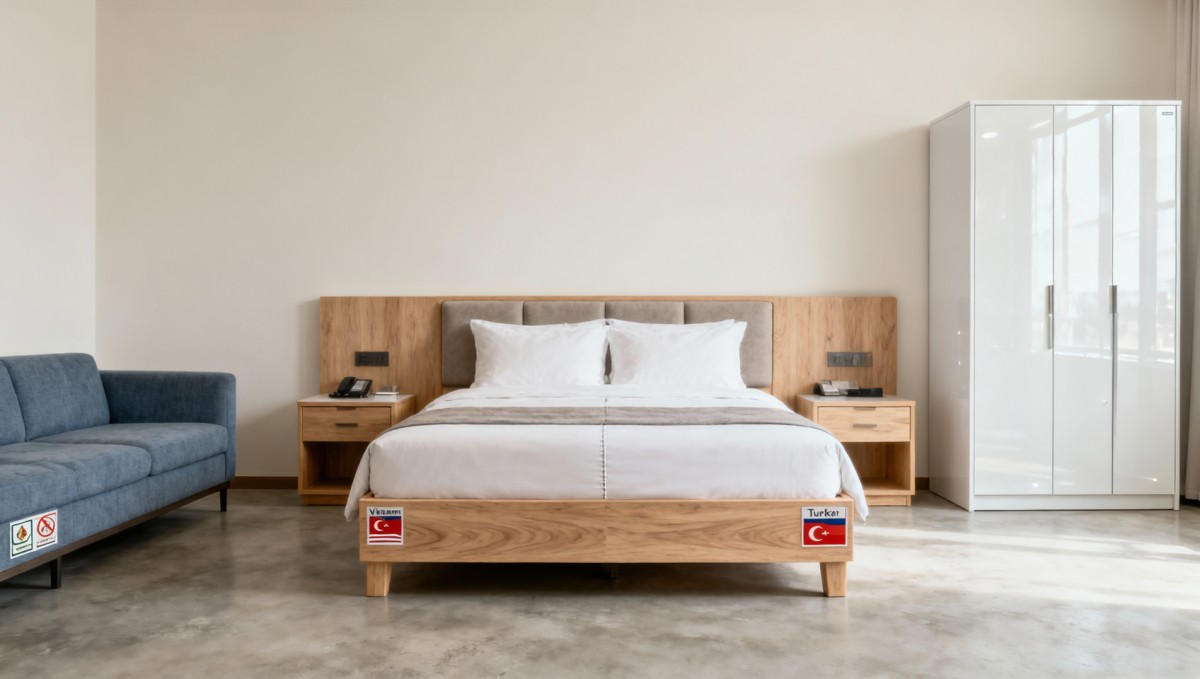
Vietnam’s export-oriented manufacturing ecosystem has aligned tightly with EU and U.S. compliance pathways. Over 71% of GCT-vetted Vietnamese factories hold active BIFMA X5.9 (seating), EN 1728 (furniture strength), and UL 94 V-0 (flame spread) certifications—often embedded in their SOPs from raw material intake.
Turkey demonstrates strong regional compliance (e.g., TSE EN 1728, TS EN 1021-1), but fewer facilities maintain parallel U.S.-focused certification stacks. Only 39% of audited Turkish suppliers held active CARB Phase 2 and ANSI/BIFMA certifications—requiring additional third-party validation for North American deployments.
Key Certification Readiness Comparison
This gap matters most during multi-property rollouts: Vietnamese partners typically deliver full compliance dossiers within 5 business days of order confirmation. Turkish partners average 12–18 days—often requiring parallel lab submissions to accelerate approvals.
Delivery Predictability Across Complex Hotel Fit-Outs
A 200-room hotel requires coordinated delivery of 200+ bed frames, 400+ nightstands, 200+ wardrobes, and 100+ lounge pieces—all arriving within a 14-day window to avoid site idle time. GCT’s logistics benchmarking shows Vietnamese suppliers achieve 94.2% on-time-in-full (OTIF) for consolidated container shipments to EU and U.S. ports, with average port-to-site lead time of 28–35 days.
Turkish suppliers show stronger regional advantage: OTIF reaches 96.8% for deliveries to Middle East and Eastern Europe, with port-to-site times of 12–18 days. However, transatlantic and transpacific shipments drop to 83.5% OTIF due to vessel schedule volatility and limited direct liner services—adding 7–10 days contingency to planning.
Crucially, Vietnamese factories demonstrate higher responsiveness to mid-stream change orders: 89% can accommodate specification updates (e.g., fabric swaps, finish adjustments) up to 10 days pre-shipment without timeline impact. Turkish facilities manage this within 7 days—reflecting tighter internal engineering handoffs.
Why Global Procurement Teams Are Prioritizing Vietnam for Multi-Property Rollouts
When evaluating long-term partnerships—not one-off orders—the decision hinges on three interlocking pillars: repeatability, responsiveness, and regulatory resilience. Vietnam excels in standardized production execution, particularly for high-volume, low-variation programs (e.g., standardized guestroom packages across Marriott Autograph or IHG Voco brands).
Turkey retains distinct advantages for bespoke, design-led projects demanding artisanal metalwork, custom stone inlays, or regionally inspired upholstery—especially when serving EMEA-based developers with shorter sea-leg logistics. But for global operators scaling across Asia-Pacific, Americas, and Europe simultaneously, Vietnam offers tighter cross-regional compliance harmonization and faster iteration cycles.
GCT’s latest sourcing intelligence report identifies 4 critical evaluation checkpoints before finalizing origin selection:
- Request full batch-level test reports—not just certificates—for your exact SKU configuration (e.g., “fabric A + foam density 35 kg/m³ + frame hardwood species”)
- Validate traceability depth: Can the supplier map each component back to its raw material mill, coating batch, and finishing line shift?
- Confirm change-order policy: What’s the latest cutoff for spec modifications without timeline penalty or MOQ reset?
- Require proof of current year’s third-party lab testing—especially for flame retardancy and VOC emissions—on identical materials used in your order
Get Your Customized Sourcing Roadmap—Backed by On-the-Ground Verification
Don’t base multi-million-dollar procurement decisions on brochures or trade-show conversations. GCT provides end-to-end verification services for hospitality furniture sourcing—including factory capability scoring, sample validation against brand specs, compliance dossier review, and real-time production monitoring via encrypted video feeds.
We help you determine whether Vietnam’s scalability and compliance maturity—or Turkey’s design agility and regional proximity—better aligns with your next 3-year portfolio plan. Our team delivers actionable intelligence—not generic comparisons.
Contact GCT today for a free consultation on your upcoming hotel furniture sourcing initiative. Specify your project scope (e.g., “120-room resort in Dubai, requiring EN 1728 + BS 5852 + LEED-compliant materials”), and we’ll provide: a shortlisted supplier matrix, realistic lead-time benchmarks, compliance gap analysis, and sample approval protocol recommendations—all within 3 business days.
Search News
Hot Articles
- Stage Lighting & TrussCCTV5 Snooker Broadcast Drives 37% Surge in Stage Lighting Export InquiriesApr 21, 2026
- Indoor PlaygroundVietnam Mandates Child Finger-Trap Sensors for Indoor Play EquipmentApr 21, 2026
- Stage Lighting & TrussGuangdong vs. Shanxi CBA Game Highlights Domestic Smart Arena LightingApr 21, 2026
Popular Tags
Need ExpertConsultation?
Connect with our specialized leisureengineering team for procurementstrategies.
Recommended News
 Apr 10, 2026RCEP Cuts ASEAN Hotel Furniture Tariffs to 0% for Chinese Bamboo ProductsRCEP cuts ASEAN hotel furniture tariffs to 0% for Chinese bamboo products. Explore how this benefits exporters, procurement teams & supply chains in Southeast Asia's booming hospitality sector.● Hospitality Sourcing Dir
 Apr 10, 2026US Hotel Association Updates 2026 Smart Room Tech Guidelines, Mandates UL 2900-2-2 CertificationUS Hotel Association mandates UL 2900-2-2 certification for smart room tech by 2026. Learn how this impacts IoT manufacturers and hotel chains' procurement strategies.● Hospitality Sourcing Dir
 Apr 10, 2026EU Mandates QR Codes for Hotel Linens: China Exporters Must Comply by April 2026EU mandates QR codes for hotel linens by 2026, impacting China's textile exporters. Learn compliance requirements for traceability, sustainability reporting, and supply chain adaptation.● Hospitality Sourcing Dir
 Apr 09, 2026Zibo Launches 'Treasure Shandong Through the Lens' Photo Tour, Themed Homestays Emerge as Cross-Border Marketing ToolDiscover Zibo's 'Treasure Shandong Through the Lens' photo tour featuring 32 themed homestays blending vintage cameras, Hanfu culture & industrial spaces. A groundbreaking cross-border marketing model attracting global influencers & platforms like Rakuten Travel.● Hospitality Sourcing Dir
 Apr 09, 2026Yangzhou Slender West Lake Flower Festival Opens, Blending Heritage and Tech for Luxury TourismDiscover the 2026 Yangzhou Slender West Lake Flower Festival, blending heritage crafts with AR technology for luxury tourism. Experience cultural performances, workshops, and themed stays attracting global travelers. Explore China's new era of experiential tourism.● Hospitality Sourcing Dir
 Apr 09, 2026New Team Travel Contracts Raise Compliance Standards for Overseas AgenciesNew team travel contracts enforce stricter compliance for overseas agencies, requiring rigorous vetting of Chinese suppliers. Learn how these 2026 regulations impact study tours, hotels, and global partnerships.● Hospitality Sourcing Dir
 Apr 09, 2026Shangyou County's Hotel Subsidy Policy Boosts China's MICE Tourism AppealShangyou County's 2026 hotel subsidy policy offers RMB 100 per room for MICE tourism, boosting China's appeal to international buyers. Discover how this strategic move enhances cost-effective accommodations for corporate events and study tours.● Hospitality Sourcing Dir
 Apr 21, 2026Open or closed hotel wardrobes for easier housekeeping?Hotel wardrobes affect housekeeping speed, guest appeal, and hospitality procurement. Compare open vs closed designs for hotel furniture, luxury furniture, and hotel room furniture planning.● Hospitality Sourcing Dir
 Apr 21, 2026Hotel wardrobes that fit luggage without wasting spaceHotel wardrobes that fit luggage smartly without wasting space—explore hotel furniture solutions that elevate hotel room furniture, support hospitality procurement, and enhance guest comfort.● Hospitality Sourcing Dir
 Apr 21, 2026Why hotel room furniture wears unevenly after openingHotel furniture wear starts unevenly from day one. Learn how hotel beds, hotel chairs, hotel desks and hotel room furniture perform in real use, with smart hospitality procurement tips.● Hospitality Sourcing Dir
 Apr 21, 2026Hotel room furniture packages that cut design mismatchHotel room furniture packages align hotel furniture, hotel beds, hotel chairs, hotel tables, and hotel desks with luxury furniture standards—reducing design mismatch and speeding hospitality procurement.● Hospitality Sourcing Dir
 Apr 21, 2026Low seat or deep seat hotel sofas for modern lobbies?Hotel furniture buyers compare low seat and deep seat hotel sofas for modern lobbies. Explore luxury furniture choices that improve comfort, traffic flow, brand image, and hospitality procurement value.● Hospitality Sourcing Dir
 Apr 21, 2026Hotel sofas that keep their shape in high traffic areasHotel sofas, hotel furniture, and hospitality furniture that keep shape in high-traffic areas—discover luxury furniture sourcing tips, durable commercial furniture specs, and smarter hospitality procurement.● Hospitality Sourcing Dir
 Apr 21, 2026Why hospitality furniture needs different specs by zoneHospitality furniture specs vary by zone. Learn how hotel furniture, hotel beds, hotel chairs, hotel tables, and hotel desks improve durability, ROI, and luxury guest experience.● Hospitality Sourcing Dir
 Apr 21, 2026Hospitality furniture that supports faster room turnoverHospitality furniture that speeds room turnover: compare hotel beds, hotel chairs, hotel tables, hotel desks and hotel sofas for easier cleaning, durability, and smarter hospitality procurement.● Hospitality Sourcing Dir
 Apr 21, 2026Where hotel equipment budgets usually go off trackHotel furniture and hotel equipment budgets often fail from hidden scope, logistics, and lifecycle costs. Learn smarter hospitality procurement for hotel beds, chairs, tables, and luxury furniture.● Hospitality Sourcing Dir
 Apr 21, 2026Hotel equipment upgrades that improve guest flow firstHotel equipment upgrades improve guest flow fast with hotel furniture, hotel beds, hotel chairs, catering equipment, and soundproofing materials—boost comfort, efficiency, and procurement ROI.● Hospitality Sourcing Dir
 Apr 21, 2026What shortens the life of commercial furniture in hotelsHotel furniture and commercial furniture wear out fast when hotel beds, hotel chairs, hotel tables, hotel desks, and hotel sofas face heavy use, poor maintenance, and weak materials. Learn smart hospitality procurement tips.● Hospitality Sourcing Dir
 Apr 21, 2026Commercial furniture trends hotels are actually adoptingCommercial furniture trends hotels are adopting: luxury furniture, hotel beds, hotel chairs, hotel tables and hotel sofas that improve hotel furniture sourcing, durability, and hospitality procurement value.● Hospitality Sourcing Dir
 Apr 21, 2026How to spot hotel furniture built for daily wearHotel furniture buying guide: learn how to assess hotel beds, hotel chairs, hotel tables, and hospitality furniture for daily wear, lower maintenance, and smarter hospitality procurement.● Hospitality Sourcing Dir
 Apr 21, 2026Hotel furniture mistakes that age a room too quicklyHotel furniture buying guide: avoid costly hotel beds, hotel chairs, and hotel room furniture mistakes. Discover luxury furniture tips for durable, brand-right hospitality procurement.● Hospitality Sourcing Dir
 Apr 21, 2026Why some soundproofing materials fail after installationLearn why soundproofing materials fail after installation in hotel furniture projects. Explore hotel beds, hotel sofas, hotel wardrobes and hospitality procurement tips for lasting acoustic performance.● Hospitality Sourcing Dir
 Apr 21, 2026Soundproofing materials that work best between guest roomsSoundproofing materials for hotel furniture projects: discover the best systems between guest rooms, from mineral wool to acoustic doors, to improve comfort, protect reviews, and support hospitality procurement.● Hospitality Sourcing Dir
 Apr 21, 2026How firm should hotel beds be for mixed guest profiles?Hotel beds for mixed guest profiles: learn how hotel furniture and hospitality procurement teams balance comfort, durability, and luxury furniture standards to improve guest satisfaction.● Hospitality Sourcing Dir