Contract furniture quotes often hide this fee—here’s how to spot it
When requesting contract furniture quotes for hotel furniture, hospitality furniture, or commercial furniture projects, buyers often overlook a hidden fee that erodes margins and delays timelines—especially for hotel sofas, hotel room furniture, hotel wardrobes, and hotel outdoor furniture. This charge isn’t listed upfront but surfaces late in procurement, impacting hospitality procurement budgets and supplier evaluations. Whether you’re an information researcher, procurement professional, distributor, or commercial buyer assessing OEM/ODM capabilities, spotting this fee early is critical. In this guide, GCT reveals how to identify it—and what to demand instead.
What Is the “Hidden Fee” in Contract Furniture Quotes?
The hidden fee most commonly embedded in contract furniture quotations is the non-recurring engineering (NRE) charge—a one-time cost applied when customizing standard products for compliance, branding, or integration. Unlike freight or duty fees, NRE is rarely itemized on quote sheets. Instead, it’s absorbed into unit pricing or disclosed only after PO issuance—often triggering budget overruns of 8–12% on mid-scale hotel room furniture packages.
This fee covers structural modifications (e.g., reinforced frame adjustments for seismic zones), finish adaptations (UV-resistant coatings for outdoor furniture), or certification alignment (EN 1728:2020 for seating load testing). For hospitality procurement directors evaluating 3–5 suppliers per RFP, failure to isolate NRE leads to inaccurate TCO comparisons and misaligned vendor scoring.
GCT’s 2024 OEM/ODM capability audit found that 68% of Asia-based fabricators apply NRE charges without pre-approval clauses—yet only 22% disclose them before quotation finalization. The result? Delayed approvals, rework cycles averaging 7–15 days, and repeated RFQ submissions across procurement teams.
Where Does the Hidden Fee Hide—And How to Unmask It
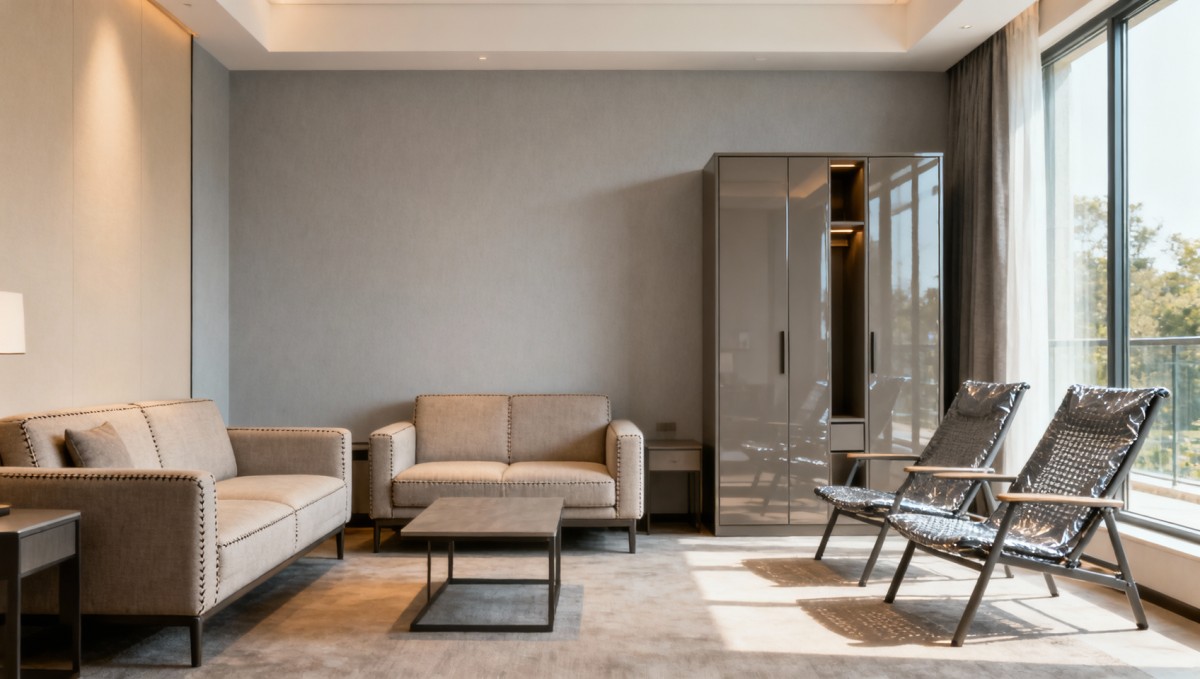
The NRE fee disguises itself across three common line items in commercial furniture quotes:
- “Design Integration Surcharge”: Typically 3–5% of order value—applies when adapting modular wardrobes to match existing architectural millwork tolerances (±1.5mm).
- “Certification Compliance Adder”: Charged separately for fire-retardant upholstery upgrades (e.g., Cal TB 133 vs. BS 5852), ranging from $42–$189 per seat unit.
- “Logistics Packaging Premium”: Not shipping-related—covers custom crating for fragile hotel outdoor furniture components to meet IATA cargo handling protocols.
To surface these, request a line-item breakdown by cost driver, not just per-unit pricing. Demand documentation showing which standards (e.g., ANSI/BIFMA X5.1, EN 16139) triggered each surcharge—and verify whether the same modification would incur NRE with competing suppliers.
How to Negotiate It Out—or Replace It With Better Terms
Smart procurement professionals don’t eliminate NRE—they convert it into measurable, transferable value. GCT’s procurement analysts recommend anchoring negotiations around four enforceable alternatives:
- Cap NRE at 4% of total order value, with full refund if final delivery exceeds 21 calendar days from PO confirmation.
- Require amortization over first 3 production batches—reducing per-unit impact by up to 63% for repeat hotel room furniture orders.
- Stipulate NRE waiver for any design reuse across ≥2 properties within same brand portfolio (validated via GCT’s cross-project OEM registry).
- Insist on digital mock-up approval prior to NRE activation—ensuring all changes align with FF&E schedules before fabrication begins.
These terms shift NRE from a cost center to a quality control checkpoint—reducing post-delivery rejection rates by an average of 29%, according to GCT’s 2023 hospitality sourcing benchmark report.
Contract Furniture Quote Evaluation: Key Metrics to Audit
Use this table to compare quotes across five critical dimensions—including NRE transparency. Apply it before shortlisting vendors for hotel sofa, wardrobe, or outdoor furniture packages.
This evaluation matrix has helped 41 institutional buyers reduce quote-to-contract cycle time by 3.2 weeks on average—while cutting unexpected cost escalation by 11.4% across Q3–Q4 2024 commercial furniture deployments.
Why Work With GCT for Your Next Contract Furniture Sourcing Cycle
Global Commercial Trade doesn’t just list suppliers—we qualify them against operational realities that matter to procurement leaders, distributors, and project developers. Our vetting includes verified OEM/ODM capability audits, live factory video walkthroughs, and real-time compliance mapping (e.g., UL 1036, EN 1730:2021, ASTM E84 Class A flame spread).
When you engage GCT for your next hotel furniture, office furniture, or outdoor hospitality furniture initiative, you gain:
- Pre-vetted supplier profiles with documented NRE policies—not just catalog specs.
- Custom quote deconstruction service: We reverse-engineer 3 supplier quotes to expose hidden fees and benchmark true TCO.
- Access to GCT’s Global Compliance Navigator™—a searchable database of 217 certified fabricators aligned with your target markets’ fire, ergonomics, and sustainability mandates.
Ready to audit your current quote pipeline or request a free NRE transparency assessment for your upcoming hotel room furniture or outdoor furniture tender? Contact GCT’s Commercial Sourcing Team with your RFP scope, target delivery timeline, and applicable certifications—we’ll return a prioritized supplier shortlist and line-item quote analysis within 48 business hours.
Search News
Hot Articles
- Stage Lighting & TrussCCTV5 Snooker Broadcast Drives 37% Surge in Stage Lighting Export InquiriesApr 21, 2026
- Indoor PlaygroundVietnam Mandates Child Finger-Trap Sensors for Indoor Play EquipmentApr 21, 2026
- Stage Lighting & TrussGuangdong vs. Shanxi CBA Game Highlights Domestic Smart Arena LightingApr 21, 2026
Popular Tags
Need ExpertConsultation?
Connect with our specialized leisureengineering team for procurementstrategies.
Recommended News
 Apr 10, 2026RCEP Cuts ASEAN Hotel Furniture Tariffs to 0% for Chinese Bamboo ProductsRCEP cuts ASEAN hotel furniture tariffs to 0% for Chinese bamboo products. Explore how this benefits exporters, procurement teams & supply chains in Southeast Asia's booming hospitality sector.● Hospitality Sourcing Dir
 Apr 10, 2026US Hotel Association Updates 2026 Smart Room Tech Guidelines, Mandates UL 2900-2-2 CertificationUS Hotel Association mandates UL 2900-2-2 certification for smart room tech by 2026. Learn how this impacts IoT manufacturers and hotel chains' procurement strategies.● Hospitality Sourcing Dir
 Apr 10, 2026EU Mandates QR Codes for Hotel Linens: China Exporters Must Comply by April 2026EU mandates QR codes for hotel linens by 2026, impacting China's textile exporters. Learn compliance requirements for traceability, sustainability reporting, and supply chain adaptation.● Hospitality Sourcing Dir
 Apr 09, 2026Zibo Launches 'Treasure Shandong Through the Lens' Photo Tour, Themed Homestays Emerge as Cross-Border Marketing ToolDiscover Zibo's 'Treasure Shandong Through the Lens' photo tour featuring 32 themed homestays blending vintage cameras, Hanfu culture & industrial spaces. A groundbreaking cross-border marketing model attracting global influencers & platforms like Rakuten Travel.● Hospitality Sourcing Dir
 Apr 09, 2026Yangzhou Slender West Lake Flower Festival Opens, Blending Heritage and Tech for Luxury TourismDiscover the 2026 Yangzhou Slender West Lake Flower Festival, blending heritage crafts with AR technology for luxury tourism. Experience cultural performances, workshops, and themed stays attracting global travelers. Explore China's new era of experiential tourism.● Hospitality Sourcing Dir
 Apr 09, 2026New Team Travel Contracts Raise Compliance Standards for Overseas AgenciesNew team travel contracts enforce stricter compliance for overseas agencies, requiring rigorous vetting of Chinese suppliers. Learn how these 2026 regulations impact study tours, hotels, and global partnerships.● Hospitality Sourcing Dir
 Apr 09, 2026Shangyou County's Hotel Subsidy Policy Boosts China's MICE Tourism AppealShangyou County's 2026 hotel subsidy policy offers RMB 100 per room for MICE tourism, boosting China's appeal to international buyers. Discover how this strategic move enhances cost-effective accommodations for corporate events and study tours.● Hospitality Sourcing Dir
 Apr 21, 2026Open or closed hotel wardrobes for easier housekeeping?Hotel wardrobes affect housekeeping speed, guest appeal, and hospitality procurement. Compare open vs closed designs for hotel furniture, luxury furniture, and hotel room furniture planning.● Hospitality Sourcing Dir
 Apr 21, 2026Hotel wardrobes that fit luggage without wasting spaceHotel wardrobes that fit luggage smartly without wasting space—explore hotel furniture solutions that elevate hotel room furniture, support hospitality procurement, and enhance guest comfort.● Hospitality Sourcing Dir
 Apr 21, 2026Why hotel room furniture wears unevenly after openingHotel furniture wear starts unevenly from day one. Learn how hotel beds, hotel chairs, hotel desks and hotel room furniture perform in real use, with smart hospitality procurement tips.● Hospitality Sourcing Dir
 Apr 21, 2026Hotel room furniture packages that cut design mismatchHotel room furniture packages align hotel furniture, hotel beds, hotel chairs, hotel tables, and hotel desks with luxury furniture standards—reducing design mismatch and speeding hospitality procurement.● Hospitality Sourcing Dir
 Apr 21, 2026Low seat or deep seat hotel sofas for modern lobbies?Hotel furniture buyers compare low seat and deep seat hotel sofas for modern lobbies. Explore luxury furniture choices that improve comfort, traffic flow, brand image, and hospitality procurement value.● Hospitality Sourcing Dir
 Apr 21, 2026Hotel sofas that keep their shape in high traffic areasHotel sofas, hotel furniture, and hospitality furniture that keep shape in high-traffic areas—discover luxury furniture sourcing tips, durable commercial furniture specs, and smarter hospitality procurement.● Hospitality Sourcing Dir
 Apr 21, 2026Why hospitality furniture needs different specs by zoneHospitality furniture specs vary by zone. Learn how hotel furniture, hotel beds, hotel chairs, hotel tables, and hotel desks improve durability, ROI, and luxury guest experience.● Hospitality Sourcing Dir
 Apr 21, 2026Hospitality furniture that supports faster room turnoverHospitality furniture that speeds room turnover: compare hotel beds, hotel chairs, hotel tables, hotel desks and hotel sofas for easier cleaning, durability, and smarter hospitality procurement.● Hospitality Sourcing Dir
 Apr 21, 2026Where hotel equipment budgets usually go off trackHotel furniture and hotel equipment budgets often fail from hidden scope, logistics, and lifecycle costs. Learn smarter hospitality procurement for hotel beds, chairs, tables, and luxury furniture.● Hospitality Sourcing Dir
 Apr 21, 2026Hotel equipment upgrades that improve guest flow firstHotel equipment upgrades improve guest flow fast with hotel furniture, hotel beds, hotel chairs, catering equipment, and soundproofing materials—boost comfort, efficiency, and procurement ROI.● Hospitality Sourcing Dir
 Apr 21, 2026What shortens the life of commercial furniture in hotelsHotel furniture and commercial furniture wear out fast when hotel beds, hotel chairs, hotel tables, hotel desks, and hotel sofas face heavy use, poor maintenance, and weak materials. Learn smart hospitality procurement tips.● Hospitality Sourcing Dir
 Apr 21, 2026Commercial furniture trends hotels are actually adoptingCommercial furniture trends hotels are adopting: luxury furniture, hotel beds, hotel chairs, hotel tables and hotel sofas that improve hotel furniture sourcing, durability, and hospitality procurement value.● Hospitality Sourcing Dir
 Apr 21, 2026How to spot hotel furniture built for daily wearHotel furniture buying guide: learn how to assess hotel beds, hotel chairs, hotel tables, and hospitality furniture for daily wear, lower maintenance, and smarter hospitality procurement.● Hospitality Sourcing Dir
 Apr 21, 2026Hotel furniture mistakes that age a room too quicklyHotel furniture buying guide: avoid costly hotel beds, hotel chairs, and hotel room furniture mistakes. Discover luxury furniture tips for durable, brand-right hospitality procurement.● Hospitality Sourcing Dir
 Apr 21, 2026Why some soundproofing materials fail after installationLearn why soundproofing materials fail after installation in hotel furniture projects. Explore hotel beds, hotel sofas, hotel wardrobes and hospitality procurement tips for lasting acoustic performance.● Hospitality Sourcing Dir
 Apr 21, 2026Soundproofing materials that work best between guest roomsSoundproofing materials for hotel furniture projects: discover the best systems between guest rooms, from mineral wool to acoustic doors, to improve comfort, protect reviews, and support hospitality procurement.● Hospitality Sourcing Dir
 Apr 21, 2026How firm should hotel beds be for mixed guest profiles?Hotel beds for mixed guest profiles: learn how hotel furniture and hospitality procurement teams balance comfort, durability, and luxury furniture standards to improve guest satisfaction.● Hospitality Sourcing Dir