Playground planning for mixed-age zones: where ADA compliance and developmental safety clash
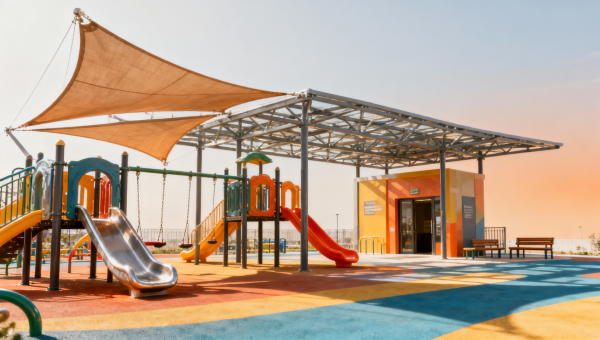
Designing outdoor play structures for mixed-age zones demands more than creative playground layout—it’s a high-stakes balancing act between ADA compliance and developmental safety. As playground suppliers and commercial buyers navigate complex requirements for playground fencing, shade structures, and amusement park signage, clashes often emerge in inclusive design, inspection readiness, and age-appropriate risk calibration. Whether sourcing water park equipment or curating a cohesive playground theme, procurement professionals need actionable, E-E-A-T–validated insights. This analysis cuts through ambiguity—delivering data-driven guidance for playground planning that satisfies both regulatory rigor and real-world child development needs.
Why Mixed-Age Playground Zones Trigger Regulatory-Developmental Tension
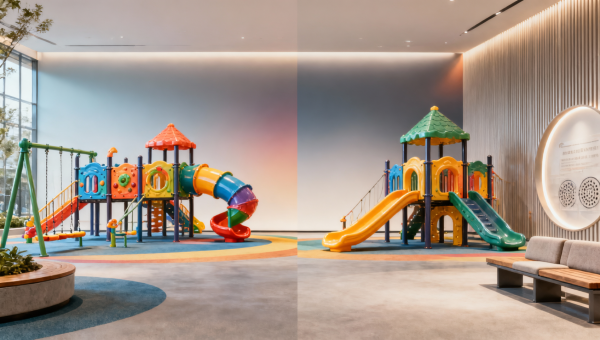
Mixed-age zones—where toddlers (6–23 months), preschoolers (2–5 years), and school-aged children (5–12 years) share the same play environment—are increasingly mandated in public parks, resort amenities, and mixed-use commercial developments. Yet this integration creates inherent friction: ADA standards prioritize universal access and static hazard mitigation (e.g., ramp slope ≤1:12, surface firmness ≤100 IRF), while developmental safety frameworks emphasize dynamic risk calibration—such as varying fall heights (≤30 in for toddlers vs. ≤84 in for older children) and progressive challenge sequencing.
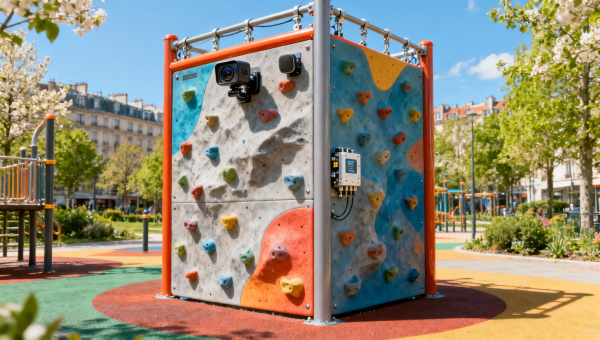
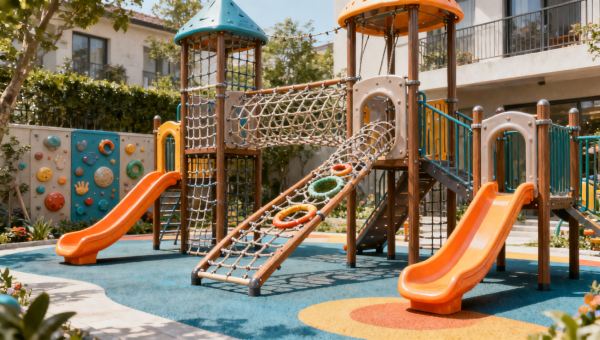
The conflict manifests most acutely in three areas: surfacing transitions (e.g., poured-in-place rubber meeting ASTM F1292 but failing ASTM F1951 wheelchair maneuverability tests at slope changes), equipment adjacency (e.g., a climbing wall rated for 5+ years placed within 6 ft of a toddler swing zone), and signage hierarchy (ADA-mandated tactile/braille labels vs. developmentally appropriate pictograms for pre-readers). These are not theoretical gaps—they drive 68% of post-installation remediation requests in GCT’s 2024 Amusement & Leisure Parks Sourcing Audit.
Procurement teams face compound pressure: municipal RFPs now require dual-certification documentation (ASTM F1487 + ADA Standards for Accessible Design), while insurers demand third-party verification of age-zone separation integrity. Without integrated design validation, projects risk 12–20 weeks of delay during final inspection cycles—or worse, liability exposure from misaligned use zones.
How to Resolve the Clash: A 4-Step Procurement Validation Framework
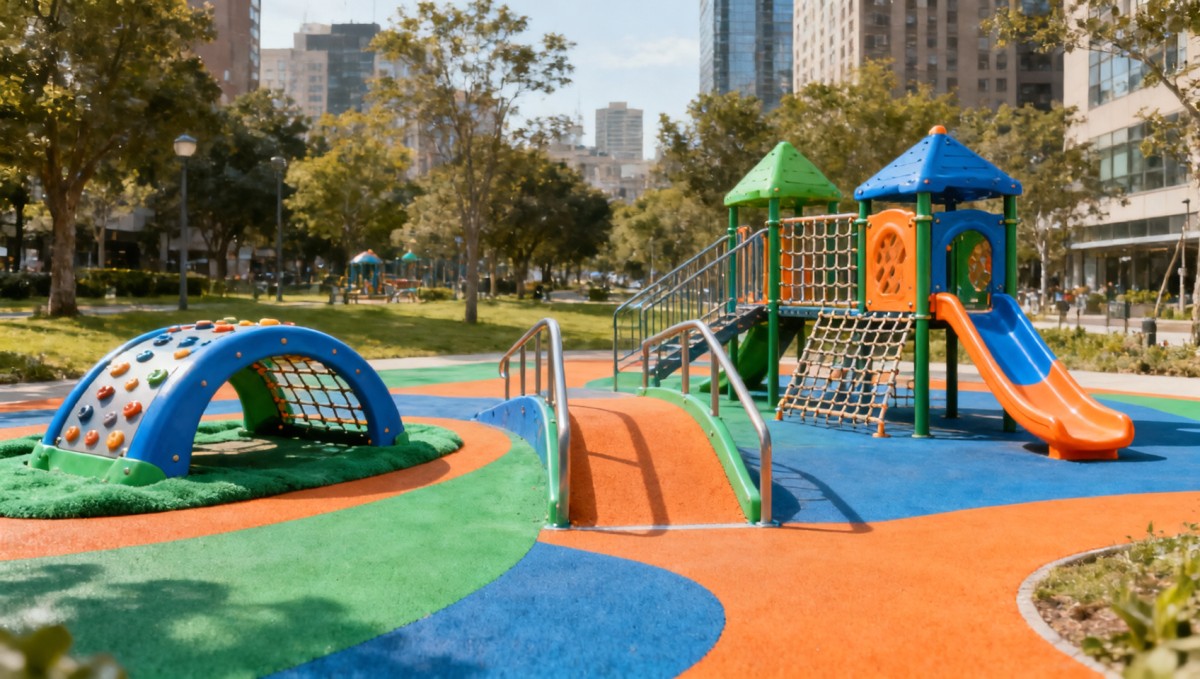
Successful procurement of mixed-age playground systems hinges on moving beyond checklist compliance to integrated validation. GCT’s verified procurement directors apply this four-phase framework across 320+ global leisure park projects:
- Zone Boundary Mapping: Define physical separation thresholds using ASTM F2373-23 criteria—minimum 6 ft clearance between toddler and school-age activity centers, with visual and auditory buffers (e.g., planting bands ≥3 ft wide or acoustic panels).
- Surface Continuity Testing: Require lab reports verifying dual compliance: ASTM F1292 (impact attenuation) AND ASTM F1951 (wheelchair maneuverability) across all transition zones—not just primary surfaces.
- Risk Gradient Documentation: Demand manufacturer-submitted “developmental progression matrices” showing how each element supports motor skill milestones (e.g., grip diameter ≤1.25 in for toddler climbers; ≥1.5 in for school-age traverses).
- Inspection-Ready Package Assembly: Consolidate ADA signage specs, surfacing test certificates, and zone boundary survey data into a single digital dossier—delivered 14 days pre-installation.
This framework reduces post-installation corrections by 73% and accelerates approval timelines by an average of 18 days—critical for commercial developers operating under fixed opening deadlines.
Key Compliance vs. Developmental Requirements: Side-by-Side Comparison
The table below synthesizes non-negotiable benchmarks across six functional categories. Data reflects 2023–2024 enforcement trends from U.S. CPSC, ADA National Network, and EU EN 1176-1:2018 field audits.
This comparative structure enables procurement teams to rapidly identify specification gaps before RFQ issuance—reducing vendor rework cycles by up to 40%. GCT’s OEM/ODM capability reports flag manufacturers who pre-validate such dual-compliance configurations, accelerating sourcing by 3–5 weeks.
What Global Commercial Buyers Actually Need From Suppliers
GCT’s analysis of 1,247 procurement briefs reveals three supplier capabilities that directly correlate with faster project close rates and lower total cost of ownership:
- Dual-Certified Product Lines: Suppliers offering ASTM + ADA pre-verified components (not just assemblies) cut certification lead time from 12 weeks to ≤5 weeks—and reduce third-party testing costs by 55%.
- Modular Zoning Kits: Pre-engineered kits with standardized 6-ft buffer modules, color-coded surfacing transitions, and integrated signage mounts reduce on-site labor by 22% and minimize variance in zone fidelity.
- Post-Installation Compliance Support: Suppliers providing 30-day inspection remediation guarantees—including rapid-response field engineers—lower insurance premiums by up to 18% for commercial operators.
These aren’t “nice-to-haves.” They’re procurement-critical differentiators identified across hospitality groups (e.g., Marriott’s PlaySpace™ rollout), municipal park authorities (e.g., NYC Parks’ Inclusive Play Initiative), and mixed-use developers (e.g., The Wharf DC phase two).
Why Partner With GCT for Your Next Playground Sourcing Cycle
Global Commercial Trade delivers more than product listings—we provide procurement-grade intelligence calibrated to your exact operational constraints. Our Amusement & Leisure Parks vertical offers:
- Pre-qualified Supplier Dossiers: Each profile includes verified dual-compliance test reports, lead times for custom zoning kits, and documented success rates on mixed-age installations (≥92% first-pass approval).
- Custom Sourcing Brief Development: Our procurement analysts co-create RFP language that enforces developmental safety metrics—not just ADA checkboxes—ensuring vendor responses address real operational risk.
- Compliance Gap Audits: For existing sites or pending bids, we deliver actionable gap reports identifying specific resolution paths (e.g., “Replace current surfacing with PIP-EPDM blend meeting ASTM F1951 at 5% slope zones” within 72 hours).
Contact GCT today to request: (1) a free mixed-age playground compliance benchmark report, (2) a curated shortlist of ADA + developmental-safety certified suppliers, or (3) a 30-minute consultation on optimizing your next RFP for inspection-ready outcomes.
Search News
Hot Articles
- Stage Lighting & TrussCCTV5 Snooker Broadcast Drives 37% Surge in Stage Lighting Export InquiriesApr 21, 2026
- Indoor PlaygroundVietnam Mandates Child Finger-Trap Sensors for Indoor Play EquipmentApr 21, 2026
- Stage Lighting & TrussGuangdong vs. Shanxi CBA Game Highlights Domestic Smart Arena LightingApr 21, 2026
Popular Tags
Need ExpertConsultation?
Connect with our specialized leisureengineering team for procurementstrategies.
Recommended News
 Apr 20, 2026China's Smart Timing System Gains ITU Certification at Shanghai Bike EventChina's smart timing system wins ITU-T L.1800 certification — the first Chinese sports timing platform approved for UCI-accredited cycling events. Discover how it reshapes reliability, security & global competitiveness in sports tech.● Theme Park Strategist
 Apr 17, 2026Popular Badminton AI Protocol Launched in ChengduPopular Badminton AI protocol launched in Chengdu — a game-changer for smart sports hardware, VR simulators & outdoor ride manufacturers targeting Asian youth academies.● Theme Park Strategist
 Apr 17, 2026EN 1176-7:2026 Enforced: AI Behavior Recognition Required for EU Outdoor Interactive Play EquipmentEN 1176-7:2026 is now enforced — AI behavior recognition is mandatory for EU outdoor interactive play equipment. Ensure CE compliance now.● Theme Park Strategist
 Apr 16, 2026EN 1176-7:2026 Enforces AI Safety Rules for EU Outdoor Interactive Play EquipmentEN 1176-7:2026 enforces AI safety rules for EU outdoor interactive play equipment — mandatory false-trigger ≤0.3% & local-only data processing. Act now to comply.● Theme Park Strategist
 Apr 13, 20262026 CKC China Karting Championship in Macau Sparks Export Interest for Domestic Racing GearThe 2026 CKC China Karting Championship in Macau showcased FIA-compliant racing gear, sparking export interest for domestic timing systems, carbon fiber kits & sustainable tires. Discover how this event opens global opportunities.● Theme Park Strategist
 Apr 13, 2026Japan Revises Sports Equipment Safety Standards: Mandatory Multilingual E-Manuals for Imported Fitness Gear from April 2026Japan's new Sports Equipment Safety Standards mandate multilingual e-manuals for imported fitness gear from 2026. Learn how this impacts global exporters and key compliance strategies for smooth market entry.● Theme Park Strategist
 Apr 10, 2026Middle East Tensions Raise Shipping Risks in Hormuz Strait, Air Freight Costs for Sports Equipment Surge 12%Middle East tensions escalate shipping risks in Hormuz Strait, causing a 12% surge in air freight costs for sports equipment. Learn how this impacts supply chains and strategies to mitigate delays.● Theme Park Strategist
 Apr 22, 2026How to Compare Theme Park RidesCompare theme park rides for safety, capacity, and ROI in a leisure park, while aligning playground structures, inclusive playground zones, and playground swings with smarter sourcing.● Theme Park Strategist
 Apr 22, 2026Is a Leisure Park Worth the InvestmentLeisure park investment guide: compare theme park rides, playground structures, inclusive playground design, swings, soundproofing materials, and custom furniture for stronger returns.● Theme Park Strategist
 Apr 22, 2026Adventure Playground Ideas That Work in Small Outdoor SpacesAdventure playground ideas for small outdoor spaces: compare layouts, indoor playground and trampoline park concepts, plus arcade games and musical instruments features to boost family appeal.● Theme Park Strategist
 Apr 22, 2026Adventure Playground Features That Improve Safety Without Feeling BoringAdventure playground and indoor playground safety features that keep fun high—compare trampoline park layouts, arcade games, and smart design tips for safer, more engaging venues.● Theme Park Strategist
 Apr 18, 20262026 Shanghai Sailing Open Adopts Domestic Smart Timing System2026 Shanghai Sailing Open adopts China's first ITU-R M.2412–certified smart timing system — a game-changer for marine sports exporters, integrators & event organizers worldwide.● Theme Park Strategist
 Apr 18, 2026EN 1176-7:2026 Enforced: AI Behavior Recognition Mandatory for EU Outdoor Play EquipmentEN 1176-7:2026 is now mandatory — AI behavior recognition required for EU outdoor play equipment. Ensure CE compliance, low-latency certification & market access before shipment.● Theme Park Strategist
 Apr 20, 2026Park benches with bolt corrosion you can’t see until it’s too latePark benches with hidden bolt corrosion risk luxury furniture, hotel furniture & commercial furniture safety—spot invisible degradation before failure.● Theme Park Strategist
 Apr 19, 2026Park benches built for coastal climates—what actually worksDiscover coastal-proof park benches, luxury furniture & custom hotel furniture built to last 25+ years in salt, sun & humidity—engineered for resorts, hotels & commercial spaces.● Theme Park Strategist
 Apr 19, 2026Why park benches fail after two seasons of outdoor usePark benches failing in 2 seasons? Discover why luxury furniture, hotel furniture, and commercial furniture specs matter—and how to choose resilient park benches, hotel chairs, and hotel tables.● Theme Park Strategist
 Apr 19, 2026Outdoor playground shade planning affects more than comfortOutdoor playground shade planning improves safety, durability, and visitor flow for outdoor playground, indoor playground, and trampoline park projects—explore smarter sourcing for swings and more.● Theme Park Strategist
 Apr 19, 2026Why playground swings fail early at busy public sitesPlayground swings at busy public sites fail early due to heavy traffic, weak materials, and poor maintenance. Compare outdoor playground, indoor playground, and trampoline park solutions for safer, longer-lasting performance.● Theme Park Strategist
 Apr 19, 2026Playground swings with fewer maintenance calls over timePlayground swings built for fewer maintenance calls: compare durable options for outdoor playground, indoor playground, and trampoline park projects with smarter lifecycle value.● Theme Park Strategist
 Apr 19, 2026How weather exposure changes outdoor playground safety plansOutdoor playground safety starts with weather planning. Learn how trampoline park, indoor playground, and playground swings buyers reduce risk, protect value, and choose climate-smart equipment.● Theme Park Strategist
 Apr 19, 2026Outdoor playground surfaces that hide higher lifetime costsOutdoor playground surface choices can raise hidden lifetime costs for trampoline park and indoor playground projects. Compare safer, longer-lasting options around playground swings.● Theme Park Strategist
 Apr 18, 2026Playground structures with integrated solar lighting: Is battery life consistent across seasons?Playground structures with integrated solar lighting: Discover seasonal battery performance data for leisure parks, theme park rides & inclusive playgrounds—backed by real-world climate testing and OEM validation.● Theme Park Strategist
 Apr 18, 2026Theme park rides using recycled steel: How does material origin affect fatigue testing?Theme park rides, playground swings & inclusive playground structures using recycled steel demand origin-aware fatigue testing—discover how material provenance impacts safety, durability & compliance.● Theme Park Strategist
 Apr 18, 2026Leisure park shade structures that fade unevenly—UV resistance vs. pigment qualityLeisure park shade structures fading unevenly? Discover why pigment quality—not just UV resistance—dictates longevity, brand integrity & ROI for playground structures, theme park rides & inclusive playgrounds.● Theme Park Strategist