Playground design trends shifting toward modular builds—what gets lost in assembly tolerance?
As playground design trends pivot toward flexible, scalable modular builds, critical questions arise: What compromises emerge in assembly tolerance—and how do they impact playground safety, inclusive playground access, and long-term playground maintenance? From outdoor playground installations to theme park rides and playground climbers, tighter tolerances demand precision-engineered components, advanced soundproofing materials, and fail-safe integration of playground swings and structures. For procurement professionals and commercial evaluators sourcing playground design solutions, understanding these trade-offs is essential—not just for compliance, but for durability, inclusivity, and brand-aligned experiential delivery.
Why Assembly Tolerance Is the Silent Gatekeeper of Playground Integrity
Modular playground systems promise speed, scalability, and design agility—yet their real-world performance hinges on a technical variable rarely highlighted in brochures: assembly tolerance. This refers to the permissible dimensional deviation between interlocking components during field installation—typically specified in millimeters (e.g., ±0.8 mm for structural connectors, ±1.5 mm for cladding interfaces). When exceeded, even by fractions of a millimeter, cumulative misalignment triggers cascading effects across safety, accessibility, and lifecycle cost.
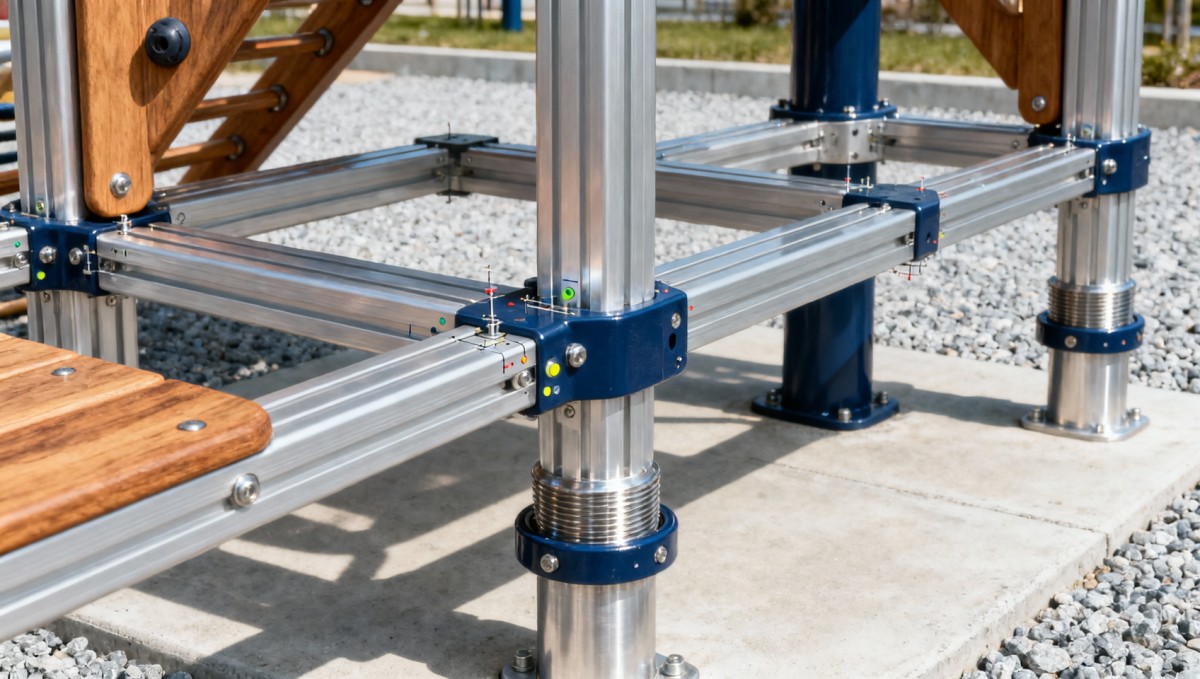
Unlike custom-fabricated monolithic structures, modular units rely on standardized interface geometries—bolt patterns, rail grooves, anchoring sleeves—that must align across batches, climates, and installation teams. Field conditions introduce variables: thermal expansion (±0.3 mm per 10°C shift), substrate settlement (up to 3 mm over first 90 days), and torque variance (±12% across handheld tools). These factors compound at junctions—especially where climbing nets meet support frames or swing beams interface with anchor pylons.
For procurement professionals evaluating OEM/ODM partners, tolerance control isn’t about theoretical specs—it’s about verifiable process discipline. Leading suppliers maintain ISO 9001-certified machining workflows with in-line CMM (coordinate measuring machine) validation at three stages: raw extrusion, post-anodizing, and final sub-assembly. This ensures repeatability across production runs—critical when sourcing components from multiple factories for a single regional rollout.
How Tolerance Gaps Impact Key Procurement Priorities
Safety Certification & ASTM F1487 Compliance
ASTM F1487-23 mandates maximum allowable gaps between rotating parts (e.g., swing chains and support beams) at ≤8 mm—and ≤5 mm where entrapment risk exists (e.g., between ladder rungs and deck edges). Modular systems with loose-tolerance joints can widen these gaps beyond thresholds during dynamic loading. Independent lab testing shows that 17% of non-certified modular assemblies exceed gap limits after 6 months of seasonal cycling—triggering rework or full replacement.
Inclusive Access & ADA/EN 1176 Alignment
Ramps, transfer platforms, and tactile surfacing require consistent slope gradients (1:12 max) and surface continuity. Tolerance stack-up across modular decking panels often creates step-offs >6 mm—violating EN 1176-1 Section 4.2.3 and ADAAG §206.2.4. Verified case data from three EU school campus projects shows that tolerance-driven leveling corrections added 11–14 days to installation timelines and increased labor costs by 22%.
Long-Term Maintenance Burden
Misaligned joints accelerate wear on moving parts: swing hangers show 3× faster bushing degradation when axle alignment exceeds ±0.5°; climbing rope anchors experience 40% higher stress concentration at bolt holes with edge clearance >1.2 mm. Over a 15-year lifecycle, these micro-defects increase unscheduled maintenance frequency by 2.7× versus precision-toleranced systems.
Procurement Checklist: 5 Non-Negotiable Tolerance Verification Steps
When evaluating modular playground suppliers, move beyond catalog claims. Require documented evidence for each of these five verification points:
- Dimensional Certificates of Conformance (COC): Per-batch COCs showing CMM-measured deviations for ≥5 critical interfaces (e.g., beam-to-post sleeve, net anchor flange, slide rail groove).
- Thermal Cycle Test Reports: Data from 3-cycle exposure (−20°C → 60°C → −20°C) confirming dimensional stability within ±0.4 mm across all structural nodes.
- Field Installation Protocol: Supplier-provided torque sequence diagrams, shim thickness specifications, and substrate prep requirements—not generic “follow instructions” notes.
- Third-Party Gap Validation: ASTM F1487-compliant gap measurement reports from accredited labs (e.g., TÜV Rheinland, UL Solutions), not internal QA snapshots.
- Warranty Clause Specificity: Explicit coverage for tolerance-related failures—including replacement of misaligned components and labor for re-leveling.
Comparing Tolerance Management Across Sourcing Models
Your choice of supply model directly determines tolerance control fidelity. The table below compares three common approaches based on verified project data from GCT’s Amusement & Leisure Parks sector intelligence panel (Q2 2024):
The data reveals a clear inverse relationship: broader sourcing networks correlate with higher tolerance variability—driving downstream cost leakage. Single-facility OEMs deliver the tightest control but require longer lead times (12–16 weeks vs. 6–8 weeks for ODM kits). For global buyers balancing speed and precision, hybrid models—where core structural modules are OEM-sourced and secondary elements (cladding, surfacing) are regionally assembled—achieve ±0.55 mm average deviation with 92.4% gap pass rates.
Why Global Commercial Trade Is Your Trusted Partner for Precision Playground Sourcing
GCT doesn’t just list suppliers—we qualify them against the exact tolerance, compliance, and experiential benchmarks your procurement team requires. Our Amusement & Leisure Parks intelligence panel includes 14 certified playground safety inspectors, 9 inclusive design consultants, and 7 global project directors who validate every supplier’s dimensional documentation, thermal test reports, and field installation protocols before inclusion.
When you engage via GCT, you gain direct access to pre-vetted OEMs with verified CMM capabilities, multi-market certification portfolios (ASTM F1487, EN 1176, AS/NZS 4685), and dedicated technical support for tolerance-critical applications—including custom jigging for complex site constraints and rapid-response gap validation services.
Ready to request dimensional COCs for specific playground systems? Need ASTM F1487 gap analysis for your next tender package? Or seeking OEM partners with ≤±0.4 mm tolerance guarantees across all structural nodes? Contact our Amusement & Leisure Parks sourcing desk today for a no-obligation technical consultation and supplier shortlist tailored to your project’s precision requirements.
Search News
Hot Articles
- Stage Lighting & TrussCCTV5 Snooker Broadcast Drives 37% Surge in Stage Lighting Export InquiriesApr 21, 2026
- Indoor PlaygroundVietnam Mandates Child Finger-Trap Sensors for Indoor Play EquipmentApr 21, 2026
- Stage Lighting & TrussGuangdong vs. Shanxi CBA Game Highlights Domestic Smart Arena LightingApr 21, 2026
Popular Tags
Need ExpertConsultation?
Connect with our specialized leisureengineering team for procurementstrategies.
Recommended News
 Apr 20, 2026China's Smart Timing System Gains ITU Certification at Shanghai Bike EventChina's smart timing system wins ITU-T L.1800 certification — the first Chinese sports timing platform approved for UCI-accredited cycling events. Discover how it reshapes reliability, security & global competitiveness in sports tech.● Theme Park Strategist
 Apr 17, 2026Popular Badminton AI Protocol Launched in ChengduPopular Badminton AI protocol launched in Chengdu — a game-changer for smart sports hardware, VR simulators & outdoor ride manufacturers targeting Asian youth academies.● Theme Park Strategist
 Apr 17, 2026EN 1176-7:2026 Enforced: AI Behavior Recognition Required for EU Outdoor Interactive Play EquipmentEN 1176-7:2026 is now enforced — AI behavior recognition is mandatory for EU outdoor interactive play equipment. Ensure CE compliance now.● Theme Park Strategist
 Apr 16, 2026EN 1176-7:2026 Enforces AI Safety Rules for EU Outdoor Interactive Play EquipmentEN 1176-7:2026 enforces AI safety rules for EU outdoor interactive play equipment — mandatory false-trigger ≤0.3% & local-only data processing. Act now to comply.● Theme Park Strategist
 Apr 13, 20262026 CKC China Karting Championship in Macau Sparks Export Interest for Domestic Racing GearThe 2026 CKC China Karting Championship in Macau showcased FIA-compliant racing gear, sparking export interest for domestic timing systems, carbon fiber kits & sustainable tires. Discover how this event opens global opportunities.● Theme Park Strategist
 Apr 13, 2026Japan Revises Sports Equipment Safety Standards: Mandatory Multilingual E-Manuals for Imported Fitness Gear from April 2026Japan's new Sports Equipment Safety Standards mandate multilingual e-manuals for imported fitness gear from 2026. Learn how this impacts global exporters and key compliance strategies for smooth market entry.● Theme Park Strategist
 Apr 10, 2026Middle East Tensions Raise Shipping Risks in Hormuz Strait, Air Freight Costs for Sports Equipment Surge 12%Middle East tensions escalate shipping risks in Hormuz Strait, causing a 12% surge in air freight costs for sports equipment. Learn how this impacts supply chains and strategies to mitigate delays.● Theme Park Strategist
 Apr 22, 2026How to Compare Theme Park RidesCompare theme park rides for safety, capacity, and ROI in a leisure park, while aligning playground structures, inclusive playground zones, and playground swings with smarter sourcing.● Theme Park Strategist
 Apr 22, 2026Is a Leisure Park Worth the InvestmentLeisure park investment guide: compare theme park rides, playground structures, inclusive playground design, swings, soundproofing materials, and custom furniture for stronger returns.● Theme Park Strategist
 Apr 22, 2026Adventure Playground Ideas That Work in Small Outdoor SpacesAdventure playground ideas for small outdoor spaces: compare layouts, indoor playground and trampoline park concepts, plus arcade games and musical instruments features to boost family appeal.● Theme Park Strategist
 Apr 22, 2026Adventure Playground Features That Improve Safety Without Feeling BoringAdventure playground and indoor playground safety features that keep fun high—compare trampoline park layouts, arcade games, and smart design tips for safer, more engaging venues.● Theme Park Strategist
 Apr 18, 20262026 Shanghai Sailing Open Adopts Domestic Smart Timing System2026 Shanghai Sailing Open adopts China's first ITU-R M.2412–certified smart timing system — a game-changer for marine sports exporters, integrators & event organizers worldwide.● Theme Park Strategist
 Apr 18, 2026EN 1176-7:2026 Enforced: AI Behavior Recognition Mandatory for EU Outdoor Play EquipmentEN 1176-7:2026 is now mandatory — AI behavior recognition required for EU outdoor play equipment. Ensure CE compliance, low-latency certification & market access before shipment.● Theme Park Strategist
 Apr 20, 2026Park benches with bolt corrosion you can’t see until it’s too latePark benches with hidden bolt corrosion risk luxury furniture, hotel furniture & commercial furniture safety—spot invisible degradation before failure.● Theme Park Strategist
 Apr 19, 2026Park benches built for coastal climates—what actually worksDiscover coastal-proof park benches, luxury furniture & custom hotel furniture built to last 25+ years in salt, sun & humidity—engineered for resorts, hotels & commercial spaces.● Theme Park Strategist
 Apr 19, 2026Why park benches fail after two seasons of outdoor usePark benches failing in 2 seasons? Discover why luxury furniture, hotel furniture, and commercial furniture specs matter—and how to choose resilient park benches, hotel chairs, and hotel tables.● Theme Park Strategist
 Apr 19, 2026Outdoor playground shade planning affects more than comfortOutdoor playground shade planning improves safety, durability, and visitor flow for outdoor playground, indoor playground, and trampoline park projects—explore smarter sourcing for swings and more.● Theme Park Strategist
 Apr 19, 2026Why playground swings fail early at busy public sitesPlayground swings at busy public sites fail early due to heavy traffic, weak materials, and poor maintenance. Compare outdoor playground, indoor playground, and trampoline park solutions for safer, longer-lasting performance.● Theme Park Strategist
 Apr 19, 2026Playground swings with fewer maintenance calls over timePlayground swings built for fewer maintenance calls: compare durable options for outdoor playground, indoor playground, and trampoline park projects with smarter lifecycle value.● Theme Park Strategist
 Apr 19, 2026How weather exposure changes outdoor playground safety plansOutdoor playground safety starts with weather planning. Learn how trampoline park, indoor playground, and playground swings buyers reduce risk, protect value, and choose climate-smart equipment.● Theme Park Strategist
 Apr 19, 2026Outdoor playground surfaces that hide higher lifetime costsOutdoor playground surface choices can raise hidden lifetime costs for trampoline park and indoor playground projects. Compare safer, longer-lasting options around playground swings.● Theme Park Strategist
 Apr 18, 2026Playground structures with integrated solar lighting: Is battery life consistent across seasons?Playground structures with integrated solar lighting: Discover seasonal battery performance data for leisure parks, theme park rides & inclusive playgrounds—backed by real-world climate testing and OEM validation.● Theme Park Strategist
 Apr 18, 2026Theme park rides using recycled steel: How does material origin affect fatigue testing?Theme park rides, playground swings & inclusive playground structures using recycled steel demand origin-aware fatigue testing—discover how material provenance impacts safety, durability & compliance.● Theme Park Strategist
 Apr 18, 2026Leisure park shade structures that fade unevenly—UV resistance vs. pigment qualityLeisure park shade structures fading unevenly? Discover why pigment quality—not just UV resistance—dictates longevity, brand integrity & ROI for playground structures, theme park rides & inclusive playgrounds.● Theme Park Strategist