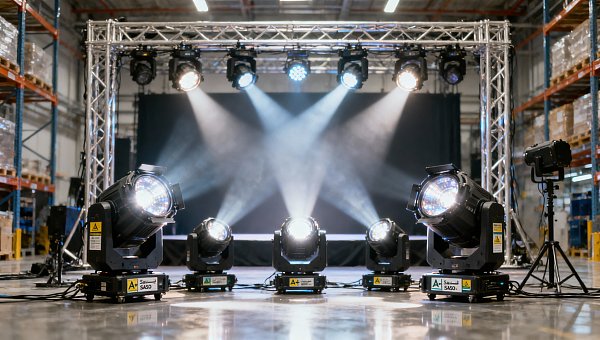
Laser Incident at Cyndi Wang Concert Triggers Global IEC 62471 Reassessment
On May 7, 2026, a laser-related incident during a large-scale concert in Taiwan caused temporary visual discomfort among multiple audience members. The event has prompted urgent attention from international standardization bodies and directly impacts manufacturers and exporters of stage lighting equipment—particularly those supplying the EU and UK markets—where compliance with the updated IEC 62471:2023 standard is now critical for CE certification and Q3 shipment readiness.
Event Overview
A laser equipment malfunction occurred during a concert featuring artist Cyndi Wang on May 7, 2026, in Taiwan. Reports confirmed temporary visual discomfort among several attendees. On May 8, 2026, the International Electrotechnical Commission (IEC) initiated a global applicability review of IEC 62471:2023. Subsequently, TÜV Germany and BSI UK notified Chinese stage lighting exporters that, effective June 2026, all stage laser fixtures and moving beam lights must be accompanied by full test reports certifying compliance with IEC 62471 Class 1 or 1M requirements; otherwise, CE certificates will not be issued.
Industries Affected
Direct Exporters (EU/UK-Focused)
Exporters shipping stage lasers or moving beam lights to the EU or UK are immediately affected because CE marking—required for market access—will now be withheld without valid IEC 62471:2023 Class 1/1M test reports. This directly delays shipments scheduled for the Q3 peak season.
Lighting Manufacturers (OEM/ODM)
Manufacturers producing laser-based or high-intensity beam lighting products face revised testing obligations. Even if previously certified under older editions of IEC 62471, retesting against the 2023 edition is now mandatory for new production lots destined for Europe.
Testing & Certification Service Providers
Laboratories and certification bodies accredited for photobiological safety testing are experiencing increased demand for IEC 62471:2023 Class 1/1M assessments. Lead times for testing may extend due to capacity constraints, especially for complex beam-forming devices.
Supply Chain & Logistics Operators
Freight forwarders and customs agents handling stage lighting consignments bound for EU/UK ports must now verify documentation completeness—including up-to-date photobiological safety reports—prior to release. Incomplete dossiers risk customs holds or rejection at point of entry.
Key Actions for Enterprises and Practitioners
Monitor official updates from TÜV, BSI, and IEC
While the May 8 notification is confirmed, formal implementation timelines, transitional arrangements, and scope clarifications (e.g., whether retrofitting existing stock is required) remain pending. Enterprises should subscribe to technical bulletins from notified bodies and track IEC’s ongoing review status.
Prioritize testing for high-risk product categories
Products emitting collimated visible laser radiation (e.g., stage laser projectors, high-power beam movers) are most likely subject to strict Class 1/1M verification. Exporters should identify these items first and initiate testing before June 2026.
Distinguish between policy signal and operational enforcement
The current requirement reflects a policy signal backed by notified body action—not yet an EU-wide legislative amendment. However, since CE certification is gatekept by notified bodies, their interpretation effectively governs market access. Compliance must therefore align with their current position, not wait for regulatory codification.
Prepare documentation and coordinate with labs early
Given anticipated testing backlogs, enterprises should compile product specifications, optical schematics, and intended use conditions now—and engage accredited labs immediately to secure test slots ahead of the June deadline.
Editorial Perspective / Industry Observation
Observably, this incident functions less as an isolated safety failure and more as a catalyst accelerating enforcement of long-standing photobiological safety expectations. Analysis shows that IEC 62471:2023 introduces refined exposure limit calculations and stricter classification thresholds for pulsed and scanned laser sources—changes previously under-adopted in stage lighting manufacturing. The current situation is best understood not as a sudden regulatory shift, but as a convergence of incident-driven scrutiny and pre-existing technical updates gaining operational weight. From an industry perspective, sustained attention is warranted—not only for immediate CE implications, but also for emerging alignment trends in other regulated markets (e.g., Australia’s RCM, Japan’s PSE), where similar photobiological safety reviews may follow.
In summary, the Cyndi Wang concert laser incident has crystallized a latent compliance requirement into an actionable, time-bound obligation for stage lighting exporters and manufacturers targeting Europe. It signals tightening enforcement of photobiological safety standards—not a new rule, but a newly prioritized one. Currently, it is more accurate to interpret this development as an enforcement inflection point rather than a foundational regulatory change.
Source: Official notifications from TÜV Germany and BSI UK (dated May 2026); IEC public statement on IEC 62471:2023 review initiation (May 8, 2026). Note: Ongoing IEC review outcomes and potential revisions to national transposition timelines remain under observation.
Search News
Hot Articles
- Stationery & UniformsHow Schools Can Cut Printing Costs When Buying Ink Cartridges in BulkSep 21, 2026
- Jewelry Packaging & DisplayHow to Evaluate a Luxury Retail Packaging Supplier for Premium Brand ConsistencySep 20, 2026
- Commercial KitchenHow to Select a Spiral Dough Mixer for Bakery Batch Size and Dough HydrationSep 19, 2026
Popular Tags
Need ExpertConsultation?
Connect with our specialized leisureengineering team for procurementstrategies.
Recommended News
 Jul 13, 2026Stage Riser Platforms Explained: Types, Load Ratings, and Best-Fit Event UsesStage riser platforms explained clearly: compare types, load ratings, safety factors, and best-fit event uses to choose smarter, safer solutions for conferences, schools, hotels, and live shows.● Pro Audio Engineer
 Jul 09, 2026SASO Fast Track Cuts Stage Lighting Export Lead TimeSASO Fast Track cuts stage lighting export lead time from 45 days to 12 working days. Learn how Saudi certification changes affect truss suppliers, OEMs, buyers, and shipment planning.● Pro Audio Engineer
 Jul 08, 2026SASO Updates Stage Lighting Label Rules for LED Moving HeadsSASO updates stage lighting label rules for LED moving heads, requiring three-level energy efficiency values and bilingual labels. See what exporters and buyers must do before October 2026.● Pro Audio Engineer
 Jul 07, 2026SASO Adds Energy Label Rules for Stage Lighting ImportsSASO Adds Energy Label Rules for Stage Lighting Imports: learn which stage lighting products now need Arabic energy labels and SASO-recognized test reports before Sept. 1, 2026.● Pro Audio Engineer
 Jul 06, 2026Saudi SASO Sets A+ Rule for Stage LED LightingSaudi SASO sets A+ rule for stage LED lighting from Oct 1, 2026. Learn how the new SASO label and IEC 62722-2-1:2026 standard impact compliance, shipping, and market access.● Pro Audio Engineer
 Jul 04, 2026SASO Tightens RF Test Rules for Wireless Stage ControlsSASO tightens RF test rules for wireless stage controls in Saudi Arabia. Learn how the new IEC 62368-3 requirement impacts stage lighting exports, compliance, and delivery.● Pro Audio Engineer
 Jul 03, 2026Saudi SASO Adds RF Approval Rule for Stage LightingSaudi SASO adds RF approval rule for stage lighting. Learn how the new SASO RoHS+RF certification affects wireless lighting, truss control exports, retail access, and project delivery in Saudi Arabia.● Pro Audio Engineer
 Jul 02, 2026SASO Starts EMC Pilot for Smart Stage Lighting in SaudiSASO starts an EMC pilot for smart stage lighting in Saudi Arabia, impacting dimming controllers, cloud access, and project compliance. See what suppliers and integrators must do now.● Pro Audio Engineer
 Jul 01, 2026Saudi SASO Tightens UV-C Limits for Stage LightingSaudi SASO tightens UV-C limits for stage lighting and truss products. Learn the 2026 SASO IEC 62471 update, retesting deadline, customs risks, and how to protect Saudi shipments.● Pro Audio Engineer
 Jun 30, 2026EN 62471:2026 Adds UV-C Limit for Stage LightingEN 62471:2026 adds a UV-C limit for stage lighting, impacting LED moving heads, laser fixtures, and truss lighting. Learn what changes before Dec 1, 2026.● Pro Audio Engineer
 Jun 29, 2026TUV Adds Wi-Fi 7 EMC Test for Stage LightingTUV Adds Wi-Fi 7 EMC Test for Stage Lighting sold into the EU. Learn the Oct 1, 2026 deadline, retesting rules, and how EN 55032:2024 impacts certificates, shipments, and compliance planning.● Pro Audio Engineer
 Jun 25, 2026LED PAR Cans Wholesale: What to Compare in Wattage, Beam Angle, and DMX ControlLED par cans wholesale buyers should compare wattage, beam angle, and DMX control before requesting quotes. Learn how to avoid costly mismatches and choose fixtures that fit each venue.● Pro Audio Engineer
 Jun 16, 2026Stage Lighting Equipment List for Small Venues: What You Need and How to Plan ItStage lighting equipment for small venues: discover a practical equipment list, planning tips, and smart setup ideas to improve performance, flexibility, and long-term value.● Pro Audio Engineer
 Jun 12, 2026Vietnam Tightens EMC Rules for Stage Lighting LEDsVietnam Tightens EMC Rules for Stage Lighting LEDs: learn how QCVN 139:2026 impacts imports, testing, sourcing, and delivery planning for stage lighting businesses.● Pro Audio Engineer
 Jun 11, 2026LPGA Shanghai Debut Lifts Stage Lighting OrdersStage lighting and truss demand is rising as LPGA Shanghai debuts in 2026. Learn how tighter delivery windows, compliance, and project execution are reshaping global orders.● Pro Audio Engineer
 Jun 04, 2026UK EPR Rules Expand to Stage Lighting and TrussUK EPR rules for stage lighting and truss expand in Q3 2026. Learn how UKCA-linked registration, reporting, recycling fees, and material documentation will affect compliance and market access.● Pro Audio Engineer
 Jun 03, 2026UK EPR Fee Hits Stage Truss Textiles in Q3 2026UK EPR Fee for stage truss textiles starts in Q3 2026. Learn what new recycling charges and UKCA-Flame rules mean for lighting and truss suppliers.● Pro Audio Engineer
 Jun 02, 2026UK EPR Fee Hits Stage Lighting & TrussUK EPR Fee Hits Stage Lighting & Truss products with textile components in 2026. Learn compliance risks, BOM updates, and cost impacts for UK exporters.● Pro Audio Engineer
 May 25, 2026China's Carbon Fiber Truss Strength Up 32% at 2026 Sports ExpoCarbon fiber truss strength up 32% at 2026 Sports Expo—UL 1598 certified, CE+UL ready. Discover how China’s stage infrastructure is winning European music festivals & global tenders.● Pro Audio Engineer
 May 23, 2026Vietnam Mandates Bilingual MSDS for Stage Lighting & Truss ImportsVietnam mandates bilingual MSDS (Vietnamese & Chinese) for stage lighting and truss imports — ensure compliance by July 1, 2026 to avoid shipment rejection.● Pro Audio Engineer
 May 20, 20263 Chinese Stage Lighting Firms Join LA28 Olympic Supplier List3 Chinese stage lighting firms join LA28 Olympic supplier list — showcasing ISO 20121 & UL 1574 compliance, sustainability leadership, and global credibility in live-event infrastructure.● Pro Audio Engineer
 May 20, 2026What matters most when choosing lighting stands crank up?Lighting stands crank up: learn what really matters beyond height—load capacity, crank safety, stability, compatibility, and serviceability—to choose the right stand with confidence.● Pro Audio Engineer
 May 19, 20263 Chinese Stage Lighting Firms Join IOC’s 2028 LA Olympics Supplier ListChinese stage lighting firms join IOC's 2028 LA Olympics supplier list — a major validation for OEM/ODM exporters and tech integrators in global sports & entertainment lighting.● Pro Audio Engineer
 May 19, 2026When are chain hoists for stage the better rigging choiceChain hoists for stage are the better rigging choice when you need precise lifting, compact headroom use, and reliable repeat performance. See key use cases and buyer tips.● Pro Audio Engineer