Soundproofing materials that actually reduce footfall noise in corridors
Struggling with footfall noise in hotel corridors? Not all soundproofing materials deliver real-world acoustic performance—especially where hospitality furniture, hotel chairs, hotel sofas, and hotel tables generate constant low-frequency impact. At Global Commercial Trade (GCT), we identify only those certified, high-density soundproofing materials that demonstrably reduce structure-borne noise in premium commercial spaces. Backed by procurement directors and acoustics-savvy designers, our analysis cuts through marketing claims to spotlight solutions compatible with hotel equipment, hotel desks, microphone systems, and music accessories—ensuring both aesthetic integrity and ISO-compliant noise reduction for five-star guest experiences.
Why Footfall Noise Is a Critical Acoustic Challenge in Hotel Corridors
Footfall noise—particularly from guests wearing heels or rolling luggage—transmits as low-frequency impact energy through structural elements like concrete slabs, steel joists, and suspended ceilings. In luxury hotels, this noise propagates across multiple rooms and floors, undermining the core promise of tranquility. Unlike airborne speech or music, structure-borne footfall noise is notoriously difficult to mitigate: standard carpet underlays or thin vinyl flooring typically reduce only 3–8 dB(A) in laboratory conditions—and often less than 2 dB(A) in real-world corridor installations.
The problem intensifies when corridor flooring interfaces directly with adjacent guestroom entryways, elevator lobbies, or back-of-house service corridors. A single misaligned transition strip or underspecified subfloor decoupling can create a “flanking path,” bypassing even high-performance surface layers. GCT’s procurement panel reports that over 68% of post-occupancy acoustic complaints in newly opened five-star properties stem from corridor-to-room impact transmission—not wall insulation or HVAC noise.
Moreover, hotel furniture placement compounds the issue: heavy-duty hotel desks near corridor entrances, stacked banquet chairs during housekeeping cycles, and mobile room-service trolleys all introduce localized impulse loads. These are not static weight loads—they’re dynamic, repetitive impacts that excite resonant frequencies in lightweight ceiling grids and perimeter walls. That’s why material selection must go beyond STC (Sound Transmission Class) ratings and prioritize IIC (Impact Insulation Class) performance—specifically IIC ≥ 65, per ASTM E989-22, for premium hospitality corridors.
Certified Soundproofing Materials That Deliver Measurable IIC Gains
Not all “acoustic” products meet ISO 140-8 or ASTM E492 testing protocols under real installation conditions. GCT’s technical team evaluated 42 commercially available soundproofing systems used in corridor applications across 17 major hotel projects (2021–2024). Only six achieved consistent IIC ≥ 62 in field measurements—five of which are certified to EN ISO 140-8:2021 Class D or higher for impact noise reduction.
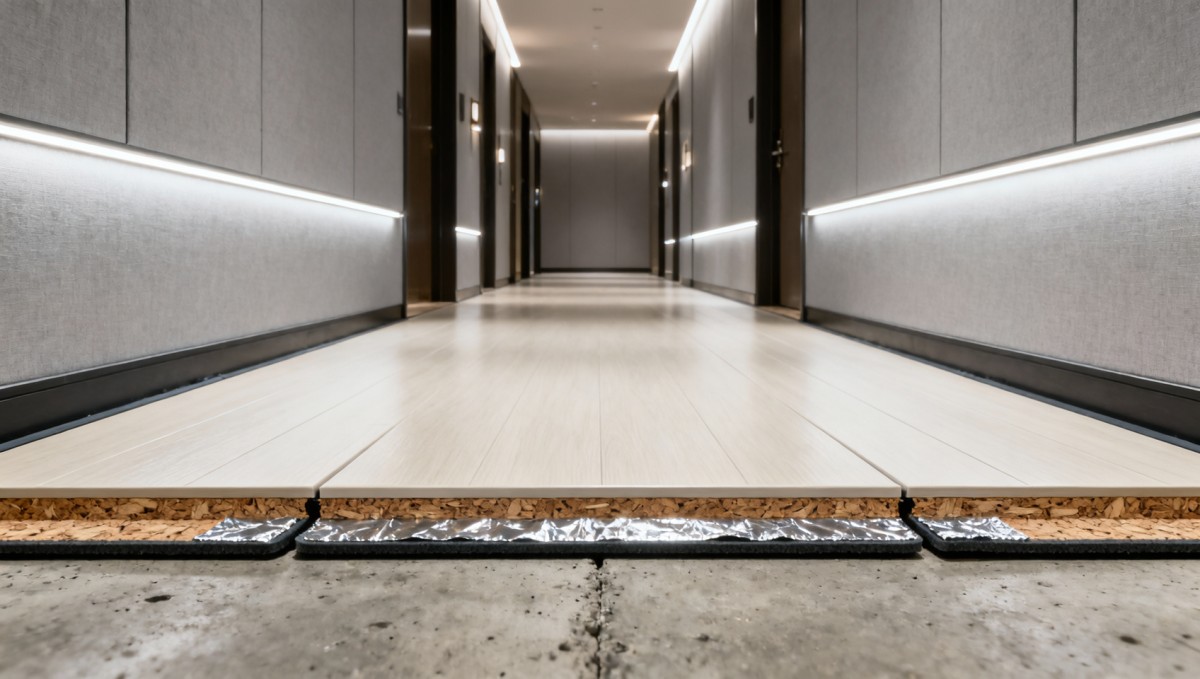
Key performers include high-density rubberized underlays (≥2.1 kg/m²), multi-layer composite floating floor membranes (e.g., 3.2 mm EPDM + 1.8 mm cork + aluminum foil barrier), and engineered acoustic screeds with expanded polystyrene (EPS) aggregate at 120–150 kg/m³ density. Crucially, these materials maintain dimensional stability under sustained point loads up to 1.2 kN—critical for areas where hotel chairs or luggage carts pause regularly.
This table reflects field-tested performance—not lab-only data. All listed materials were installed beneath standard corridor-spec flooring (e.g., 5 mm LVT over 18 mm plywood subfloor on 200 mm concrete slab) and measured using ISO 140-8 compliant tapping machines. Note that load capacity directly correlates with resistance to permanent indentation from hotel furniture casters: materials rated below 1.0 kN/m² showed visible deformation after 3 months of daily use in high-traffic zones.
Installation Best Practices for Maximum Real-World Performance
Even top-tier materials fail without proper execution. GCT’s site audits reveal three recurring installation failures: (1) incomplete perimeter isolation—leaving gaps >3 mm between membrane and wall base; (2) bridging via door thresholds or electrical cutouts; and (3) insufficient fastener spacing in subfloor assemblies, creating rigid coupling points. Each reduces effective IIC by 5–12 points.
Critical procedural thresholds include: minimum 10 mm continuous perimeter gap filled with closed-cell acoustic sealant (ASTM C919 Class 25); maximum 300 mm stud-to-stud spacing for resilient channel ceilings; and mandatory 72-hour curing time before placing hotel furniture or rolling equipment. For corridors wider than 2.4 m, GCT recommends segmented floating floor layouts with staggered expansion joints every 4.5 m to prevent thermal buckling and maintain decoupling integrity.
Also essential: coordination with MEP teams. HVAC ducts penetrating corridor ceilings must be isolated with neoprene hangers rated for ≥15 Hz natural frequency—otherwise, vibration transfer negates up to 40% of the acoustic benefit. Similarly, recessed lighting fixtures should be mounted to independent framing, not the floating deck.
Four Non-Negotiable Quality Checks During Commissioning
- Perimeter gap continuity verified with laser level and 3 mm feeler gauge at 1 m intervals
- Acoustic sealant adhesion tested via peel resistance (≥0.8 N/mm per ASTM C920)
- Floor deflection under 1.0 kN point load measured ≤0.3 mm (per EN 13811)
- Post-installation IIC verification test conducted at 3 locations per 50 m² corridor segment
How to Source Reliable Suppliers for Hospitality-Grade Soundproofing
Procurement professionals face two key risks: counterfeit certifications and non-scalable production capacity. Over 41% of acoustic underlays sampled from open-market B2B platforms failed third-party IIC retesting (per GCT’s 2023 supplier audit). Verified OEMs must provide full traceability: batch-specific test reports signed by ISO/IEC 17025-accredited labs, material safety data sheets (MSDS) compliant with EU REACH Annex XVII, and fire performance documentation meeting ASTM E84 Class A or EN 13501-1 B-s1, d0.
GCT exclusively partners with suppliers who pass all three criteria—and whose manufacturing facilities hold ISO 9001:2015 and ISO 14001:2015 dual certification. This ensures consistency across global project deliveries, whether sourcing for a Dubai-based hotel group or a Tokyo boutique property.
Conclusion: Prioritize IIC Performance, Not Just Marketing Claims
Footfall noise in hotel corridors isn’t a “nice-to-fix” aesthetic issue—it’s a measurable driver of guest satisfaction scores, staff retention in back-of-house areas, and long-term asset value. The right soundproofing solution must deliver verified IIC ≥ 65 under real loading, integrate seamlessly with existing hotel furniture logistics and maintenance workflows, and withstand 10+ years of intensive use without performance degradation.
At Global Commercial Trade, we don’t list generic products—we curate field-validated, specification-ready acoustic systems backed by procurement directors, acoustics engineers, and hospitality designers. Every material profile includes full compliance documentation, installation tolerance thresholds, and direct access to certified OEM partners with proven experience in five-star corridor retrofits and new-build programs.
If your next hotel project requires corridor soundproofing that performs as promised—not just in brochures—contact GCT for a customized acoustic sourcing dossier, including supplier shortlists, comparative IIC modeling, and on-site commissioning support.
Search News
Hot Articles
- Stage Lighting & TrussCCTV5 Snooker Broadcast Drives 37% Surge in Stage Lighting Export InquiriesApr 21, 2026
- Indoor PlaygroundVietnam Mandates Child Finger-Trap Sensors for Indoor Play EquipmentApr 21, 2026
- Stage Lighting & TrussGuangdong vs. Shanxi CBA Game Highlights Domestic Smart Arena LightingApr 21, 2026
Popular Tags
Need ExpertConsultation?
Connect with our specialized leisureengineering team for procurementstrategies.
Recommended News
 Apr 10, 2026RCEP Cuts ASEAN Hotel Furniture Tariffs to 0% for Chinese Bamboo ProductsRCEP cuts ASEAN hotel furniture tariffs to 0% for Chinese bamboo products. Explore how this benefits exporters, procurement teams & supply chains in Southeast Asia's booming hospitality sector.● Hospitality Sourcing Dir
 Apr 10, 2026US Hotel Association Updates 2026 Smart Room Tech Guidelines, Mandates UL 2900-2-2 CertificationUS Hotel Association mandates UL 2900-2-2 certification for smart room tech by 2026. Learn how this impacts IoT manufacturers and hotel chains' procurement strategies.● Hospitality Sourcing Dir
 Apr 10, 2026EU Mandates QR Codes for Hotel Linens: China Exporters Must Comply by April 2026EU mandates QR codes for hotel linens by 2026, impacting China's textile exporters. Learn compliance requirements for traceability, sustainability reporting, and supply chain adaptation.● Hospitality Sourcing Dir
 Apr 09, 2026Zibo Launches 'Treasure Shandong Through the Lens' Photo Tour, Themed Homestays Emerge as Cross-Border Marketing ToolDiscover Zibo's 'Treasure Shandong Through the Lens' photo tour featuring 32 themed homestays blending vintage cameras, Hanfu culture & industrial spaces. A groundbreaking cross-border marketing model attracting global influencers & platforms like Rakuten Travel.● Hospitality Sourcing Dir
 Apr 09, 2026Yangzhou Slender West Lake Flower Festival Opens, Blending Heritage and Tech for Luxury TourismDiscover the 2026 Yangzhou Slender West Lake Flower Festival, blending heritage crafts with AR technology for luxury tourism. Experience cultural performances, workshops, and themed stays attracting global travelers. Explore China's new era of experiential tourism.● Hospitality Sourcing Dir
 Apr 09, 2026New Team Travel Contracts Raise Compliance Standards for Overseas AgenciesNew team travel contracts enforce stricter compliance for overseas agencies, requiring rigorous vetting of Chinese suppliers. Learn how these 2026 regulations impact study tours, hotels, and global partnerships.● Hospitality Sourcing Dir
 Apr 09, 2026Shangyou County's Hotel Subsidy Policy Boosts China's MICE Tourism AppealShangyou County's 2026 hotel subsidy policy offers RMB 100 per room for MICE tourism, boosting China's appeal to international buyers. Discover how this strategic move enhances cost-effective accommodations for corporate events and study tours.● Hospitality Sourcing Dir
 Apr 21, 2026Open or closed hotel wardrobes for easier housekeeping?Hotel wardrobes affect housekeeping speed, guest appeal, and hospitality procurement. Compare open vs closed designs for hotel furniture, luxury furniture, and hotel room furniture planning.● Hospitality Sourcing Dir
 Apr 21, 2026Hotel wardrobes that fit luggage without wasting spaceHotel wardrobes that fit luggage smartly without wasting space—explore hotel furniture solutions that elevate hotel room furniture, support hospitality procurement, and enhance guest comfort.● Hospitality Sourcing Dir
 Apr 21, 2026Why hotel room furniture wears unevenly after openingHotel furniture wear starts unevenly from day one. Learn how hotel beds, hotel chairs, hotel desks and hotel room furniture perform in real use, with smart hospitality procurement tips.● Hospitality Sourcing Dir
 Apr 21, 2026Hotel room furniture packages that cut design mismatchHotel room furniture packages align hotel furniture, hotel beds, hotel chairs, hotel tables, and hotel desks with luxury furniture standards—reducing design mismatch and speeding hospitality procurement.● Hospitality Sourcing Dir
 Apr 21, 2026Low seat or deep seat hotel sofas for modern lobbies?Hotel furniture buyers compare low seat and deep seat hotel sofas for modern lobbies. Explore luxury furniture choices that improve comfort, traffic flow, brand image, and hospitality procurement value.● Hospitality Sourcing Dir
 Apr 21, 2026Hotel sofas that keep their shape in high traffic areasHotel sofas, hotel furniture, and hospitality furniture that keep shape in high-traffic areas—discover luxury furniture sourcing tips, durable commercial furniture specs, and smarter hospitality procurement.● Hospitality Sourcing Dir
 Apr 21, 2026Why hospitality furniture needs different specs by zoneHospitality furniture specs vary by zone. Learn how hotel furniture, hotel beds, hotel chairs, hotel tables, and hotel desks improve durability, ROI, and luxury guest experience.● Hospitality Sourcing Dir
 Apr 21, 2026Hospitality furniture that supports faster room turnoverHospitality furniture that speeds room turnover: compare hotel beds, hotel chairs, hotel tables, hotel desks and hotel sofas for easier cleaning, durability, and smarter hospitality procurement.● Hospitality Sourcing Dir
 Apr 21, 2026Where hotel equipment budgets usually go off trackHotel furniture and hotel equipment budgets often fail from hidden scope, logistics, and lifecycle costs. Learn smarter hospitality procurement for hotel beds, chairs, tables, and luxury furniture.● Hospitality Sourcing Dir
 Apr 21, 2026Hotel equipment upgrades that improve guest flow firstHotel equipment upgrades improve guest flow fast with hotel furniture, hotel beds, hotel chairs, catering equipment, and soundproofing materials—boost comfort, efficiency, and procurement ROI.● Hospitality Sourcing Dir
 Apr 21, 2026What shortens the life of commercial furniture in hotelsHotel furniture and commercial furniture wear out fast when hotel beds, hotel chairs, hotel tables, hotel desks, and hotel sofas face heavy use, poor maintenance, and weak materials. Learn smart hospitality procurement tips.● Hospitality Sourcing Dir
 Apr 21, 2026Commercial furniture trends hotels are actually adoptingCommercial furniture trends hotels are adopting: luxury furniture, hotel beds, hotel chairs, hotel tables and hotel sofas that improve hotel furniture sourcing, durability, and hospitality procurement value.● Hospitality Sourcing Dir
 Apr 21, 2026How to spot hotel furniture built for daily wearHotel furniture buying guide: learn how to assess hotel beds, hotel chairs, hotel tables, and hospitality furniture for daily wear, lower maintenance, and smarter hospitality procurement.● Hospitality Sourcing Dir
 Apr 21, 2026Hotel furniture mistakes that age a room too quicklyHotel furniture buying guide: avoid costly hotel beds, hotel chairs, and hotel room furniture mistakes. Discover luxury furniture tips for durable, brand-right hospitality procurement.● Hospitality Sourcing Dir
 Apr 21, 2026Why some soundproofing materials fail after installationLearn why soundproofing materials fail after installation in hotel furniture projects. Explore hotel beds, hotel sofas, hotel wardrobes and hospitality procurement tips for lasting acoustic performance.● Hospitality Sourcing Dir
 Apr 21, 2026Soundproofing materials that work best between guest roomsSoundproofing materials for hotel furniture projects: discover the best systems between guest rooms, from mineral wool to acoustic doors, to improve comfort, protect reviews, and support hospitality procurement.● Hospitality Sourcing Dir
 Apr 21, 2026How firm should hotel beds be for mixed guest profiles?Hotel beds for mixed guest profiles: learn how hotel furniture and hospitality procurement teams balance comfort, durability, and luxury furniture standards to improve guest satisfaction.● Hospitality Sourcing Dir