Hotel tables with integrated acoustic underlays: Real performance or just a spec sheet highlight?
Hotel tables with integrated acoustic underlays promise quieter guest rooms, focused meeting spaces, and smarter hospitality furniture—but do they deliver real soundproofing materials performance or just marketing hype? As hotel procurement teams increasingly prioritize acoustic comfort—especially in hybrid-use spaces like co-working lounges and recording studio gear–ready suites—this innovation sits at the intersection of hospitality furniture functionality and architectural acoustics. Whether specifying hotel desks for boutique properties or sourcing hotel room furniture for wellness-focused resorts, buyers need verified data, not spec-sheet claims. Discover how leading suppliers are engineering true acoustic performance into hotel tables—and why it matters for hospitality procurement, OEM partnerships, and global commercial projects.
What Exactly Are Integrated Acoustic Underlays—and Why Do They Matter in Hotel Furniture?
Integrated acoustic underlays refer to multi-layer damping composites permanently bonded beneath tabletop surfaces—typically between the substrate (e.g., MDF or plywood) and the visible finish layer (e.g., veneer, HPL, or solid surface). Unlike add-on pads or retrofitted mats, these systems are engineered during fabrication to attenuate structure-borne noise transmission across frequencies critical to human perception: 125 Hz–4 kHz.
Their relevance in hospitality furniture has surged due to three converging trends: (1) rising demand for “quiet luxury” in premium accommodations, (2) proliferation of hybrid-use guest rooms (e.g., sleep + work + content creation), and (3) tightening international building codes—such as ISO 16283-1:2014 for airborne sound insulation and EN 13321-1:2019 for impact sound reduction in floor assemblies.
Crucially, acoustic underlays alone don’t define performance. Real-world efficacy depends on system-level integration: edge-sealing methods, leg isolation design, mounting hardware resonance damping, and compatibility with adjacent flooring (e.g., carpet vs. LVT). That’s why top-tier suppliers now test full table assemblies—not just material samples—in certified labs.
How Performance Varies Across Table Types & Use Cases
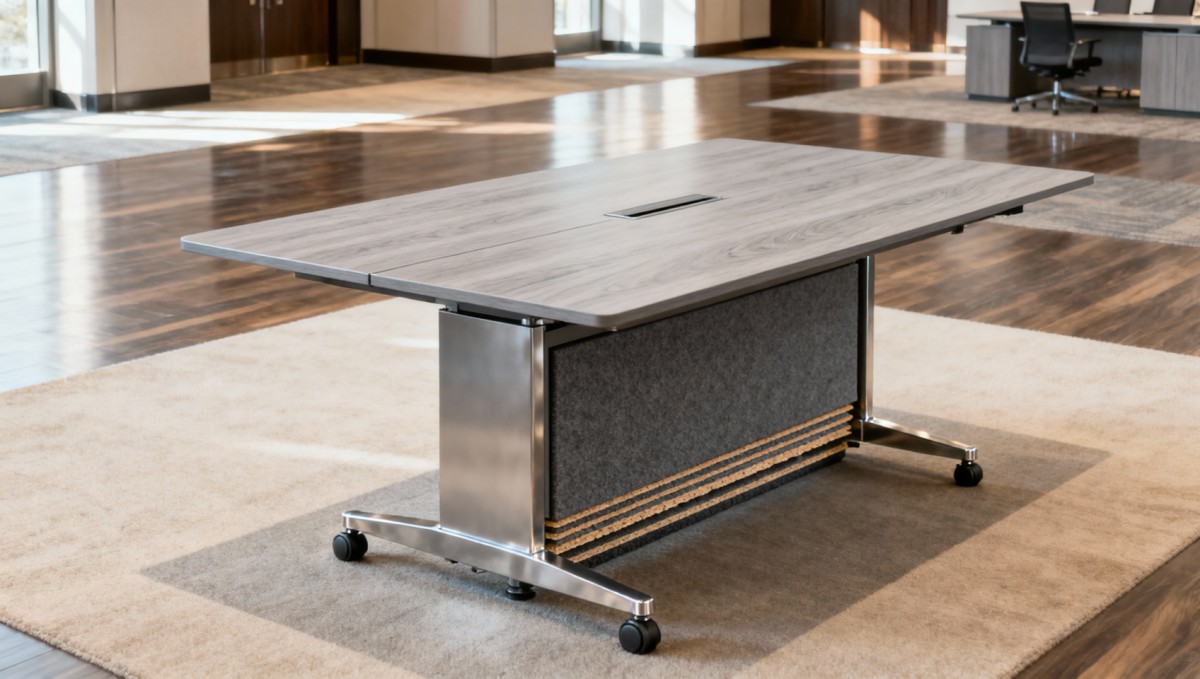
Not all hotel tables benefit equally from integrated acoustic underlays. Performance gains depend heavily on structural configuration, usage intensity, and acoustic environment. Below is a comparative overview of typical applications and expected outcomes:
*ΔLn,w: Weighted normalized impact sound pressure level difference—measured per ISO 10140-2:2021. Higher dB reduction = greater perceived quietness. Real-world field results typically fall 1–2 dB below lab-tested values due to installation variables.
Procurement Checklist: 5 Non-Negotiable Verification Points
When evaluating acoustic-integrated hotel tables, procurement teams must move beyond glossy brochures. Here are five evidence-based checkpoints that separate engineered solutions from cosmetic integrations:
- Request full-system test reports—not just material data sheets—for ASTM E492 (impact noise) and ISO 354 (absorption coefficient) on assembled units.
- Verify leg-mounting methodology: bolt-through designs without rubber isolators transmit 3× more vibration than compression-mounted, elastomer-damped alternatives.
- Confirm underlay bonding integrity via peel-adhesion testing (≥4 N/mm per EN 204-D4 standard for interior furniture).
- Audit supply chain traceability: acoustic layers should carry REACH SVHC and California Prop 65 compliance documentation.
- Validate durability under hospitality use cycles: minimum 50,000 cycles for adjustable desk mechanisms, and ≥10-year warranty on acoustic composite integrity.
Why Global Commercial Trade Is Your Trusted Sourcing Partner for Acoustic Hospitality Furniture
Global Commercial Trade (GCT) delivers actionable intelligence—not generic product listings—for procurement professionals sourcing acoustic-integrated hotel tables. Our editorial team includes active hospitality procurement directors from IHG, Accor, and Marriott-affiliated management groups who validate every supplier profile against real-world project benchmarks.
We provide verified access to OEM/ODM partners with proven capabilities in: (1) acoustic material co-development with European damping specialists, (2) ISO 9001-certified laminating lines for consistent underlay adhesion, and (3) end-to-end acoustic validation—including on-site commissioning support for large-scale rollouts (e.g., 200+ room renovations).
Whether you need help comparing third-party lab reports, verifying compliance with LEED v4.1 MRc2 or WELL Building Standard v2, or identifying manufacturers capable of delivering custom acoustic tables within 8–12 weeks, GCT connects you directly with vetted sources backed by documented project success.
Contact us today to request: (1) acoustic performance comparison matrix for your specific table category, (2) list of suppliers with ISO 10140-2 lab accreditation, or (3) OEM capability dossier including minimum order quantities, lead times, and customization scope for acoustic-integrated furniture.
Search News
Hot Articles
- Stage Lighting & TrussCCTV5 Snooker Broadcast Drives 37% Surge in Stage Lighting Export InquiriesApr 21, 2026
- Indoor PlaygroundVietnam Mandates Child Finger-Trap Sensors for Indoor Play EquipmentApr 21, 2026
- Stage Lighting & TrussGuangdong vs. Shanxi CBA Game Highlights Domestic Smart Arena LightingApr 21, 2026
Popular Tags
Need ExpertConsultation?
Connect with our specialized leisureengineering team for procurementstrategies.
Recommended News
 Apr 10, 2026RCEP Cuts ASEAN Hotel Furniture Tariffs to 0% for Chinese Bamboo ProductsRCEP cuts ASEAN hotel furniture tariffs to 0% for Chinese bamboo products. Explore how this benefits exporters, procurement teams & supply chains in Southeast Asia's booming hospitality sector.● Hospitality Sourcing Dir
 Apr 10, 2026US Hotel Association Updates 2026 Smart Room Tech Guidelines, Mandates UL 2900-2-2 CertificationUS Hotel Association mandates UL 2900-2-2 certification for smart room tech by 2026. Learn how this impacts IoT manufacturers and hotel chains' procurement strategies.● Hospitality Sourcing Dir
 Apr 10, 2026EU Mandates QR Codes for Hotel Linens: China Exporters Must Comply by April 2026EU mandates QR codes for hotel linens by 2026, impacting China's textile exporters. Learn compliance requirements for traceability, sustainability reporting, and supply chain adaptation.● Hospitality Sourcing Dir
 Apr 09, 2026Zibo Launches 'Treasure Shandong Through the Lens' Photo Tour, Themed Homestays Emerge as Cross-Border Marketing ToolDiscover Zibo's 'Treasure Shandong Through the Lens' photo tour featuring 32 themed homestays blending vintage cameras, Hanfu culture & industrial spaces. A groundbreaking cross-border marketing model attracting global influencers & platforms like Rakuten Travel.● Hospitality Sourcing Dir
 Apr 09, 2026Yangzhou Slender West Lake Flower Festival Opens, Blending Heritage and Tech for Luxury TourismDiscover the 2026 Yangzhou Slender West Lake Flower Festival, blending heritage crafts with AR technology for luxury tourism. Experience cultural performances, workshops, and themed stays attracting global travelers. Explore China's new era of experiential tourism.● Hospitality Sourcing Dir
 Apr 09, 2026New Team Travel Contracts Raise Compliance Standards for Overseas AgenciesNew team travel contracts enforce stricter compliance for overseas agencies, requiring rigorous vetting of Chinese suppliers. Learn how these 2026 regulations impact study tours, hotels, and global partnerships.● Hospitality Sourcing Dir
 Apr 09, 2026Shangyou County's Hotel Subsidy Policy Boosts China's MICE Tourism AppealShangyou County's 2026 hotel subsidy policy offers RMB 100 per room for MICE tourism, boosting China's appeal to international buyers. Discover how this strategic move enhances cost-effective accommodations for corporate events and study tours.● Hospitality Sourcing Dir
 Apr 21, 2026Open or closed hotel wardrobes for easier housekeeping?Hotel wardrobes affect housekeeping speed, guest appeal, and hospitality procurement. Compare open vs closed designs for hotel furniture, luxury furniture, and hotel room furniture planning.● Hospitality Sourcing Dir
 Apr 21, 2026Hotel wardrobes that fit luggage without wasting spaceHotel wardrobes that fit luggage smartly without wasting space—explore hotel furniture solutions that elevate hotel room furniture, support hospitality procurement, and enhance guest comfort.● Hospitality Sourcing Dir
 Apr 21, 2026Why hotel room furniture wears unevenly after openingHotel furniture wear starts unevenly from day one. Learn how hotel beds, hotel chairs, hotel desks and hotel room furniture perform in real use, with smart hospitality procurement tips.● Hospitality Sourcing Dir
 Apr 21, 2026Hotel room furniture packages that cut design mismatchHotel room furniture packages align hotel furniture, hotel beds, hotel chairs, hotel tables, and hotel desks with luxury furniture standards—reducing design mismatch and speeding hospitality procurement.● Hospitality Sourcing Dir
 Apr 21, 2026Low seat or deep seat hotel sofas for modern lobbies?Hotel furniture buyers compare low seat and deep seat hotel sofas for modern lobbies. Explore luxury furniture choices that improve comfort, traffic flow, brand image, and hospitality procurement value.● Hospitality Sourcing Dir
 Apr 21, 2026Hotel sofas that keep their shape in high traffic areasHotel sofas, hotel furniture, and hospitality furniture that keep shape in high-traffic areas—discover luxury furniture sourcing tips, durable commercial furniture specs, and smarter hospitality procurement.● Hospitality Sourcing Dir
 Apr 21, 2026Why hospitality furniture needs different specs by zoneHospitality furniture specs vary by zone. Learn how hotel furniture, hotel beds, hotel chairs, hotel tables, and hotel desks improve durability, ROI, and luxury guest experience.● Hospitality Sourcing Dir
 Apr 21, 2026Hospitality furniture that supports faster room turnoverHospitality furniture that speeds room turnover: compare hotel beds, hotel chairs, hotel tables, hotel desks and hotel sofas for easier cleaning, durability, and smarter hospitality procurement.● Hospitality Sourcing Dir
 Apr 21, 2026Where hotel equipment budgets usually go off trackHotel furniture and hotel equipment budgets often fail from hidden scope, logistics, and lifecycle costs. Learn smarter hospitality procurement for hotel beds, chairs, tables, and luxury furniture.● Hospitality Sourcing Dir
 Apr 21, 2026Hotel equipment upgrades that improve guest flow firstHotel equipment upgrades improve guest flow fast with hotel furniture, hotel beds, hotel chairs, catering equipment, and soundproofing materials—boost comfort, efficiency, and procurement ROI.● Hospitality Sourcing Dir
 Apr 21, 2026What shortens the life of commercial furniture in hotelsHotel furniture and commercial furniture wear out fast when hotel beds, hotel chairs, hotel tables, hotel desks, and hotel sofas face heavy use, poor maintenance, and weak materials. Learn smart hospitality procurement tips.● Hospitality Sourcing Dir
 Apr 21, 2026Commercial furniture trends hotels are actually adoptingCommercial furniture trends hotels are adopting: luxury furniture, hotel beds, hotel chairs, hotel tables and hotel sofas that improve hotel furniture sourcing, durability, and hospitality procurement value.● Hospitality Sourcing Dir
 Apr 21, 2026How to spot hotel furniture built for daily wearHotel furniture buying guide: learn how to assess hotel beds, hotel chairs, hotel tables, and hospitality furniture for daily wear, lower maintenance, and smarter hospitality procurement.● Hospitality Sourcing Dir
 Apr 21, 2026Hotel furniture mistakes that age a room too quicklyHotel furniture buying guide: avoid costly hotel beds, hotel chairs, and hotel room furniture mistakes. Discover luxury furniture tips for durable, brand-right hospitality procurement.● Hospitality Sourcing Dir
 Apr 21, 2026Why some soundproofing materials fail after installationLearn why soundproofing materials fail after installation in hotel furniture projects. Explore hotel beds, hotel sofas, hotel wardrobes and hospitality procurement tips for lasting acoustic performance.● Hospitality Sourcing Dir
 Apr 21, 2026Soundproofing materials that work best between guest roomsSoundproofing materials for hotel furniture projects: discover the best systems between guest rooms, from mineral wool to acoustic doors, to improve comfort, protect reviews, and support hospitality procurement.● Hospitality Sourcing Dir
 Apr 21, 2026How firm should hotel beds be for mixed guest profiles?Hotel beds for mixed guest profiles: learn how hotel furniture and hospitality procurement teams balance comfort, durability, and luxury furniture standards to improve guest satisfaction.● Hospitality Sourcing Dir