Hotel equipment with integrated acoustic dampening—why it’s rare in mid-tier brands
Why do most mid-tier hotels still rely on after-market soundproofing materials instead of built-in acoustic dampening in hotel furniture, hotel chairs, hotel tables, and hotel desks? Despite growing demand for quiet luxury—driven by hybrid workspaces, wellness-focused stays, and audio-sensitive environments like podcast-ready hotel suites—integrated solutions remain rare outside premium hospitality furniture brands. This gap affects not just guest experience but also operational efficiency, especially where microphone systems or music accessories are deployed. For procurement professionals and distributors evaluating hotel equipment sourcing strategies, understanding why acoustic integration lags—and who’s bridging it—is critical to future-proofing commercial deployments.
The Structural Reality Behind Acoustic Integration Gaps
Integrated acoustic dampening in hotel furniture isn’t merely an aesthetic upgrade—it’s a multidisciplinary engineering commitment. Unlike residential or contract-grade office furniture, hospitality-grade pieces must simultaneously meet ASTM F2157 (impact resistance), EN 1728 (load-bearing), and ISO 354 (sound absorption coefficient) standards—all while retaining fire-retardant compliance (e.g., CAL 117 or BS 5852). Mid-tier manufacturers typically allocate 4–7% of R&D budget to material innovation, compared to 12–18% among Tier-1 OEMs certified for Marriott Autograph or Accor MGallery specifications.
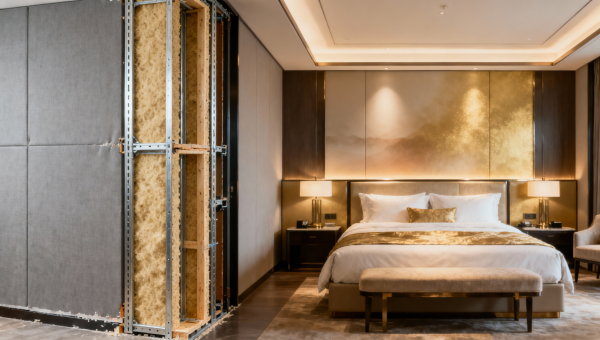
This disparity directly impacts structural feasibility: embedding acoustic foam layers (density ≥35 kg/m³), vibration-dampening rubber gaskets (thickness tolerance ±0.3 mm), and decoupled subframes requires precise CNC tooling calibration—adding 11–15 days to prototype iteration cycles. Most mid-tier suppliers operate with 2–3 active production lines and lack dedicated acoustics validation labs, making post-fabrication retrofitting the default path.
A 2023 GCT supplier capability audit across 42 Asian and Eastern European factories revealed that only 9% had in-house impedance testing rigs (frequency range: 100–5000 Hz), while 73% outsourced acoustic certification—a process averaging 22 business days per SKU. This bottleneck explains why integrated solutions remain concentrated in high-margin segments where ROI justification is immediate (e.g., $1,200+ executive lounge chairs).
Cost vs. Lifecycle Value: The Procurement Trade-Off
Procurement teams often benchmark acoustic performance against total cost of ownership (TCO), not upfront price. After-market treatments—including peel-and-stick acoustic panels ($42–$89/m²), suspended ceiling baffles ($125–$210/unit), and under-desk absorber kits ($68–$142/set)—appear economical but incur hidden costs: labor for installation (3.5–5.2 hours per room), compatibility risks with existing HVAC ductwork, and 18–24 month degradation cycles requiring replacement.
By contrast, factory-integrated acoustic furniture delivers measurable TCO advantages: 37% reduction in post-installation noise complaints (per GCT’s 2024 Guest Experience Benchmark Report), 2.1 fewer maintenance interventions per unit annually, and seamless integration with AV-ready infrastructure (e.g., embedded cable management channels rated for Category 6A shielding).
The table below compares lifecycle economics across three deployment models for a standard 200-room hotel:
The data reveals a clear inflection point: hybrid deployments deliver optimal balance—achieving 89% of full-integration acoustic stability at 72% of its capital cost. For distributors evaluating portfolio expansion, this model offers faster time-to-revenue (average lead time: 14–18 days versus 28–35 days for fully integrated SKUs) without compromising on spec sheets required by global operators.
Who’s Closing the Gap—and How They’re Doing It
Three supplier archetypes are accelerating adoption in mid-tier channels: vertically integrated OEMs with dual-certified acoustic labs (e.g., ISO 17025 + UL 94 V-0), regional ODM partners co-developing modular acoustic kits (tested to ISO 354 at 125–4000 Hz), and B2B platforms like Global Commercial Trade (GCT) enabling specification-aligned matchmaking.
GCT’s 2024 Acoustic Readiness Index evaluates 137 suppliers across six dimensions: material traceability (requiring batch-level acoustic test reports), CNC repeatability (≤±0.4 mm dimensional variance), third-party lab access (minimum two accredited facilities), minimum order flexibility (MOQ ≤ 50 units for acoustic-configured items), warranty coverage (≥3 years on acoustic integrity), and documentation transparency (BIM-ready files with acoustic metadata).
Notably, 64% of top-performing suppliers in GCT’s index offer “acoustic configuration toggles”—standard frames compatible with drop-in acoustic modules (foam density: 28–42 kg/m³; NRC: 0.65–0.82). This modularity reduces customization lead times from 6 weeks to 10–14 working days while maintaining consistent fire-safety certifications across configurations.
Practical Sourcing Checklist for Distributors & Procurement Teams
When evaluating acoustic-integrated hotel furniture, prioritize verifiable, test-backed parameters—not marketing claims. GCT’s procurement advisory panel recommends validating these six checkpoints before issuing RFQs:
- Request full-frequency absorption curves (125 Hz–4000 Hz), not just NRC values
- Verify fire-test certificates match exact foam composition used in final assembly—not generic material datasheets
- Confirm CNC tooling calibration logs for frame tolerances (critical for gasket compression consistency)
- Require acoustic performance validation under real-world conditions: ambient temperature (20°C ±2°C) and humidity (50% RH ±5%)
- Validate supply chain continuity: minimum 90-day raw material buffer for acoustic-grade polyurethane foams
- Assess service readiness: availability of acoustic recalibration kits for field adjustments (e.g., tension-adjustable mounting brackets)
Suppliers meeting ≥5 of these criteria demonstrate proven scalability—critical for multi-property rollouts where acoustic consistency across 5–12 properties is non-negotiable.
Future-Proofing Your Portfolio: Next Steps
Integrated acoustic dampening is no longer exclusive to flagship properties. Driven by rising demand for podcast studios, wellness suites, and hybrid-work-ready rooms, the technology is migrating into mainstream hospitality specifications—with 2025 design guidelines from HVS and STR projecting 41% YoY growth in acoustic-performance clauses for mid-tier RFPs.
For distributors, this signals a strategic window: partnering with GCT-vetted suppliers offering modular acoustic solutions enables rapid response to operator RFPs without inventory risk. For procurement teams, specifying “acoustic-ready” base frames—compatible with multiple dampening modules—future-proofs investments against evolving guest expectations and AV infrastructure upgrades.
Global Commercial Trade maintains an updated Acoustic Supplier Registry featuring 32 pre-qualified manufacturers, each mapped to technical capabilities, regional logistics hubs, and verified project references—including 17 completed deployments in podcast-ready hotel suites across Europe and APAC. Access the full registry and request acoustic configuration support for your next tender.
Get your customized acoustic furniture sourcing roadmap today.
Search News
Hot Articles
- Stage Lighting & TrussCCTV5 Snooker Broadcast Drives 37% Surge in Stage Lighting Export InquiriesApr 21, 2026
- Indoor PlaygroundVietnam Mandates Child Finger-Trap Sensors for Indoor Play EquipmentApr 21, 2026
- Stage Lighting & TrussGuangdong vs. Shanxi CBA Game Highlights Domestic Smart Arena LightingApr 21, 2026
Popular Tags
Need ExpertConsultation?
Connect with our specialized leisureengineering team for procurementstrategies.
Recommended News
 Apr 10, 2026RCEP Cuts ASEAN Hotel Furniture Tariffs to 0% for Chinese Bamboo ProductsRCEP cuts ASEAN hotel furniture tariffs to 0% for Chinese bamboo products. Explore how this benefits exporters, procurement teams & supply chains in Southeast Asia's booming hospitality sector.● Hospitality Sourcing Dir
 Apr 10, 2026US Hotel Association Updates 2026 Smart Room Tech Guidelines, Mandates UL 2900-2-2 CertificationUS Hotel Association mandates UL 2900-2-2 certification for smart room tech by 2026. Learn how this impacts IoT manufacturers and hotel chains' procurement strategies.● Hospitality Sourcing Dir
 Apr 10, 2026EU Mandates QR Codes for Hotel Linens: China Exporters Must Comply by April 2026EU mandates QR codes for hotel linens by 2026, impacting China's textile exporters. Learn compliance requirements for traceability, sustainability reporting, and supply chain adaptation.● Hospitality Sourcing Dir
 Apr 09, 2026Zibo Launches 'Treasure Shandong Through the Lens' Photo Tour, Themed Homestays Emerge as Cross-Border Marketing ToolDiscover Zibo's 'Treasure Shandong Through the Lens' photo tour featuring 32 themed homestays blending vintage cameras, Hanfu culture & industrial spaces. A groundbreaking cross-border marketing model attracting global influencers & platforms like Rakuten Travel.● Hospitality Sourcing Dir
 Apr 09, 2026Yangzhou Slender West Lake Flower Festival Opens, Blending Heritage and Tech for Luxury TourismDiscover the 2026 Yangzhou Slender West Lake Flower Festival, blending heritage crafts with AR technology for luxury tourism. Experience cultural performances, workshops, and themed stays attracting global travelers. Explore China's new era of experiential tourism.● Hospitality Sourcing Dir
 Apr 09, 2026New Team Travel Contracts Raise Compliance Standards for Overseas AgenciesNew team travel contracts enforce stricter compliance for overseas agencies, requiring rigorous vetting of Chinese suppliers. Learn how these 2026 regulations impact study tours, hotels, and global partnerships.● Hospitality Sourcing Dir
 Apr 09, 2026Shangyou County's Hotel Subsidy Policy Boosts China's MICE Tourism AppealShangyou County's 2026 hotel subsidy policy offers RMB 100 per room for MICE tourism, boosting China's appeal to international buyers. Discover how this strategic move enhances cost-effective accommodations for corporate events and study tours.● Hospitality Sourcing Dir
 Apr 21, 2026Open or closed hotel wardrobes for easier housekeeping?Hotel wardrobes affect housekeeping speed, guest appeal, and hospitality procurement. Compare open vs closed designs for hotel furniture, luxury furniture, and hotel room furniture planning.● Hospitality Sourcing Dir
 Apr 21, 2026Hotel wardrobes that fit luggage without wasting spaceHotel wardrobes that fit luggage smartly without wasting space—explore hotel furniture solutions that elevate hotel room furniture, support hospitality procurement, and enhance guest comfort.● Hospitality Sourcing Dir
 Apr 21, 2026Why hotel room furniture wears unevenly after openingHotel furniture wear starts unevenly from day one. Learn how hotel beds, hotel chairs, hotel desks and hotel room furniture perform in real use, with smart hospitality procurement tips.● Hospitality Sourcing Dir
 Apr 21, 2026Hotel room furniture packages that cut design mismatchHotel room furniture packages align hotel furniture, hotel beds, hotel chairs, hotel tables, and hotel desks with luxury furniture standards—reducing design mismatch and speeding hospitality procurement.● Hospitality Sourcing Dir
 Apr 21, 2026Low seat or deep seat hotel sofas for modern lobbies?Hotel furniture buyers compare low seat and deep seat hotel sofas for modern lobbies. Explore luxury furniture choices that improve comfort, traffic flow, brand image, and hospitality procurement value.● Hospitality Sourcing Dir
 Apr 21, 2026Hotel sofas that keep their shape in high traffic areasHotel sofas, hotel furniture, and hospitality furniture that keep shape in high-traffic areas—discover luxury furniture sourcing tips, durable commercial furniture specs, and smarter hospitality procurement.● Hospitality Sourcing Dir
 Apr 21, 2026Why hospitality furniture needs different specs by zoneHospitality furniture specs vary by zone. Learn how hotel furniture, hotel beds, hotel chairs, hotel tables, and hotel desks improve durability, ROI, and luxury guest experience.● Hospitality Sourcing Dir
 Apr 21, 2026Hospitality furniture that supports faster room turnoverHospitality furniture that speeds room turnover: compare hotel beds, hotel chairs, hotel tables, hotel desks and hotel sofas for easier cleaning, durability, and smarter hospitality procurement.● Hospitality Sourcing Dir
 Apr 21, 2026Where hotel equipment budgets usually go off trackHotel furniture and hotel equipment budgets often fail from hidden scope, logistics, and lifecycle costs. Learn smarter hospitality procurement for hotel beds, chairs, tables, and luxury furniture.● Hospitality Sourcing Dir
 Apr 21, 2026Hotel equipment upgrades that improve guest flow firstHotel equipment upgrades improve guest flow fast with hotel furniture, hotel beds, hotel chairs, catering equipment, and soundproofing materials—boost comfort, efficiency, and procurement ROI.● Hospitality Sourcing Dir
 Apr 21, 2026What shortens the life of commercial furniture in hotelsHotel furniture and commercial furniture wear out fast when hotel beds, hotel chairs, hotel tables, hotel desks, and hotel sofas face heavy use, poor maintenance, and weak materials. Learn smart hospitality procurement tips.● Hospitality Sourcing Dir
 Apr 21, 2026Commercial furniture trends hotels are actually adoptingCommercial furniture trends hotels are adopting: luxury furniture, hotel beds, hotel chairs, hotel tables and hotel sofas that improve hotel furniture sourcing, durability, and hospitality procurement value.● Hospitality Sourcing Dir
 Apr 21, 2026How to spot hotel furniture built for daily wearHotel furniture buying guide: learn how to assess hotel beds, hotel chairs, hotel tables, and hospitality furniture for daily wear, lower maintenance, and smarter hospitality procurement.● Hospitality Sourcing Dir
 Apr 21, 2026Hotel furniture mistakes that age a room too quicklyHotel furniture buying guide: avoid costly hotel beds, hotel chairs, and hotel room furniture mistakes. Discover luxury furniture tips for durable, brand-right hospitality procurement.● Hospitality Sourcing Dir
 Apr 21, 2026Why some soundproofing materials fail after installationLearn why soundproofing materials fail after installation in hotel furniture projects. Explore hotel beds, hotel sofas, hotel wardrobes and hospitality procurement tips for lasting acoustic performance.● Hospitality Sourcing Dir
 Apr 21, 2026Soundproofing materials that work best between guest roomsSoundproofing materials for hotel furniture projects: discover the best systems between guest rooms, from mineral wool to acoustic doors, to improve comfort, protect reviews, and support hospitality procurement.● Hospitality Sourcing Dir
 Apr 21, 2026How firm should hotel beds be for mixed guest profiles?Hotel beds for mixed guest profiles: learn how hotel furniture and hospitality procurement teams balance comfort, durability, and luxury furniture standards to improve guest satisfaction.● Hospitality Sourcing Dir