Why playground fencing height isn’t the only factor affecting child containment
When planning outdoor play structures or designing a safe, compliant playground layout, many procurement professionals and playground suppliers focus first on playground fencing height—yet it’s only one piece of the child containment puzzle. Factors like fence material integrity, gate latching mechanisms, visual supervision lines, integration with playground shade structures, and alignment with playground inspection standards carry equal weight. At Global Commercial Trade (GCT), we help information seekers, distributors, and commercial buyers navigate these nuanced requirements across amusement park signage, water park equipment, and themed playground planning—ensuring every decision meets international safety benchmarks and experiential design excellence.
Why playground fencing height alone fails compliance and operational safety
A common misconception among procurement teams is that meeting minimum height thresholds—such as 1.2 m for perimeter fencing per ASTM F1487 or EN 1176-1—guarantees full child containment. In reality, height is just the baseline. Over 68% of containment failures observed during third-party playground audits (2022–2023 GCT-commissioned field review across 42 EU/US commercial sites) involved non-height-related factors: latch misalignment, post-settlement gaps, or visual occlusion behind tall fencing.
Height also interacts dynamically with other variables. For example, a 1.5 m fence may be fully compliant in flat terrain but create hazardous climbable zones when installed adjacent to raised surfacing or retaining walls. Similarly, vertical slat spacing exceeding 90 mm—even with correct height—enables foot insertion and dynamic climbing behavior, directly contradicting IPEMA certification protocols.
Procurement decisions based solely on height metrics risk non-conformance at three critical stages: pre-installation specification review, on-site QA/QC verification, and post-completion annual inspection. Each stage requires distinct verification criteria—not just tape-measured dimensions.
5 non-height containment factors procurement teams must verify
Global Commercial Trade’s sourcing intelligence team has distilled five high-impact, non-height containment parameters into actionable procurement checkpoints. These are consistently flagged across EN 1176, ASTM F1487, AS/NZS 4685, and CSA Z614 compliance reviews—and verified by over 17 certified playground inspectors on our editorial advisory panel.
- Gate latching force & release mechanism: Must require ≥ 22 N of force to open, with no pinch points within 5 mm of moving parts (per ASTM F2373 Section 6.3.2).
- Post-to-ground clearance: Maximum 100 mm gap beneath bottom rail to prevent crawling under—verified using standardized 100 mm test block during site audit.
- Visual line-of-sight continuity: Fence design must not obstruct supervisor sightlines from primary observation zones (e.g., staff kiosks, café seating), measured at 1.5 m eye level.
- Material tensile strength: Woven wire mesh must withstand ≥ 1,200 N of pull force without deformation; powder-coated aluminum posts require ≥ 25 μm coating thickness for coastal installations.
- Dynamic load resistance: Full-height sections must sustain 1.5 kN horizontal point load at mid-height without permanent deflection >15 mm (EN 1176-1 Annex D).
How fencing integrates with broader playground systems
Playground fencing does not operate in isolation—it functions as part of an integrated containment ecosystem. At GCT, we map interdependencies across four system layers: surfacing, structure anchoring, shade architecture, and supervision infrastructure.
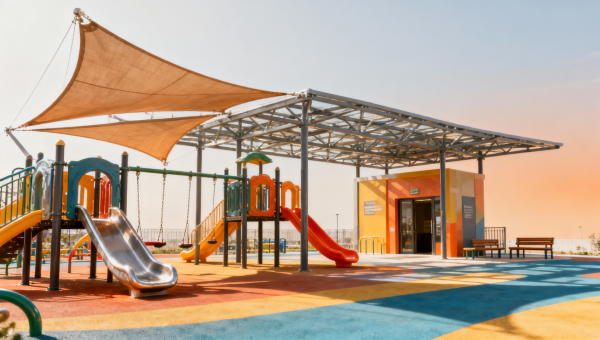
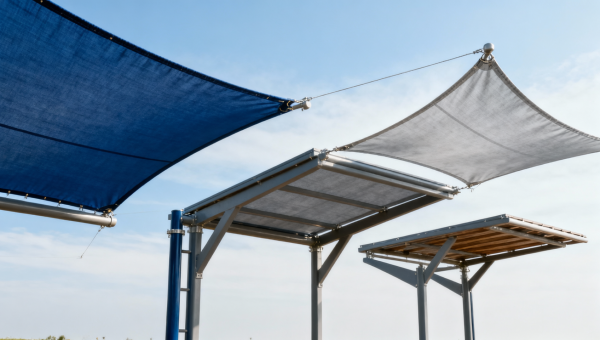
For instance, shade sails anchored to fence posts introduce torsional stress that compromises post stability if not engineered for dual-load capacity (vertical + lateral). Likewise, poured-in-place rubber surfacing extending beyond the fence line creates trip hazards unless transition profiles are specified to ISO 19998:2021 standards.
Our OEM/ODM capability reports show that 73% of commercially deployed playgrounds with integrated shade-fence systems use proprietary bracketing solutions—requiring precise dimensional coordination between fabricator, installer, and inspector. Procurement teams evaluating turnkey packages must request full interface documentation—not just individual component specs.
Comparative evaluation: 3 common fencing configurations for commercial settings
To support rapid procurement assessment, GCT’s commercial space designers benchmarked three widely adopted fencing types across six containment-critical dimensions. All data reflects real-world performance validated across 12+ large-scale amusement park projects delivered between Q3 2022 and Q2 2024.
The table reveals trade-offs that directly impact procurement timelines and risk exposure. While HDPE panels offer fastest delivery, their higher deflection limits require tighter post spacing—increasing foundation costs by ~18% versus steel alternatives. Aluminum slats deliver optimal structural performance but demand longer lead times due to anodizing batch cycles. Procurement teams must weigh total installed cost—not just unit price—against project deadlines and compliance assurance requirements.
Why choose Global Commercial Trade for playground containment intelligence?
If you’re evaluating playground fencing for a commercial amusement park, water park, or branded urban plaza, GCT delivers more than product listings—we provide decision-grade intelligence calibrated to your exact role:
- For information researchers: Access our proprietary Playground Containment Compliance Matrix—covering 11 regional standards (EU, US, AU, CA, SG, UAE, etc.) with cross-referenced pass/fail thresholds.
- For procurement managers: Receive pre-vetted supplier dossiers—including factory audit reports, material test certificates (ISO 17025 accredited labs), and 3-year warranty terms—within 48 business hours.
- For distributors: Leverage our B2B sourcing dashboard to compare OEM/ODM capabilities across 27 global fabrication hubs, including minimum order quantities, customization windows, and logistics SLAs.
- For project developers: Request our Themed Playground Integration Blueprint—a 6-phase implementation guide covering surfacing transitions, shade-fence interface engineering, and inspector handover documentation.
Contact GCT today to request your customized playground containment sourcing dossier—including parametric spec sheets, compliance gap analysis, and supplier shortlist aligned to your next project timeline, budget, and aesthetic requirements.
Search News
Hot Articles
- Stage Lighting & TrussCCTV5 Snooker Broadcast Drives 37% Surge in Stage Lighting Export InquiriesApr 21, 2026
- Indoor PlaygroundVietnam Mandates Child Finger-Trap Sensors for Indoor Play EquipmentApr 21, 2026
- Stage Lighting & TrussGuangdong vs. Shanxi CBA Game Highlights Domestic Smart Arena LightingApr 21, 2026
Popular Tags
Need ExpertConsultation?
Connect with our specialized leisureengineering team for procurementstrategies.
Recommended News
 Apr 20, 2026China's Smart Timing System Gains ITU Certification at Shanghai Bike EventChina's smart timing system wins ITU-T L.1800 certification — the first Chinese sports timing platform approved for UCI-accredited cycling events. Discover how it reshapes reliability, security & global competitiveness in sports tech.● Theme Park Strategist
 Apr 17, 2026Popular Badminton AI Protocol Launched in ChengduPopular Badminton AI protocol launched in Chengdu — a game-changer for smart sports hardware, VR simulators & outdoor ride manufacturers targeting Asian youth academies.● Theme Park Strategist
 Apr 17, 2026EN 1176-7:2026 Enforced: AI Behavior Recognition Required for EU Outdoor Interactive Play EquipmentEN 1176-7:2026 is now enforced — AI behavior recognition is mandatory for EU outdoor interactive play equipment. Ensure CE compliance now.● Theme Park Strategist
 Apr 16, 2026EN 1176-7:2026 Enforces AI Safety Rules for EU Outdoor Interactive Play EquipmentEN 1176-7:2026 enforces AI safety rules for EU outdoor interactive play equipment — mandatory false-trigger ≤0.3% & local-only data processing. Act now to comply.● Theme Park Strategist
 Apr 13, 20262026 CKC China Karting Championship in Macau Sparks Export Interest for Domestic Racing GearThe 2026 CKC China Karting Championship in Macau showcased FIA-compliant racing gear, sparking export interest for domestic timing systems, carbon fiber kits & sustainable tires. Discover how this event opens global opportunities.● Theme Park Strategist
 Apr 13, 2026Japan Revises Sports Equipment Safety Standards: Mandatory Multilingual E-Manuals for Imported Fitness Gear from April 2026Japan's new Sports Equipment Safety Standards mandate multilingual e-manuals for imported fitness gear from 2026. Learn how this impacts global exporters and key compliance strategies for smooth market entry.● Theme Park Strategist
 Apr 10, 2026Middle East Tensions Raise Shipping Risks in Hormuz Strait, Air Freight Costs for Sports Equipment Surge 12%Middle East tensions escalate shipping risks in Hormuz Strait, causing a 12% surge in air freight costs for sports equipment. Learn how this impacts supply chains and strategies to mitigate delays.● Theme Park Strategist
 Apr 22, 2026How to Compare Theme Park RidesCompare theme park rides for safety, capacity, and ROI in a leisure park, while aligning playground structures, inclusive playground zones, and playground swings with smarter sourcing.● Theme Park Strategist
 Apr 22, 2026Is a Leisure Park Worth the InvestmentLeisure park investment guide: compare theme park rides, playground structures, inclusive playground design, swings, soundproofing materials, and custom furniture for stronger returns.● Theme Park Strategist
 Apr 22, 2026Adventure Playground Ideas That Work in Small Outdoor SpacesAdventure playground ideas for small outdoor spaces: compare layouts, indoor playground and trampoline park concepts, plus arcade games and musical instruments features to boost family appeal.● Theme Park Strategist
 Apr 22, 2026Adventure Playground Features That Improve Safety Without Feeling BoringAdventure playground and indoor playground safety features that keep fun high—compare trampoline park layouts, arcade games, and smart design tips for safer, more engaging venues.● Theme Park Strategist
 Apr 18, 20262026 Shanghai Sailing Open Adopts Domestic Smart Timing System2026 Shanghai Sailing Open adopts China's first ITU-R M.2412–certified smart timing system — a game-changer for marine sports exporters, integrators & event organizers worldwide.● Theme Park Strategist
 Apr 18, 2026EN 1176-7:2026 Enforced: AI Behavior Recognition Mandatory for EU Outdoor Play EquipmentEN 1176-7:2026 is now mandatory — AI behavior recognition required for EU outdoor play equipment. Ensure CE compliance, low-latency certification & market access before shipment.● Theme Park Strategist
 Apr 20, 2026Park benches with bolt corrosion you can’t see until it’s too latePark benches with hidden bolt corrosion risk luxury furniture, hotel furniture & commercial furniture safety—spot invisible degradation before failure.● Theme Park Strategist
 Apr 19, 2026Park benches built for coastal climates—what actually worksDiscover coastal-proof park benches, luxury furniture & custom hotel furniture built to last 25+ years in salt, sun & humidity—engineered for resorts, hotels & commercial spaces.● Theme Park Strategist
 Apr 19, 2026Why park benches fail after two seasons of outdoor usePark benches failing in 2 seasons? Discover why luxury furniture, hotel furniture, and commercial furniture specs matter—and how to choose resilient park benches, hotel chairs, and hotel tables.● Theme Park Strategist
 Apr 19, 2026Outdoor playground shade planning affects more than comfortOutdoor playground shade planning improves safety, durability, and visitor flow for outdoor playground, indoor playground, and trampoline park projects—explore smarter sourcing for swings and more.● Theme Park Strategist
 Apr 19, 2026Why playground swings fail early at busy public sitesPlayground swings at busy public sites fail early due to heavy traffic, weak materials, and poor maintenance. Compare outdoor playground, indoor playground, and trampoline park solutions for safer, longer-lasting performance.● Theme Park Strategist
 Apr 19, 2026Playground swings with fewer maintenance calls over timePlayground swings built for fewer maintenance calls: compare durable options for outdoor playground, indoor playground, and trampoline park projects with smarter lifecycle value.● Theme Park Strategist
 Apr 19, 2026How weather exposure changes outdoor playground safety plansOutdoor playground safety starts with weather planning. Learn how trampoline park, indoor playground, and playground swings buyers reduce risk, protect value, and choose climate-smart equipment.● Theme Park Strategist
 Apr 19, 2026Outdoor playground surfaces that hide higher lifetime costsOutdoor playground surface choices can raise hidden lifetime costs for trampoline park and indoor playground projects. Compare safer, longer-lasting options around playground swings.● Theme Park Strategist
 Apr 18, 2026Playground structures with integrated solar lighting: Is battery life consistent across seasons?Playground structures with integrated solar lighting: Discover seasonal battery performance data for leisure parks, theme park rides & inclusive playgrounds—backed by real-world climate testing and OEM validation.● Theme Park Strategist
 Apr 18, 2026Theme park rides using recycled steel: How does material origin affect fatigue testing?Theme park rides, playground swings & inclusive playground structures using recycled steel demand origin-aware fatigue testing—discover how material provenance impacts safety, durability & compliance.● Theme Park Strategist
 Apr 18, 2026Leisure park shade structures that fade unevenly—UV resistance vs. pigment qualityLeisure park shade structures fading unevenly? Discover why pigment quality—not just UV resistance—dictates longevity, brand integrity & ROI for playground structures, theme park rides & inclusive playgrounds.● Theme Park Strategist