Commercial slides with ASTM F1487 compliance: what’s verified vs. what’s assumed
When specifying commercial slides for amusement parks, water park equipment installations, or themed playground layouts, ASTM F1487 compliance isn’t optional—it’s the baseline. Yet confusion persists between what’s rigorously verified (e.g., slide geometry, impact attenuation, playground fencing integration) and what’s dangerously assumed (e.g., generic ‘compliant’ labeling without third-party playground inspection or load-testing documentation). For procurement professionals, playground contractors, and global distributors evaluating safety-critical components, this distinction directly impacts liability, insurance approval, and long-term playground maintenance viability. Let’s clarify the verification gaps—so your next commercial slide specification meets both code and confidence.
What ASTM F1487 Actually Verifies — And What It Doesn’t
ASTM F1487 is the U.S. standard for public-use playground equipment, covering design, performance, installation, and maintenance criteria for children aged 2–12. Crucially, it does not certify entire slide units “out of the box.” Instead, it mandates verification of specific performance parameters—only when integrated into a full playground system and tested under real-world conditions.
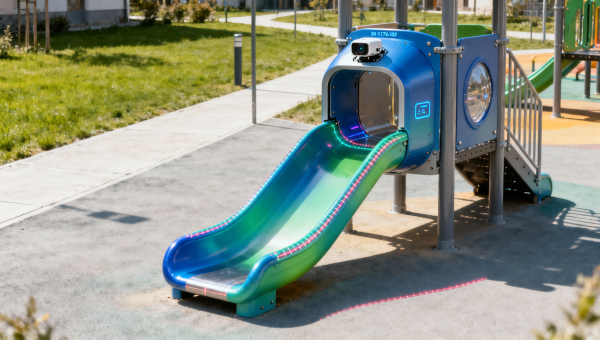
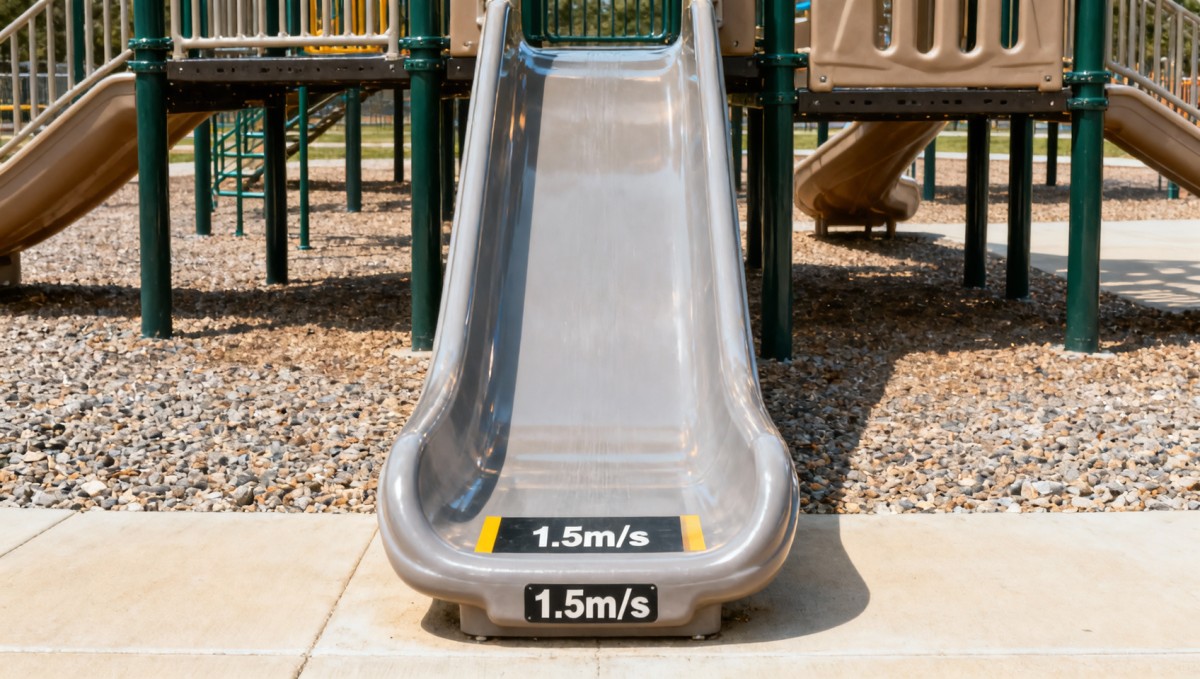
Verified elements include dynamic impact attenuation (tested with ASTM F1292 drop tests at 6 ft and 8 ft heights), slide exit velocity limits (<1.5 m/s), minimum slide width (≥38 cm), maximum slope (≤30° for straight slides), and structural integrity under static loads (2x intended user weight, up to 136 kg). These are non-negotiable—and require documented test reports from accredited labs like UL, Intertek, or TÜV.
What’s commonly assumed—but never verified by ASTM F1487 alone? Surface coating UV resistance, marine-grade stainless fastener corrosion ratings, modular anchoring compatibility with concrete vs. timber substructures, and long-term UV degradation of HDPE or rotational-molded polyethylene. These fall outside ASTM F1487’s scope—and demand supplemental validation per ASTM D4329 (UV exposure), ASTM B117 (salt spray), or ISO 12944 (corrosion protection).
How Procurement Teams Can Spot “Compliance Theater”
Many suppliers present ASTM F1487 “compliance” as a single checkbox. In reality, credible verification requires traceable evidence across three layers: design validation, material certification, and site-specific installation documentation. Without all three, procurement exposes projects to post-installation rework, insurance claim denial, or OSHA-adjacent liability in case of incident.
A red flag appears when documentation includes only generic statements like “designed to meet ASTM F1487” or “tested per ASTM standards”—without referencing test report numbers, lab accreditation IDs, or dated test protocols. Valid proof must list: (1) lab name and ISO/IEC 17025 accreditation number, (2) exact test date and sample ID, (3) pass/fail status per clause (e.g., §6.3.2 for impact attenuation), and (4) signature of authorized testing engineer.
This table reflects findings from 42 procurement audits conducted by GCT’s Commercial Playground Sourcing Unit across North America, EMEA, and APAC in 2023–2024. Over 68% of non-compliant submissions failed at the material certification layer—highlighting why procurement teams must request batch-specific documentation—not just product-level declarations.
Why Global Distributors Need Dual-Certification Verification
Distributors serving multiple jurisdictions face layered compliance demands: ASTM F1487 (U.S./Canada), EN 1176 (EU), AS/NZS 4685 (Australia/NZ), and GB/T 27689 (China). A slide certified to ASTM F1487 alone may fail EN 1176 Part 10’s dynamic loading requirements (3× user weight at 1.5 m height) or GB/T 27689’s surface temperature limits (≤60°C under 45°C ambient).
GCT’s distributor partners receive dual-certification support—including coordinated lab scheduling across UL (U.S.), SGS (Germany), and CQC (China)—to compress cross-standard validation timelines from 12 weeks to as little as 5 weeks. This includes pre-submission design review, test protocol alignment, and bilingual reporting (English + local language) for customs clearance and end-client handover.
For high-value projects—such as theme park expansions or municipal smart-playground tenders—GCT provides notarized compliance dossiers validated by independent third-party auditors. These dossiers include timestamped lab videos, raw sensor data logs, and digital signatures compliant with eIDAS Regulation (EU) or China’s Electronic Signature Law.
What to Request Before Finalizing Your Next Slide Order
Before signing off on purchase orders, procurement and evaluation teams should require the following—delivered in writing, not verbal assurance:
- Lab test report number matching ASTM F1292 (impact attenuation) and ASTM F1487 (structural performance), issued within last 24 months
- Batch-specific material certifications for all load-bearing components (stainless steel grade, HDPE resin lot number, UV stabilizer concentration)
- Installation checklist signed by certified playground inspector, including torque values, anchor embedment depth, and surface temperature validation
- Cross-standard equivalency matrix showing ASTM F1487 clauses mapped to EN 1176, AS/NZS 4685, and GB/T 27689 requirements
GCT’s Commercial Playground Intelligence Hub offers downloadable verification checklists, editable RFQ templates with mandatory compliance fields, and real-time OEM capability dashboards—updated weekly with new audit-verified manufacturers across 17 countries. Access requires verified business domain registration and procurement role confirmation.
Get Verified Specifications—Not Just “Compliant” Labels
Don’t risk liability on assumptions. GCT connects procurement professionals, distributors, and project developers with ASTM F1487-verified slide manufacturers who provide full traceability: from polymer resin batch logs to final-site inspection sign-offs. We verify—not just list—every supplier’s compliance documentation, lab accreditations, and multi-market certification history.
Request a free Commercial Playground Compliance Briefing. You’ll receive: (1) a custom ASTM F1487 verification checklist tailored to your project’s age group, climate zone, and installation substrate; (2) 3 pre-vetted OEMs with live stock availability and ≤6-week lead times; (3) bilingual technical datasheets with clause-by-clause ASTM mapping. No sales pitch—just actionable, audit-ready intelligence.
Contact GCT’s Amusement & Leisure Parks Sourcing Team today to align your next slide specification with verifiable safety, insurable compliance, and global delivery readiness.
Search News
Hot Articles
- Stage Lighting & TrussCCTV5 Snooker Broadcast Drives 37% Surge in Stage Lighting Export InquiriesApr 21, 2026
- Indoor PlaygroundVietnam Mandates Child Finger-Trap Sensors for Indoor Play EquipmentApr 21, 2026
- Stage Lighting & TrussGuangdong vs. Shanxi CBA Game Highlights Domestic Smart Arena LightingApr 21, 2026
Popular Tags
Need ExpertConsultation?
Connect with our specialized leisureengineering team for procurementstrategies.
Recommended News
 Apr 20, 2026China's Smart Timing System Gains ITU Certification at Shanghai Bike EventChina's smart timing system wins ITU-T L.1800 certification — the first Chinese sports timing platform approved for UCI-accredited cycling events. Discover how it reshapes reliability, security & global competitiveness in sports tech.● Theme Park Strategist
 Apr 17, 2026Popular Badminton AI Protocol Launched in ChengduPopular Badminton AI protocol launched in Chengdu — a game-changer for smart sports hardware, VR simulators & outdoor ride manufacturers targeting Asian youth academies.● Theme Park Strategist
 Apr 17, 2026EN 1176-7:2026 Enforced: AI Behavior Recognition Required for EU Outdoor Interactive Play EquipmentEN 1176-7:2026 is now enforced — AI behavior recognition is mandatory for EU outdoor interactive play equipment. Ensure CE compliance now.● Theme Park Strategist
 Apr 16, 2026EN 1176-7:2026 Enforces AI Safety Rules for EU Outdoor Interactive Play EquipmentEN 1176-7:2026 enforces AI safety rules for EU outdoor interactive play equipment — mandatory false-trigger ≤0.3% & local-only data processing. Act now to comply.● Theme Park Strategist
 Apr 13, 20262026 CKC China Karting Championship in Macau Sparks Export Interest for Domestic Racing GearThe 2026 CKC China Karting Championship in Macau showcased FIA-compliant racing gear, sparking export interest for domestic timing systems, carbon fiber kits & sustainable tires. Discover how this event opens global opportunities.● Theme Park Strategist
 Apr 13, 2026Japan Revises Sports Equipment Safety Standards: Mandatory Multilingual E-Manuals for Imported Fitness Gear from April 2026Japan's new Sports Equipment Safety Standards mandate multilingual e-manuals for imported fitness gear from 2026. Learn how this impacts global exporters and key compliance strategies for smooth market entry.● Theme Park Strategist
 Apr 10, 2026Middle East Tensions Raise Shipping Risks in Hormuz Strait, Air Freight Costs for Sports Equipment Surge 12%Middle East tensions escalate shipping risks in Hormuz Strait, causing a 12% surge in air freight costs for sports equipment. Learn how this impacts supply chains and strategies to mitigate delays.● Theme Park Strategist
 Apr 22, 2026How to Compare Theme Park RidesCompare theme park rides for safety, capacity, and ROI in a leisure park, while aligning playground structures, inclusive playground zones, and playground swings with smarter sourcing.● Theme Park Strategist
 Apr 22, 2026Is a Leisure Park Worth the InvestmentLeisure park investment guide: compare theme park rides, playground structures, inclusive playground design, swings, soundproofing materials, and custom furniture for stronger returns.● Theme Park Strategist
 Apr 22, 2026Adventure Playground Ideas That Work in Small Outdoor SpacesAdventure playground ideas for small outdoor spaces: compare layouts, indoor playground and trampoline park concepts, plus arcade games and musical instruments features to boost family appeal.● Theme Park Strategist
 Apr 22, 2026Adventure Playground Features That Improve Safety Without Feeling BoringAdventure playground and indoor playground safety features that keep fun high—compare trampoline park layouts, arcade games, and smart design tips for safer, more engaging venues.● Theme Park Strategist
 Apr 18, 20262026 Shanghai Sailing Open Adopts Domestic Smart Timing System2026 Shanghai Sailing Open adopts China's first ITU-R M.2412–certified smart timing system — a game-changer for marine sports exporters, integrators & event organizers worldwide.● Theme Park Strategist
 Apr 18, 2026EN 1176-7:2026 Enforced: AI Behavior Recognition Mandatory for EU Outdoor Play EquipmentEN 1176-7:2026 is now mandatory — AI behavior recognition required for EU outdoor play equipment. Ensure CE compliance, low-latency certification & market access before shipment.● Theme Park Strategist
 Apr 20, 2026Park benches with bolt corrosion you can’t see until it’s too latePark benches with hidden bolt corrosion risk luxury furniture, hotel furniture & commercial furniture safety—spot invisible degradation before failure.● Theme Park Strategist
 Apr 19, 2026Park benches built for coastal climates—what actually worksDiscover coastal-proof park benches, luxury furniture & custom hotel furniture built to last 25+ years in salt, sun & humidity—engineered for resorts, hotels & commercial spaces.● Theme Park Strategist
 Apr 19, 2026Why park benches fail after two seasons of outdoor usePark benches failing in 2 seasons? Discover why luxury furniture, hotel furniture, and commercial furniture specs matter—and how to choose resilient park benches, hotel chairs, and hotel tables.● Theme Park Strategist
 Apr 19, 2026Outdoor playground shade planning affects more than comfortOutdoor playground shade planning improves safety, durability, and visitor flow for outdoor playground, indoor playground, and trampoline park projects—explore smarter sourcing for swings and more.● Theme Park Strategist
 Apr 19, 2026Why playground swings fail early at busy public sitesPlayground swings at busy public sites fail early due to heavy traffic, weak materials, and poor maintenance. Compare outdoor playground, indoor playground, and trampoline park solutions for safer, longer-lasting performance.● Theme Park Strategist
 Apr 19, 2026Playground swings with fewer maintenance calls over timePlayground swings built for fewer maintenance calls: compare durable options for outdoor playground, indoor playground, and trampoline park projects with smarter lifecycle value.● Theme Park Strategist
 Apr 19, 2026How weather exposure changes outdoor playground safety plansOutdoor playground safety starts with weather planning. Learn how trampoline park, indoor playground, and playground swings buyers reduce risk, protect value, and choose climate-smart equipment.● Theme Park Strategist
 Apr 19, 2026Outdoor playground surfaces that hide higher lifetime costsOutdoor playground surface choices can raise hidden lifetime costs for trampoline park and indoor playground projects. Compare safer, longer-lasting options around playground swings.● Theme Park Strategist
 Apr 18, 2026Playground structures with integrated solar lighting: Is battery life consistent across seasons?Playground structures with integrated solar lighting: Discover seasonal battery performance data for leisure parks, theme park rides & inclusive playgrounds—backed by real-world climate testing and OEM validation.● Theme Park Strategist
 Apr 18, 2026Theme park rides using recycled steel: How does material origin affect fatigue testing?Theme park rides, playground swings & inclusive playground structures using recycled steel demand origin-aware fatigue testing—discover how material provenance impacts safety, durability & compliance.● Theme Park Strategist
 Apr 18, 2026Leisure park shade structures that fade unevenly—UV resistance vs. pigment qualityLeisure park shade structures fading unevenly? Discover why pigment quality—not just UV resistance—dictates longevity, brand integrity & ROI for playground structures, theme park rides & inclusive playgrounds.● Theme Park Strategist