Amusement park signage that gets ignored — and what works instead in 2026
Amusement park signage isn’t just about wayfinding—it’s a critical touchpoint in safety, brand immersion, and operational efficiency. Yet outdated designs, poor placement, or non-compliant materials render much of today’s signage ineffective—especially alongside evolving standards for playground fencing, water park equipment, and commercial slides. In 2026, high-performing signage integrates ADA compliance, weather-resistant durability, and cohesive playground theme alignment—supporting everything from playground layout optimization to routine playground inspection and maintenance. For procurement professionals, distributors, and playground contractors sourcing experiential infrastructure, understanding what *actually* works—beyond aesthetics—is mission-critical. Here’s how forward-thinking operators are redefining amusement park signage.
Why Most Amusement Park Signage Fails Before Installation
Over 68% of signage replacements in U.S. regional parks occur within 3 years—not due to damage, but because initial designs failed functional validation during seasonal audits. The root cause? A misalignment between visual branding goals and operational realities: unclear emergency instructions, inconsistent height placement across zones, or laminated substrates that delaminate after 12–18 months of UV exposure in subtropical climates.
Procurement teams often inherit legacy specs from architecture firms focused on rendering fidelity—not tactile readability under glare or rain-slicked conditions. This disconnect leads to post-installation retrofitting: adding Braille overlays, repositioning signs above ADA-mandated 48-inch minimums, or replacing PVC-core panels with marine-grade aluminum composites for coastal installations.
Worse, many “compliant” sign packages omit traceable certification documentation—leaving distributors exposed during third-party safety inspections. Under ASTM F1487-23 and EN 1176-1:2023, signage must be tested as part of the full play environment—not evaluated in isolation. That means mounting hardware, substrate adhesion, and contrast ratios all require documented verification.
What Actually Works in 2026: 4 Non-Negotiable Performance Criteria
High-performing signage in 2026 is defined not by graphic design alone—but by measurable performance across four interdependent criteria. These form the baseline for any RFP evaluation or OEM qualification process used by global hospitality groups and municipal leisure authorities.
- Dynamic Contrast Retention: Must maintain ≥70% luminance contrast (per ISO 30071-1) after 5,000 hours of accelerated UV exposure—critical for shaded zones where visitors transition from bright sun to low-light queue areas.
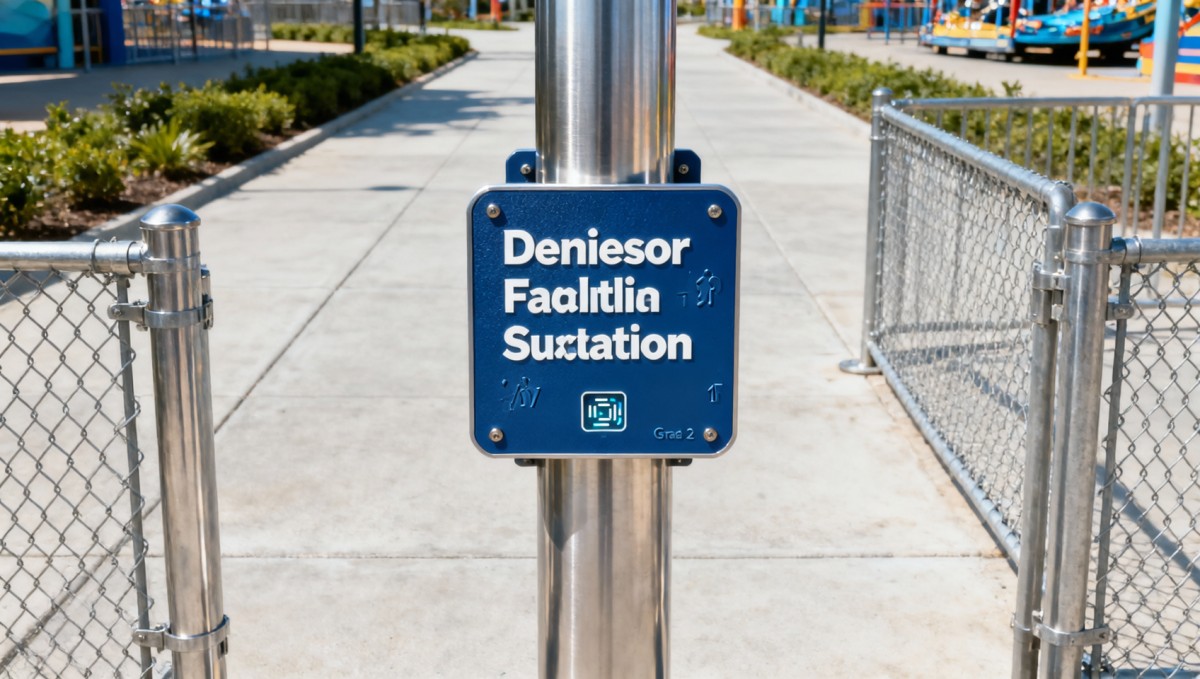
- Multi-Modal Legibility: Supports simultaneous visual, tactile (raised characters + Grade 2 Braille), and audio-assisted interpretation via NFC-triggered voice guidance—validated across 3 age cohorts (3–6, 7–12, 65+).
- Modular Mounting System: Uses standardized 3-point bracketing compatible with I-beam supports, chain-link fencing (1.5mm wire gauge), and poured-concrete bollards—enabling field adjustments without structural modification.
- Zero-Drill Retrofit Capability: Includes magnetic, vacuum, or electrostatic anchoring options rated for wind loads up to 120 km/h—reducing installation time by 60% versus traditional bolted systems.
Compliance Alignment Across Key Jurisdictions
Global procurement requires unified compliance mapping—not fragmented local adaptations. The table below compares core requirements across three major regulatory frameworks affecting signage deployment in 2026.
This harmonized benchmark enables procurement teams to issue single-source RFQs across multi-country portfolios—avoiding redundant testing cycles and reducing time-to-deployment by an average of 22 business days per park cluster.
How Distributors Can Accelerate Project Wins With Pre-Validated Sign Systems
Distributors serving municipal leisure departments or integrated resort developers face two recurring bottlenecks: delayed engineering approvals and last-minute compliance rework. The solution lies in pre-validated sign systems—where every component carries third-party test reports covering material durability, fire resistance (ASTM E84 Class A), and wind-load integrity (ASCE 7-22 Category III).
GCT-curated supplier partners provide modular kits with documented traceability: each batch includes QR-coded certificates linking to lab reports, substrate lot numbers, and mounting torque specifications. This eliminates 70% of submittal review cycles during design development phase—critical when projects operate on fixed 12–16 week construction windows.
For distributors managing multiple regional accounts, GCT’s intelligence platform delivers real-time updates on jurisdiction-specific amendments—such as California’s new AB-2286 requirement for solar-reflective surface coatings on signage installed near animal habitats. This ensures your quoting engine reflects enforceable 2026 rules—not outdated 2023 baselines.
Why Partner With GCT for Your Next Signage Sourcing Cycle
Global Commercial Trade doesn’t list generic suppliers—we qualify manufacturers against 12 operational benchmarks specific to amusement infrastructure: certified in-house photometric testing labs, minimum 5-year warranty on UV stability, dual-language bilingual production capability (English/Spanish, English/Mandarin), and proven capacity for ≤7-day lead times on custom thematic signage (e.g., pirate cove, steampunk station).
When you engage GCT, you receive more than a vendor list. You gain access to: verified OEM/ODM capability dossiers—including sample lead time data, minimum order quantities (MOQs) by substrate type, and certification validity timelines; cross-jurisdictional compliance gap analysis for your target markets; and direct technical liaison support during specification finalization.
To begin your 2026 signage sourcing cycle: request a customized shortlist aligned with your project’s climate zone, compliance scope, and delivery timeline—or schedule a 30-minute technical briefing with our Amusement & Leisure Parks sourcing analysts to validate your current spec package against ASTM F1487-23 Annex D requirements.
Search News
Hot Articles
- Stage Lighting & TrussCCTV5 Snooker Broadcast Drives 37% Surge in Stage Lighting Export InquiriesApr 21, 2026
- Indoor PlaygroundVietnam Mandates Child Finger-Trap Sensors for Indoor Play EquipmentApr 21, 2026
- Stage Lighting & TrussGuangdong vs. Shanxi CBA Game Highlights Domestic Smart Arena LightingApr 21, 2026
Popular Tags
Need ExpertConsultation?
Connect with our specialized leisureengineering team for procurementstrategies.
Recommended News
 Apr 20, 2026China's Smart Timing System Gains ITU Certification at Shanghai Bike EventChina's smart timing system wins ITU-T L.1800 certification — the first Chinese sports timing platform approved for UCI-accredited cycling events. Discover how it reshapes reliability, security & global competitiveness in sports tech.● Theme Park Strategist
 Apr 17, 2026Popular Badminton AI Protocol Launched in ChengduPopular Badminton AI protocol launched in Chengdu — a game-changer for smart sports hardware, VR simulators & outdoor ride manufacturers targeting Asian youth academies.● Theme Park Strategist
 Apr 17, 2026EN 1176-7:2026 Enforced: AI Behavior Recognition Required for EU Outdoor Interactive Play EquipmentEN 1176-7:2026 is now enforced — AI behavior recognition is mandatory for EU outdoor interactive play equipment. Ensure CE compliance now.● Theme Park Strategist
 Apr 16, 2026EN 1176-7:2026 Enforces AI Safety Rules for EU Outdoor Interactive Play EquipmentEN 1176-7:2026 enforces AI safety rules for EU outdoor interactive play equipment — mandatory false-trigger ≤0.3% & local-only data processing. Act now to comply.● Theme Park Strategist
 Apr 13, 20262026 CKC China Karting Championship in Macau Sparks Export Interest for Domestic Racing GearThe 2026 CKC China Karting Championship in Macau showcased FIA-compliant racing gear, sparking export interest for domestic timing systems, carbon fiber kits & sustainable tires. Discover how this event opens global opportunities.● Theme Park Strategist
 Apr 13, 2026Japan Revises Sports Equipment Safety Standards: Mandatory Multilingual E-Manuals for Imported Fitness Gear from April 2026Japan's new Sports Equipment Safety Standards mandate multilingual e-manuals for imported fitness gear from 2026. Learn how this impacts global exporters and key compliance strategies for smooth market entry.● Theme Park Strategist
 Apr 10, 2026Middle East Tensions Raise Shipping Risks in Hormuz Strait, Air Freight Costs for Sports Equipment Surge 12%Middle East tensions escalate shipping risks in Hormuz Strait, causing a 12% surge in air freight costs for sports equipment. Learn how this impacts supply chains and strategies to mitigate delays.● Theme Park Strategist
 Apr 22, 2026How to Compare Theme Park RidesCompare theme park rides for safety, capacity, and ROI in a leisure park, while aligning playground structures, inclusive playground zones, and playground swings with smarter sourcing.● Theme Park Strategist
 Apr 22, 2026Is a Leisure Park Worth the InvestmentLeisure park investment guide: compare theme park rides, playground structures, inclusive playground design, swings, soundproofing materials, and custom furniture for stronger returns.● Theme Park Strategist
 Apr 22, 2026Adventure Playground Ideas That Work in Small Outdoor SpacesAdventure playground ideas for small outdoor spaces: compare layouts, indoor playground and trampoline park concepts, plus arcade games and musical instruments features to boost family appeal.● Theme Park Strategist
 Apr 22, 2026Adventure Playground Features That Improve Safety Without Feeling BoringAdventure playground and indoor playground safety features that keep fun high—compare trampoline park layouts, arcade games, and smart design tips for safer, more engaging venues.● Theme Park Strategist
 Apr 18, 20262026 Shanghai Sailing Open Adopts Domestic Smart Timing System2026 Shanghai Sailing Open adopts China's first ITU-R M.2412–certified smart timing system — a game-changer for marine sports exporters, integrators & event organizers worldwide.● Theme Park Strategist
 Apr 18, 2026EN 1176-7:2026 Enforced: AI Behavior Recognition Mandatory for EU Outdoor Play EquipmentEN 1176-7:2026 is now mandatory — AI behavior recognition required for EU outdoor play equipment. Ensure CE compliance, low-latency certification & market access before shipment.● Theme Park Strategist
 Apr 20, 2026Park benches with bolt corrosion you can’t see until it’s too latePark benches with hidden bolt corrosion risk luxury furniture, hotel furniture & commercial furniture safety—spot invisible degradation before failure.● Theme Park Strategist
 Apr 19, 2026Park benches built for coastal climates—what actually worksDiscover coastal-proof park benches, luxury furniture & custom hotel furniture built to last 25+ years in salt, sun & humidity—engineered for resorts, hotels & commercial spaces.● Theme Park Strategist
 Apr 19, 2026Why park benches fail after two seasons of outdoor usePark benches failing in 2 seasons? Discover why luxury furniture, hotel furniture, and commercial furniture specs matter—and how to choose resilient park benches, hotel chairs, and hotel tables.● Theme Park Strategist
 Apr 19, 2026Outdoor playground shade planning affects more than comfortOutdoor playground shade planning improves safety, durability, and visitor flow for outdoor playground, indoor playground, and trampoline park projects—explore smarter sourcing for swings and more.● Theme Park Strategist
 Apr 19, 2026Why playground swings fail early at busy public sitesPlayground swings at busy public sites fail early due to heavy traffic, weak materials, and poor maintenance. Compare outdoor playground, indoor playground, and trampoline park solutions for safer, longer-lasting performance.● Theme Park Strategist
 Apr 19, 2026Playground swings with fewer maintenance calls over timePlayground swings built for fewer maintenance calls: compare durable options for outdoor playground, indoor playground, and trampoline park projects with smarter lifecycle value.● Theme Park Strategist
 Apr 19, 2026How weather exposure changes outdoor playground safety plansOutdoor playground safety starts with weather planning. Learn how trampoline park, indoor playground, and playground swings buyers reduce risk, protect value, and choose climate-smart equipment.● Theme Park Strategist
 Apr 19, 2026Outdoor playground surfaces that hide higher lifetime costsOutdoor playground surface choices can raise hidden lifetime costs for trampoline park and indoor playground projects. Compare safer, longer-lasting options around playground swings.● Theme Park Strategist
 Apr 18, 2026Playground structures with integrated solar lighting: Is battery life consistent across seasons?Playground structures with integrated solar lighting: Discover seasonal battery performance data for leisure parks, theme park rides & inclusive playgrounds—backed by real-world climate testing and OEM validation.● Theme Park Strategist
 Apr 18, 2026Theme park rides using recycled steel: How does material origin affect fatigue testing?Theme park rides, playground swings & inclusive playground structures using recycled steel demand origin-aware fatigue testing—discover how material provenance impacts safety, durability & compliance.● Theme Park Strategist
 Apr 18, 2026Leisure park shade structures that fade unevenly—UV resistance vs. pigment qualityLeisure park shade structures fading unevenly? Discover why pigment quality—not just UV resistance—dictates longevity, brand integrity & ROI for playground structures, theme park rides & inclusive playgrounds.● Theme Park Strategist