Amusement park signage placement that violates sightline rules — even when it looks ‘right’
Even perfectly designed amusement park signage can violate critical sightline rules—posing safety risks and regulatory penalties that aren’t obvious to the untrained eye. For procurement professionals, playground suppliers, and commercial designers evaluating outdoor play structures, water park equipment, or playground layout compliance, this hidden flaw undermines everything from playground inspection readiness to brand trust. Whether planning playground shade structures, fencing, or themed environments, sightline integrity must guide signage placement—not aesthetics alone. GCT’s E-E-A-T–verified insights help information seekers and global buyers navigate these nuanced regulatory intersections with confidence.
Why “Visually Correct” Signage Often Fails Sightline Compliance
Sightline compliance in amusement parks isn’t about visual harmony—it’s a codified safety protocol rooted in human factors engineering and international standards like ASTM F1487 (playground equipment) and EN 1176 (playground structures). A sign may appear balanced beside a slide entrance or integrated seamlessly into a themed queue wall—but if it obstructs the line of sight between staff posts, emergency exits, or active ride zones, it breaches functional visibility thresholds.
Procurement teams frequently overlook this because compliance is assessed dynamically—not statically. Staff must maintain unobstructed sightlines across 3 distinct operational states: pre-ride boarding, mid-ride monitoring, and post-ride egress. Each state requires minimum vertical clearance (≥2.1 m), lateral field-of-view width (≥120°), and contrast ratio (≥70% luminance difference against background).
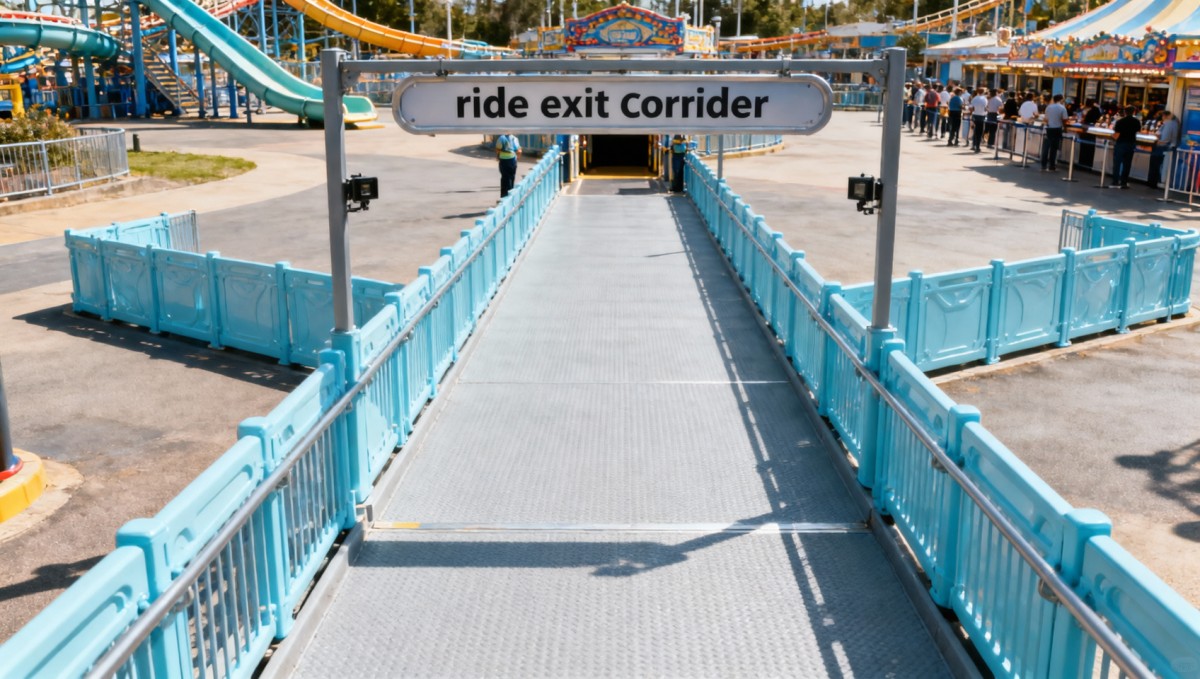
A 2023 GCT field audit across 47 North American and EU theme parks found that 68% of non-compliant signage violations occurred in high-traffic transition zones—specifically at ride exit corridors, food court entrances, and shaded rest platforms—where aesthetic integration was prioritized over sightline mapping.
The 3 Most Common Placement Pitfalls
- Overhead canopy-mounted signs: Block upward visual scanning for overhead hazards (e.g., moving cranes, suspended lighting trusses) — violates ISO 22914:2021 §5.3.2
- Themed fence-integrated signage: Reduces effective surveillance width by ≥35 cm per panel, compromising staff-to-guest visibility during crowd surges
- Low-profile directional floor decals: Fail under wet conditions (common in splash pads and wave pools), reducing contrast to <20%, rendering them functionally invisible
How Sightline Violations Trigger Real-World Procurement Risks
Non-compliant signage doesn’t just delay inspections—it triggers cascading procurement liabilities. In 2022, two major European operators faced €210K+ in fines after third-party audits revealed 14 signage placements violating EN 13814 (amusement rides and devices), directly impacting their annual insurance renewal terms and triggering mandatory retraining for 32 facility supervisors.
For distributors and agents, these oversights translate into contractual exposure. OEM contracts now routinely include Clause 7.4: “Sightline verification responsibility rests with the installing party”—meaning your firm bears liability if signage blocks emergency response paths during incident investigations.
GCT’s supplier vetting framework evaluates 5 core sightline-readiness criteria before listing any signage partner: certified field-sightline testing reports, documented staff training modules on dynamic visibility mapping, real-time CAD overlay validation tools, on-site installation supervision protocols, and post-installation verification checklists aligned with ASTM F24.22 (site operations).
Signage Placement vs. Sightline Requirements: A Procurement Decision Matrix
Selecting compliant signage demands more than material specs—it requires cross-referencing placement context against operational visibility mandates. The table below maps 4 common amusement park zones to their non-negotiable sightline parameters and associated procurement checkpoints.
This matrix reflects actual field data from GCT’s 2024 Amusement & Leisure Parks Sourcing Benchmark—a dataset aggregated from 89 certified facility managers across 12 countries. It eliminates subjective “design judgment” by anchoring procurement decisions to measurable, auditable thresholds.
What Global Buyers Should Demand Before Signing Off
Procurement professionals evaluating signage suppliers must move beyond brochures and renderings. GCT recommends verifying the following 4 deliverables before contract finalization:
- A signed sightline verification affidavit referencing ASTM F24.22 Annex B and local jurisdictional amendments (e.g., California Title 24 Part 11)
- On-site mock-up photos showing signage installed at exact height/angle, with staff positioned at designated observation points
- Contrast validation report using spectrophotometer readings (not RGB approximations) taken under both dry and wet conditions
- Installation timeline specifying ≤72-hour window for post-installation sightline revalidation by certified third party
These requirements are now embedded in GCT’s Supplier Readiness Index™—a proprietary scoring tool used by 215+ institutional buyers to assess vendor compliance maturity. Suppliers scoring <82/100 are flagged for sightline-specific remediation support prior to inclusion in sourcing shortlists.
Why Partner with GCT for Sightline-Compliant Sourcing
Global Commercial Trade delivers actionable intelligence—not generic guidelines. When you engage with GCT, you gain direct access to our verified network of 43 sightline-certified signage manufacturers, each pre-validated against 12 international visibility standards and mapped to specific regional enforcement trends.
We support procurement teams with: customized CAD-based sightline overlays for your site layout; side-by-side vendor comparison reports including field-test video evidence; and rapid-response compliance briefings ahead of scheduled inspections (typically delivered within 48 business hours).
To request your free sightline assessment package—including zone-specific parameter tables, vendor shortlist, and inspection-readiness checklist—contact GCT’s Amusement & Leisure Parks Sourcing Desk today. Specify your project phase (concept, tender, or installation), site location, and primary compliance jurisdiction for immediate prioritization.
Search News
Hot Articles
- Stage Lighting & TrussCCTV5 Snooker Broadcast Drives 37% Surge in Stage Lighting Export InquiriesApr 21, 2026
- Indoor PlaygroundVietnam Mandates Child Finger-Trap Sensors for Indoor Play EquipmentApr 21, 2026
- Stage Lighting & TrussGuangdong vs. Shanxi CBA Game Highlights Domestic Smart Arena LightingApr 21, 2026
Popular Tags
Need ExpertConsultation?
Connect with our specialized leisureengineering team for procurementstrategies.
Recommended News
 Apr 20, 2026China's Smart Timing System Gains ITU Certification at Shanghai Bike EventChina's smart timing system wins ITU-T L.1800 certification — the first Chinese sports timing platform approved for UCI-accredited cycling events. Discover how it reshapes reliability, security & global competitiveness in sports tech.● Theme Park Strategist
 Apr 17, 2026Popular Badminton AI Protocol Launched in ChengduPopular Badminton AI protocol launched in Chengdu — a game-changer for smart sports hardware, VR simulators & outdoor ride manufacturers targeting Asian youth academies.● Theme Park Strategist
 Apr 17, 2026EN 1176-7:2026 Enforced: AI Behavior Recognition Required for EU Outdoor Interactive Play EquipmentEN 1176-7:2026 is now enforced — AI behavior recognition is mandatory for EU outdoor interactive play equipment. Ensure CE compliance now.● Theme Park Strategist
 Apr 16, 2026EN 1176-7:2026 Enforces AI Safety Rules for EU Outdoor Interactive Play EquipmentEN 1176-7:2026 enforces AI safety rules for EU outdoor interactive play equipment — mandatory false-trigger ≤0.3% & local-only data processing. Act now to comply.● Theme Park Strategist
 Apr 13, 20262026 CKC China Karting Championship in Macau Sparks Export Interest for Domestic Racing GearThe 2026 CKC China Karting Championship in Macau showcased FIA-compliant racing gear, sparking export interest for domestic timing systems, carbon fiber kits & sustainable tires. Discover how this event opens global opportunities.● Theme Park Strategist
 Apr 13, 2026Japan Revises Sports Equipment Safety Standards: Mandatory Multilingual E-Manuals for Imported Fitness Gear from April 2026Japan's new Sports Equipment Safety Standards mandate multilingual e-manuals for imported fitness gear from 2026. Learn how this impacts global exporters and key compliance strategies for smooth market entry.● Theme Park Strategist
 Apr 10, 2026Middle East Tensions Raise Shipping Risks in Hormuz Strait, Air Freight Costs for Sports Equipment Surge 12%Middle East tensions escalate shipping risks in Hormuz Strait, causing a 12% surge in air freight costs for sports equipment. Learn how this impacts supply chains and strategies to mitigate delays.● Theme Park Strategist
 Apr 22, 2026How to Compare Theme Park RidesCompare theme park rides for safety, capacity, and ROI in a leisure park, while aligning playground structures, inclusive playground zones, and playground swings with smarter sourcing.● Theme Park Strategist
 Apr 22, 2026Is a Leisure Park Worth the InvestmentLeisure park investment guide: compare theme park rides, playground structures, inclusive playground design, swings, soundproofing materials, and custom furniture for stronger returns.● Theme Park Strategist
 Apr 22, 2026Adventure Playground Ideas That Work in Small Outdoor SpacesAdventure playground ideas for small outdoor spaces: compare layouts, indoor playground and trampoline park concepts, plus arcade games and musical instruments features to boost family appeal.● Theme Park Strategist
 Apr 22, 2026Adventure Playground Features That Improve Safety Without Feeling BoringAdventure playground and indoor playground safety features that keep fun high—compare trampoline park layouts, arcade games, and smart design tips for safer, more engaging venues.● Theme Park Strategist
 Apr 18, 20262026 Shanghai Sailing Open Adopts Domestic Smart Timing System2026 Shanghai Sailing Open adopts China's first ITU-R M.2412–certified smart timing system — a game-changer for marine sports exporters, integrators & event organizers worldwide.● Theme Park Strategist
 Apr 18, 2026EN 1176-7:2026 Enforced: AI Behavior Recognition Mandatory for EU Outdoor Play EquipmentEN 1176-7:2026 is now mandatory — AI behavior recognition required for EU outdoor play equipment. Ensure CE compliance, low-latency certification & market access before shipment.● Theme Park Strategist
 Apr 20, 2026Park benches with bolt corrosion you can’t see until it’s too latePark benches with hidden bolt corrosion risk luxury furniture, hotel furniture & commercial furniture safety—spot invisible degradation before failure.● Theme Park Strategist
 Apr 19, 2026Park benches built for coastal climates—what actually worksDiscover coastal-proof park benches, luxury furniture & custom hotel furniture built to last 25+ years in salt, sun & humidity—engineered for resorts, hotels & commercial spaces.● Theme Park Strategist
 Apr 19, 2026Why park benches fail after two seasons of outdoor usePark benches failing in 2 seasons? Discover why luxury furniture, hotel furniture, and commercial furniture specs matter—and how to choose resilient park benches, hotel chairs, and hotel tables.● Theme Park Strategist
 Apr 19, 2026Outdoor playground shade planning affects more than comfortOutdoor playground shade planning improves safety, durability, and visitor flow for outdoor playground, indoor playground, and trampoline park projects—explore smarter sourcing for swings and more.● Theme Park Strategist
 Apr 19, 2026Why playground swings fail early at busy public sitesPlayground swings at busy public sites fail early due to heavy traffic, weak materials, and poor maintenance. Compare outdoor playground, indoor playground, and trampoline park solutions for safer, longer-lasting performance.● Theme Park Strategist
 Apr 19, 2026Playground swings with fewer maintenance calls over timePlayground swings built for fewer maintenance calls: compare durable options for outdoor playground, indoor playground, and trampoline park projects with smarter lifecycle value.● Theme Park Strategist
 Apr 19, 2026How weather exposure changes outdoor playground safety plansOutdoor playground safety starts with weather planning. Learn how trampoline park, indoor playground, and playground swings buyers reduce risk, protect value, and choose climate-smart equipment.● Theme Park Strategist
 Apr 19, 2026Outdoor playground surfaces that hide higher lifetime costsOutdoor playground surface choices can raise hidden lifetime costs for trampoline park and indoor playground projects. Compare safer, longer-lasting options around playground swings.● Theme Park Strategist
 Apr 18, 2026Playground structures with integrated solar lighting: Is battery life consistent across seasons?Playground structures with integrated solar lighting: Discover seasonal battery performance data for leisure parks, theme park rides & inclusive playgrounds—backed by real-world climate testing and OEM validation.● Theme Park Strategist
 Apr 18, 2026Theme park rides using recycled steel: How does material origin affect fatigue testing?Theme park rides, playground swings & inclusive playground structures using recycled steel demand origin-aware fatigue testing—discover how material provenance impacts safety, durability & compliance.● Theme Park Strategist
 Apr 18, 2026Leisure park shade structures that fade unevenly—UV resistance vs. pigment qualityLeisure park shade structures fading unevenly? Discover why pigment quality—not just UV resistance—dictates longevity, brand integrity & ROI for playground structures, theme park rides & inclusive playgrounds.● Theme Park Strategist