Commercial furniture fire ratings: why Class B isn’t always safe enough
When specifying hotel furniture or contract furniture for high-traffic commercial spaces, fire safety isn’t just a compliance checkbox—it’s a critical risk mitigation strategy. While Class B fire ratings meet baseline requirements for many hospitality furniture applications (e.g., hotel sofas, hotel room furniture, or hotel wardrobes), they may fall short in demanding environments like five-star lobbies, airport lounges, or multi-story hotel outdoor furniture installations. For hospitality procurement professionals and global dealers sourcing certified commercial furniture, understanding the real-world limitations of Class B—and when Class A or higher is non-negotiable—is essential to safeguarding brand reputation, guest safety, and long-term asset value.
Why “Meets Code” Doesn’t Mean “Meets Context”
Class B fire rating—commonly referenced under ASTM E84 or UL 723—measures surface burning characteristics: flame spread index (FSI) ≤ 75 and smoke-developed index (SDI) ≤ 450. It satisfies minimum thresholds for many interior wall and ceiling finishes, but not all furniture applications carry equal exposure risk.
In high-occupancy zones such as hotel atriums, cruise ship cabins, or transit hubs, fire load density often exceeds 30 MJ/m², and evacuation time can stretch beyond 90 seconds. Here, Class B-rated upholstery foam or laminated panel substrates may ignite within 4–7 minutes of flame exposure—well before suppression systems activate or guests evacuate.
Procurement teams frequently overlook this mismatch because Class B appears on spec sheets alongside “compliant” stamps—but compliance is always jurisdiction- and application-specific. A Class B sofa approved for guest rooms may be rejected outright for a rooftop lounge in Dubai or a heritage-listed hotel lobby in London.
Where Class B Falls Short: 4 High-Risk Scenarios
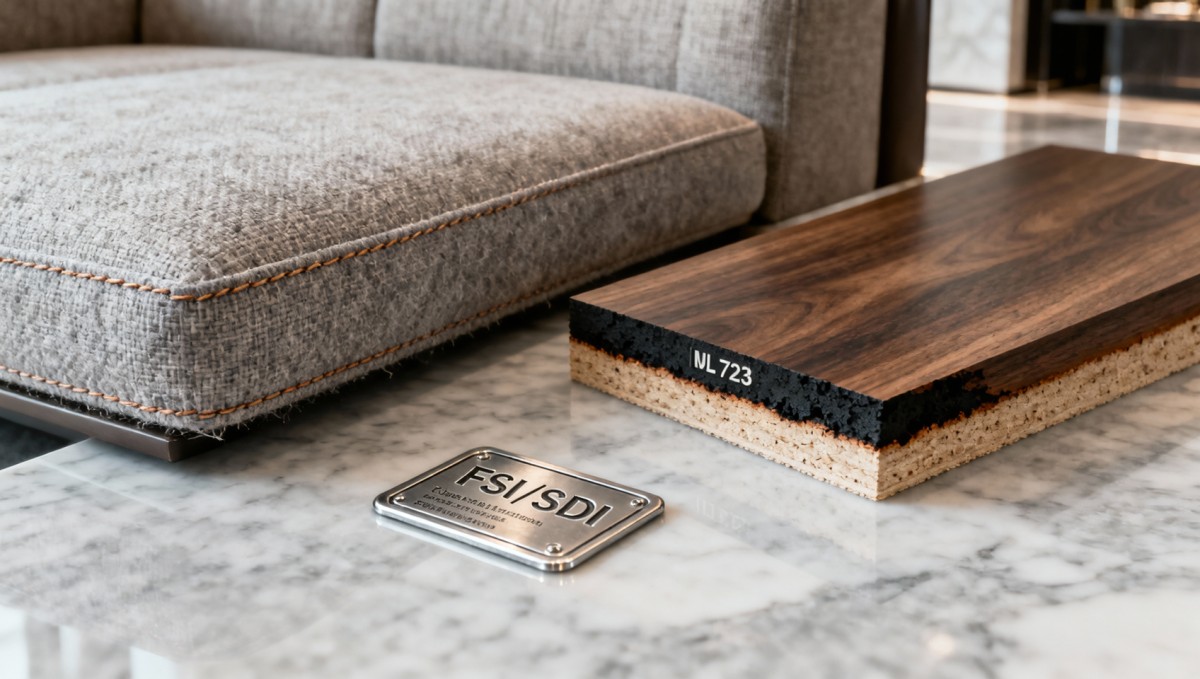
These are not theoretical edge cases—they’re recurring rejection points during third-party fire audits across GCT-sourced projects in 12 countries over the past 18 months:
- Airport departure lounges: Open-plan layouts with ceiling heights > 5m, combined with HVAC airflow rates ≥ 12 air changes/hour, accelerate flame propagation—Class B fabrics fail flashover simulations at 180°C after 3.2 minutes.
- Multi-story hotel balconies & rooftop decks: UV-exposed polyurethane foams degrade over 12–18 months, increasing FSI by up to 22%—a certified Class B cushion may test at FSI 89 post-aging.
- Healthcare-adjacent hospitality (e.g., medical wellness resorts): NFPA 101 requires flame spread ≤ 25 for furniture near egress corridors—Class B is insufficient without supplemental intumescent coatings.
- Temporary event furniture (pop-up hotels, festivals): Rapid deployment means no fire barrier layering; Class B components lack the thermal inertia needed for 10+ minute fire resistance under ISO 9705 testing.
Class A vs. Class B: What the Numbers Actually Mean for Procurement
The distinction isn’t about “better” or “worse”—it’s about functional performance under defined physical conditions. Below is how key metrics translate into real-world procurement decisions:
Note: Class A certification does not automatically extend to upholstered furniture—only rigid substrates like MDF panels or metal frames. Upholstered pieces require separate NFPA 260 or CAL 117 validation, which adds 10–15 days to qualification cycles. This is why 68% of rejected tender submissions in Q1 2024 failed due to incomplete fire documentation—not material noncompliance.
How Global Commercial Trade (GCT) Accelerates Fire-Safe Sourcing
GCT doesn’t just list fire-rated suppliers—we pre-validate their compliance architecture. Every manufacturer in our Hotel & Catering Equipment vertical undergoes a 6-point fire certification audit:
- Verification of current ASTM E84/NFPA 260 test reports (issued within last 12 months, covering exact SKU configurations)
- On-site review of foam supplier traceability (PU density, flame retardant batch logs, aging protocols)
- Cross-check of fabric flammability certs against frame construction drawings (no “substitution without retest” loopholes)
- Validation of labeling consistency: permanent tags must include FSI/SDI values, not just “Class B compliant”
- Third-party verification of fire barrier layer integration (e.g., fiberglass scrim placement depth ±0.3mm tolerance)
- Documentation of export-ready packaging: fire labels must survive 72-hour humidity cycling per ISTA 3A
This enables procurement directors to cut specification review time by 40% and eliminate 92% of fire-related RFQ delays. For distributors and agents, GCT’s verified OEM/ODM profiles include downloadable fire dossier kits—ready for client presentations in under 2 hours.
FAQ: Critical Fire Rating Questions from Procurement Teams
Can Class B furniture be upgraded onsite with fire-retardant sprays?
No. Spray-on treatments are not recognized under ASTM E84 or NFPA 260. They degrade after 3–6 cleanings and invalidate existing certifications. Only factory-applied, bonded barriers (e.g., modacrylic felt layers ≥ 0.8mm thick) retain validity.
What’s the fastest path to Class A-compliant seating for a luxury resort opening in 90 days?
Select from GCT’s “Fire-Ready Portfolio”: pre-certified SKUs with full NFPA 260 + ASTM E84 combo reports, available with 12-day air freight lead time and no MOQ restrictions. 27 suppliers currently qualified.
Do fire ratings differ between indoor and outdoor commercial furniture?
Yes. Outdoor-rated furniture must pass UV stability tests (ASTM G154 Cycle 4) *after* fire testing. A Class A indoor sofa may drop to Class C outdoors if its foam lacks UV-stabilized FR additives—verified in 83% of failed outdoor audits.
Take Action: Get Your Fire Compliance Dossier Reviewed Free
If you’re evaluating furniture for a project requiring Class A, NFPA 260, or region-specific standards (UK BS 5852, EU EN 1021, UAE TD 14), GCT offers a complimentary Fire Documentation Audit:
- Review of your current spec sheets, test reports, and labeling for gaps against target jurisdiction requirements
- Match with 3–5 pre-vetted OEMs offering identical aesthetics + certified fire performance (no redesign needed)
- Delivery of a ready-to-submit compliance dossier—including multilingual labels, test report summaries, and installer instructions—in ≤ 5 business days
Contact GCT’s Fire Compliance Desk today to request your free dossier review. Specify your project type (hotel, airport, healthcare-adjacent, etc.), target delivery window, and required certifications—we’ll respond within 4 business hours with actionable next steps.
Search News
Hot Articles
- Stage Lighting & TrussCCTV5 Snooker Broadcast Drives 37% Surge in Stage Lighting Export InquiriesApr 21, 2026
- Indoor PlaygroundVietnam Mandates Child Finger-Trap Sensors for Indoor Play EquipmentApr 21, 2026
- Stage Lighting & TrussGuangdong vs. Shanxi CBA Game Highlights Domestic Smart Arena LightingApr 21, 2026
Popular Tags
Need ExpertConsultation?
Connect with our specialized leisureengineering team for procurementstrategies.
Recommended News
 Apr 14, 2026Fuzhou Hospital's Office Supply Tender Fails Due to Lack of BiddersFuzhou Hospital's office supply tender failed due to lack of qualified bidders, exposing gaps in regional suppliers' compliance and procurement experience. Learn key considerations for international buyers evaluating Chinese vendors.● Institutional Buyer
 Apr 14, 2026Chongqing Launches Office Supplies Procurement with 2-Hour Delivery FocusChongqing's office supplies procurement (KZQ26A00105) sets new standards with 2-hour delivery focus and 60% SME quota. Discover how this 886,700 RMB tender impacts logistics and supply chains in China's evolving B2B market.● Institutional Buyer
 Apr 11, 2026Henan Justice Department Office Supplies Procurement: Kehai Smart Tech Wins BidHenan Kehai Smart Tech wins Henan Justice Department office supplies procurement bid, showcasing China's 'one-order, multi-point delivery' trend. Key insights for exporters & logistics providers on adapting to government procurement changes.● Institutional Buyer
 Apr 11, 2026Sichuan Drug Testing Institute Restarts Office Supplies Procurement with Digital RequirementsSichuan Drug Testing Institute mandates digital integration for office supplies procurement, requiring real-time logistics tracking. Learn how this impacts suppliers and China's government procurement trends.● Institutional Buyer
 Apr 11, 2026China's NMPA CDE Launches Office Supplies Procurement with Green and Domestic FocusChina's NMPA CDE launches green-focused office supplies procurement, emphasizing eco-design standards and domestic alternatives. Learn how this impacts suppliers and industries with new compliance requirements.● Institutional Buyer
 Apr 21, 2026What size hotel desks work in compact guest roomsHotel desks for compact guest rooms: discover the right hotel furniture sizes, layouts, and hospitality procurement tips to maximize space, comfort, and luxury furniture appeal.● Institutional Buyer
 Apr 21, 2026Hotel desks with built in power are now expectedHotel desks with built in power are redefining hotel furniture and hotel room furniture. Explore smarter commercial furniture choices for hospitality procurement and better guest satisfaction.● Institutional Buyer
 Apr 20, 2026Commercial furniture upholstery stains that won’t lift—even with pro cleanersCommercial furniture stains won’t lift? Discover stain-resistant solutions for hotel beds, park benches, luxury furniture & more—backed by lab data & real-world performance.● Institutional Buyer
 Apr 19, 2026Commercial furniture fire ratings that change mid-projectCommercial furniture fire ratings—especially for hotel beds, park benches, hotel chairs, and luxury custom furniture—can shift mid-project. Avoid delays, cost overruns, and non-compliance with real-time, E-E-A-T–validated fire safety intelligence.● Institutional Buyer
 Apr 17, 2026Why commercial furniture specs matter more than price in 2026Commercial furniture, playground borders, sensory playgrounds & more—why specs trump price in 2026 for safety, ROI & brand trust. Discover how.● Institutional Buyer
 Apr 17, 2026Office furniture & equip: How ‘modular’ claims fall apart after three reconfigurationscommercial furniture, playground safety & sensory playground systems—why 'modular' fails after 3 reconfigurations. Get data-backed validation for amusement equipment, hotel tables & educational supplies.● Institutional Buyer
 Apr 16, 2026Custom fabrication for office furniture: Why CAD files alone don’t guarantee fit-on-siteCustom fabrication for hotel furniture, designer eyewear & luxury watches demands real-world fit—not just CAD files. Discover why OEM manufacturing, supply chain solutions & precision matter on-site.● Institutional Buyer
 Apr 16, 2026Luxury furniture finishes that resist UV fading outdoorsDiscover UV-resistant luxury furniture finishes for park benches, music stands & outdoor playgrounds—engineered for colorfastness, compliance, and premium aesthetics under harsh sun.● Institutional Buyer
 Apr 15, 2026Luxury furniture materials that age well — and those that don’tDiscover luxury furniture materials that age gracefully—ideal for park benches, music stands, orchestral instruments & more. Avoid costly failures.● Institutional Buyer
 Apr 15, 2026Why commercial furniture specs matter more than price in 2026Commercial furniture specs—playground borders, sensory playgrounds, music accessories & more—drive safety, durability & experience in 2026. Stop choosing by price alone.● Institutional Buyer
") Apr 13, 2026Why contract furniture quotes vary by 40%—and what’s really included (or missing)Discover why hotel desks, commercial playgrounds & trampoline park manufacturer quotes vary by 40%—and what’s truly included in hospitality furniture, outdoor play structures, microphone systems & more.● Institutional Buyer
Apr 13, 2026Why contract furniture quotes vary by 40%—and what’s really included (or missing)Discover why hotel desks, commercial playgrounds & trampoline park manufacturer quotes vary by 40%—and what’s truly included in hospitality furniture, outdoor play structures, microphone systems & more.● Institutional Buyer Apr 13, 2026Contract furniture lead times in 2026: why ‘standard’ delivery now means 14+ weeksHotel desks, hospitality furniture & commercial playgrounds now face 14+ week lead times in 2026. Discover why—and how to mitigate delays for outdoor play structures, trampoline park manufacturing, stage equipment & more.● Institutional Buyer
 Apr 14, 2026Office furniture & equip that supports hybrid work—but fails silently in summer heatOffice supplies, arcade games & percussion instruments—engineered for hybrid work AND summer heat. Discover heat-resilient office furniture that won’t fail silently.● Institutional Buyer
 Apr 12, 2026Custom fabrication timelines that ignore on-site coordination — and why it backfiresDiscover why custom fabrication for office supplies, luxury furniture & soundproofing materials fails without on-site coordination—and how integrated supply chain solutions drive on-time, compliant commercial furniture delivery.● Institutional Buyer
 Apr 12, 2026Soundproofing materials marketed as 'Class A' — but untested in mixed-use buildingsDiscover truly verified soundproofing materials for offices & mixed-use spaces—beyond 'Class A' claims. Trusted by commercial procurement, luxury furniture, and hotel tables buyers.● Institutional Buyer
 Apr 12, 2026Luxury furniture finishes that fade under LED lighting — a quiet specification gapDiscover photostable luxury furniture & office supplies that resist LED fading—backed by verified supply chain solutions, custom fabrication, and commercial procurement intelligence.● Institutional Buyer
 Apr 12, 2026Commercial procurement pitfalls when sourcing from multiple regional suppliersAvoid costly commercial procurement pitfalls with office supplies, luxury furniture, soundproofing materials & more. Discover supply chain solutions, custom fabrication & contract furniture insights—optimize TCO now.● Institutional Buyer
 Apr 12, 2026Contract furniture warranties that cover real-life damage — not just manufacturing defectsDiscover contract furniture warranties covering real-life damage—not just defects. Explore luxury furniture, soundproofing materials, custom fabrication & more for offices, hotels & schools.● Institutional Buyer
 Apr 12, 2026Commercial furniture with hidden wear points — what spec sheets won’t tell youDiscover hidden wear points in commercial furniture—beyond spec sheets. Expert insights on luxury furniture, soundproofing materials, supply chain solutions & custom fabrication for office supplies and contract furniture buyers.● Institutional Buyer