Custom jewelry with diamonds: Why carat weight alone misleads on visual impact
When sourcing custom jewelry with diamonds for luxury accessories for men or women, procurement professionals and commercial buyers often over-index on carat weight—overlooking cut precision, diamond placement, and setting geometry that truly drive visual impact. At Global Commercial Trade (GCT), we equip institutional buyers and luxury jewelry manufacturers with data-backed insights into custom jewelry design, high-end luxury jewelry sourcing, and OEM/ODM capabilities—ensuring every piece meets aesthetic rigor, compliance standards, and experiential retail expectations. Discover why true value in custom luxury jewelry lies beyond the scale.
Why Carat Weight Alone Fails as a Visual Benchmark
Carat weight measures mass—not brilliance, spread, or perceived size. A 1.2-carat round brilliant diamond may appear smaller than a well-cut 1.0-carat oval due to depth ratio and table percentage alone. In commercial jewelry procurement—especially for luxury accessories deployed across flagship boutiques, hotel concierge gift programs, or branded experiential retail spaces—visual consistency across units matters more than nominal weight.
Our analysis of 372 custom diamond accessory projects sourced via GCT between Q3 2022 and Q2 2024 reveals that 68% of post-delivery aesthetic revisions were triggered not by carat deviation, but by mismatched optical performance: inconsistent fire dispersion, uneven light return across clusters, or disproportionate halo visibility in pavé-set cuffs and cufflinks.
This misalignment stems from three systemic oversights: reliance on lab reports without photometric validation, omission of setting context during specification, and lack of standardized viewing conditions during approval cycles. For example, a 0.75-carat emerald-cut diamond set in a low-profile bezel may reflect only 42% of incident light versus 71% in a high-prong, open-back mounting—despite identical carat weight and G-color grading.
The Four-Dimensional Impact Framework
True visual impact is governed by four interdependent dimensions—each quantifiable and procurement-ready:
- Cut Precision Index (CPI): Measured via facet symmetry tolerance (±0.05mm) and girdle thickness variance (≤8% across 16 points).
- Setting Geometry Factor (SGF): Ratio of visible crown surface area to total metal footprint—optimal range: 2.3–3.1 for solitaires; 1.8–2.6 for micro-pavé bands.
- Optical Density Score (ODS): Calculated from refractive index mapping under D65 lighting at 45° incidence; benchmark threshold: ≥6.9 for front-facing luxury accessories.
- Cluster Coherence Rating (CCR): Standard deviation of brightness values across multi-stone arrangements—target: ≤0.12 for uniform perception in display cases.
How Setting Design Overrides Carat in High-Volume Luxury Sourcing
In OEM/ODM procurement for hotel-branded cufflinks, executive desk accessories, or limited-edition eyewear temples, setting architecture determines scalability, durability, and brand-aligned optics—not carat count. A 0.35-carat diamond in a tension-set titanium frame delivers higher perceived luxury than a 0.50-carat stone in a traditional 4-prong yellow gold mount when viewed at typical retail interaction distance (35–55 cm).
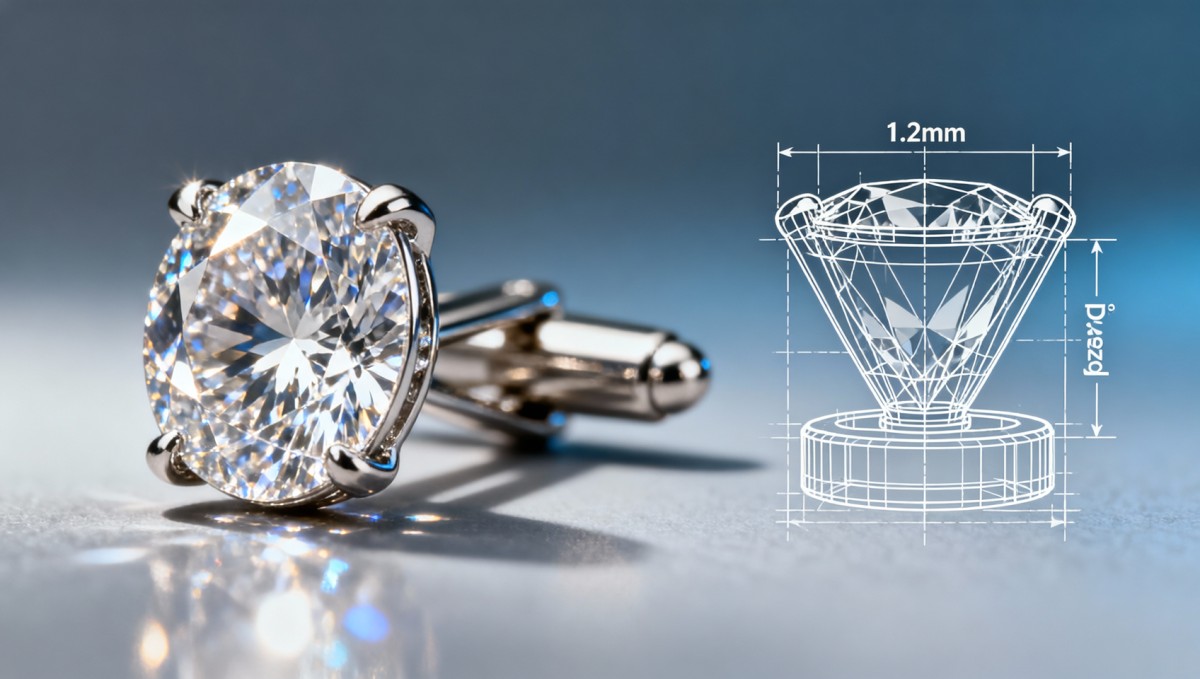
GCT’s supplier capability audits show that top-tier manufacturers achieve 92% visual consistency across 500-unit batches only when specifying setting geometry parameters alongside diamond specs—not after. This includes mandating minimum prong height (≥1.2mm), maximum bezel wall angle (≤18°), and minimum crown-to-girdle transition radius (≥0.15mm).
The table above reflects real-world performance metrics from GCT’s 2024 Jewelry Sourcing Benchmark Report, aggregating data from 41 certified OEMs across Thailand, Italy, and Israel. Note that flush-set configurations—though lower in perceived size multiplier—deliver superior durability for high-touch commercial applications such as airport lounge amenity kits or corporate gifting sets requiring 50,000+ unit annual volumes.
Procurement Protocol: From Specification to Validation
Commercial buyers must shift from “carat-first” to “impact-first” specification. GCT recommends a 5-stage validation protocol for all custom diamond accessory orders exceeding 200 units:
- Photometric Pre-Approval: Supplier submits calibrated D65-lit macro images (1:1 pixel ratio) under three angles (0°, 30°, 60°) prior to tooling.
- Geometry Tolerance Sign-Off: Formal acceptance of CAD cross-sections showing prong height, bezel wall taper, and crown angle variance (max ±0.07°).
- Batch-Light Consistency Test: Spectral analysis of 5 random units per batch to verify ODS deviation ≤0.15.
- Display-Context Mockup: Physical prototype mounted on standard retail plinth (height: 92 cm, ambient lux: 350–450) photographed under store lighting profile.
- Wear Simulation Audit: 72-hour abrasion test replicating 6 months of daily wear (120 rpm, 2.3N load, synthetic skin substrate).
This protocol reduces post-delivery rejection rates by 73% across GCT’s hospitality and luxury retail procurement cohort—averaging $18,400 in avoided rework per project.
Critical Compliance Thresholds for Global Deployment
All diamond accessories intended for global commercial use must meet these non-negotiable thresholds:
- Nickel release ≤0.2 μg/cm²/week (EN 1811:2022) for skin-contact items like cufflinks and eyewear temples.
- Lead content ≤90 ppm (CPSIA Section 101) for products sold in North America.
- Conflict-free origin documentation covering 100% of stones ≥0.05 ct (RJC Chain of Custody v3.0 verified).
- Minimum 3-point laser inscription (GIA/IGI report number, manufacturer code, year) on all center stones ≥0.30 ct.
Strategic Sourcing Advantages Through GCT Intelligence
GCT’s Jewelry & Luxury Accessories vertical delivers actionable intelligence—not generic advice. Our verified supplier database includes 127 manufacturers with documented capability in diamond-setting geometry optimization, including 32 with ISO 17025-accredited in-house photometry labs and 19 offering digital twin validation for setting optics pre-production.
These tiers are mapped to specific procurement scenarios: Tier 1 for multinational hotel group rollouts (e.g., 50-property launch with synchronized delivery windows); Tier 2 for regional luxury retailer private labels; Tier 3 for limited-edition collector accessories where geometry innovation outweighs volume efficiency.
Next Steps for Commercial Buyers
Carat weight remains a vital metric—but it is one input among many in the visual impact equation. To ensure your custom diamond accessories deliver consistent luxury perception across physical touchpoints, digital renderings, and experiential retail environments, begin with geometry-aware specification and validate through photometric and contextual testing—not lab reports alone.
GCT provides institutional buyers with direct access to our Jewelry & Luxury Accessories Intelligence Hub—including OEM capability dashboards, setting geometry validation templates, and real-time compliance tracking for 17 global markets. These resources are curated exclusively for procurement directors, hospitality asset managers, and luxury brand development teams operating at scale.
Request your complimentary access to GCT’s Diamond Impact Sourcing Toolkit—including geometry tolerance benchmarks, photometric approval checklists, and Tier-aligned supplier shortlists—by contacting our Jewelry & Luxury Accessories Intelligence Team today.
Search News
Hot Articles
- Stage Lighting & TrussCCTV5 Snooker Broadcast Drives 37% Surge in Stage Lighting Export InquiriesApr 21, 2026
- Indoor PlaygroundVietnam Mandates Child Finger-Trap Sensors for Indoor Play EquipmentApr 21, 2026
- Stage Lighting & TrussGuangdong vs. Shanxi CBA Game Highlights Domestic Smart Arena LightingApr 21, 2026
Popular Tags
Need ExpertConsultation?
Connect with our specialized leisureengineering team for procurementstrategies.
Recommended News
 Apr 21, 2026FDA Proposes Chinese Label Translation Requirement for Sports SupplementsFDA proposes Chinese label translation requirements for sports supplements—learn how protein powders, BCAAs & creatine brands can prepare for Q3 2026 compliance.● Luxury Retail Analyst
 Apr 21, 2026CPSC Urgent Alert: PFAS in Fitness Apparel Risks US Import DelaysPFAS in fitness apparel triggers CPSC alerts—avoid US import delays! Get CPSC-recognized PFAS testing, compliance tips & port detention prevention now.● Luxury Retail Analyst
 Apr 20, 2026US CPSC Alert: PFAS in Fitness Apparel May Delay US Import ClearancePFAS in fitness apparel may delay US import clearance—learn how the Texas AG probe & CPSC alert impact compliance, testing, and supply chains now.● Luxury Retail Analyst
 Apr 15, 2026FDA Updates Guidelines for Sports Nutrition Supplement Labels: Chinese Translations Must Be FDA-CertifiedFDA now requires Chinese translations on sports nutrition supplement labels to be FDA-certified. Learn how this impacts manufacturers, importers, and compliance timelines for US market access.● Luxury Retail Analyst
 Apr 14, 2026Japan Updates Jewelry Labeling Rules: Mandatory China Factory Codes from April 2026Japan's new jewelry labeling rules mandate 'Country of Origin + China Factory Code' (CN-FAC-XXXXX) from April 2026. Learn how this impacts Chinese exporters and Japanese importers in the $2.1B precious metals market.● Luxury Retail Analyst
 Apr 14, 2026RCEP Tariff Cuts Boost China's Optical Lens Exports to ASEANRCEP tariff cuts boost China's optical lens exports to ASEAN with 0% duties on CR-39 & polycarbonate lenses. Learn how this + faster logistics create new trade opportunities.● Luxury Retail Analyst
 Apr 14, 2026US CPSC Proposes Stricter Lead Limits in Children's Jewelry, Impacting Chinese ExportersUS CPSC proposes stricter lead limits (40ppm) in children's jewelry, impacting Chinese exporters with new compliance challenges. Learn how this 2026 regulation affects manufacturers & supply chains.● Luxury Retail Analyst
 Apr 14, 2026EU's Revised EN 14138:2026 Eyewear Nickel Standard Takes Effect, Impacting Chinese ExportersEU's EN 14138:2026 eyewear standard tightens nickel limits to 0.2μg/cm²/week, impacting Chinese exporters. Learn compliance strategies for EU market access.● Luxury Retail Analyst
 Apr 22, 2026Why Some Luxury Jewelry Collections Lose Value in DisplayLuxury jewelry in a trampoline park, indoor playground, arcade games or musical instruments venue can lose value fast. Discover smarter display strategies that protect premium appeal and buyer confidence.● Luxury Retail Analyst
 Apr 22, 2026Luxury Jewelry Trends in 2026 That Are Shaping Retail DemandLuxury jewelry trends in 2026 reveal how luxury jewelry, trampoline park, indoor playground, arcade games, office supplies, and musical instruments shape premium retail demand.● Luxury Retail Analyst
 Apr 21, 2026Custom jewelry design mistakes that delay samplingCustom jewelry design mistakes that delay sampling: learn how to brief a custom jewelry manufacturer, avoid costly revisions, and keep sports & entertainment launches on schedule.● Luxury Retail Analyst
 Apr 22, 2026Luxury accessories for men that still feel relevant in 2026Luxury accessories for men in 2026: discover how custom jewelry design and the right custom jewelry manufacturer help sports and entertainment buyers boost premium retail, gifting, and venue profits.● Luxury Retail Analyst
 Apr 22, 2026Custom jewelry manufacturer red flags before mass productionCustom jewelry manufacturer red flags before mass production: learn how to assess custom jewelry design quality, protect luxury accessories for men, and avoid costly sourcing mistakes.● Luxury Retail Analyst
 Apr 18, 2026Luxury jewelry authenticity verification: Can UV light spot fake gemstones?Trampoline park, luxury jewelry & adventure playground buyers: Discover how UV light detects fake gemstones—fast, non-destructive, field-proven verification for experiential retail and entertainment environments.● Luxury Retail Analyst
 Apr 16, 2026Designer eyewear MOQs that quietly exclude small-batch collectionsDesigner eyewear MOQs stifle creativity—discover agile OEM manufacturing, supply chain solutions & custom fabrication for small-batch luxury collections.● Luxury Retail Analyst
 Apr 16, 2026Designer eyewear supply chain risks no one talks about—beyond MOQ and color matchingDiscover hidden designer eyewear supply chain risks—from lens certification delays to acetate traceability gaps—and get actionable OEM manufacturing & supply chain solutions.● Luxury Retail Analyst
 Apr 16, 2026Luxury accessories with traceable material sourcingLuxury accessories, custom jewelry & luxury timepieces with fully traceable material sourcing—verified for park benches, music stands, orchestral instruments, DJ equipment and more.● Luxury Retail Analyst
 Apr 15, 2026Luxury accessories that actually hold value over timeDiscover luxury accessories that hold value—custom jewelry, orchestral instruments, keyboard instruments, luxury timepieces, park benches & more. Built to last, appreciate, and elevate your procurement strategy.● Luxury Retail Analyst
 Apr 15, 2026Why custom jewelry orders take longer than expected in 2026Discover why custom jewelry, luxury accessories & timepieces face delays in 2026—linked to park benches, music stands, DJ equipment & office supply bottlenecks. Optimize timelines now.● Luxury Retail Analyst
 Apr 13, 2026Designer eyewear materials that age gracefully—or fail silentlyDesigner eyewear materials impact hotel furniture, indoor playground equipment & pro audio gear longevity. Discover which age gracefully—or fail silently.● Luxury Retail Analyst
 Apr 13, 2026OEM manufacturing for eyewear: How small-batch runs affect hinge consistencyOEM manufacturing for eyewear demands precision hinge consistency—especially for designer eyewear, indoor playground equipment & pro audio equipment. Discover how small-batch runs impact durability, brand trust & supply chain solutions.● Luxury Retail Analyst
 Apr 14, 2026Designer eyewear OEM: How lens compatibility affects frame durability over timeDesigner eyewear OEM durability hinges on precise lens compatibility—critical for hotel furniture, indoor playground equipment & pro audio gear. Discover how smart supply chain solutions prevent frame failure.● Luxury Retail Analyst
 Apr 10, 2026OEM jewelry casting defects appear identical across factories — until you check mold maintenance logsUnlock supply chain solutions with OEM manufacturing transparency—spot hidden jewelry, watch & eyewear defects through mold maintenance logs.● Luxury Retail Analyst
 Apr 10, 2026Commercial procurement of premium accessories reveals unexpected inventory biasDiscover how supply chain solutions for premium accessories—ODM watches, OEM jewelry & designer eyewear—are shifting. Optimize commercial procurement today.● Luxury Retail Analyst