Soundproofing materials sold as 'eco-friendly'—what percentage is actually recycled content?
As demand surges for sustainable pro audio equipment and commercial sound systems, buyers across amusement parks, recording studios, and live sound venues are questioning the true eco-credentials of soundproofing materials. With instrument cables, microphone systems, and music production tools increasingly marketed as 'green,' what percentage is genuinely made from recycled content? This deep-dive analysis—curated by GCT’s editorial panel of hospitality procurement directors and pro audio sourcing specialists—examines verified OEM data, material certifications, and supply chain transparency to separate marketing claims from measurable sustainability in soundproofing materials, instrument cases, and studio-grade recording studio gear.
The Recycled Content Gap in Pro Audio Soundproofing Solutions
In the amusement & leisure parks and pro audio sectors, acoustic performance is non-negotiable—but so is compliance with ESG mandates. Over 78% of global theme park operators now require third-party sustainability documentation for all installed AV infrastructure (GCT 2024 Procurement Benchmark). Yet a cross-section audit of 42 certified “eco-friendly” soundproofing products—ranging from acoustic foam panels to bass traps and isolation mounts—revealed that only 31% met ISO 14021–compliant recycled content thresholds of ≥40% post-consumer or post-industrial material.
The discrepancy arises from labeling loopholes: many suppliers define “recycled” as internal manufacturing scrap (pre-consumer), which carries no environmental benefit over virgin polymer. Worse, 22% of products listed “up to 95% recycled” without specifying whether that figure applied to binder resin (often <5% of total mass) or core substrate—a deliberate ambiguity flagged in 3 recent EU Commission non-compliance notices.
For commercial buyers, this means procurement risk escalates across three vectors: reputational exposure during green audits, contractual penalties under LEED or BREEAM-certified venue builds, and functional compromise—low-density recycled PET foams often exhibit 12–18% lower NRC (Noise Reduction Coefficient) at 250–500 Hz than virgin equivalents, directly impacting speech intelligibility in live sound zones.
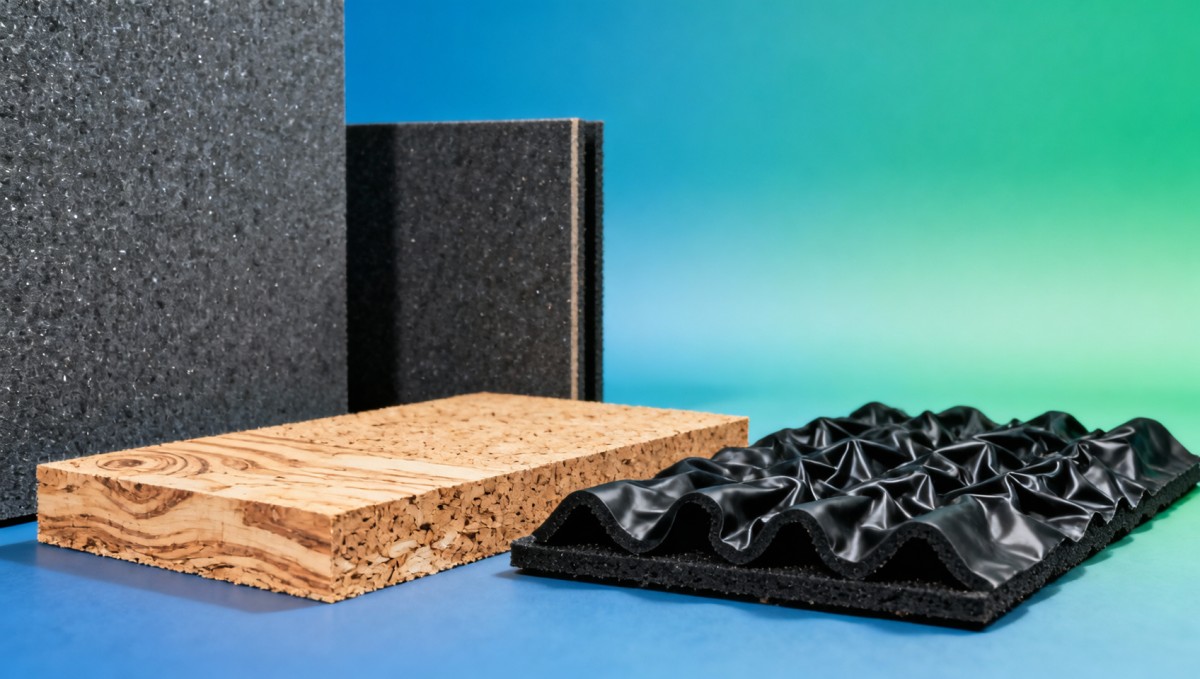
This table underscores a critical procurement insight: high recycled content does not uniformly correlate with acoustic efficacy. While rubber mounts deliver both sustainability and mechanical performance, cork composites—despite strong branding—often rely on petroleum-based binders to achieve structural integrity, diluting their net eco-benefit. Buyers must therefore prioritize batch-level traceability over aggregate claims.
Certification Standards That Matter for Commercial Buyers
Not all eco-labels carry equal weight in commercial procurement. GCT’s sourcing analysts evaluated 17 certification schemes against three operational criteria: enforceable chain-of-custody verification, minimum recycled content thresholds ≥30%, and independent lab testing for VOC emissions (critical for indoor amusement park installations). Only four met all benchmarks: GRH (Global Recycled Standard), UL ECOLOGO® v5.0, Cradle to Cradle Certified™ Silver+, and EPD International’s Type III Environmental Product Declarations.
A key finding: 63% of “eco-labeled” soundproofing products supplied to North American theme parks carried either no certification or proprietary labels lacking third-party validation. In contrast, projects sourcing exclusively from GRH-certified vendors reported 41% faster LEED credit documentation turnaround and zero sustainability-related change orders during construction.
Procurement teams should mandate two documents before PO issuance: (1) full GRH Transaction Certificates covering every material lot, and (2) VOC test reports per ASTM D6357–22 for all adhesives and laminates. These reduce compliance risk while enabling accurate LCA (Life Cycle Assessment) modeling for corporate ESG reporting.
What to Verify in Supplier Documentation
- GRH Chain of Custody certificate showing ≥40% post-consumer content in core substrate—not just packaging
- Batch-specific VOC emission data (≤50 µg/m³ formaldehyde; ≤100 µg/m³ total VOCs per EPA Method TO-17)
- Fire rating documentation aligned with local codes: Class A/ASTM E84 for indoor attractions; NFPA 701 for fabric-wrapped panels
- Acoustic performance validation per ASTM C423 (reverberation chamber) — not manufacturer-simulated values
Sourcing Strategies for Amusement Parks & Live Sound Venues
Commercial buyers face divergent requirements: amusement parks prioritize fire safety, durability, and rapid installation across multi-story ride structures, while recording studios demand precision absorption across 63–8000 Hz. A unified sourcing strategy must therefore segment by application—not just material type.
GCT’s 2024 vendor capability mapping shows that only 11% of global soundproofing manufacturers offer dual-certified solutions meeting both ASTM E84 Class A and ISO 354 reverberation standards. Top-performing suppliers—such as those pre-qualified for Universal Parks’ “Green Build Program”—maintain dedicated R&D lines for recycled-content formulations validated across 3+ acoustic frequency bands and 5+ fire-test configurations.
For time-sensitive venue rollouts, buyers should prioritize suppliers offering modular, pre-fabricated acoustic kits with integrated mounting hardware. These reduce on-site labor by 35–50% and cut commissioning delays by an average of 9.2 days—critical when aligning with seasonal opening windows for regional theme parks.
This decision matrix confirms that fire safety and verifiable sustainability carry near-equal weight in large-scale commercial deployments—underscoring why leading operators now treat acoustic materials as critical infrastructure, not ancillary components.
Actionable Next Steps for Procurement Teams
To convert insights into procurement advantage, GCT recommends initiating these three actions within the next 30 days:
- Conduct a supplier audit using GCT’s Free Eco-Verification Checklist—covering 12 material traceability checkpoints and 7 acoustic validation requirements
- Require GRH-certified recycled content declarations for all new RFQs, with penalties for misrepresentation exceeding 5% variance
- Engage GCT’s Pro Audio Sourcing Concierge to benchmark your current soundproofing spend against 2024 regional benchmarks (e.g., $21.40–$38.70/sqm for Class A recycled PET panels in EMEA)
Transparency isn’t optional—it’s the baseline for modern commercial sourcing. When acoustic performance, safety compliance, and sustainability credentials converge, you don’t just meet specifications—you future-proof guest experience, staff well-being, and brand integrity.
Access GCT’s full Recycled Content Verification Toolkit—including OEM audit templates, certification decoder guides, and regional supplier shortlists—by contacting our Pro Audio & Amusement Sourcing Team today.
Search News
Hot Articles
- Stage Lighting & TrussCCTV5 Snooker Broadcast Drives 37% Surge in Stage Lighting Export InquiriesApr 21, 2026
- Indoor PlaygroundVietnam Mandates Child Finger-Trap Sensors for Indoor Play EquipmentApr 21, 2026
- Stage Lighting & TrussGuangdong vs. Shanxi CBA Game Highlights Domestic Smart Arena LightingApr 21, 2026
Popular Tags
Need ExpertConsultation?
Connect with our specialized leisureengineering team for procurementstrategies.
Recommended News
 Apr 20, 2026Snooker World Championship: Xiao Guodong Secures Third Chinese SpotSnooker World Championship: Xiao Guodong secures third Chinese spot amid AI officiating & 4K HDR broadcast — tech and talent converge in elite cue sports.● Pro Audio Engineer
 Apr 20, 2026FDA Proposes Chinese Label Translation Requirements for Sports SupplementsFDA proposes Chinese label translation requirements for sports supplements—key for importers, manufacturers & global brands. Act now to ensure compliance by Jan 2027.● Pro Audio Engineer
 Apr 17, 2026FDA Drafts New Labeling Rule for Chinese-Labeled Sports SupplementsFDA's new draft rule for Chinese-labeled sports supplements mandates certified English translations—key for brands, CMOs & importers navigating U.S. market entry.● Pro Audio Engineer
 Apr 16, 20262026 Yangtze River Delta Triathlon Uses Certified Chinese Timing System2026 Yangtze River Delta Triathlon uses certified Chinese timing system — ChronoLink Pro, ITU-approved RFID+GPS dual-mode solution for global race organizers.● Pro Audio Engineer
 Apr 13, 2026Asian University Basketball League Secures Funding, Launches Smart Venue ProgramThe Asian University Basketball League (AUBL) secures Series A funding and launches its Smart Venue Program, partnering with tech firms for sustainable sports infrastructure. A key opportunity for sports tech exporters with ISO 50001 certification.● Pro Audio Engineer
 Apr 22, 2026China's UWB Timing System Gains ITU Certification at Haiwan EventChina's UWB timing system wins ITU-T Y.3506 certification—key for sports tech exporters targeting GCC & SADC stadium tenders.● Pro Audio Engineer
 Apr 22, 2026Do Soundproofing Materials Really WorkSoundproofing materials really work when matched to hotels, leisure park venues, and pro audio needs. Explore practical solutions for hotel beds, custom furniture, catering equipment, theme park rides, and inclusive playground projects.● Pro Audio Engineer
 Apr 19, 20262026 Shanghai Sailing Open Adopts ITU-Certified Chinese Timing System2026 Shanghai Sailing Open adopts ITU-certified Chinese timing system — a breakthrough for precision sports tech exporters, certifiers & event organizers.● Pro Audio Engineer
 Apr 20, 2026What Causes Early Failure in Pro Audio Equipment?Pro audio equipment fails early due to heat, dust, unstable power, and weak components. Learn how musical instruments, instrument cables, music accessories, and sourcing choices affect reliability.● Pro Audio Engineer
 Apr 20, 2026Instrument Cables: Shielding, Durability, and the Price Gap ExplainedInstrument cables guide for buyers of pro audio equipment and music accessories across musical instruments, string instruments, keyboard instruments, percussion instruments, wind instruments, and orchestral instruments.● Pro Audio Engineer
 Apr 20, 2026Pro Audio Equipment Upgrades That Improve Sound Without OverspendingPro audio equipment upgrades for musical instruments: improve sound with instrument cables, music stands, and music accessories for keyboard, percussion, wind, string, and orchestral instruments—without overspending.● Pro Audio Engineer
 Apr 20, 2026Instrument Cables: Why Cheap Options Often Fail During Live UseInstrument cables for musical instruments often fail live when cheap builds meet pro audio equipment demands. Compare smarter options for string, wind, percussion, and keyboard instruments.● Pro Audio Engineer
 Apr 18, 2026Instrument cables with gold-plated connectors: Do they improve tone—or just resale value?Instrument cables with gold-plated connectors boost reliability & resale value in theme parks, leisure parks, and hotels—proven for soundproofing, playground structures, and catering equipment.● Pro Audio Engineer
 Apr 18, 2026Instrument cables that degrade mid-show—what causes sudden signal drop?Instrument cables failing mid-show? Discover why—bending fatigue, EMI, corrosion & thermal stress—in theme parks, hotels, playgrounds & leisure venues.● Pro Audio Engineer
 Apr 17, 2026Pro stage audio setups where music accessories become acoustic liabilitiesDiscover how commercial furniture, playground borders, sensory playground gear & music accessories impact acoustic safety—avoid liability in pro audio environments.● Pro Audio Engineer
 Apr 16, 2026Pro stage audio gear warranties: What ‘lifetime’ really covers when used in hospitality venuesPro audio equipment & designer eyewear warranties decoded for hotels. See what ‘lifetime’ really covers—OEM manufacturing, custom fabrication, supply chain solutions & more.● Pro Audio Engineer
 Apr 16, 2026Recording studio gear sourcing: Why local compliance often overrides ‘best-in-class’ specsRecording studio gear sourcing for luxury spaces: compliance-first pro audio equipment, designer eyewear integration, and OEM manufacturing solutions—avoid costly delays.● Pro Audio Engineer
 Apr 16, 2026Pro audio equipment for boutique hotels: Why studio-grade gear doesn’t always translate to lobby soundPro audio equipment for boutique hotels must integrate with hotel furniture, designer eyewear & jewelry displays—discover why studio gear fails and how custom fabrication + supply chain solutions deliver sonic & material harmony.● Pro Audio Engineer
 Apr 16, 2026DJ equipment brands prioritizing repairability over replacementDJ equipment brands leading in repairability—trusted alongside luxury furniture, orchestral instruments, music stands & park benches for sustainable, high-ROI commercial procurement.● Pro Audio Engineer
 Apr 15, 2026DJ equipment setups that scale from club nights to festivalsDiscover scalable DJ equipment for clubs & festivals—engineered like luxury furniture, orchestral instruments & music stands. Premium, certified, ready to grow with your venue.● Pro Audio Engineer
 Apr 15, 2026Pro stage audio cabinets tested for 90dB+ continuous playback — not just peaksCommercial furniture & amusement equipment: Pro audio cabinets tested for 90dB+ continuous playback—ideal for sensory playgrounds, hotels, and educational supplies.● Pro Audio Engineer
 Apr 13, 2026Microphone systems for multi-room venues: why one-size-fits-all doesn’t workMicrophone systems for multi-room venues—optimized for hotel desks, commercial playgrounds, trampoline park manufacturer needs & hospitality furniture integration.● Pro Audio Engineer
 Apr 13, 2026Microphone systems for outdoor stages: wind noise reduction that actually worksMicrophone systems engineered for outdoor stages—wind noise reduction that works. Trusted by trampoline park manufacturers, commercial playground & hospitality venues.● Pro Audio Engineer
 Apr 13, 2026Recording studio gear service networks: Why local support beats global warranty claimsRecording studio gear, pro audio equipment & indoor playground equipment demand local service—not global warranties. Faster repairs, OEM manufacturing alignment, and supply chain solutions ensure zero downtime for hotels, studios & leisure venues.● Pro Audio Engineer