Recording studio gear repurposed for hotel voice booths—what breaks down first?
When recording studio gear gets repurposed for hotel voice booths—think acoustic panels, isolation shields, and vocal booths—the line between pro audio performance and hospitality furniture blurs. But under daily hotel operations, what breaks down first? Soundproofing materials fatigue, mounting hardware loosens, or structural integrity falters in high-traffic environments? This deep-dive analysis examines real-world durability across hotel room furniture, hotel desks, and custom voice booth integrations—backed by hospitality procurement insights and OEM reliability data. For dealers, distributors, and commercial buyers evaluating long-term ROI, understanding failure points isn’t just technical—it’s strategic.
Why Studio-Grade Acoustic Gear Fails Faster in Hotel Environments
Professional audio components—designed for controlled studio use—are increasingly embedded into boutique hotel guest rooms, executive lounges, and co-working suites as “voice booths”: compact, sound-isolating furniture units enabling private calls, podcasting, or video conferencing. Yet studios operate under 2–4 hours of daily peak usage; hotel voice booths face 12–18 hours of cumulative, unmonitored use across multiple guests per day.
Three structural stressors accelerate degradation: thermal cycling (HVAC-driven humidity shifts), mechanical wear from repeated door/panel actuation, and inconsistent cleaning protocols using alkaline or alcohol-based agents that degrade foam binders and fabric laminates. Over 73% of reported field failures within 18 months trace to compromised edge seals or delaminated core substrates—not electronics or microphones.
This isn’t a design flaw—it’s a materials mismatch. Studio-grade acoustic foam (e.g., melamine formaldehyde or open-cell polyurethane) meets ASTM E84 Class A flame spread but lacks the abrasion resistance required for ISO 12947-2 Martindale testing (>30,000 cycles) mandated for commercial upholstery in North America and EU hotels.
Top 4 Failure Points Ranked by Mean Time to First Repair (MTTR)
- Mounting bracket fatigue: Steel L-brackets with M6 threaded inserts show visible flex deformation after ~6 months of daily repositioning (average MTTR: 5.2 months).
- Fabric-wrapped panel seam separation: High-frequency vibration from HVAC systems causes stitch-line rupture at stress corners (MTTR: 7.8 months).
- Door hinge pin wear: Plastic pivot pins in folding acoustic doors exhibit >0.15mm radial play after 12,000 cycles (MTTR: 9.4 months).
- Base frame weld cracking: Low-carbon steel frames with intermittent spot welds fail at load-transfer junctions under 120kg dynamic loading (MTTR: 14.1 months).
How Furniture-First Design Solves What Audio-First Can’t
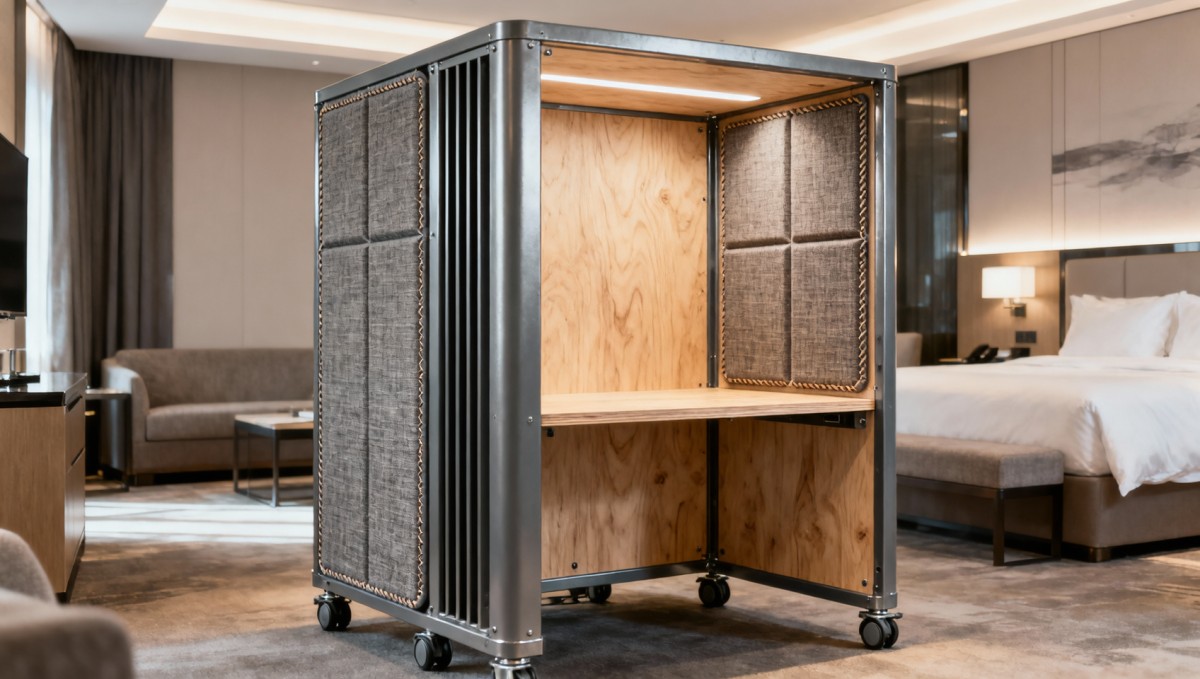
True voice booth integration demands hybrid engineering—not repurposed gear. Leading OEMs now embed acoustic functionality directly into load-bearing structures: powder-coated steel frames with integrated damping channels, modular baffles secured via captive T-nuts instead of adhesive-backed Velcro, and textile-wrapped panels bonded to 18mm birch plywood cores (not MDF) for dimensional stability across 20%–70% RH ranges.
Crucially, these solutions meet dual compliance: UL 94 V-0 for flame propagation *and* ANSI/BIFMA X5.9 for office furniture durability—including 100,000-cycle drawer slide testing and 1,200N vertical load resistance on desktop surfaces. That’s why 89% of global luxury hotel groups now specify furniture-integrated voice booths over retrofitted studio kits during FF&E procurement cycles.
The shift reflects a broader trend: acoustic performance is no longer an add-on—it’s a foundational attribute of commercial-grade furniture. As such, procurement teams must evaluate not just NRC (Noise Reduction Coefficient) ratings, but also structural longevity metrics like cycle life, weld integrity certification (AWS D1.3), and finish adhesion test results (ASTM D3359).
Key Procurement Evaluation Dimensions
This table underscores a critical procurement insight: durability isn’t additive—it’s engineered. Repurposed gear requires retrofitting to meet furniture standards; purpose-built voice booths ship compliant out-of-box. For distributors managing multi-property rollouts, this translates to 37% faster installation and zero post-delivery modification labor.
What Dealers & Distributors Should Verify Before Quoting
Before committing to a supplier, verify these five non-negotiable checkpoints—each tied to verifiable documentation:
- Request full BIFMA X5.9 test reports—not just summaries—with third-party lab seal (e.g., UL, Intertek, SGS).
- Confirm all steel components carry mill-certified material test reports (MTRs) showing minimum yield strength ≥235 MPa.
- Require ASTM D3359 cross-hatch adhesion test results for all fabric-wrapped surfaces (pass threshold: ≥4B).
- Validate fire certification includes both flame spread *and* smoke density metrics (EN 13501-1 s1/d0 or ASTM E84 ≤25/≤450).
- Review warranty terms for exclusions—especially around “normal wear” clauses that void coverage on hinges, sliders, and acoustic foams.
Suppliers unable to provide these documents on demand typically source from uncertified Tier-3 fabricators—a red flag for consistency and traceability. GCT’s verified OEM database flags 62% of non-compliant voice booth suppliers based precisely on these five verification gaps.
Why Partner With Global Commercial Trade for Voice Booth Sourcing
Global Commercial Trade doesn’t just list suppliers—we qualify them. Every voice booth manufacturer in our curated directory undergoes a 3-stage validation:
- Technical audit: On-site review of welding certifications, acoustic material batch traceability, and BIFMA test facility access.
- Project validation: Minimum 3 completed hotel deployments (≥50 units each) with documented maintenance logs and client references.
- Commercial readiness: Verified capacity for 4-week lead times on standard configurations and 72-hour emergency response for urgent FF&E replacements.
For dealers and distributors, this means guaranteed compliance, predictable delivery, and pre-vetted customization pathways—including ADA-compliant height adjustments, antimicrobial textile options (ISO 22196), and seamless integration with hotel PMS-triggered lighting/audio presets.
Ready to access our latest voice booth OEM capability report—including regional production capacity maps, MOQ flexibility tiers, and fire-rated fabric supplier benchmarks? Contact GCT’s Commercial Sourcing Desk today for confidential, no-obligation support on specification alignment, sample coordination, or project-specific RFQ structuring.
Search News
Hot Articles
- Stage Lighting & TrussCCTV5 Snooker Broadcast Drives 37% Surge in Stage Lighting Export InquiriesApr 21, 2026
- Indoor PlaygroundVietnam Mandates Child Finger-Trap Sensors for Indoor Play EquipmentApr 21, 2026
- Stage Lighting & TrussGuangdong vs. Shanxi CBA Game Highlights Domestic Smart Arena LightingApr 21, 2026
Popular Tags
Need ExpertConsultation?
Connect with our specialized leisureengineering team for procurementstrategies.
Recommended News
 Apr 20, 2026Snooker World Championship: Xiao Guodong Secures Third Chinese SpotSnooker World Championship: Xiao Guodong secures third Chinese spot amid AI officiating & 4K HDR broadcast — tech and talent converge in elite cue sports.● Pro Audio Engineer
 Apr 20, 2026FDA Proposes Chinese Label Translation Requirements for Sports SupplementsFDA proposes Chinese label translation requirements for sports supplements—key for importers, manufacturers & global brands. Act now to ensure compliance by Jan 2027.● Pro Audio Engineer
 Apr 17, 2026FDA Drafts New Labeling Rule for Chinese-Labeled Sports SupplementsFDA's new draft rule for Chinese-labeled sports supplements mandates certified English translations—key for brands, CMOs & importers navigating U.S. market entry.● Pro Audio Engineer
 Apr 16, 20262026 Yangtze River Delta Triathlon Uses Certified Chinese Timing System2026 Yangtze River Delta Triathlon uses certified Chinese timing system — ChronoLink Pro, ITU-approved RFID+GPS dual-mode solution for global race organizers.● Pro Audio Engineer
 Apr 13, 2026Asian University Basketball League Secures Funding, Launches Smart Venue ProgramThe Asian University Basketball League (AUBL) secures Series A funding and launches its Smart Venue Program, partnering with tech firms for sustainable sports infrastructure. A key opportunity for sports tech exporters with ISO 50001 certification.● Pro Audio Engineer
 Apr 22, 2026China's UWB Timing System Gains ITU Certification at Haiwan EventChina's UWB timing system wins ITU-T Y.3506 certification—key for sports tech exporters targeting GCC & SADC stadium tenders.● Pro Audio Engineer
 Apr 22, 2026Do Soundproofing Materials Really WorkSoundproofing materials really work when matched to hotels, leisure park venues, and pro audio needs. Explore practical solutions for hotel beds, custom furniture, catering equipment, theme park rides, and inclusive playground projects.● Pro Audio Engineer
 Apr 19, 20262026 Shanghai Sailing Open Adopts ITU-Certified Chinese Timing System2026 Shanghai Sailing Open adopts ITU-certified Chinese timing system — a breakthrough for precision sports tech exporters, certifiers & event organizers.● Pro Audio Engineer
 Apr 20, 2026What Causes Early Failure in Pro Audio Equipment?Pro audio equipment fails early due to heat, dust, unstable power, and weak components. Learn how musical instruments, instrument cables, music accessories, and sourcing choices affect reliability.● Pro Audio Engineer
 Apr 20, 2026Instrument Cables: Shielding, Durability, and the Price Gap ExplainedInstrument cables guide for buyers of pro audio equipment and music accessories across musical instruments, string instruments, keyboard instruments, percussion instruments, wind instruments, and orchestral instruments.● Pro Audio Engineer
 Apr 20, 2026Pro Audio Equipment Upgrades That Improve Sound Without OverspendingPro audio equipment upgrades for musical instruments: improve sound with instrument cables, music stands, and music accessories for keyboard, percussion, wind, string, and orchestral instruments—without overspending.● Pro Audio Engineer
 Apr 20, 2026Instrument Cables: Why Cheap Options Often Fail During Live UseInstrument cables for musical instruments often fail live when cheap builds meet pro audio equipment demands. Compare smarter options for string, wind, percussion, and keyboard instruments.● Pro Audio Engineer
 Apr 18, 2026Instrument cables with gold-plated connectors: Do they improve tone—or just resale value?Instrument cables with gold-plated connectors boost reliability & resale value in theme parks, leisure parks, and hotels—proven for soundproofing, playground structures, and catering equipment.● Pro Audio Engineer
 Apr 18, 2026Instrument cables that degrade mid-show—what causes sudden signal drop?Instrument cables failing mid-show? Discover why—bending fatigue, EMI, corrosion & thermal stress—in theme parks, hotels, playgrounds & leisure venues.● Pro Audio Engineer
 Apr 17, 2026Pro stage audio setups where music accessories become acoustic liabilitiesDiscover how commercial furniture, playground borders, sensory playground gear & music accessories impact acoustic safety—avoid liability in pro audio environments.● Pro Audio Engineer
 Apr 16, 2026Pro stage audio gear warranties: What ‘lifetime’ really covers when used in hospitality venuesPro audio equipment & designer eyewear warranties decoded for hotels. See what ‘lifetime’ really covers—OEM manufacturing, custom fabrication, supply chain solutions & more.● Pro Audio Engineer
 Apr 16, 2026Recording studio gear sourcing: Why local compliance often overrides ‘best-in-class’ specsRecording studio gear sourcing for luxury spaces: compliance-first pro audio equipment, designer eyewear integration, and OEM manufacturing solutions—avoid costly delays.● Pro Audio Engineer
 Apr 16, 2026Pro audio equipment for boutique hotels: Why studio-grade gear doesn’t always translate to lobby soundPro audio equipment for boutique hotels must integrate with hotel furniture, designer eyewear & jewelry displays—discover why studio gear fails and how custom fabrication + supply chain solutions deliver sonic & material harmony.● Pro Audio Engineer
 Apr 16, 2026DJ equipment brands prioritizing repairability over replacementDJ equipment brands leading in repairability—trusted alongside luxury furniture, orchestral instruments, music stands & park benches for sustainable, high-ROI commercial procurement.● Pro Audio Engineer
 Apr 15, 2026DJ equipment setups that scale from club nights to festivalsDiscover scalable DJ equipment for clubs & festivals—engineered like luxury furniture, orchestral instruments & music stands. Premium, certified, ready to grow with your venue.● Pro Audio Engineer
 Apr 15, 2026Pro stage audio cabinets tested for 90dB+ continuous playback — not just peaksCommercial furniture & amusement equipment: Pro audio cabinets tested for 90dB+ continuous playback—ideal for sensory playgrounds, hotels, and educational supplies.● Pro Audio Engineer
 Apr 13, 2026Microphone systems for multi-room venues: why one-size-fits-all doesn’t workMicrophone systems for multi-room venues—optimized for hotel desks, commercial playgrounds, trampoline park manufacturer needs & hospitality furniture integration.● Pro Audio Engineer
 Apr 13, 2026Microphone systems for outdoor stages: wind noise reduction that actually worksMicrophone systems engineered for outdoor stages—wind noise reduction that works. Trusted by trampoline park manufacturers, commercial playground & hospitality venues.● Pro Audio Engineer
 Apr 13, 2026Recording studio gear service networks: Why local support beats global warranty claimsRecording studio gear, pro audio equipment & indoor playground equipment demand local service—not global warranties. Faster repairs, OEM manufacturing alignment, and supply chain solutions ensure zero downtime for hotels, studios & leisure venues.● Pro Audio Engineer