Which Playground Swings Are Safest
When buyers ask which playground swings are safest, the shortest useful answer is this: the safest commercial swing is usually not a single “type” by name, but a properly certified swing system matched to the user group, installed over the right impact surface, and maintained on a documented schedule. For most public and commercial projects, inclusive bucket swings for toddlers, well-designed belt swings for general use, and adaptive high-back seats for accessible play are safer choices than poorly specified traditional models. By contrast, safety risk rises quickly when seat design, chain coatings, fall zones, surfacing, and compliance documentation are treated as secondary purchasing criteria.
For procurement teams, distributors, and project evaluators in amusement and leisure environments, swing safety should be assessed as a sourcing decision, not just a product feature. That means comparing standards compliance, injury reduction potential, durability, maintenance burden, spare-part availability, and suitability for the site’s user profile.
What buyers really need to know first: the safest swing is the one that fits the users and the site
There is no universally safest playground swing for every project. A swing that performs safely in a preschool setting may be unsuitable for a mixed-age public park, and a standard belt seat may not serve an inclusive playground well enough. The correct question is not simply “Which swing is safest?” but “Which swing configuration creates the lowest practical risk for our users, environment, and operating model?”
In commercial sourcing, the best safety outcomes usually come from choosing swings based on five factors:
- Age group and physical ability of the users
- Compliance with relevant safety standards
- Seat and suspension design
- Impact-attenuating surfacing and fall-zone planning
- Maintenance frequency and replacement-part support
For example, if the project serves toddlers, a full bucket swing with leg openings and torso support is typically safer than a flat belt seat. If the goal is inclusive public use, adaptive or high-support seats may offer a better balance of accessibility and protection. If the site expects heavy traffic, buyers should prioritize anti-corrosion hardware, coated chains, and easily replaceable components that reduce wear-related safety failures over time.
Which playground swing types are generally considered safest?
From a commercial risk perspective, the safest swing types are those that provide the right level of body support without introducing unnecessary entrapment, collision, or misuse risks. The main categories include the following.
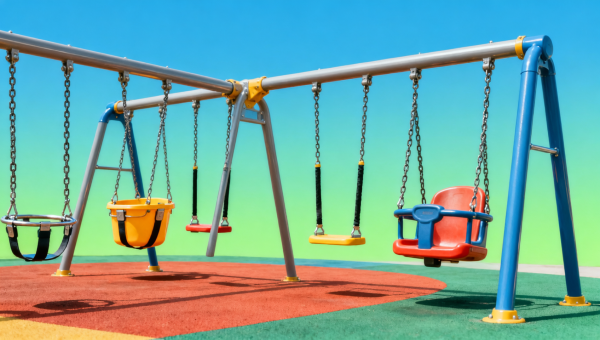
1. Bucket swings for toddlers
These are widely considered the safest option for very young children because they provide a deeper seat and better containment. A high-quality commercial bucket swing reduces the chance of slipping forward or sideways during motion. However, buyers should still check for appropriate sizing, flexible but durable materials, and certified hardware. A poorly designed toddler seat can still create leg entrapment or wear-related issues.
2. Belt swings for general playground use
For school-age users, a flexible belt seat is often a strong safety choice because it is simple, widely tested, and less rigid than older hard-seat designs. Soft rubber or reinforced flexible seats can reduce impact severity if incidental contact occurs. These swings are also easier to maintain and replace, which matters in high-use commercial environments.
3. High-back or adaptive swings for inclusive play
For users needing greater trunk support, an adaptive seat with back support, harness options, or transfer-friendly design may be the safest choice. This category is especially important in inclusive playgrounds, education projects, and family leisure spaces where accessibility is part of the specification. Buyers should verify both accessibility intent and safety certification, because not all “inclusive” products deliver equal support or durability.
4. Group or basket swings with caution
Basket swings, nest swings, and multi-user swings can support inclusive play and social interaction, but they require more careful evaluation. They can be safe when properly engineered, but they also create higher collision forces, more complex supervision needs, and larger movement envelopes. For this reason, they are not automatically the safest option simply because they are popular or versatile.
In many procurement scenarios, the safest overall specification is a mixed swing bay strategy: toddler bucket swings for early years, belt swings for general use, and adaptive options where inclusive access is required.
What makes one commercial swing safer than another?
Buyers should focus less on marketing language and more on technical details that directly affect injury prevention and operational reliability.
Seat material and flexibility
Flexible rubber, reinforced polymer, or soft-touch commercial-grade materials generally outperform rigid legacy designs in safety terms. They can reduce the severity of incidental impact and often tolerate weather exposure better when manufactured to a high standard.
Chain and suspension protection
Pinch points are a common concern on swings. Coated chains, finger protection, and well-designed connectors help reduce hand injuries. This is especially important in family attractions, schools, and public playgrounds with unsupervised use.
Frame stability and structural engineering
The seat itself does not determine safety alone. The entire swing frame, crossbeam, anchoring system, and load rating must be appropriate for intended use intensity. Commercial buyers should request engineering data, static and dynamic load information, and installation guidance.
Spacing and fall zone
Many injuries are caused not by the seat, but by inadequate clearance or poor layout. Safe swing operation depends on proper spacing between seats, between bays, and around the forward and backward path of motion. Even a certified swing becomes a hazard if installed into an undersized area.
Impact surfacing
This is one of the most overlooked sourcing issues. A safer swing over inadequate surfacing is still unsafe. Wet-pour rubber, engineered wood fiber, rubber mulch, or tile systems should be selected according to fall height, climate, maintenance ability, and local code requirements. For serious procurement decisions, surfacing should be evaluated as part of the swing package, not as an afterthought.
Which safety standards and certifications should commercial buyers check?
For procurement teams, compliance is often the fastest way to filter credible suppliers from risky ones. Exact requirements vary by market, but buyers should look for documentation aligned with major playground standards such as:
- ASTM and CPSC guidance for the United States
- EN 1176 and related standards in Europe
- Local municipal, school, or public safety regulations in the destination market
However, simply seeing a standards logo is not enough. Buyers should ask for:
- Test reports from recognized laboratories
- Material specifications
- Installation instructions
- Maintenance manuals
- Warranty terms
- Traceable product identification and batch records
This is especially important for distributors and sourcing agents handling cross-border procurement. A swing may be manufactured competently, but if its compliance documents do not match the project jurisdiction, it can still create legal and operational problems.
How should procurement teams compare suppliers when safety is the priority?
If safety is the lead criterion, buyers should evaluate suppliers across the full product lifecycle rather than comparing only unit price. A practical commercial checklist includes:
- Does the supplier specialize in commercial playground equipment rather than general outdoor products?
- Are the swings designed for the intended age band and usage intensity?
- Can the supplier provide third-party test evidence?
- What anti-corrosion measures are used for chains, fasteners, and frames?
- Are replacement seats, chains, and connectors readily available?
- What is the expected maintenance interval?
- Can the supplier support OEM or project-specific customization without compromising certification?
- Has the supplier completed comparable public, school, or leisure park projects?
For business evaluators, lifecycle cost is critical. A lower-cost swing with poor UV resistance, fast chain wear, or weak after-sales support may create more downtime, more replacements, and more safety exposure than a higher-quality alternative. In this category, safer often also means more economical over the asset’s useful life.
What mistakes make otherwise safe playground swings unsafe?
Several common sourcing and installation mistakes undermine safety, even when the product itself is acceptable.
Choosing by appearance instead of user profile
A visually attractive swing does not guarantee appropriate support for toddlers, inclusive users, or high-traffic public use. Safety starts with matching the design to the actual user base.
Ignoring surfacing and clearance requirements
This is one of the most frequent project-level errors. Buyers sometimes focus on the swing frame and leave surfacing to another vendor without coordinated planning. That fragmentation can create compliance gaps.
Underestimating maintenance
All swings wear over time. Chains, bearings, connectors, and seats need inspection and replacement. If the site operator cannot support frequent upkeep, buyers should specify lower-maintenance designs and strong spare-part availability from the start.
Using residential-grade products in commercial settings
This creates avoidable risk. Products intended for private home use typically do not meet the durability, load, or compliance demands of public and commercial environments.
Overlooking accessibility needs
In many modern projects, safety and inclusivity are connected. If users with different physical needs are expected, failing to specify adaptive seating can reduce both usability and safety.
Best swing choices by project type
Different environments call for different “safest” answers.
Schools and early childhood centers
Bucket swings for younger children and flexible belt swings for older age groups are usually the safest and easiest to supervise. Durability and easy replacement are key.
Public parks and municipal playgrounds
Commercial-grade belt swings with coated chains, supported by robust surfacing systems, are often the best baseline choice. Inclusive additions should be considered where community use is broad.
Inclusive playgrounds
Adaptive high-support seats and carefully selected basket or nest swings can play an important role, but layout, supervision planning, and movement clearance must be handled carefully.
Leisure parks and family entertainment environments
Safety decisions should account for heavy throughput, broad age variation, and brand risk. Here, buyers should prioritize certified commercial systems, documented maintenance protocols, and suppliers with established after-sales capability.
Final sourcing guidance: how to decide which playground swings are safest for your project
If you need a practical buying conclusion, start here: for toddlers, bucket swings are generally the safest; for typical school-age public use, high-quality flexible belt swings are often the safest balance of simplicity, reliability, and low injury risk; for inclusive environments, adaptive supported seats are essential. Basket and group swings can be safe, but they demand more careful planning and are not automatically the lowest-risk option.
For commercial buyers, the safest playground swings are the ones backed by verifiable standards compliance, durable materials, appropriate surfacing, correct installation geometry, and a realistic maintenance plan. In other words, safe swing sourcing is a system decision.
When evaluating suppliers, distributors, or OEM partners, prioritize documented safety performance over broad product claims. That approach not only protects users but also reduces liability, improves lifecycle value, and strengthens the long-term credibility of any leisure park, school, or public recreation project.
Search News
Hot Articles
- Stage Lighting & TrussCCTV5 Snooker Broadcast Drives 37% Surge in Stage Lighting Export InquiriesApr 21, 2026
- Indoor PlaygroundVietnam Mandates Child Finger-Trap Sensors for Indoor Play EquipmentApr 21, 2026
- Stage Lighting & TrussGuangdong vs. Shanxi CBA Game Highlights Domestic Smart Arena LightingApr 21, 2026
Popular Tags
Need ExpertConsultation?
Connect with our specialized leisureengineering team for procurementstrategies.
Recommended News
 Apr 21, 2026Vietnam Mandates Child Finger-Trap Sensors for Indoor Play EquipmentVietnam mandates child finger-trap sensors for indoor play equipment—comply with TCVN 9507:2023 by July 1, 2026 to clear customs & protect kids.● Theme Park Strategist
 Apr 20, 2026NES Launches Sports Community Curator ProgramSports Community Curator program launched by NES — join global fitness studios, uni clubs & outdoor groups to co-create, test gear & grow with Chinese sports brands.● Theme Park Strategist
 Apr 17, 2026CPSC AI Safety Alert: 200ms Delay in Child Playground AI Systems = HazardCPSC AI Safety Alert: 200ms delay in child playground AI systems = hazard. Learn how latency compliance impacts Target/Walmart listings, testing, and supply chain.● Theme Park Strategist
 Apr 17, 20262026 Shanghai Sailing Open Adopts Domestic SeaChronos Pro Timing SystemSeaChronos Pro timing system debuts at 2026 Shanghai Sailing Open — ITU-certified, millisecond-accurate, wind- and tide-integrated. A game-changer for marine sports tech.● Theme Park Strategist
 Apr 16, 2026FDA Proposes New Labeling Rules for Sports Nutrition Supplements with Chinese LabelsFDA's new labeling rules for sports nutrition supplements with Chinese labels take effect April 2026—learn compliance must-dos for U.S. importers, manufacturers & brands.● Theme Park Strategist
 Apr 15, 2026Saudi SASO Updates Amusement Ride Standards: VR Devices Now Require Mandatory EMC TestingSaudi SASO's new 2026 standard mandates EMC testing for VR amusement rides, impacting exporters. Learn key compliance strategies for Saudi market access.● Theme Park Strategist
 Apr 14, 2026Japan Mandates Multilingual E-Manuals for Fitness Equipment from April 2026Japan mandates multilingual e-manuals for fitness equipment from April 2026. Learn how this impacts manufacturers & importers with JIS T 0601-1 compliance requirements. Stay ahead of the regulation!● Theme Park Strategist
 Apr 13, 2026WTT Taiyuan Adopts Chinese AI Table Tennis Analysis System with ITTF Export CertificationWTT Taiyuan adopts Chinese AI table tennis analysis system with ITTF export certification, enabling real-time ball speed & spin tracking. A game-changer for sports tech in emerging markets like Southeast Asia & Middle East.● Theme Park Strategist
 Apr 13, 2026First Female Snooker Player Achieves Multiple Century Breaks as Chinese Table Gains WPBSA CertificationChinese snooker player Bai Yulu makes history with multiple century breaks using WPBSA-certified 'Tournament Pro X7' table, marking a milestone for Chinese manufacturing in professional snooker equipment. Discover how this impacts global markets.● Theme Park Strategist
 Apr 13, 2026RCEP Zero Tariff on China's TPU Sports Protective Gear Boosts ASEAN TradeRCEP's zero-tariff policy on China's TPU sports protective gear boosts ASEAN trade, giving Chinese exporters cost advantages over Korean rivals. Learn how manufacturers and distributors can capitalize on this opportunity.● Theme Park Strategist
 Apr 10, 2026Japan's JIS T 9001:2026 Sports Flooring Anti-Slip Standard Mandatory from April 2026Japan's JIS T 9001:2026 standard mandates anti-slip sports flooring (SCOF ≥ 0.6) from April 2026. Chinese exporters must adapt to meet new requirements. Learn key compliance strategies.● Theme Park Strategist
 Apr 10, 2026Bai Yulu Makes History at Snooker World Championship, Sparks Surge in Women's Sports Equipment DemandBai Yulu makes history at Snooker World Championship with two century breaks, sparking 185% surge in women's sports equipment demand. Discover how manufacturers, e-commerce & supply chains can capitalize on this trend.● Theme Park Strategist
 Apr 10, 20262026 Badminton Asia Championships Quarterfinals Schedule Announced, Shi Yuqi to Compete; Southeast Asia Racket Orders Face 6-8 Week Delays2026 Badminton Asia Championships quarterfinals schedule revealed with Shi Yuqi competing, while Southeast Asia faces 6-8 week racket delays. Learn how supply chain issues impact manufacturers and get strategies to navigate equipment shortages.● Theme Park Strategist
 Apr 10, 2026WTT Taiyuan Challenge Sparks Smart Equipment Demand: Japan Buyers Scrutinize AI Training TechDiscover how the WTT Taiyuan Challenge boosts demand for AI training tech as Japanese buyers evaluate smart sports equipment. Learn key opportunities for manufacturers with JIS-certified solutions.● Theme Park Strategist
 Apr 10, 2026Chinese Snooker Players' Success Spurs Global Demand for Cue AccessoriesChinese snooker players' success drives 210% global demand surge for cue accessories. Explore how manufacturers & exporters can capitalize on this trend with UK, German & Australian markets leading inquiries.● Theme Park Strategist
 Apr 10, 2026EU Updates EN 16830:2026 Eyewear Safety Standard, Impacting China's Sports Goggle ExportsEU's updated EN 16830:2026 eyewear safety standard impacts China's sports goggle exports with stricter CE certification requirements. Learn how manufacturers and exporters can adapt to new impact resistance, UV400+, and blue light blocking standards before the September 2026 deadline.● Theme Park Strategist
 Apr 22, 2026Vietnam Mandates Child Finger-Trap Sensors for Indoor Playground EquipmentVietnam mandates child finger-trap sensors for indoor playground equipment—comply with QCVN 128:2026 & TCVN 9350:2023 before Oct 2026!● Theme Park Strategist
 Apr 22, 2026Why Build an Inclusive Playground NowInclusive playground planning now boosts leisure park value with safer playground swings and playground structures, helping buyers reduce retrofit risk and attract more families.● Theme Park Strategist
 Apr 22, 2026What Makes Playground Structures LastPlayground structures that last depend on smart materials, weather resistance, and strong design. Explore how inclusive playground and playground swings buyers reduce lifecycle costs.● Theme Park Strategist
 Apr 22, 2026Which Playground Swings Are SafestPlayground swings safety guide: discover the safest playground swings for every leisure park or inclusive playground, with certified playground structures, surfacing, and buyer tips.● Theme Park Strategist
 Apr 22, 2026How to Tell if an Indoor Playground Design Is Too GenericIndoor playground buyers: learn how to spot a generic indoor playground design before it feels like a trampoline park or adventure playground template, and protect brand appeal and ROI.● Theme Park Strategist
 Apr 22, 2026Indoor Playground Layout Mistakes That Limit Repeat VisitsIndoor playground and trampoline park layout mistakes can quietly reduce repeat visits, spend, and safety. Learn how zoning, arcade games flow, and adventure playground planning drive stronger returns.● Theme Park Strategist
 Apr 22, 2026Trampoline Park Equipment That Wears Out Faster Than ExpectedTrampoline park buyers: discover which indoor playground and adventure playground components wear out first, how to cut downtime, improve safety, and choose equipment with better long-term ROI.● Theme Park Strategist
 Apr 22, 2026What Makes a Trampoline Park Profitable Beyond Ticket Sales?Trampoline park profit goes beyond tickets with arcade games, indoor playground and adventure playground upgrades. Discover smarter revenue ideas for buyers and operators.● Theme Park Strategist